



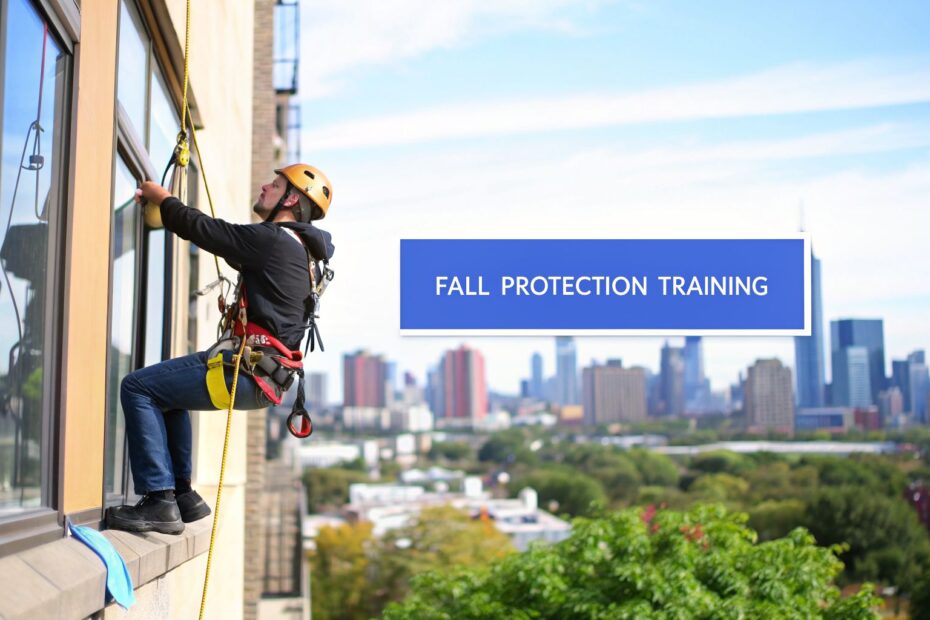
When you’re working at height, fall protection isn't just a good idea—it's the law. The rules from federal OSHA are clear: any employee working four feet or more off the ground in general industry, or six feet in construction, must be trained by a qualified person. This isn't a recommendation; it's a non-negotiable legal requirement designed to keep workers safe.
The Foundation of Workplace Safety at Heights

For professional window cleaners, this training is the absolute foundation of a safe operation. Think of it like a pilot's license. It’s the documented proof that a technician knows how to spot hazards and manage enormous risks before their feet ever leave the ground. Our teams use professional tools like squeegees, ladders, boom lifts, scaffolding, rope descent systems, and pure water systems to wash windows on all types of buildings.
Whether a crew is on a simple ladder job at a Scottsdale home, using a complex rope descent system on a Denver high-rise, or operating a boom lift in Las Vegas, the core principles don't change.
Understanding the Regulatory Landscape
The main federal rule everyone needs to know is OSHA's 29 CFR 1926.503. Even though this standard has been around for ages, fall protection violations are consistently one of the top citations issued by OSHA inspectors. That tells you there's a major disconnect between knowing the rules and actually following them.
In fact, a shocking survey on fall incidents found that in nearly half of all reported falls (48.8 percent), no fall protection was being used at all. It's a statistic that underscores the life-or-death importance of not just having the gear, but making sure every single employee is trained to use it. You can dig into the data and see more on the specifics of fall protection training requirements on SafetyCulture's marketplace.
This all points to one critical truth: training is so much more than a certificate on the wall. It’s about building a safety culture where every team member instinctively understands the risks and knows exactly what to do about them.
OSHA is very specific that a "qualified person" must lead the training. This isn't just your most experienced crew member. It's someone with a recognized degree, certification, or extensive knowledge and experience who can officially identify and solve fall hazard problems.
OSHA Fall Protection Training Essentials for Window Cleaners
To make this crystal clear, here’s a quick breakdown of what these OSHA requirements look like in the real world for a professional window cleaning team.
| Requirement Category | What It Means for Your Window Cleaner | Real-World Example |
|---|---|---|
| Hazard Recognition | Your tech must be able to spot fall dangers specific to your property. | Identifying unprotected skylights, weak anchor points on a roof, or an unstable ledge. |
| Procedure Training | They need to know the correct procedures for setting up, inspecting, and using fall protection systems. | Properly setting up a rope descent system (RDS) or ensuring a personal fall arrest system (PFAS) is worn and anchored correctly. |
| Equipment Use | Training must cover the proper use, care, and inspection of all gear. | Knowing how to inspect a harness for wear and tear, check rope integrity, or confirm a self-retracting lifeline is functioning. |
| Rescue Procedures | Workers must know what to do if a fall occurs. | Having a practiced plan to quickly and safely retrieve a fallen worker suspended in their harness to prevent suspension trauma. |
Understanding these core pillars is the first step toward ensuring your window cleaning provider is operating safely and in full compliance with the law.
More Than Just Federal Rules
It’s crucial to remember that federal OSHA rules are just the starting point. Many states, including Arizona, Colorado, and Nevada, run their own OSHA-approved state plans. These state-level agencies can, and often do, enforce stricter or more specific requirements.
This means a company cleaning windows in Phoenix has to follow the rules set by the Arizona Division of Occupational Safety and Health (ADOSH), not just federal OSHA. The same goes for work in cities like Boulder or Chandler.
And training is just one part of the bigger compliance picture. A truly professional operation also masters things like OSHA Recordkeeping Compliance, ensuring every incident, training session, and inspection is documented perfectly. It’s this multi-layered commitment to safety that truly separates the pros from the rest.
Who Needs Fall Protection Training and Why It Matters
When people think of fall protection, they often picture technicians scaling skyscrapers. While that’s certainly true for high-rise specialists on a rope descent system in downtown Phoenix, the need for this training is actually much wider.
The rules apply just as much to a crew member on an extension ladder cleaning second-story windows at a home in Boulder. The simple truth is that any worker exposed to a fall hazard must be properly trained. This isn’t just a good idea; it’s a core requirement for anyone whose job takes them off the ground.
In professional window cleaning, fall hazards come in many forms. Whether it’s ladders, scaffolding, aerial lifts, or complex rope access gear, the risk is always there. This makes thorough training an absolute must.
More Than Just a Certificate
You can think of fall protection training like a pilot’s pre-flight checklist. No pilot would ever dream of taking off without completing their checks and having rigorous training. In the same way, a professional window cleaner should never go up without a solid grasp of fall hazards and safety protocols.
This training goes far beyond just checking a box for regulatory compliance. It deals with the real-world consequences of an accident. Proper training is the most important defense we have against serious, life-changing injuries and the clearest way an employer meets their duty to create a safe work environment.
For years, "Fall Protection – General Requirements" has been the #1 most frequently cited violation by OSHA. This shows that there’s still a big difference between knowing the rules and actually following them in the field. Effective, ongoing training is what closes that gap.
A fall doesn't just affect the worker; it impacts their family, their coworkers, and your property. Investing in proven safety training is an investment in preventing tragedy and making sure every job, whether in Tempe or Westminster, is finished safely.
Identifying Who Is at Risk
So, who exactly needs this training? The answer is anyone whose work involves a potential fall hazard. In our line of work, that covers a lot of roles and situations.
- Residential Technicians: Even cleaning windows on a two-story home in Glendale often means using ladders that go past the four-foot threshold, which makes training mandatory.
- Commercial Crews: Workers cleaning storefronts or low-rise commercial buildings in Arvada might use scaffolding or small lifts, both of which have their own safety rules.
- Mid-Rise and High-Rise Specialists: For technicians working on taller buildings in places like Las Vegas or Flagstaff, advanced equipment like boom lifts and rope descent systems are common, and expert training is critical.
- Supervisors and Spotters: It’s not just about the person at height. Anyone who oversees the work, sets up the equipment, or acts as a ground monitor also needs to understand all the procedures and risks involved.
If a team member is part of a job at height in any way, they are part of the safety system and need training. This makes sure every person on site, from the lead technician on a boom lift over a commercial campus in Paradise Valley to the ground crew in Golden, is speaking the same language of safety.
This commitment protects our team and you, our client. It guarantees that the work on your property is handled by true professionals who put safety above everything else. In a high-risk industry, there is simply no substitute for expert-led training.
What a Compliant Training Program Actually Covers
Just checking the "training" box isn't enough. The real difference between a safe crew and a liable one comes down to the quality of that training. A compliant fall protection program is much more than a generic safety video or a quick slideshow presentation. It has to be a structured, hands-on curriculum led by a qualified person and built around the specific jobs your window cleaning crew actually performs.
So, what does it mean to be "properly trained"? OSHA spells out several core topics that are non-negotiable. This ensures every technician has the same fundamental knowledge to work safely at height, whether they’re on a two-story home or a major commercial building.
Recognizing and Evaluating Fall Hazards
The first step in any good training is teaching workers how to see a job site through a safety lens. This is all about hazard recognition—the skill of spotting and assessing potential fall dangers before anyone even leaves the ground.
This is more than just glancing up at the windows. It involves a detailed site inspection to catch things like:
- Unstable or soft ground where a boom lift might be set up.
- Overhead power lines that are too close to the work area.
- Unprotected roof edges or skylights on a commercial property.
- Anchor points for rope descent systems that are weak, damaged, or unverified.
For our teams, this is a mandatory first step on every single job. It doesn't matter if it's a simple residential project or a complex high-rise downtown.
Understanding Fall Protection Systems
Once your crew can spot the hazards, they need to know which safety systems to use to control them. The training must cover the nuts and bolts of various fall protection methods, including how they work and, just as importantly, what their limitations are.
A common and dangerous mistake is thinking one type of safety gear works for every situation. A compliant program teaches workers to choose the right system for the job, not just the one they're most familiar with.
Key systems that must be covered include:
- Personal Fall Arrest Systems (PFAS): This is the classic harness, lanyard, and anchor point setup designed to stop a fall that's already in progress.
- Guardrail Systems: A form of passive protection, these are physical barriers that prevent a worker from ever reaching a fall hazard in the first place.
- Safety Net Systems: Often used on large-scale construction or major maintenance jobs to catch workers if they fall.
- Rope Descent Systems (RDS): This is highly specialized equipment used for high-rise window cleaning and requires its own advanced, specific training.
The diagram below shows some of the most common work scenarios where this kind of training is an absolute must.

As you can see, it doesn't matter if a worker is on a ladder, a scaffold, or a boom lift—the fundamental need for solid fall protection training is always there.
Mastering Equipment Use and Inspection
Knowing the theory is useless without the practical skill to back it up. A huge part of any effective program involves hands-on training where employees physically demonstrate they can use and take care of their equipment. When building your own program, it's helpful to know how to deliver internal compliance training that actually sticks.
This practical portion must include:
- Pre-Use Inspection: Workers have to learn how to inspect every single piece of gear—harnesses, lanyards, ropes, carabiners—for any signs of wear, damage, or malfunction before every use.
- Proper Donning: Training isn't complete until every technician can put on their full-body harness correctly, ensuring it will perform exactly as designed if a fall happens.
- Correct Anchorage: Employees need to be taught how to identify and use secure anchor points that are capable of supporting the required load, which is at least 5,000 pounds per worker attached.
If you want to take a deeper dive into one of the most common tools of the trade, check out our guide on the professional use and safety of ladders for window cleaners.
Executing Rescue Plans
Finally, a truly compliant program must answer the "what if" question. If a worker falls and is left suspended in their harness, every second is critical. Training has to cover the exact procedures for a prompt and safe rescue.
This is essential for preventing "suspension trauma," a severe medical emergency that can happen when someone hangs suspended for too long. Every team working at height must have a clear, practiced rescue plan before they ever start the job.
When Is Retraining Required to Stay Compliant?
Getting your fall protection certification isn't a one-and-done deal. It's an ongoing commitment to safety, much like a professional athlete constantly practices to keep their skills sharp. While OSHA doesn't require a blanket annual recertification for every single worker, the fall protection training requirements are crystal clear about when retraining is absolutely mandatory.
This isn’t about just memorizing rules once. It's about ensuring that knowledge stays fresh and is applied correctly in the field, every single day.
Think of it this way: your initial training is like passing your driver's test. You get your license and understand the basic rules of the road. Retraining is the advanced defensive driving course you take after the city redesigns a major highway interchange—it ensures you’re ready for the new reality.
For a professional window cleaning crew, this is vital. Our work environments change constantly, from a residential job in Commerce City to a high-rise in Laughlin. Proactive retraining is how we guarantee our team's skills are always a step ahead of the challenges.
Key Triggers for Mandatory Retraining
OSHA lays out three main situations that legally require an employer to retrain their team. These triggers are designed to address new hazards, different equipment, or a clear gap in an employee's understanding. Knowing these is a cornerstone of staying compliant.
When the Workplace Changes: If a job site is altered in a way that introduces new fall hazards, retraining is a must. This could be a building renovation that changes roof access points or the installation of new architectural features that demand different anchoring strategies. A job in Erie might be straightforward one year and far more complex the next.
When Equipment Changes: The tools of our trade are always evolving. If we switch to a new model of aerial lift, adopt a different brand of rope descent system, or upgrade our personal fall arrest systems, every technician must be retrained on the specific use, inspection, and limitations of that new gear.
When an Employee Shows a Lack of Skill: This one is crucial. If a supervisor spots a worker using equipment incorrectly, or if a near-miss reveals that an employee no longer understands the safety protocols, immediate retraining is required. It's a critical feedback loop that corrects unsafe habits before they can cause an accident.
Going Beyond the Bare Minimum
Simply waiting for one of those triggers to happen isn't good enough for a company truly committed to safety. The best companies, including ours, see the OSHA minimums as the starting line, not the finish line. That’s why we make annual refresher training a non-negotiable best practice for our entire team.
An annual refresher ensures that safety protocols stay top-of-mind. It gets every technician—from a new hire to a 20-year veteran—perfectly aligned with the latest standards and company procedures. This proactive approach goes far beyond OSHA’s baseline requirements.
This dedication is especially important because "Fall Protection – Training Requirements" is consistently one of the top 10 most cited OSHA violations. In fact, recent data shows it was the #6 most common violation, which tells you a lot of companies are failing to keep their teams’ knowledge up to date.
By investing in regular, scheduled retraining, we build a culture where safety is an active, daily practice. It's how we ensure every team member, whether working on a property in Chandler or Westminster, has the sharp, current skills needed to protect themselves, their colleagues, and your property.
State-Specific Rules for Arizona, Colorado, and Nevada
Think of federal OSHA regulations as the national speed limit for safety—they set the absolute minimum standard. But for any company working across state lines, just knowing the federal rules isn't enough. You have to know the local laws, too. This is especially true in our primary service areas of Arizona, Colorado, and Nevada, which are all what’s known as "State Plan" states.
In simple terms, this means each state runs its own safety and health program, which has been approved by the federal government. These state agencies can—and often do—add their own requirements on top of the federal ones. For a property manager, this is a critical detail. It means your window cleaning partner must prove they have localized expertise to keep your property fully compliant.
This is the kind of expertise that provides genuine peace of mind. Knowing your contractor is compliant with every single local and federal law, whether it's for a residential job in Phoenix or a high-rise in Denver, is simply non-negotiable.
Arizona ADOSH Regulations
In Arizona, workplace safety is managed by the Arizona Division of Occupational Safety and Health (ADOSH). While ADOSH adopts most federal OSHA standards, including the core fall protection training requirements, it has its own inspectors and its own enforcement priorities.
For our teams working in places like Scottsdale or Flagstaff, compliance isn't just about following the federal rulebook. It's about staying aligned with ADOSH's specific areas of focus. For example, ADOSH puts a heavy emphasis on heat-related illness prevention, which directly impacts fall protection when our technicians are working at height in Arizona's extreme temperatures.
A key takeaway for Arizona property managers: a compliant window cleaning company must be prepared for an ADOSH inspection at any time. This demands meticulous record-keeping of all training certifications and daily equipment inspections, proving that safety protocols are followed on every job site, from Tempe to Paradise Valley.
Colorado Safety Standards
Colorado has a slightly different setup. The state operates its own plan under the Colorado Division of Labor and Employment, but it only covers public sector employees. For private-sector jobs like professional window cleaning in Boulder or Arvada, federal OSHA is in charge. But that doesn't mean state and local laws are off the table.
Colorado has its own statutes that can affect workplace safety, and local cities often have their own permitting rules for equipment like boom lifts or scaffolding. A truly professional company has to navigate all these layers of regulation.
- Federal Oversight: All our fall protection training must meet the federal OSHA standard, 29 CFR 1926.503.
- Local Nuances: Our teams in Westminster or Golden are also trained to be aware of any local ordinances that could impact a job's setup and execution.
This dual focus ensures that whether we’re using rope descent systems downtown or ladders in a suburb like Erie, our operations are fully compliant from every possible angle.
Nevada OSHA Requirements
Nevada has one of the most active State Plan programs in the country, run by Nevada OSHA (NV OSHA). Just like Arizona, NV OSHA adopts most federal standards, but it has a well-earned reputation for strict enforcement, especially in the high-risk environments you find in Las Vegas and Laughlin.
NV OSHA also has its own specific standards that add to the federal rules. For a professional window cleaning company, this translates to an even greater need for perfect documentation and proven expertise. The construction industry is a major focus for NV OSHA, so any work involving scaffolding or aerial lifts gets intense scrutiny.
Our commitment to safety means we don't just meet the fall protection training requirements; we stay on top of every unique NV OSHA directive. This regional knowledge is vital for property managers who need absolute assurance that their contractor understands the specific regulatory landscape in Nevada. If you're managing properties across different regions, you might want to check out our page on window cleaning near me to get a better sense of our local presence.
How to Verify Your Window Cleaner Is Truly Compliant

As a property manager or homeowner, how can you be sure the window cleaning company you hire is really committed to safety? Talk is cheap. The real proof is in the paperwork.
Written records provide undeniable evidence that a contractor meets the strict fall protection training requirements mandated by law. Think of it like checking a contractor’s insurance policy before they start a big project—it’s just smart due diligence. Requesting to see training records isn’t being difficult; it's being responsible.
The Power of the Written Certification Record
OSHA is crystal clear about this. Employers must keep a written certification record for every single employee who completes fall protection training. This isn't just some internal file; it’s a document you, as the client, have every right to ask for and review.
This certification is the official proof that the technicians arriving at your property have the training they need to work safely at height. It transforms a company’s verbal promise of safety into a documented fact.
So, when you ask to see these records, what should you be looking for? A compliant certification must include three key pieces of information:
- The employee’s full name: This confirms the specific person on your property is the one who was trained.
- The date(s) of the training: This tells you how recent the training is.
- The signature of the qualified trainer: This proves an expert conducted and signed off on the training.
If a contractor gets defensive or can't produce these records, that's a major red flag. A reputable, safety-focused company will have these documents organized and ready to go.
We proudly make our training certifications readily available for every client. We believe transparency in safety is non-negotiable and see it as a key part of the professional service we provide across Arizona, Colorado, and Nevada.
Why This Documentation Matters More Than You Think
It's easy to assume every company is doing the right thing, but global trends show that a commitment to safety training can’t be taken for granted. Recent Gallup World Risk Poll data revealed that a shocking 62% of the global workforce has never received any occupational safety and health training. You can explore more insights on global workforce safety training from Gallup to see the full scope of their findings.
While U.S. regulations are stronger, this is exactly why asking for proof is so important. It separates the companies that just talk about safety from those who actually invest in it and document it.
This level of diligence extends to other critical safety tasks, too, like making sure rooftop anchors are properly secured. You can learn more about how we handle roof anchor testing and verification in Phoenix to see what that process involves. By verifying these credentials, you're not just protecting yourself from liability—you’re doing your part to ensure the well-being of the workers themselves.
Frequently Asked Questions About Fall Protection
When it comes to safety at height, a lot of questions naturally pop up for the property managers and homeowners we work with. Let's clear up some of the most common ones we hear about our safety practices and the fall protection training requirements that are the backbone of our work.
Is Fall Protection Training Needed for Residential Window Cleaning?
Yes, without a doubt. The requirement for fall protection training isn't about the type of building—it’s all about the height. If a job at a home in Phoenix needs a technician on an extension ladder to reach a second-story window, that's a fall hazard over four feet. That immediately triggers the need for full fall protection training.
A truly professional company doesn't have two sets of safety rules. We apply the same strict standards whether we're cleaning a private residence in Glendale or a downtown skyscraper. The danger of a fall is just as real, and our safety protocols have to be just as strong.
What Is a “Qualified Person” for Conducting Training?
OSHA uses a specific term for this: a “qualified person.” This isn't just the most seasoned person on the crew. It’s someone who has a recognized degree, certificate, or deep professional experience that proves they can solve complex fall protection problems. In short, they are a documented and verified expert.
This person has demonstrated total mastery of the subject and is officially authorized to lead and certify the training. Every single one of our technicians is trained by these proven experts.
We are always prepared to provide written certification records for your review before we start any project. These documents contain each employee’s name, the date of their training, and the signature of the qualified trainer, ensuring your complete confidence in our team.
Is Online-Only Fall Protection Training Valid?
No, it is not. While online courses can be a decent starting point for learning the theory, OSHA is crystal clear that training is not complete without a hands-on, practical component. Watching videos simply isn't enough to meet the legal standard.
A qualified trainer has to physically watch and confirm that every employee can correctly inspect their gear, put on a harness properly, and understands the rescue plan for that specific site. Whether we’re on a job in Denver or Las Vegas, this hands-on skill is what creates real safety on your property.
When you need crystal-clear windows without a single compromise on safety, trust the experts who document their commitment. Professional Window Cleaning guarantees that every technician arriving at your property is fully trained, certified, and ready to work safely at any height. Get your fast, no-obligation quote today by visiting us at https://www.getmywindowsclean.com.