




You've got a second-story bank of glass staring back at you, the ladder feels awkward, and the thought of dragging a hose across a finished area makes the whole job more annoying than it should be. That's usually the point where a water fed pole pump earns its keep, because the pump is what turns a tank of purified water into a workable cleaning system at the brush head. In the field, that small piece of equipment decides whether the job feels controlled and efficient, or fussy and underpowered.
Many people focus on the pole, the brush, or the purified water and miss the part that moves the water. That's a mistake. On real window-cleaning jobs, especially around Phoenix, Scottsdale, Tempe, and Chandler, the pump is the hidden piece that makes the whole pure-water setup worth using.
What a Water Fed Pole Pump Actually Does on the Job
A crew rolls up to a two-story stucco home in Scottsdale, looks at a tight run of upper windows, and leaves the ladder on the truck. The hose comes off the van tank, the pump starts feeding purified water, and the brush head does the work at the glass while the technician stays on the ground. That's the practical value of a water fed pole pump, it keeps the water moving to the brush without forcing the operator into a ladder routine for every second-story pane.
The system itself is simple in concept and serious in practice. Waterworks Window Cleaning describes a setup built around purified water, a telescopic pole, and the core parts of a water tank, pump, hose reel, and pole, with common van-mounted tank sizes of 500 L, 750 L, and 1000 L Waterworks setup guide. That's the kind of gear you see on professional routes in Phoenix and Tempe, where crews need reach, mobility, and a clean rinse without dragging out scaffolding for every exterior job.
Practical rule: if the pump can't deliver steady rinse water, the rest of the system doesn't matter much.
The bigger idea is older than modern window cleaning. Historians trace water-lifting technology back more than 5,500 years, with early milestones like the shaduf in Egypt and Mesopotamia around 2000 to 3000 BC and the Archimedean screw from 287 to 212 BC pump history reference. The window-cleaning version is just the latest branch of that long pump lineage, built for controlled delivery instead of raw lifting.
For a working crew, the question isn't whether the system sounds modern. It's whether the pump keeps pace with the job without making the wash sloppy, too wet, or too weak. That's where the judgment comes in. How a water-fed pole system works
Inside the System Tank, Pump, Hose, and Pole
A good water-fed setup works as a chain, and each part has a clear job. The tank holds purified water, the pump moves it, the hose carries it, the telescopic pole gives reach, and the brush head loosens dirt while the rinse water clears the glass. If one part is off, the whole setup starts acting up in ways you can feel on the glass.
The pump is there to feed water, not to hammer the surface like a pressure washer. In window cleaning, the working range is usually around 1.4 to 1.7 gallons per minute (GPM) because cleaning depends on rinse action and brush agitation, not a hard spray flow rate guide. That is why crews watch both flow and hose handling, especially on longer runs where drag and restriction can cut performance before the brush even reaches the pane.
A common sizing benchmark is a 100 psi, 12 V DC diaphragm pump specified around 5.2 L/min, about 1.2 GPM, open flow, with a maximum current draw of about 9 A pump benchmark. As outlet restriction rises, delivered flow falls and current climbs toward the pump's limit. In plain terms, a blocked jet, a pinched hose, or a shut valve makes the pump work harder while the brush gets less rinse water.
Keep the system open, because restriction steals flow faster than most people expect.
The hose matters more than new crews expect. A hose FAQ from Cleaning Spot notes that minibore hose, 8mm ID, is used for higher flow over longer distances, while smaller tubing behaves differently and has its own limits hose guide. That is why a professional setup is not just a tank and a pole tossed into a van. It is matched gear, chosen so the pump can keep enough water moving to the brush without straining itself.
For crews sorting out hose choices, the details matter. A proper water fed pole hose has to suit the pump, the pole length, and the kind of work you do day after day.
If you want a cleaner way to read the setup, start from tank to glass, not from brochure to sales pitch. For the purification side, how reverse osmosis works explains why the rinse can dry clear when the water is properly treated. The pump still has one job, keep a controlled stream moving. Everything else supports that job.
Why Window Cleaning Companies Use Pure Water Systems
A good pure-water job starts at the pump. On the job, that is the part that decides whether the brush gets a steady rinse or whether the crew is fighting weak flow and uneven reach. Homeowners want ground-based cleaning around landscaping and second-story glass. Storefronts want predictable turnaround. Property managers want the same result across a lot of windows without a lot of setup drama.
| Customer Type | Primary Benefit | Typical Use Case |
|---|---|---|
| Homeowner | Ground-based reach and cleaner landscaping protection | Upper-story exterior glass on houses in Phoenix or Scottsdale |
| Storefront or restaurant | Faster rinse work and less visible disruption | Regular curbside glass in Tempe or Las Vegas |
| Property manager or HOA | Consistent results across multiple units | Townhomes, mid-rise common areas, and shared façades in Denver or Boulder |
| High-rise or mid-rise owner | A useful method alongside access equipment | Work that still pairs with lifts or rope descent when the façade allows it |
Pure-water cleaning works because the rinse is doing the finishing. When the water has been treated properly, it dries without leaving mineral residue behind, which is why the glass can look cleaner once it dries. For readers who want the filtration side explained plainly, how reverse osmosis works is a useful technical reference.
The pump is the part that keeps that result repeatable. Longer hose runs, multi-jet brushes, and larger tank setups all depend on steady delivery, because a brush starved of water stops rinsing well and starts dragging dirt around. In practice, that means the system is only as good as the flow it can hold under load.
The method also fills a useful middle ground on the job. It is quick on many exterior panes, kinder to landscaping than dragging ladders through beds, and easier to keep moving on routine accounts. It still has limits, though. Tight access, heavy restoration work, and certain façades are better served by squeegees, lifts, or rope descent, especially when the glass needs direct hand work instead of a rinse-only finish.
| Customer Type | Primary Benefit | Typical Use Case |
|---|---|---|
| Homeowners | Safer ground-based cleaning | Upper exterior windows and hard-to-reach dormers |
| Storefronts | Faster service with less interruption | Routine glass maintenance for shops and restaurants |
| Property managers | Consistent results across multiple units | Apartment buildings, HOAs, and campus-style properties |
| High-rise teams | Useful on the right façade, alongside access gear | Mid-rise and selected exterior glass zones |
The comparison only makes sense if the pump can support the work. A weak or poorly matched pump turns pure-water cleaning into a compromise, because the crew loses the steady rinse that makes the whole system worth using. When the pump is matched to the hose, pole, and brush, the setup stays productive without forcing the technician to chase pressure by hand.
Pump Maintenance and Troubleshooting in the Field
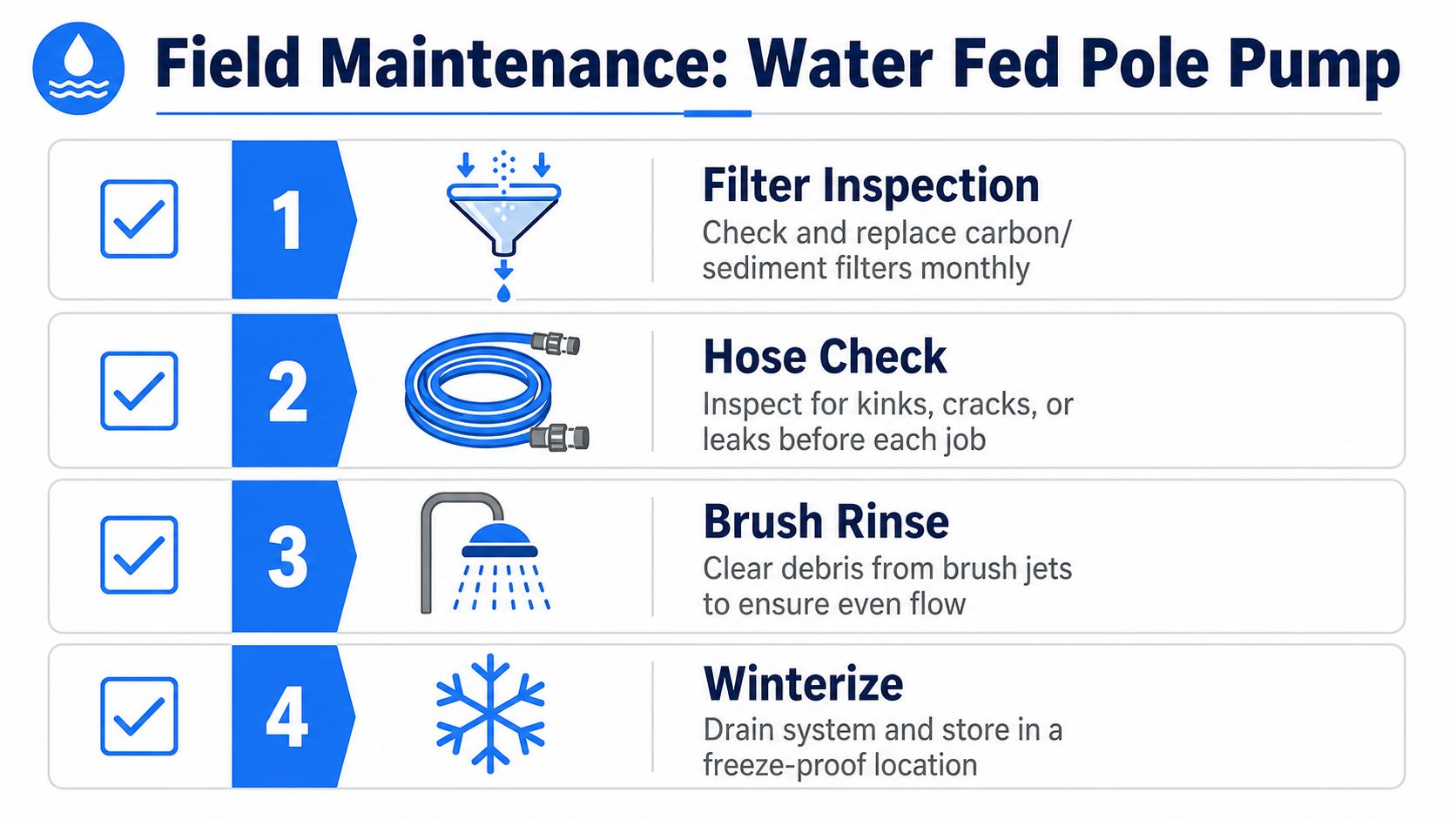
A pump that's working right is easy to ignore. A pump that starts acting up will make itself known fast, usually by weak rinse, surging flow, or a brush that feels dry at the wrong moment. The best way to avoid that is boring field discipline, filter care, hose checks, brush rinsing, and winterizing lines in colder service areas like Flagstaff.
Start with the simple stuff. Check the filter, inspect the hose for kinks or cracks, and clear debris from the brush jets before the day gets rolling. If you're running out a van in Arizona, heat management matters too, because pumps and tanks in a hot bay can get stressed long before the crew notices the problem.
A pump that suddenly feels weak is usually fighting restriction, not lacking ambition. The current-draw data from the pump benchmark shows 0.97 A at low flow, climbing to 5.3 A near 99% flow, with dead-end conditions pushing current higher pump benchmark. That's why undersized hose, blocked jets, and closed valves are such a problem. They don't just reduce rinse water, they push the electrical load toward the pump's limit.
If the pump is hot, loud, and pulsing, don't assume it's “strong.” Assume it's stressed.
Field checks that save time
- Filter inspection: keep the pre-filter clear so the pump isn't straining against dirt and grit.
- Hose inspection: look for flattening, cuts, leaks, and tight bends before the first window.
- Jet check: make sure the brush jets are open and spraying evenly, not dribbling.
- Winterizing: drain lines and store equipment in a freeze-proof spot when cold weather hits.
Cold weather changes the feel of the system too. Water becomes less forgiving in winter, so lines can behave differently than they do in summer. That's one reason crews in higher-elevation Colorado and northern Arizona keep an eye on how quickly the system pressures up and how the hose responds on colder mornings.
A worn pump usually shows its age in pieces, not all at once. Surging flow, a higher-than-normal amp draw, and loss of prime are the signs to watch. When those show up together, the gear needs attention before the next route day turns into a repair day.
Water-Fed Poles vs Ladders, Lifts, and Rope Descent
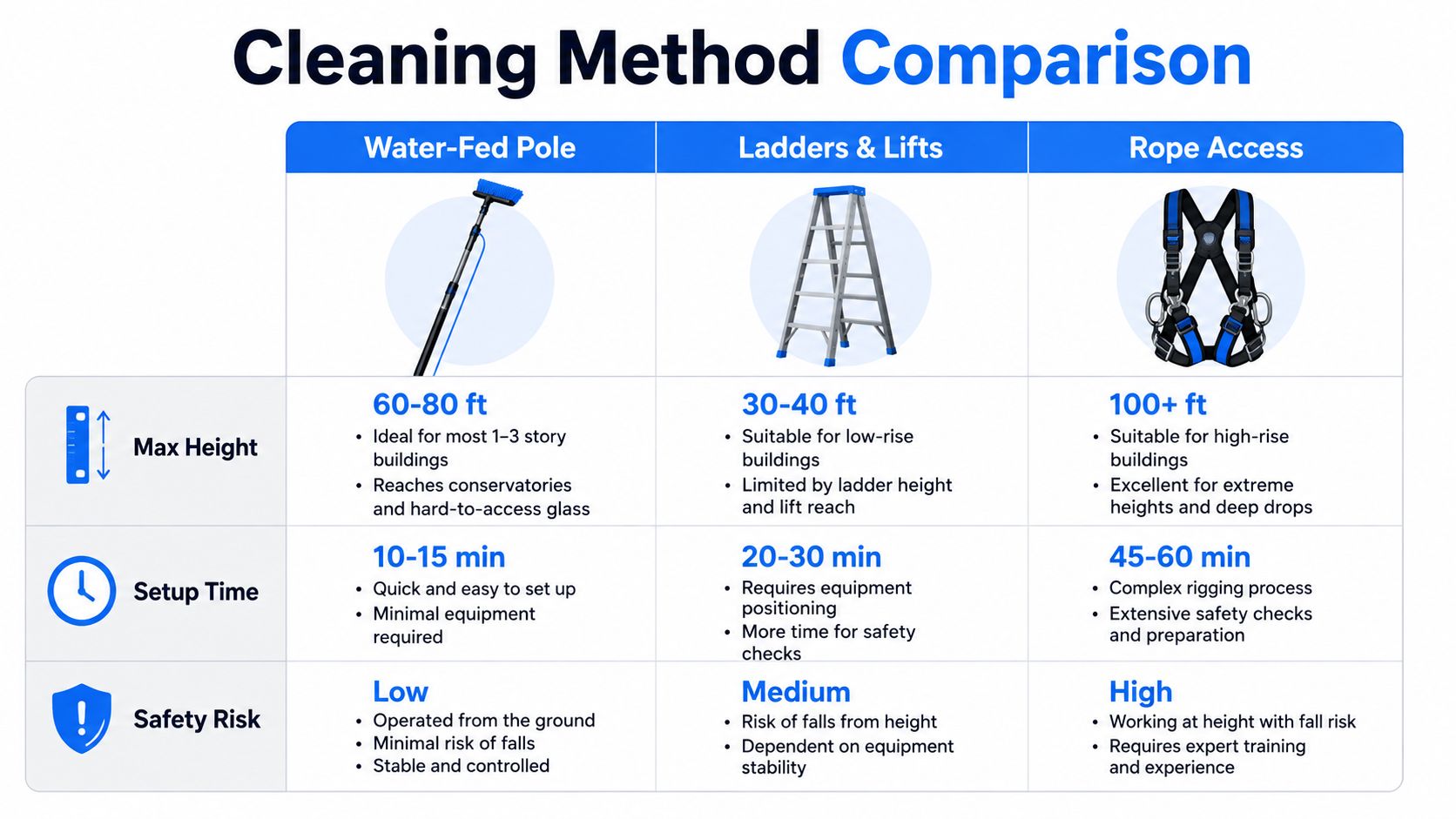
A water-fed pole earns its keep on the right kind of glass, but I never treat it as a universal answer. On a clean residential run, a good pump, proper flow, and enough pole reach can keep a crew off ladders and moving quickly. Industry material puts water-fed pole work at about 90 feet from the ground, and also notes roughly 80% less ladder use on residential jobs and up to 40% faster job time in the right conditions system overview. That is a solid advantage for houses, storefronts, and a lot of lower commercial work.
The job changes fast once the glass gets neglected or the building layout gets difficult. Heavy buildup, oxidation, tight recesses, and corner access can force a crew back to squeegees, boom lifts, scaffolding, or rope descent systems. On Denver mid-rises, Boulder mixed-use work, and Las Vegas hospitality properties, the right method depends on the building shape, the access path, and how much control the technician needs on the glass.
I have seen plenty of jobs where a pole makes the day easier, and plenty where it slows everything down.
Water-fed poles work best when the rinse can fully clear the surface, the brush can reach without fighting the building, and the crew does not have to keep resetting position. Traditional access still wins on close-detail work, on heavy post-construction cleanup, and on windows set in places where the brush cannot rinse the edges clean. For taller or more complicated builds, crews often move into high-rise glass cleaning equipment instead of stretching a pure-water setup beyond what it can do well.
The better choice is the one that fits the glass and the access, not the one that sounds newest.
Water-Fed Pole vs Traditional Access
| Method | Best Fit | Main Limit |
|---|---|---|
| Water-Fed Pole | Reachable exterior glass, routine maintenance | Heavy buildup and tight access points |
| Ladder Work | Small, targeted areas that need close control | More setup and more exposure to access risk |
| Boom Lift | Complex façades and elevated service zones | Greater mobilization and site coordination |
| Rope Descent | Tall exterior runs with the right building setup | Requires the building and crew to be suited for it |
For owners comparing methods, the core question is where the pure-water system beats standard access and where it falls short. A good pump and pole setup can save time on the right route, but it does not replace a lift on awkward architecture, and it does not replace a squeegee when the finish needs tight control. That is the line that separates the right tool from the wrong one used out of habit.
Why Hiring a Professional Beats Setting Up the Gear Yourself

A water fed pole pump looks simple from the outside, until you are the one trying to make the whole system behave on a real job. Purified water, hose sizing, tank handling, and pump calibration all have to line up. Once the weather shifts, or the hose run gets longer than you planned, the margin for error shrinks fast. That is why professional crews bring more than a pump to the property.
Professional Window Cleaning crews are annually OSHA 1910.27 trained by Expert Safety Services, background-checked, drug-free, and fully insured. That matters because a water-fed job involves more than the glass. Hoses have to stay clear, access paths have to stay open, parked vehicles can get in the way, and landscaping can be damaged if the crew is careless. A weekend setup rarely has that level of discipline built into it.
Maintenance is where a lot of do-it-yourself setups start to slip. RO and DI filters need to be tracked, tanks need to be handled properly, and the pump has to match the rest of the system. A rental rig might rinse a few panes, but it will not teach someone how to deal with dead-end flow, heat stress, or the small restriction issues that turn into downtime on site.
A crew with field experience also knows when pure water is the wrong tool for the finish the property needs. Some jobs are better handled with a lift, rope descent, or a squeegee finish from the start, especially when the glass has awkward access or needs tighter control at the edges. Good judgment saves time, and it keeps the result cleaner.
For homeowners, property managers, and HOA boards in Arizona, Colorado, and Nevada, the value is less about owning gear and more about getting steady results without having to manage the technical side. A vetted crew, proper access planning, and a satisfaction guarantee matter more than the price of a pump alone.
Choosing Window Cleaning Service in Arizona, Colorado, and Nevada
The best properties for water-fed pole work are the ones where reach, rinse, and access line up cleanly. In Phoenix, Scottsdale, Tempe, Chandler, Paradise Valley, Glendale, and Flagstaff, that usually means residential exteriors, storefront glass, and many multi-story jobs where a pole can do the work from the ground. In Denver, Boulder, Arvada, Westminster, Erie, Commerce City, and Golden, the same system fits a lot of commercial maintenance, townhomes, and mid-rise exteriors. In Las Vegas and Laughlin, it's especially useful for routine glass where speed and ground-based access matter.
| State | Cities | Typical Service Type |
|---|---|---|
| Arizona | Phoenix, Scottsdale, Tempe, Chandler, Paradise Valley, Glendale, Flagstaff | Residential, storefront, and commercial exterior glass |
| Colorado | Denver, Boulder, Arvada, Westminster, Erie, Commerce City, Golden | Commercial maintenance, multi-unit properties, and mid-rise exterior work |
| Nevada | Las Vegas, Laughlin | Retail, hospitality, and recurring window service |
A few questions come up a lot. How often should pure-water cleaning be scheduled in dusty desert conditions? It depends on exposure, but dusty areas usually need a more consistent service rhythm than shaded or sheltered properties. Is water-fed pole work safe around landscaping? Usually, yes, because the crew stays grounded and doesn't have to drag ladders through planting beds. What should you ask about the pump setup before booking? Ask whether the company matches pump flow to hose length and the job type, because that tells you a lot about whether they understand the system or just own one.
For a local quote, use the city pages that fit your property and check what method the crew plans to use. If you're in Phoenix, visit Phoenix window cleaning. If you're in Scottsdale, use Scottsdale window cleaning. For Tempe, go to Tempe window cleaning, and for Chandler, use Chandler window cleaning. Crews serving Paradise Valley, Glendale, Flagstaff, Denver, Boulder, Arvada, Westminster, Erie, Commerce City, Golden, Las Vegas, and Laughlin can match the method to the building instead of forcing one tool onto every job.
If you want a crew that understands the difference between a pump that merely runs and a pump that feeds a clean, efficient window-cleaning system, contact Professional Window Cleaning. They work this equipment every day across Arizona, Colorado, and Nevada, and they'll help you choose the right method for your glass instead of guessing at it.