




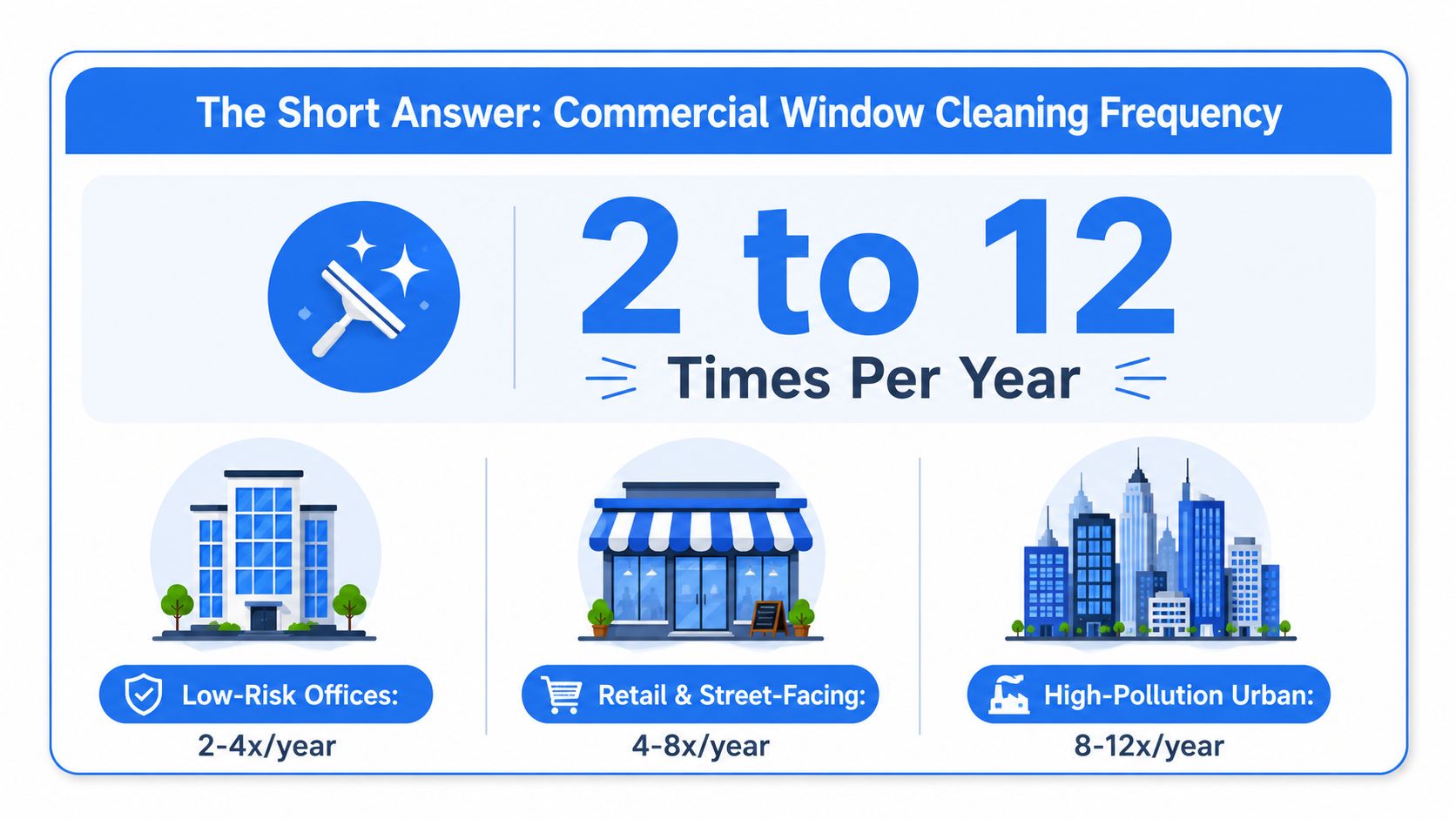
Most commercial properties need professional window cleaning 2 to 12 times per year, depending on building type, exposure, and appearance standards. Offices typically need quarterly service, while storefronts may need anything from monthly to weekly cleaning.
A property manager usually asks this question after a complaint lands in the inbox: streaked glass at the main entrance, fingerprints on the doors, or a storefront that suddenly looks tired before the weekend rush. By then, the issue isn't whether the windows need cleaning. The issue is choosing a schedule that keeps the property presentable without wasting service visits.
The right answer starts with the building, then adjusts for traffic, dust, weather, hard water, access, and tenant expectations. A restaurant, office tower, and warehouse shouldn't share the same calendar.
The Short Answer on Commercial Window Cleaning Frequency
The practical starting range is 2 to 12 professional cleanings per year, with the exact interval determined by how the building is used and how quickly its glass becomes visibly dirty. Industry guidance commonly places typical commercial properties at at least two cleanings annually, while lower-rise offices often fit a quarterly or semi-annual plan and high-traffic retail glass may require weekly to monthly attention (Sydney commercial window cleaning guidance).
A standard office with limited public contact can often begin with quarterly service, or four cleanings per year, then add monthly or bi-monthly visits for entrances, lobbies, and ground-floor glass. A street-facing retailer or restaurant needs a shorter cycle because customers see the glass at close range and touch the doors throughout the day. Low-touch warehouses can usually operate on a semi-annual or annual plan unless their glazing faces a busy road or public entrance.
Start with building use
Building type matters more than a universal calendar because dirty glass creates different operational problems in different properties.
- High-touch retail and food service: Appearance affects the customer experience every day. Doors, display windows, and lobby glass need frequent attention.
- Standard offices and medical facilities: Professional presentation matters, but most upper-floor glass doesn't collect fingerprints at the same rate as a retail entrance.
- Industrial and warehouse glass: Natural light and basic upkeep usually drive the schedule, unless public-facing glazing raises the appearance standard.
Regional conditions add another layer. Dust in Phoenix, hard-water spotting in Las Vegas, road film in Colorado, and seasonal weather can move a building into the next service tier.
Practical rule: Set the baseline by building type, then shorten it when the glass faces people, traffic, irrigation, construction, or branding.
If you manage a storefront, restaurant, or hotel, start with the building-type schedule below. Office and medical property managers should focus on separating high-touch zones from upper-level glass. Warehouse and industrial managers should look at the exposure factors before accepting an annual plan.
Recommended Cleaning Schedules by Building Type
The schedule below separates the glass that customers and tenants see every day from glazing that accumulates soil more slowly. These are operating benchmarks, not rigid rules. A flagship entrance may need a separate route even when the rest of the building follows a longer cycle.
| Property Type | Recommended Interval | Primary Driver |
|---|---|---|
| Retail storefronts | Weekly to monthly | Foot traffic, fingerprints, displays, curb appeal |
| Restaurants and food service | Weekly exterior, interior lobby every 2 to 4 weeks | Dining presentation, doors, grease, public contact |
| Low-rise offices | Quarterly, with more frequent entries | Tenant experience and ground-floor traffic |
| Medical facilities | Monthly to quarterly | Patient confidence, clarity, sanitation protocols |
| High-rise and curtain wall | Quarterly to semi-annual | Access complexity and façade exposure |
| Hotels and hospitality | Monthly exterior, quarterly full building | Lobby standards and guest perception |
| Industrial and warehouses | Semi-annual to annual | Natural light, safety, and lower public visibility |
Retail and storefront glass should be treated as a sales surface. Weekly service makes sense for busy entries, branded displays, and shops where dust and fingerprints become obvious quickly. Monthly service can work for a quieter location, but don't let a generic contract dictate the same interval for the front doors and upper display panes.
Restaurants need a similar split. Schedule the exterior weekly when the entrance sits near traffic, cooking exhaust, landscaping, or a busy sidewalk. Interior lobby glass can often run on a two-to-four-week cycle, especially where diners see reflections, menu graphics, or fingerprints on the entry doors.
Offices, medical sites, and hospitality
Office buildings usually benefit from quarterly interior cleaning, while main entrances, lobbies, and ground-floor glass often need monthly or bi-monthly attention. A tenant entering through streaked glass forms an opinion before reaching the reception desk, so the building's route should prioritize the areas that carry the most visibility.
Medical facilities deserve tighter controls around patient-facing areas. Clinics, dental offices, laboratories, and clean-room-adjacent spaces should coordinate window work with their sanitation and access procedures. Monthly to quarterly service is a sensible range, with the shortest interval reserved for entrances, waiting areas, and glass near frequent patient contact.
High-rise and curtain wall projects require a different operational approach. Quarterly to semi-annual service is commonly cited because rope descent systems, powered platforms, swing stages, and lift access make each visit more complex (commercial window cleaning frequency guidance). Hotels often need monthly exterior attention around the lobby and entrances, followed by a quarterly full-building cycle. Warehouses can usually run semi-annually or annually unless street-facing glazing or office sections need a tighter route.
Factors That Push Your Schedule More or Less Often
A calendar doesn't make glass dirty. Exposure does. Two buildings with the same floor count can require very different service intervals if one sits beside a freeway and the other is protected inside a campus.
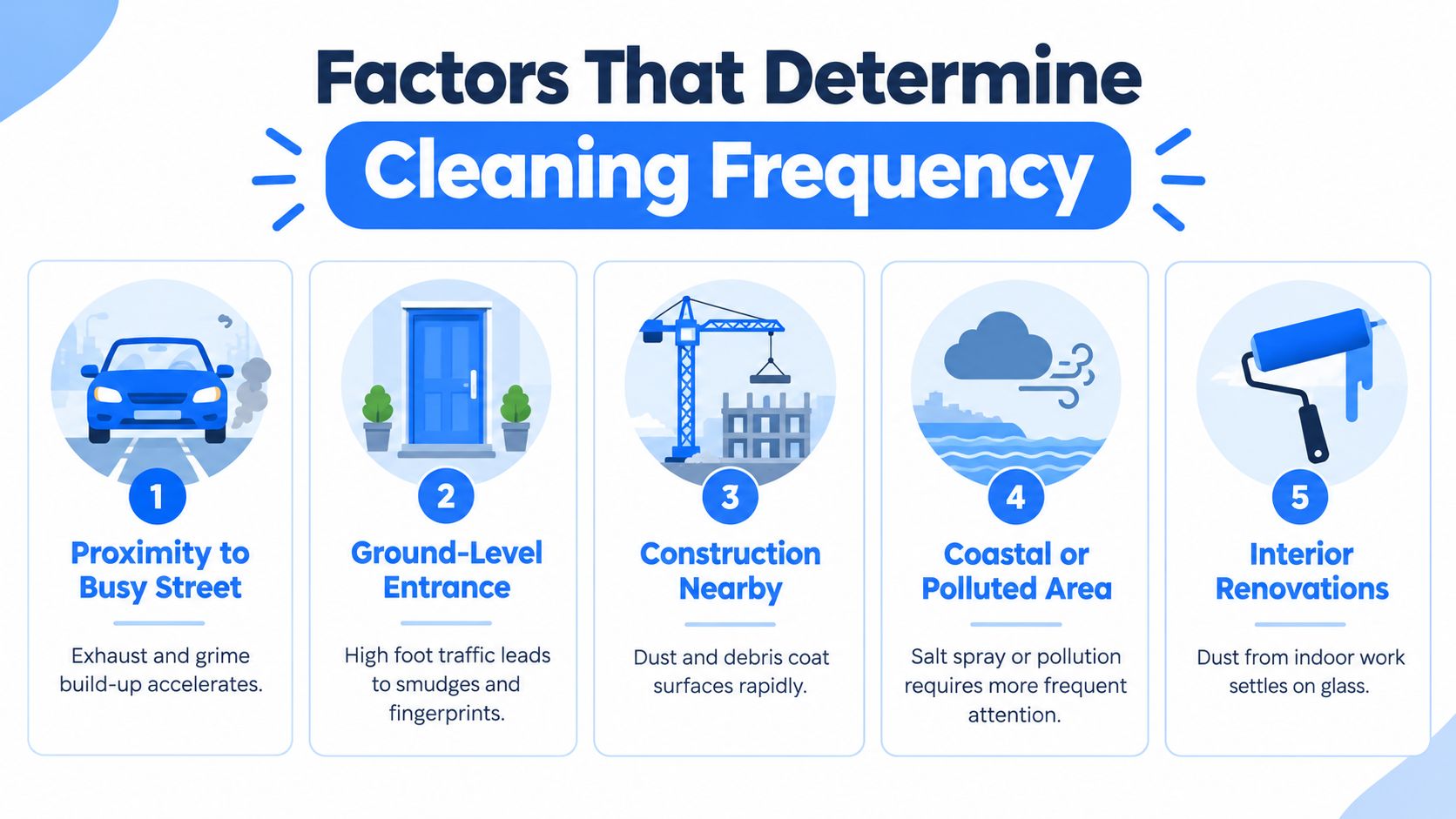
Ground-level entrances deserve the first adjustment. Doors and nearby panes collect fingerprints, dust, splashback, and contact marks faster than upper floors. A property beside active construction may need temporary service increases until the project ends, while pollen, traffic exhaust, rail corridors, and resuspended dust can keep exterior glass visibly coated even when the building itself has no unusual maintenance problem.
Inspect the exposure zone
Use these questions during a property walk-through:
- Street exposure: Does exhaust, road dust, or traffic grime settle directly onto the façade?
- Entrance contact: Do employees, customers, or deliveries constantly touch the same doors and sidelights?
- Water quality: Do sprinklers, cooling systems, or landscape irrigation spray mineral-heavy water onto the glass?
- Weather load: Does wind-driven rain, freeze-thaw weather, or intense sun bake residue onto the surface?
- Construction and landscaping: Are nearby projects, pollen, trees, or maintenance crews putting extra material in the air?
Glass type affects the cleaning method as well as the interval. Low-E and coated panes need careful handling and should not receive aggressive abrasive treatment. Tinted and reflective glass can reveal streaks and uneven drying more readily, so appearance standards may require touch-ups even when the overall contamination level is moderate.
Branding creates another hidden pressure. A logo decal, backlit menu, or product display behind glass draws attention to every smudge around it. Lease clauses, tenant turnover, and Class A appearance standards can also establish written minimums that override a general building schedule. More practical guidance is available in these commercial window cleaning tips.
When two or three conditions stack together, move the property up one tier. For example, a ground-floor storefront near construction with irrigation overspray shouldn't follow a basic monthly plan. It needs a shorter inspection cycle and a cleaning route that targets the affected elevations first.
Routine Maintenance Versus Deep Cleaning
Routine maintenance and deep cleaning are different services. A maintenance visit preserves an acceptable condition. A deep clean corrects buildup that standard work can't remove safely or efficiently.
Routine work normally includes professional squeegee cleaning, mild detergent, frame and sill attention, and track wipe-downs. A storefront visit may be completed in under an hour, depending on access and glass area, then repeated monthly, quarterly, or according to the property's operating schedule.
Deep cleaning addresses mineral deposits, hard-water etching, construction residue, oxidation, insect staining, and interior buildup. Crews may need deionized water, controlled scraping, specialized chemicals, ladders, boom lifts, scaffolding, or rope descent systems. The objective isn't just to make the glass look better for one day. It's to remove deposits before they permanently affect the surface.
| Aspect | Routine Maintenance | Deep Cleaning |
|---|---|---|
| Main purpose | Preserve clarity and presentation | Correct stubborn or bonded residue |
| Typical work | Squeegee cleaning, mild detergent, tracks, frames | Mineral removal, scraping, specialized restoration |
| Access | Ground work, ladders, water-fed poles | Lifts, scaffolding, or rope access when required |
| Scheduling | Fixed recurring cadence | Periodic, post-construction, or problem-driven |
| Best use | Prevent buildup between major interventions | Restore glass after neglect or difficult exposure |
A property that only books deep cleans lets ordinary soil sit too long between visits. A property that only books routine service may never address hard-water deposits or construction residue. Layer both services into the maintenance plan. Schedule routine visits on a fixed cadence, then plan deep cleaning every one to two years, or immediately after tenant buildouts, severe storms, or vandalism (commercial maintenance interval guidance).
How Arizona, Colorado, and Nevada Conditions Change the Calendar
Arizona, Colorado, and Nevada properties need regional adjustments because desert dust, intense sun, mineral-heavy water, and seasonal weather can shorten the clean appearance window.
In Phoenix, Scottsdale, Tempe, Chandler, Paradise Valley, and Glendale, fine dust and pollen can settle quickly on exterior glass. Monsoon winds and storm runoff can add splash marks, while irrigation overspray leaves mineral spotting that becomes harder to remove when it sits in direct sun. A retail entrance in these cities should usually start with monthly exterior service, then move more frequently when traffic, dust, or water exposure makes the glass deteriorate faster. Flagstaff brings a different mix, including stronger seasonal weather swings and freeze-thaw exposure, so lower glass and entrance areas may need additional inspection after snowmelt and storms.
Colorado properties face their own pattern. Denver, Boulder, Arvada, Westminster, Erie, Commerce City, and Golden can see spring pollen, summer construction particulate, and winter road film on lower elevations. Mountain locations may also develop mineral streaking as snow and ice melt across frames and panes. Keep ground-floor glass on a shorter route during high-exposure seasons, while upper floors can remain on the building's normal quarterly or semi-annual cycle.
Nevada's Las Vegas and Laughlin properties combine fine desert dust with hard-water spotting from irrigation and cooling equipment. A Las Vegas high-rise should plan semi-annual deionized-water rinses for exposed glass even when routine visits remain on schedule. Access planning matters on tall façades, so property managers should review high-rise glass cleaning equipment before approving a frequency that crews can't safely deliver.
OSHA limits rope descent system use to heights no greater than 300 feet above grade, unless the employer demonstrates that another access method isn't feasible or creates a greater hazard. OSHA says it adopted that limit from the ANSI/IWCA I-14.1 consensus standard (OSHA regulation, 29 CFR 1910). OSHA also warns that longer ropes above 300 feet can be more dangerous because wind affects them, making powered platforms or other feasible alternatives necessary (OSHA rope descent guidance).
Why a Recurring Program Beats Reactive Calls
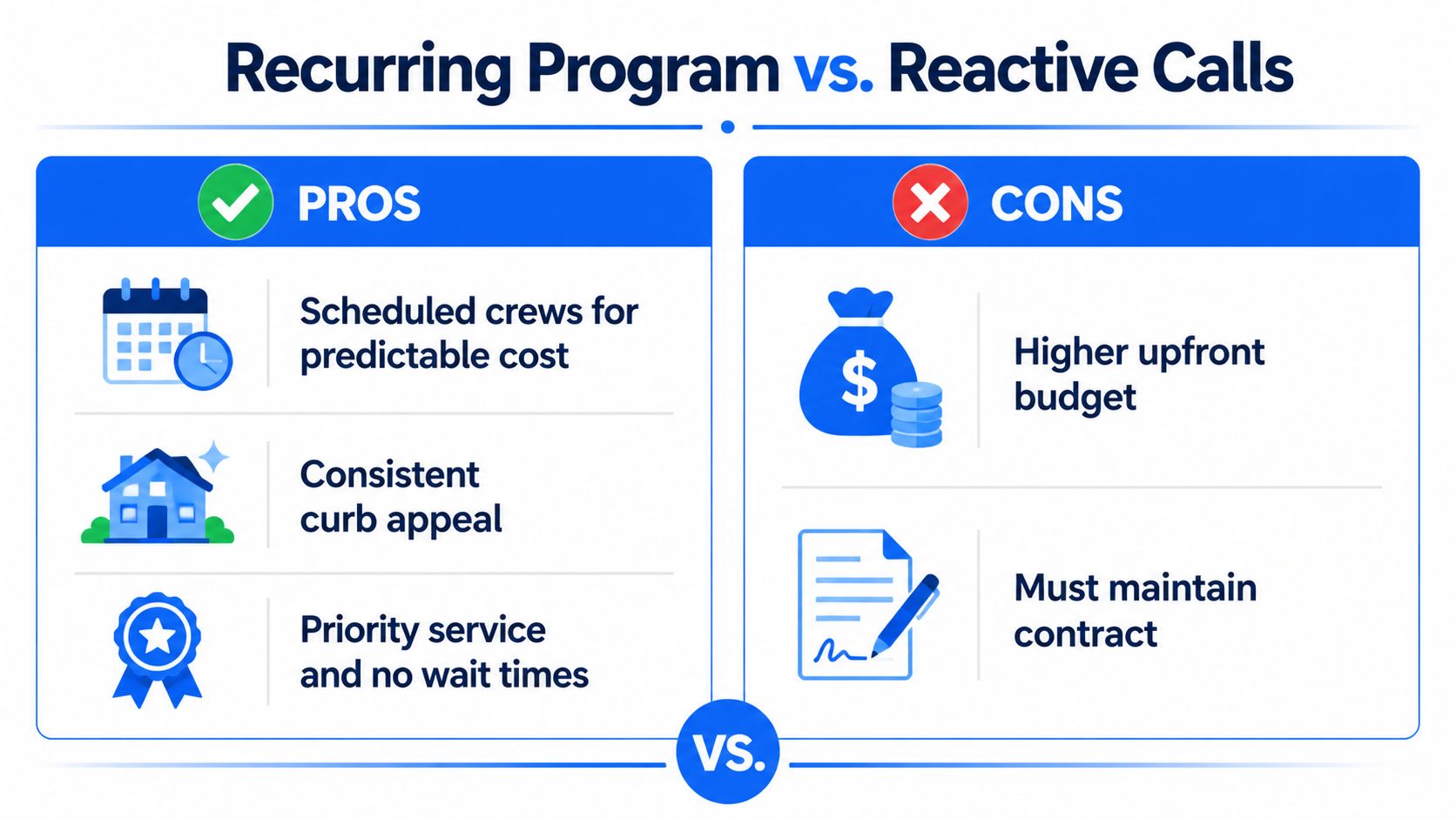
Reactive service looks economical because you call only when the windows look bad. In practice, it creates scheduling problems, inconsistent appearance, and more difficult restoration work.
Short-notice dispatch can limit crew availability and complicate access around tenants, deliveries, and operating hours. When glass sits for extended periods, mineral deposits, oxidation, insect staining, and construction residue can move beyond what routine cleaning handles. The property then needs heavier intervention instead of a predictable maintenance visit.
A recurring agreement gives the provider a known route and gives the property manager a stable operating line item. Crews learn which elevations collect dust, which entrances need touch-ups, and which irrigation heads spray the façade. For managers overseeing several locations, that history makes it easier to coordinate keys, lift access, tenant notices, and service windows.
What the program should control
- Crew availability: Recurring routes give you scheduled service instead of a scramble after a complaint.
- Appearance consistency: Tenants and customers see the same standard across each visit.
- Access coordination: Property teams can plan around business hours, escorts, lifts, and rope work.
- Condition tracking: Technicians can flag hard-water sources, damaged seals, and areas that need deep cleaning.
- Budget control: Fixed service intervals make maintenance easier to forecast than surprise calls.
A good dispatch process also matters when multiple buildings share one maintenance contract. A documented OnRoute dispatching workflow can help service teams organize assignments, access notes, technician availability, and completion records without relying on scattered messages.
Use a commercial building maintenance checklist to connect window work with tenant turnover, façade inspections, irrigation repairs, and seasonal property reviews. The strongest plan isn't the one with the most visits. It's the one that catches exposure changes before they turn a routine clean into restoration.
Building Your Own Commercial Window Cleaning Schedule
Build the calendar from the property outward. Don't start with a vendor's generic monthly package and hope it fits every elevation.
1. Audit the property
Walk the site and record the number of windows, floor levels, glass types, entry doors, storefront zones, skylights, and access constraints. Identify tinted, low-E, reflective, and standard glass. Mark areas that require ladders, water-fed poles, boom lifts, scaffolding, or rope descent systems.
2. Assign a baseline to each zone
Match retail, restaurant, office, medical, high-rise, hotel, and warehouse areas to the intervals in the building-type schedule. Then add the regional modifiers. Dust, monsoon exposure, hard-water spray, UV, construction, pollen, and winter road film should affect specific elevations rather than automatically changing the entire building.
3. Put dates on the calendar
“Monthly” is not a schedule until it has service dates. Write the planned visit dates, access requirements, tenant notifications, weather contingencies, and responsible property contact into the maintenance calendar. Separate recurring routine work from deep cleaning so each service has a defined scope.
4. Vet the provider
Ask for current insurance certificates, references from comparable commercial properties, documented OSHA-compliant rope-descent training for high-rise work, and proof that the crew can use pure-water systems or water-fed poles when appropriate. Confirm that the company has the right equipment for your elevations, including squeegees, ladders, boom lifts, scaffolding, and rope access.
5. Add quality controls
Require a pre-visit walk-through, a post-service spot inspection, and a 30-day touch-up guarantee in the agreement. The manager should know who approves completed work, how missed panes are reported, and how the crew documents damage or access limitations.
Revisit the plan after major storms, tenant turnover, nearby construction, irrigation changes, or a rebranding project that makes clean glass more visible. Professional Window Cleaning serves commercial properties across Arizona, Colorado, and Nevada with equipment including lifts, rope descent systems, water-fed poles, and professional squeegee methods, making it one option to evaluate when you compare providers.
Professional Window Cleaning can audit your property, separate high-touch glass from low-exposure elevations, and build a recurring schedule for storefronts, offices, medical facilities, warehouses, and high-rise buildings. Visit Professional Window Cleaning to request a quote and set up dependable service in Arizona, Colorado, or Nevada.