



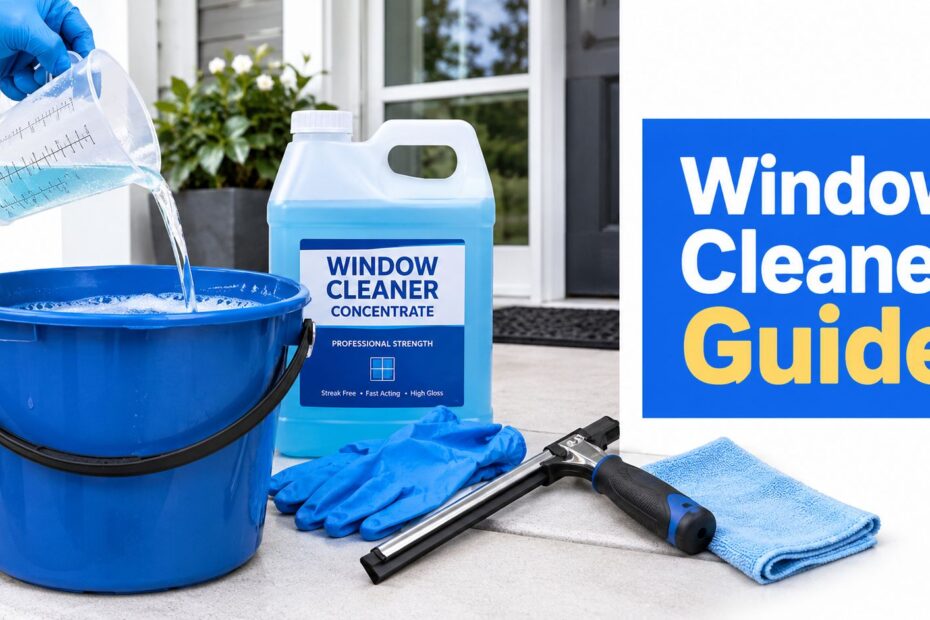
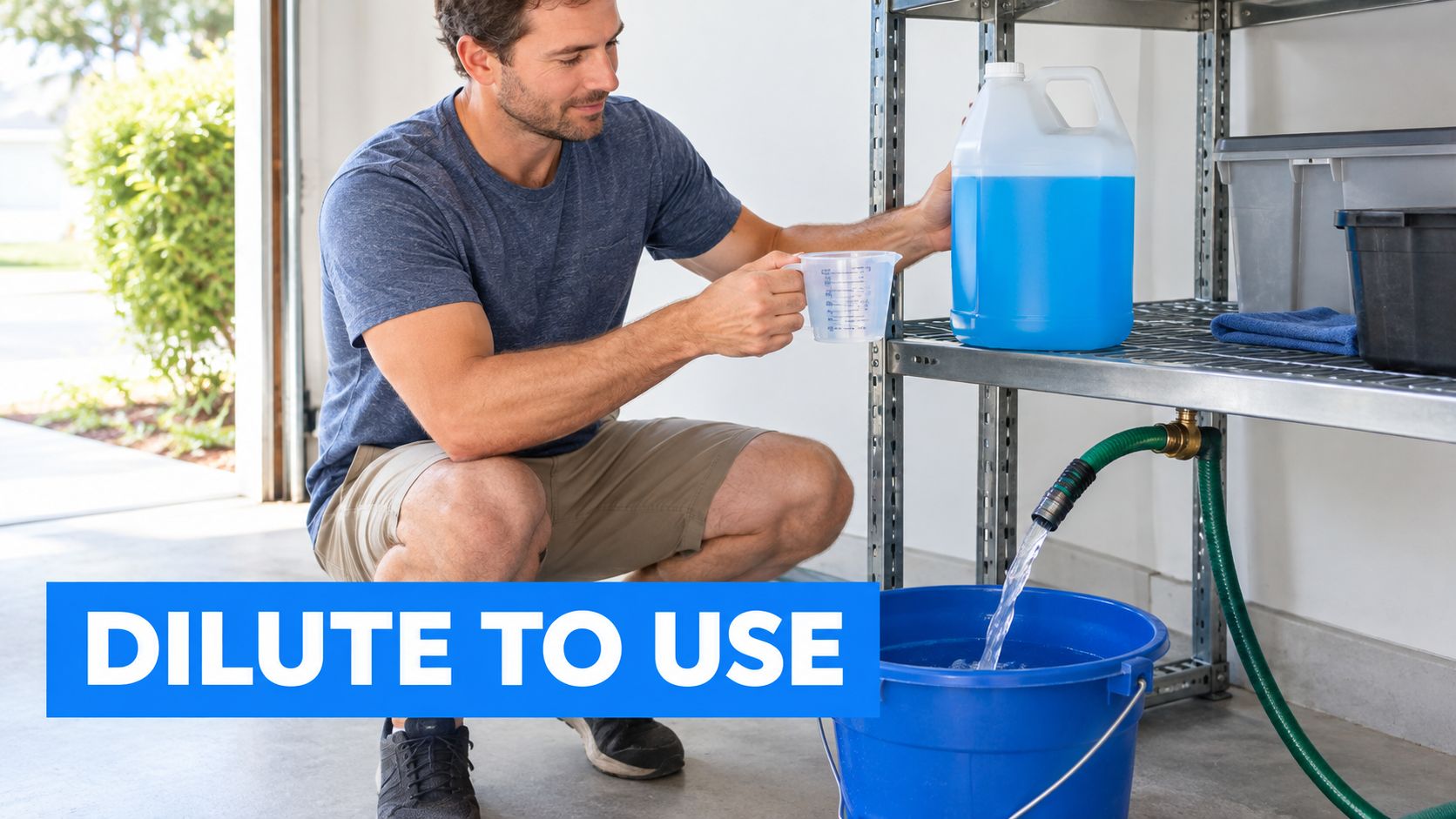
You're standing in the garage with a large jug of concentrate window cleaner, a measuring cup in one hand and a bucket filling from the hose. The label gives you a ratio, but not much help on what that mix should feel like, whether it suits your glass, or when the job has moved beyond a safe Saturday project.
Concentrate can be efficient, but the bottle is only one part of professional window cleaning. The result also depends on the glass, soil, water quality, application tool, access method, rinse technique, and the person using the equipment. A good mix can help a homeowner clean reachable panes or help a facility team manage supplies. It can't replace ladders, boom lifts, scaffolding, water-fed poles, squeegees, or properly planned rope descent work.
What Concentrate Window Cleaner Is
A concentrate window cleaner is a bulk formula mixed with water before use. Surfactants loosen the bond between glass and soil, while solvents such as isopropyl alcohol, vinegar, or ammonia derivatives can help dissolve grime and speed evaporation. The formula is only useful when its dilution suits the surface, soil, and application method.
Professional crews use the same basic chemistry at a larger operational scale. A five-gallon pail can be mixed at the specified strength and delivered through a bucket, pump sprayer, or water-fed system. Concentrate reduces the volume of finished liquid that must be shipped and stored, which suits commercial purchasing and recurring routes. Industry overviews of glass cleaners identify concentrated formats as one of the faster-growing segments, with sustainability goals, logistics, and bulk procurement contributing to demand. For a closer look at the products and equipment crews use, see what professional window cleaners use on real jobs.
What the formula is doing
A glass-specific product is not automatically interchangeable with an all-purpose cleaner. Ammonia-free concentrates are often the safer choice around tinted windows and window film. A general-purpose formula may leave residue or affect a coating, so check both the product label and the glass or film warranty before treating an unfamiliar surface.
A professional glass cleaner product sheet describes a concentrated, ammonia-free formula for glass and mirrors and warns against using it undiluted professional glass cleaner product information. The warning reflects a practical limit: adding chemical does not improve cleaning once the solution starts leaving a film.
Why professionals buy concentrate
The commercial advantages are practical:
- Less packaging: One container can replace many ready-to-use bottles.
- Simpler storage: A facility can keep a controlled supply and mix only what each route requires.
- Lower transport burden: Buyers avoid repeatedly moving finished water from supplier to job site.
- Consistent workflow: Technicians can follow a specified ratio across recurring properties.
A separate report places liquid concentrates at 31.2% of the window and glass cleaner category, with professional cleaning services, facility managers, and institutional buyers among the important demand groups window and glass cleaner market report. Concentrate therefore supports both supply control and repeatable field work. The strip washer, squeegee, and pure-water system still determine how soil is lifted, removed, and rinsed. For homeowners, a correctly mixed product can handle reachable glass. Larger buildings add access, equipment, and safety requirements that belong in a professional crew's workflow.
Dilution Ratios and Mixing Instructions That Hold Up on the Job
A mixing ratio describes the finished solution, not just the amount of water. A 1:10 mix uses one part concentrate and nine parts water, creating ten total parts. One ounce of concentrate plus nine ounces of water therefore makes ten ounces of solution.
Product directions commonly cover working ranges from 1:10 to 1:100. One professional specification calls for 1:20, or 6 ounces per gallon, and warns against using the cleaner full strength concentrated glass cleaner technical sheet. Other technical guidance uses stronger mixes for heavier soil and weaker mixes for routine cleaning dilution and ready-to-use cleaner guidance.
A practical mixing sequence
- Read the product label first. Similar-looking concentrates can have different ratios.
- Measure the water into a clean container. Use a marked bucket, tank, or proportioning system.
- Add concentrate to the water. This limits splash-back and helps the chemical disperse.
- Mix thoroughly. A large container needs more than a quick swirl.
- Label the finished solution. Record the ratio and mixing date.
- Match the delivery tool. A pump sprayer, bucket and strip washer, and water-fed pole apply and rinse differently.
Route rule: Increase concentration for documented soil, not by guesswork. If routine glass streaks, more detergent can leave more residue rather than a cleaner finish.
Facilities can also use the total-parts method to plan supply. Five gallons of concentrate mixed at 1:20 yields 100 gallons of finished solution. The actual number of homes or panes depends on window count, soil, application method, and how much solution the crew uses.
| Dilution Ratios for Common Window Cleaning Jobs | ||
|---|---|---|
| Ratio, Concentrate:Water | Typical Job | Yield from 5-Gallon Pail |
| 1:10 | Heavy soil, construction residue, or neglected glass | 55 gallons of finished solution |
| 1:20 | Routine residential or commercial maintenance | 100 gallons of finished solution |
| 1:64 | Light interior touch-ups or efficient commercial application. Some proportioning systems dispense at roughly this setting, about 2 ounces per gallon. | 325 gallons of finished solution |
| 1:100 | Light-duty work where application and rinse are tightly controlled | 505 gallons of finished solution |
The table's yields use the same total-parts calculation for a five-gallon concentrate volume. With a water-fed pole running purified water, drop the concentrate out of the equation entirely. Brush agitation and the deionized rinse do the cleaning. Hard water can still complicate the finish, so mineral-heavy supply water may require a controlled adjustment or a final squeegee pass with deionized water instead of more detergent.
For a household cleaner comparison, use this guide to a substitute for ready-to-use window cleaner. Whichever ratio you choose from the table, mix one test bucket, clean one pane, and let it dry fully before committing the rest of the pail to that strength. On a commercial route, that test also confirms whether the chosen ratio suits the crew's applicator, squeegee process, or proportioning equipment before the solution reaches the whole building.
Matching Concentrate to the Job at Hand
The right product and ratio depend on more than dirt. Access method and glass type change the workflow, even when the same concentrate sits in the truck.
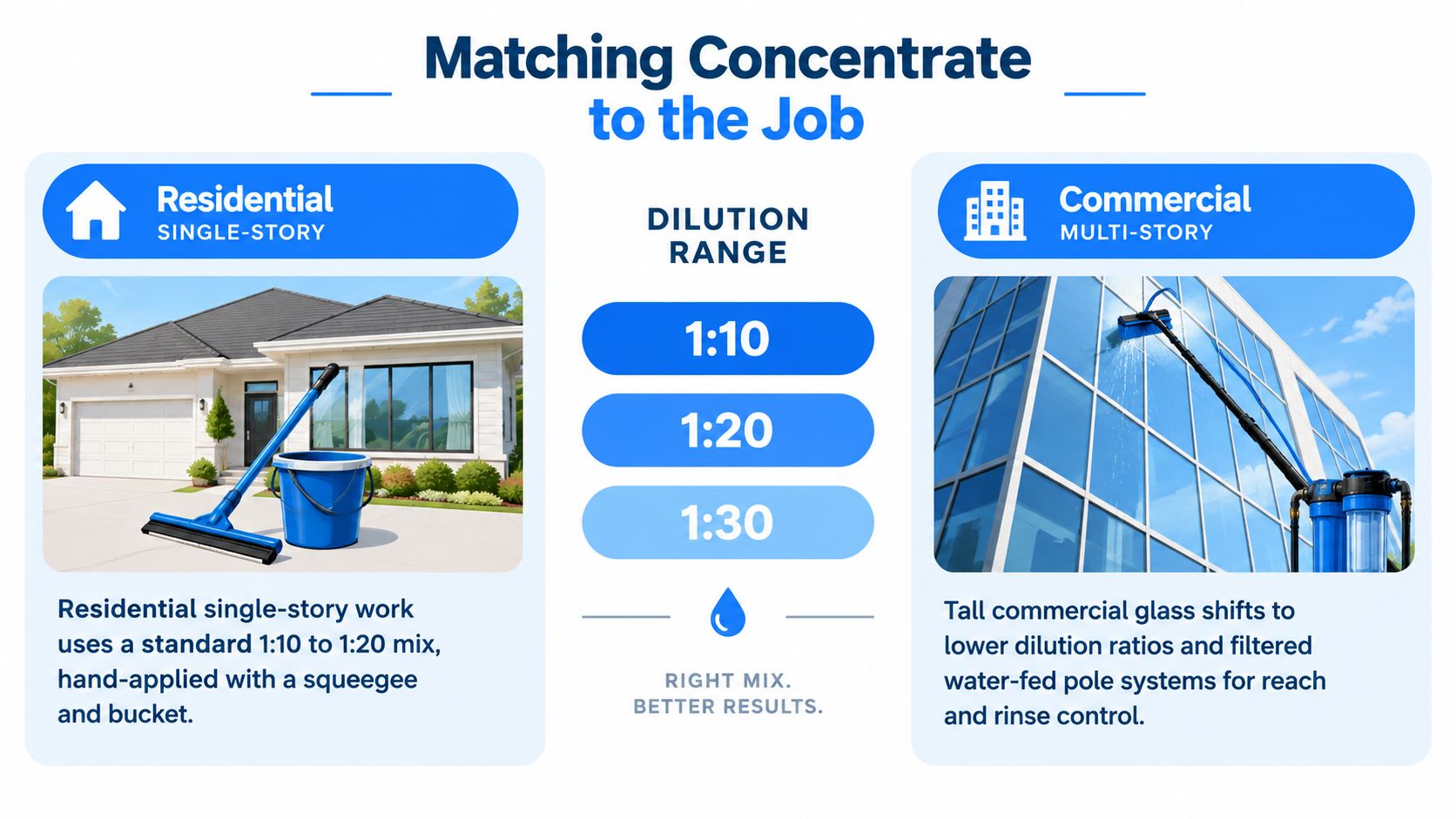
A single-story home with ordinary annealed glass is a good setting for a bucket, strip washer, and squeegee. A controlled 1:10 to 1:20 mix can handle dust, fingerprints, water spots, and cobwebs when the operator wets the glass evenly and removes the solution before it dries. Two-story residential work adds ladder positioning, weather exposure, and more difficult edges. A water-fed pole using purified water can remove the need for a traditional bucket on reachable exterior glass, while the brush provides agitation and the rinse controls minerals.
Residential and commercial differences
Commercial offices often contain tinted film, low-E coatings, or other treated surfaces. An ammonia-free glass concentrate is the safer starting point, but the building's specifications still control the decision. A haze caused by an incompatible chemical can become a warranty dispute, not just a cleaning inconvenience.
| Setting | Typical tools | Chemistry and workflow focus |
|---|---|---|
| Single-story residence | Strip washer, squeegee, ladder where appropriate | Controlled 1:10 to 1:20 mix and careful edge work |
| Two-story home | Ladder, water-fed pole, squeegee | Access planning, cobweb removal, purified rinse |
| Low-rise office | Water-fed pole, squeegee, lift when needed | Ammonia-free product for treated glass and consistent scheduling |
| Multi-story facade | Boom lift, scaffolding, rope descent system | Ground-station mixing, controlled dwell time, safe access and rinse |
The chemistry may barely change between a home and a commercial facade, but dwell time, rinse control, and access risk change substantially. A pump sprayer can distribute solution across a storefront. A water-fed pole can limit ladder exposure on suitable exterior panes. A boom lift or scaffolding may be the correct choice where the facade, setback, or architectural design makes pole work unsuitable.
High-rise work requires a separate safety conversation. OSHA describes a rope descent system as equipment that lets a worker descend in a controlled manner and stop at any point, generally including an anchorage, support rope, descent device, connectors, and a chair or seat board OSHA rope descent system interpretation. The access method must be planned before anyone mixes a bucket.
Safe Handling, Storage, and Spill Response
Concentrate is diluted before use, but it still deserves respect. Skin and eye irritation, splash-back, mislabeled bottles, and incompatible storage create avoidable problems in a garage, janitor closet, or service van.
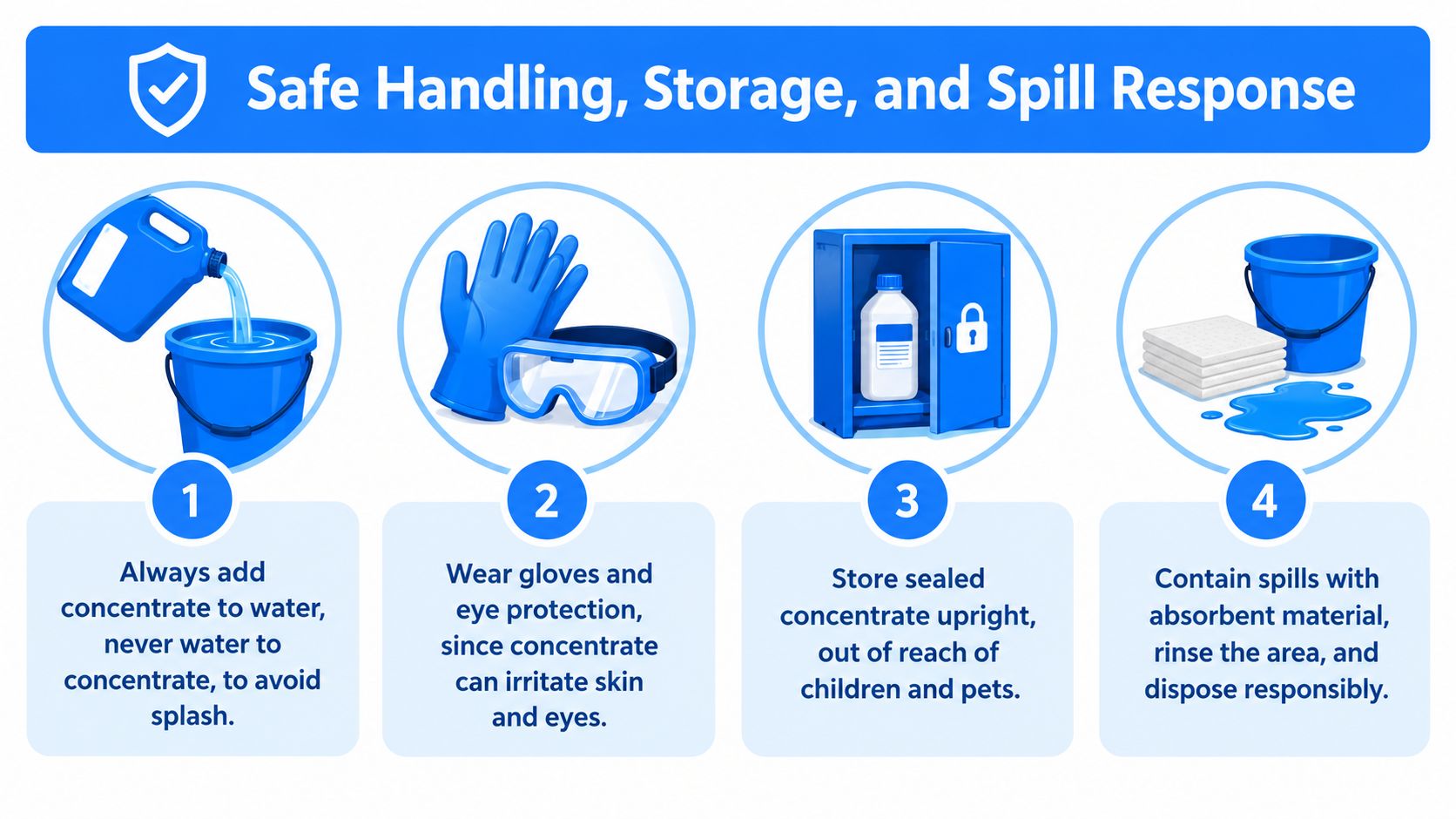
Start with the container, not the spray bottle. Put water into the mixing vessel first, then add the concentrate slowly. Guidance from the Canadian Centre for Occupational Health and Safety on cleaning products specifically emphasizes adding concentrate to water, labeling diluted containers, using a funnel for narrow-neck bottles, and following the manufacturer's directions.
A safe job-site sequence
- Protect your eyes and hands: Wear safety glasses and chemical-resistant gloves while measuring and mixing.
- Control the environment: Work in a ventilated area away from children, pets, food, and ignition sources where the product label requires it.
- Identify the bottle: Label the secondary container with the product name, dilution ratio, and mixing date.
- Keep the SDS available: Store the safety data sheet digitally or in a binder so the response steps are accessible.
- Use the right funnel: A funnel reduces spills when transferring solution into a narrow-neck sprayer.
Don't reuse a bottle with an unreadable label. A professional crew may carry several products for glass, frames, screens, and heavier construction soil. Mixing them up can damage a surface or expose the user to an unintended chemical combination.
Storage and spill response
Keep concentrate upright, tightly sealed, and in its original container. Protect it from direct sunlight and freezing conditions, since some formulas can separate or lose consistency after freeze cycles. Never assume that a diluted spray bottle has the same storage life as the original product. The label and SDS determine that answer.
For a spill, keep people away, ventilate the area, and contain the liquid with absorbent pads or another suitable material. Don't wash concentrate into a storm drain. After collection, rinse the affected area with plenty of water when the product instructions permit it, and dispose of absorbent material according to the label and local requirements.
Safety comes before speed: If the label calls for different protective equipment or emergency treatment, the label and SDS override general mixing habits.
Eco-Friendly and Biodegradable Concentrate Options
Eco-friendly concentrate requires more than a green label. Check the ingredient list, disposal instructions, and any third-party certification named in the property specification. Conventional formulas often prioritize fast soil removal with solvents and strong detergency. Biodegradable products may depend more on plant-derived surfactants, citric acid, or bio-based solvents.
The market is shifting toward greener glass-cleaning products. One report places eco-friendly and plant-based glass cleaners at 24.6% of total market share in 2025, compared with 16.8% in 2021, a 7.8 percentage-point increase market report on eco-friendly glass cleaner share. That direction matters to property managers serving schools, healthcare sites, sustainable construction projects, and facilities with chemical-impact limits.
| Conventional vs Eco-Friendly Concentrate Comparison | ||
|---|---|---|
| Attribute | Conventional Concentrate | Eco-Friendly/Biodegradable Concentrate |
| Soil cutting | Often optimized for rapid grease and soil removal | May use gentler surfactants and acids |
| Waterway profile | Often contains solvents and phosphates or quats that persist in runoff. Check the SDS aquatic-toxicity section | Designed for improved breakdown, but the label still controls disposal |
| Coating compatibility | Must be checked carefully, especially with ammonia-based chemistry | Still requires a glass and film compatibility check |
| Hard-water performance | Can offer strong cleaning, but minerals may remain | May need a deionized rinse or squeegee finish |
| Procurement | Familiar across commercial routes | Useful where sustainability specifications influence purchasing |
The trade-off appears on the job. A biodegradable formula may satisfy a facility policy while requiring more dwell time, agitation, or careful drying. As covered in the dilution section, minerals are a water problem, not a chemistry problem. No eco label replaces purified water, a clean squeegee pass, or a separate treatment for stubborn deposits.
For a broader comparison of how solution selection affects results, review the best window cleaning solution. If the property specification names third-party certification, verify it before purchase. If it does not, choose on cleaning performance and let disposal guidance break ties. On larger routes, that decision also has to account for the crew's equipment, wastewater controls, and repeat-use cost.
When DIY Concentrate Work Ends and the Pros Take Over
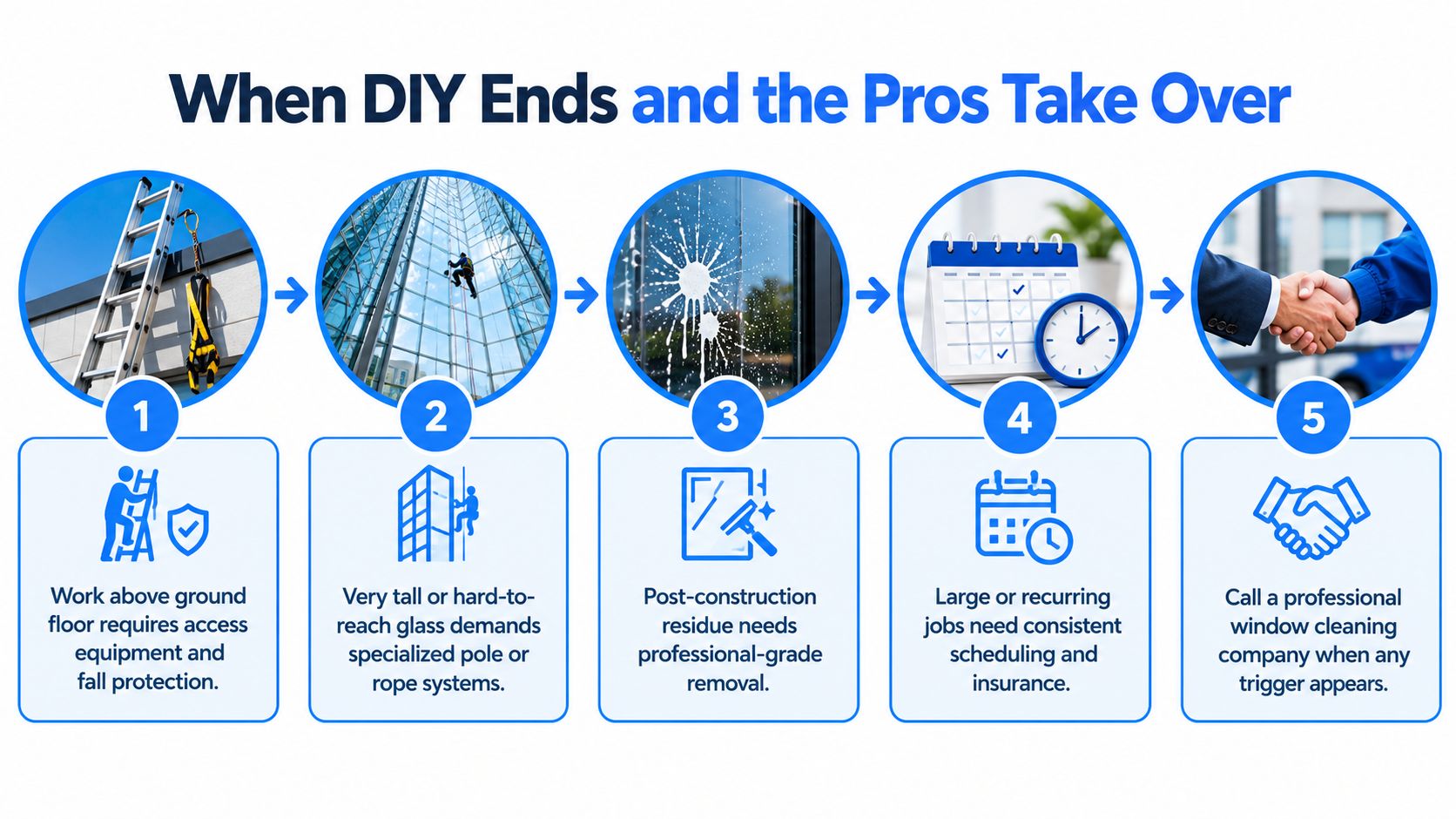
DIY concentrate work makes sense for reachable first-floor panes, interior glass, French doors, and storefront entryways. The boundary changes as soon as the operator needs unstable access, specialized equipment, or a fall-protection plan.
A property manager should stop treating the job as routine maintenance when the glass is above ground level and a stable stepladder is no longer enough. The same applies when frames show rot, seals have failed, architectural features obstruct access, or the building has post-tension cables and uncertain anchor points.
Five triggers for a professional crew
- The access is above ground-floor work. Ladders, lifts, scaffolding, and rope systems require inspection, setup, and trained operation.
- The glass is tall or obstructed. Atriums, skylights, setbacks, and multi-story facades may require water-fed poles, boom lifts, or suspended access.
- The soil is post-construction residue. Paint, silicone, adhesive, and heavy mineral deposits can require specialized tools and surface testing.
- The property carries liability exposure. A commercial site may need insurance documentation, a certificate of insurance, scheduling controls, and tenant communication.
- The work requires suspended access. Rope descent systems aren't a shortcut for a long ladder. They require suitable anchorages, an independent fall-arrest system, inspections, and trained technicians.
OSHA's general industry guidance limits rope descent systems to buildings no higher than 300 feet above grade, unless the employer demonstrates that another method isn't feasible or would create a greater hazard rope descent system requirements and anchorage information. The same guidance states that each worker's anchorage must support at least 5,000 pounds in any direction, and that the building owner must provide written confirmation that the anchorage has been identified, tested, certified, and maintained.
Washington State L&I guidance calls for an independent fall-arrest system with a separate anchorage for workers suspended from a boatswain's chair or rope descent system. It also references ANSI/IWCA I-14.1-2001 and the manufacturer's instructions for design, use, and maintenance high-rise rope descent safety guidance. Industry guidance also notes that rope descent systems above 130 feet require stabilization and that wind speed must be continuously monitored rope descent access system guidance.
In those conditions, the concentrate is the easy part. The professional crew earns its place through equipment selection, access planning, safety training, and controlled execution.
Choosing the Right Path for Your Windows and Your Building
Local conditions change the cleaning decision. Phoenix hard water can leave mineral spotting that demands purified water or a final squeegee pass. Las Vegas glass may collect mineral dust and intense sun exposure, making timing and drying control important. Colorado properties face cold conditions and freeze-thaw weather that can change how quickly solution dries and how equipment must be staged.
A facility manager comparing a five-gallon concentrate drum with a water-fed pole against a recurring professional contract should evaluate more than chemical price. Check water quality, glass accessibility, coating requirements, tenant expectations, equipment ownership, worker training, and the consequences of a fall or damaged pane.
A practical decision checklist
- Single-story homeowner: Use a product approved for the glass, measure a controlled mix such as 1:10 when the label permits it, and apply it only to reachable panes with safe footing.
- Small storefront or office: A 1:20 mix through a pump sprayer may fit routine maintenance when the product label supports it. Plan for squeegee removal and avoid spraying into occupied areas.
- Two-story or difficult residential property: Consider a water-fed pole or a professional visit instead of extending a ladder beyond a stable working position.
- Multi-story building: Use an insured crew when the property needs lifts, scaffolding, rope descent systems, documented anchorages, or fall-arrest planning.
- Regional facility portfolio: Standardize the approved chemical, ratio, labeling process, and inspection routine across Phoenix, Scottsdale, Tempe, Chandler, Paradise Valley, Glendale, Flagstaff, Denver, Boulder, Arvada, Westminster, Erie, Commerce City, Golden, Las Vegas, and Laughlin.
Professional Window Cleaning uses tools including squeegees, ladders, boom lifts, scaffolding, rope descent systems, water-fed poles, and pure water systems for residential and commercial work. The company's service areas include Arizona, Colorado, and Nevada, so a property manager can discuss whether concentrate mixing, purified water, or specialized access is appropriate for the building.
Concentrate buys efficiency at the mixing point. A professional service buys safe access, repeatable technique, equipment control, and a documented result. For a first-floor project, DIY may be sensible. For glass above ground level, recurring commercial routes, or uncertain anchorages, the responsible choice is to bring in a trained window cleaning company.
Professional Window Cleaning can assess your glass, water quality, access requirements, and the right combination of squeegees, pure water, water-fed poles, lifts, or rope descent systems. Visit Professional Window Cleaning to request a quote and schedule safe, consistent window cleaning across Arizona, Colorado, and Nevada.