



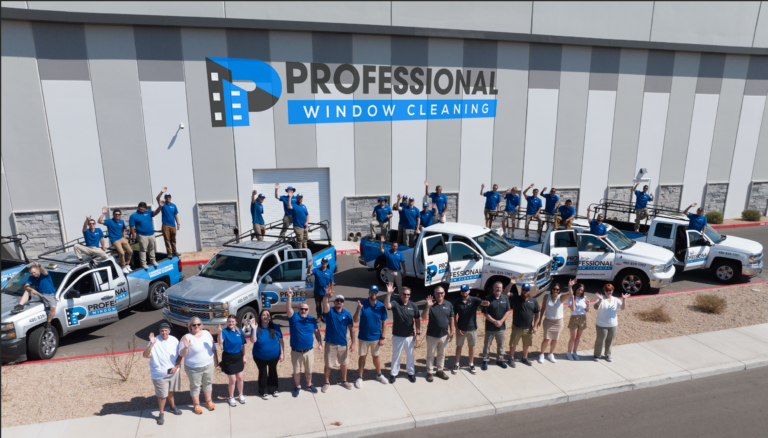
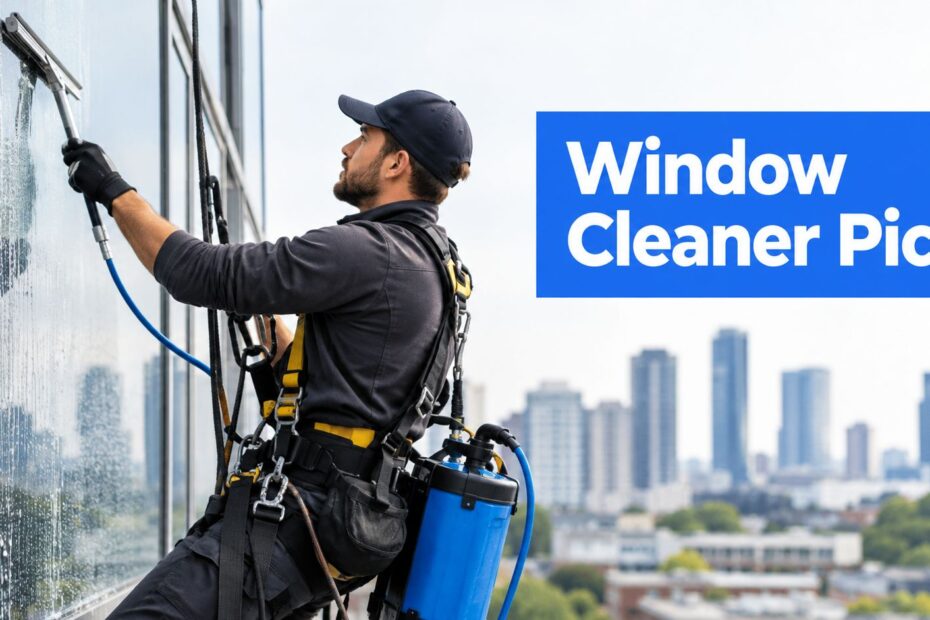
You're comparing polished residential glass, a storefront crew, and technicians working on multi-story windows. The strongest window cleaner pics don't just show shiny panes. They identify the access method, professional tools, safety equipment, surface, and visible result.
This gallery focuses exclusively on professional window cleaning services. Look for squeegees, ladders, pure water systems, boom lifts, scaffolding, and rope descent systems, not household cleaning products. Professional Window Cleaning serves residential, commercial, mid-rise, and high-rise properties across Arizona, Colorado, and Nevada, including Phoenix, Scottsdale, Tempe, Chandler, Paradise Valley, Glendale, Flagstaff, Denver, Boulder, Arvada, Westminster, Erie, Commerce City, Golden, Las Vegas, and Laughlin. If you're building a broader marketing system, see this guide to commercial cleaning advertising software.
1. Adobe Stock
Adobe Stock is a strong choice when a service page needs polished commercial imagery quickly. Search terms such as “window cleaner,” “rope descent,” “water-fed pole,” and “high-rise glass” can produce useful concepts for residential, storefront, mid-rise, and high-rise pages.
The practical advantage is workflow. Designers using Photoshop, Illustrator, or Creative Cloud Libraries can test crops, place images into layouts, and manage licensing without leaving the Adobe environment. Standard and enhanced license options also make it easier to separate routine web use from broader commercial applications.
For a window cleaning company, the image still needs a precise caption. State whether the photo shows traditional squeegee work, a water-fed pole, ladder access, or exterior glass on a multi-story building. A polished technician portrait without visible equipment tells a buyer very little about how the service is delivered.
Practical rule: Treat stock photography as an illustration of a method, not proof that your crew completed a particular job.
What the photo should reveal
Look for a clear relationship between the technician and the glass. A squeegee should be positioned against the pane, a water-fed brush should connect to a pole and pure water system, and high-access scenes should show the equipment that makes the work possible.
For authentic examples, compare stock concepts with the Professional Window Cleaning gallery. Real project photography can show the building type, access challenge, crew positioning, and final appearance more convincingly than a generic commercial image.
Best fit: Branded landing pages, commercial proposals, and campaigns that need consistent visual quality.
Trade-off: Adobe Stock costs more than free sources, and enhanced licenses or high-volume use can increase the expense. Plan details also vary between individual, team, and enterprise customers, so review the license before publishing.
2. Shutterstock
Shutterstock earns its place when you need breadth. Its large library covers residential service visits, storefront maintenance, facilities work, rope access, ladders, lifts, and building exteriors. That range helps a marketer create different visual treatments for homeowners, retail operators, property managers, and high-rise owners.
The search filters are useful in practice. Orientation, people or no people, copy space, and subject filters can narrow a large result set to images that work well in a hero section, service card, advertisement, or proposal. Team and enterprise options also suit organizations managing assets across multiple marketing users.
A good Shutterstock result makes the method obvious. A storefront photo should show the crew working around an active business. A lift image should show the bucket positioned near the glass rather than floating beside the building as a decorative prop. A rope-access image should make the descent setup and protective equipment visible.
Where the imagery works best
Stock visuals are most useful when you need to explain a service before you have a matching local project photo. They can introduce commercial window cleaning, high-access work, or water-fed pole cleaning, but the caption should avoid implying that the pictured building belongs to your customer.
Use a local landing page to connect the image to the service area. For example, a Denver commercial page should feature a caption about commercial glass access and maintenance, while a Las Vegas page might emphasize storefront presentation or multi-story exterior work. The image can support the message, but it shouldn't pretend to document a specific property.
Strengths
- Niche coverage: Search results often include rope work, PPE, facilities, and building maintenance.
- Flexible purchasing: Subscriptions, image packs, and team options suit different publishing rhythms.
- Enterprise support: Larger organizations can review licensing and asset management options centrally.
Weaknesses
- Plan complexity: Public pricing and promotions can change by region and account type.
- License upgrades: Expanded uses may require an additional license.
Shutterstock is the practical pick when selection matters more than local authenticity. Replace generic stock with job-site photos whenever the page needs to prove completed work.
3. iStock by Getty Images
iStock by Getty Images suits brands that want a controlled, polished look without searching the entire stock market. Its Essentials collection supports budget-conscious marketing, while Signature offers more premium and exclusive imagery. Subscriptions and credit packs give smaller companies different ways to acquire assets.
The library can support visuals of storefronts, residential visits, bucket trucks, rope descent work, and technician teams. The strongest choices show enough context to identify the service setting. A close-up of a hand holding a squeegee may look clean, but a wider image showing the pane, frame, work area, and protective setup communicates far more.
Use the professional window cleaning tools guide alongside the image when the page needs to explain equipment. A caption can identify a professional squeegee, water-fed pole, lift, or rope descent system, then explain why that method fits the property.
License and presentation
A standard license may suit ordinary marketing use, while broader applications may require extended protection. Review rollover terms, credit rules, and the selected collection before placing an image in advertising, printed materials, or a proposal distributed to multiple stakeholders.
iStock's polished presentation can help a company look established, but it also creates a risk. Highly staged photos may show a spotless pane, a perfectly positioned technician, and an unusually tidy work area. That's useful for brand atmosphere, not operational proof.
Best fit: Service pages, brochures, real estate materials, and campaigns that need visual consistency.
Watch for: Signature content and extended protection cost more, and plan terms differ by tier.
A strong iStock caption should name the setting, access method, tool, and visible result. If those details aren't apparent in the frame, the image is probably better as a decorative asset than as evidence of professional service.
4. Alamy
Alamy suits a gallery that needs believable service settings rather than polished studio scenes. Its library includes campus, hospital, municipal, mixed-use, and commercial buildings, giving readers visual context for work across Arizona, Colorado, and Nevada.
A facilities buyer can assess the building type, access conditions, and surrounding activity at a glance. A technician working beside an operating campus or hospital communicates different planning requirements from a storefront image. Look for visible PPE, stable footing, protected work areas, water-fed poles, lifts, scaffolding, or rope descent systems. Each detail should support a clear explanation of how professionals reach and clean the glass.
An aerial or elevated view can show façade scale and access limitations. A closer frame can show the cleaning method and the result. For before-and-after proof, use images from the same angle and comparable lighting. Stock photography cannot verify your company's work, so captions should describe what the viewer can see.
Check the license before publishing
Alamy offers subscriptions and a license calculator for one-off purchases. The calculator helps match an image to its application, placement, audience, and duration. Review the selected license carefully, particularly when an image is marked for editorial use.
Realistic imagery does not automatically provide advertising rights. Confirm that the photo supports a commercial landing page, proposal, brochure, or campaign before publishing it. Avoid implying that the technicians shown represent your company.
A useful caption identifies the building type, access method, interior or exterior setting, and visible cleaning result. It can also explain why a lift, scaffold, water-fed pole, or rope system fits that property.
Best fit: Campus, municipal, hospital, mixed-use, and facilities pages where service context matters.
Advantages
- Authentic atmosphere: Scenes can feel grounded and operational.
- Location variety: Building types support regional service pages.
- Flexible licensing: The calculator helps assess one-off requirements.
Trade-offs
- Editorial restrictions: Some images cannot support advertising.
- Selection work: License categories require careful review.
- Limited proof: Stock photos cannot establish a verified job result.
Alamy works best when each photo must show a credible work environment. Choose another source for tightly controlled brand portraits or documented before-and-after sequences from a specific property.
5. Depositphotos
A storefront photo should show more than a person holding a squeegee. It should reveal the glass, the access method, and the result a customer can expect. Depositphotos covers residential windows, commercial storefronts, water-fed poles, technicians in PPE, and exterior building work, making it useful for regular blogs, service pages, and social posts.
Its monthly and annual subscriptions, business plans, and on-demand options suit different content volumes. A small company can choose occasional downloads, while a larger marketing team can build a related image set without negotiating separately with each contributor. Review the current plan and license terms before publishing, especially for commercial campaigns.
Use a three-image sequence to explain service scope. One photo can show residential glass cleaned with a traditional squeegee. Another can identify a pure water system and water-fed pole for exterior work. A third can place a lift, scaffold, or rope descent system against a larger façade. Captions should state the property type and method rather than imply that a stock technician worked in Arizona, Colorado, or Nevada for your company.
The strongest image connects equipment to a customer concern. Pure water and a water-fed pole can reduce the need to work from inside. A boom lift can reach a larger elevation, while scaffolding can support planned façade work. Rope systems may suit difficult vertical access when the crew and property conditions allow them. These details help readers understand why the method affects safety, access, and service value.
Stock photography remains illustrative. It cannot prove a building's height, a crew's training, or the result at a customer's property. Use project-specific before-and-after photos for those claims.
Best fit: Ongoing residential, storefront, and commercial marketing that needs clear method coverage.
Trade-offs: Public pricing may require an account or checkout step, and license protections may be less extensive than those offered by premium libraries.
Depositphotos works well for practical visual coverage. Choose it when the image must explain professional window cleaning, not serve as a formal job record.
6. Envato Elements
Envato Elements makes sense for teams that need more than photographs. An active subscription provides access to stock photos, video, graphics, templates, presentations, mockups, and other creative assets. That combination can support a complete window cleaning marketing kit, including service-page imagery, proposal layouts, social graphics, and flyers.
The project-based licensing model is convenient for agencies and multi-client workflows. A team can download a suitable image, attach it to the relevant project, and use matching design elements without purchasing each file individually. Geographic pricing and plan tiers vary, so confirm current United States terms at checkout.
For window cleaning content, search for visuals that show the tool and the result together. A water-fed pole should be identifiable, not cropped into an abstract detail. A lift should appear in relation to the building façade. A technician using a squeegee should be working on a recognizable pane rather than posing beside an already-clean surface.
Where Envato earns its keep
Envato's biggest advantage is production speed. A marketing team can build a service page and supporting social campaign with a consistent visual system. Templates also help property managers prepare proposals that explain residential, commercial, mid-rise, and high-rise service options clearly.
The limitation is depth. Not every image has the specialized operational detail available from a library focused on premium industrial photography. Some assets look suitable for a general cleaning article but don't show the access method, safety equipment, or surface condition a serious buyer needs to evaluate.
Best for: Recurring creative work that combines photos, templates, presentations, and social assets.
Strong point: Project-based licensing can simplify asset organization across campaigns.
Caution: Verify whether a download is licensed for the specific project and whether team members need separate access.
Envato Elements is a value-focused creative system rather than a specialized evidence library. Use it to build consistent marketing materials, then add authentic job-site photography where safety, access, and results must be visible.
7. Unsplash and Unsplash Plus
A homeowner scrolling through a window-cleaning page needs more than a bright glass façade. The photo should show what the crew did, how they reached the surface, and what changed afterward. Unsplash can supply a clean starting image when a company has limited creative budget, but its broad library rarely documents a complete professional method.
The free Unsplash License allows many commercial uses without required attribution, subject to its prohibited-use rules. Unsplash Plus offers curated premium content and additional legal protections, including a warranty described in its plan materials as up to US$10,000 per licensed photo.
Use free images for blog headers, organic social posts, or general framing around residential and storefront services. Search results may show a spotless interior, reflective architecture, or a lifestyle scene while hiding the technician, water-fed pole, lift, scaffolding, rope descent system, or surface condition. That gap matters when customers in Arizona, Colorado, or Nevada are comparing access methods and expected results.
A stock image can establish mood. It cannot prove that a crew safely cleaned a particular building.
For evidence of finished work, pair the visual with a genuine window cleaning before-and-after example. The comparison should show the same surface from a comparable angle, with enough surrounding detail to identify the service zone. Look for removed mineral deposits, clearer reflections, cleaner edges, and consistent coverage rather than a dramatic but unverifiable close-up.
Check the license and the evidence
A permissive license does not confirm that every person, property, logo, or recognizable location is cleared for every advertisement. Model and property considerations may still apply, especially if the image appears to endorse a specific window-cleaning company.
Unsplash Plus offers more protection than a free source, but it is a single-seat product with its own terms. Confirm that the account structure suits designers, agencies, and regional offices before sharing downloaded assets.
For a gallery-style service page, use Unsplash for atmosphere and layout support. Reserve the strongest positions for authentic job-site photos that show residential panes, storefront glass, water-fed pole work, lifts, scaffolding, rope access, and comparable before-and-after results. That mix connects visual quality to safety, access, workmanship, and customer value.
Top 7 Stock Sites for Window Cleaner Pics
| Service | Licensing & integration complexity | Resource requirements | Expected outcomes | Ideal use cases | Key advantages |
|---|---|---|---|---|---|
| Adobe Stock | Clear standard vs. enhanced licenses; tight Creative Cloud integration | Paid (per-image, subscription, enterprise); higher cost for enhanced/volume | High‑quality, brand‑safe commercial imagery suitable for ads | High‑quality commercial campaigns; high‑rise and industrial window‑cleaning visuals | Creative Cloud integration; well‑documented license terms; strong business/industrial selection |
| Shutterstock | Mature licensing (subscriptions, on‑demand, enterprise); advanced search filters | Paid (monthly/annual, packs, team/enterprise); pricing varies by region/promos | Extensive coverage and reliable niche B2B visuals across scales | Facility services, rope access, PPE scenes, broad marketing needs | Massive catalog; robust search and enterprise licensing options |
| iStock (Getty) | Two collections (Essentials vs Signature); subscriptions and credit packs; extended guarantees available | Paid (budget to premium tiers); Signature and extended protections cost more | Polished, consistent, release‑cleared imagery suitable for brand use | Brand‑safe marketing, storefronts, team shots, polished service pages | High polish and consistency; strong people/property release practices |
| Alamy | Flexible/custom licensing with calculator; editorial vs commercial restrictions to check | Paid; subscription tiers and one‑off license complexity | Authentic, location‑specific, realistic imagery (less "stocky") | Editorial contexts, campuses, hospitals, municipal or locale‑specific exteriors | Excellent for realistic, location‑authentic photos and editorial needs |
| Depositphotos | Straightforward royalty‑free licensing; standard business plans | Budget‑friendly subscriptions and on‑demand; some pricing info behind login | Good quality for web/social and routine marketing; less legal depth than top tier | Blogs, service pages, social media, cost‑sensitive ongoing marketing | Cost‑effective for volume; solid breadth for trade/maintenance visuals |
| Envato Elements | Project‑tied commercial license with unlimited downloads during subscription | Paid subscription (individual/team); best value when you need many asset types | Good for marketing kits combining photos with templates/assets; variable editorial depth | Agencies or teams needing photos plus design templates, recurring workflows | Unlimited downloads; includes templates, mockups, fonts and other creative assets |
| Unsplash / Unsplash+ | Permissive free license with prohibited uses; Unsplash+ adds warranty/legal guarantee | Free tier (no cost) or paid Unsplash+ (single‑seat protections) | Modern lifestyle/editorial visuals; quality varies; limited indemnification on free tier | Low‑budget blogs, organic social, quick content where budget is tight | Zero‑cost source for commercial use; Unsplash+ adds added legal protections |
Turn Window Cleaner Pics Into Trust Signals
A gallery becomes persuasive when every image answers the questions a customer is already asking. What kind of property is this? How did the crew reach the glass? Which tool or system did they use? What safety equipment is visible? What changed after the service?
Write captions that name the service setting, access equipment, cleaning method, safety system, and visible result. For example, a caption might identify exterior storefront glass cleaned with professional squeegees, or multi-story windows reached from a boom lift. A water-fed pole image should mention pure water and exterior access. A rope descent image should make the descent setup and protective equipment visible.
Safety deserves special attention in high-access photos. OSHA's rope descent system rule requires a building owner to inform the employer in writing that each anchorage has been identified, tested, certified, and maintained to support at least 5,000 pounds, or 2,268 kg, in any direction for each employee attached. The system must also be inspected at the start of each workshift when it will be used, as explained in OSHA's rope descent system standard.
OSHA separately addresses window-cleaning fall protection for scaffolds and rope descent systems in its fall-protection standards. That distinction matters to property managers. A photo should show more than a person suspended beside glass. It should help the viewer recognize a planned access method, suitable protective equipment, controlled work positioning, and a professional approach to the building.
Build a useful local gallery
Prioritize authentic service photography for local landing pages. A Phoenix homeowner wants to see residential access and finished glass. A Scottsdale property manager may need commercial or mid-rise examples. A Denver facility team may want to see crews working around a larger building, while a Las Vegas storefront owner may care about presentation and minimal disruption.
Before-and-after images are strongest when the camera angle, service zone, and surrounding details remain consistent. Pair the visible transformation with a caption that explains whether the result involves glass, frames, screens, or a larger exterior elevation. If you use customer feedback in a page widget, this guide to testimonial content for widgets can help connect visual proof with customer experience.
The trade itself has a long documented history. One industry history traces window cleaning back to around 2,000 BC, while the modern commercial trade expanded sharply in the mid-1800s as glass panes became cheaper and more common. In 1878, Marius Moussy founded the French Cleaning Institute, showing that professional window washing was already formalizing in Europe by the late nineteenth century, as described by the International Window Cleaning Association.
The best gallery doesn't merely decorate a page. It helps homeowners, storefront operators, HOA boards, building owners, and facility managers understand the service before they request a quote. Pair each photo with a relevant city page and a clear service description, then let the combination support inquiries for residential, commercial, mid-rise, and high-rise work.
Professional Window Cleaning provides residential, commercial, mid-rise, and high-rise window cleaning across Arizona, Colorado, and Nevada, using professional squeegees, pure water systems, lifts, scaffolding, and rope descent systems. Visit Professional Window Cleaning to review service options, explore local coverage, and request a quote for your property.