




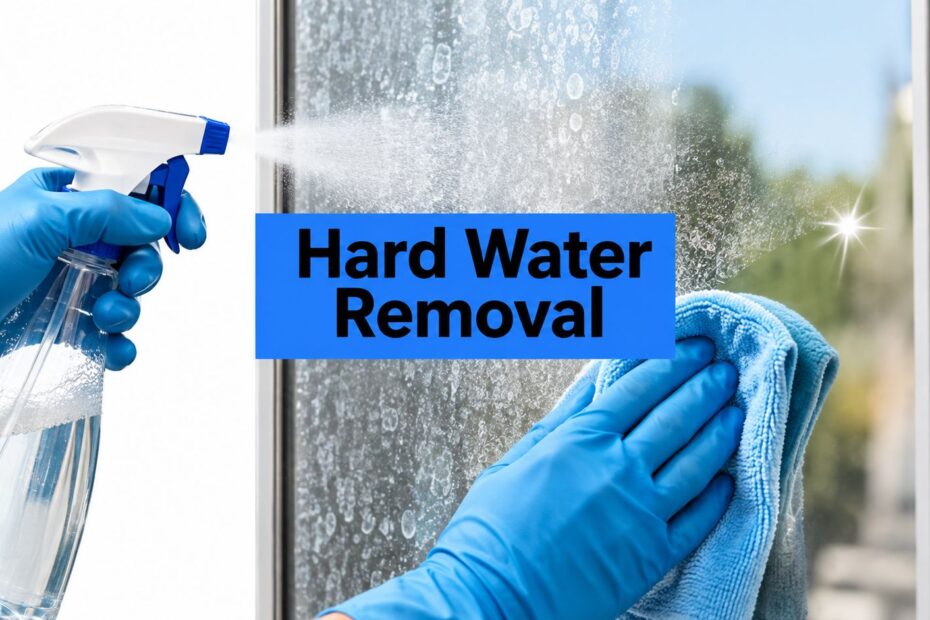
Diluted vinegar or a glass-safe mild acid can dissolve hard-water mineral film, but it won't reverse glass that's already etched. That's why homeowners in Phoenix, Scottsdale, Denver, and Las Vegas often need a professional crew to diagnose the mark before choosing a treatment.
You may be looking at sprinkler spots on a Scottsdale living-room window, a milky storefront pane in Denver, or chalky edges on a Las Vegas patio door. The instinct is to scrub harder or try a stronger cleaner. But the useful first question is simpler: is the residue sitting on the glass, or has the glass itself been etched? The answer determines what can work, what might cause damage, and when a window-cleaning professional should take over.
Why Your Windows Look Cloudy in the First Place
A cloudy pane can look dirty even after a careful wash. In a Scottsdale home, sprinkler overspray may dry across the glass and leave pale rings. A Denver storefront might have a milky film where rinse water repeatedly evaporated, while a Las Vegas patio door may show a chalky line along the bottom edge. These marks often aren't ordinary dirt. They're mineral deposits left behind by water.
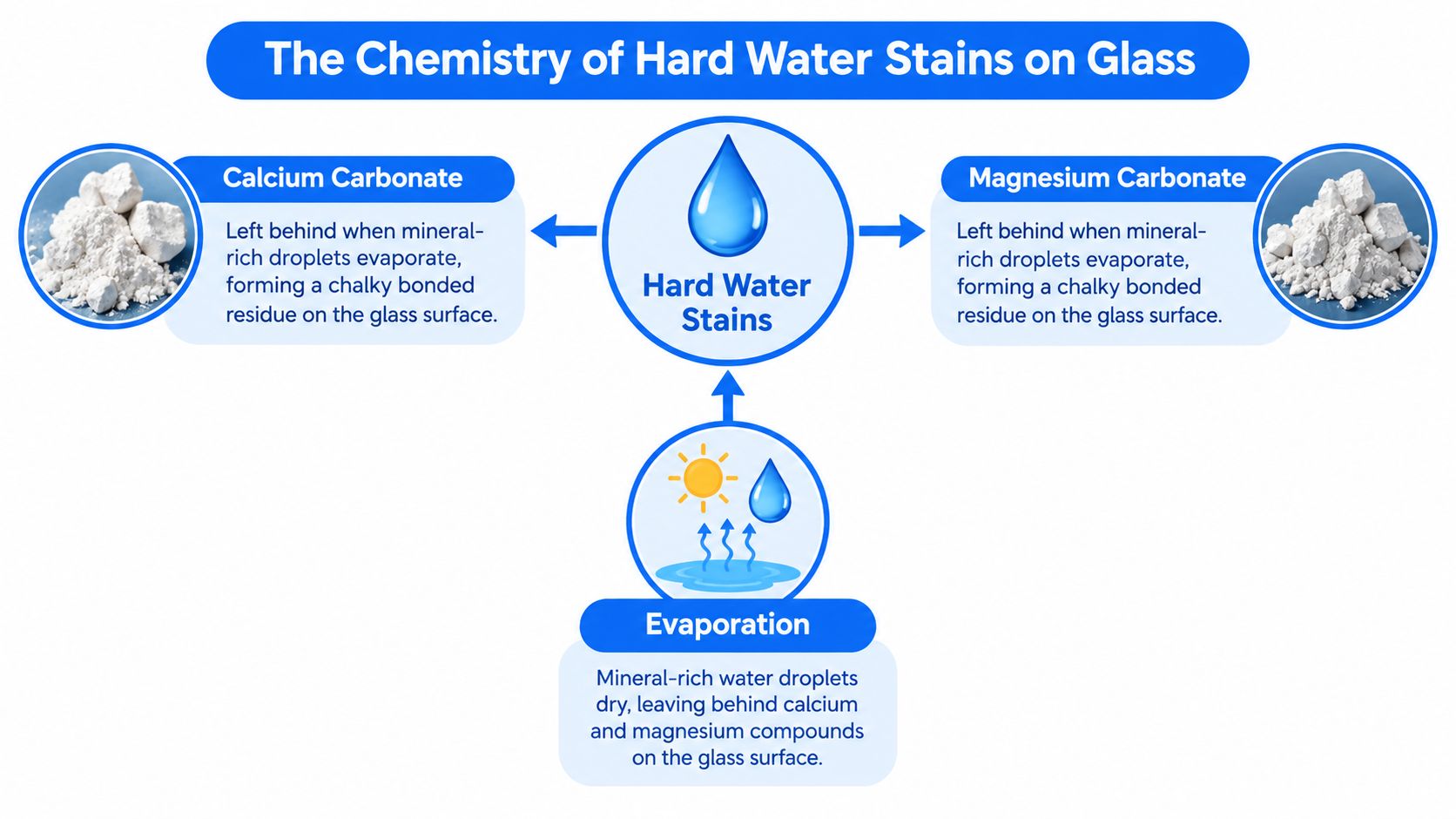
Water carries dissolved minerals, principally calcium and magnesium. When droplets land on glass and evaporate, the water disappears but the minerals remain. Repeated wetting and drying can build that residue into a film or crust that ordinary window washing won't lift.
Water hardness gives useful context. The U.S. Geological Survey classifies water above 180 mg/L as calcium carbonate equivalent as very hard and notes that very hard water can produce scale on pipes, boilers, tanks, and other surfaces. The same mineral-deposition mechanism helps explain cloudy windows. (USGS guidance on water hardness)
The stain may be on the glass, or in it
Mineral film sits on the surface and may respond to a compatible mild acid. Etching is different: prolonged exposure or harsh treatment can alter the glass itself, leaving microscopic pits that ordinary cleaning can't remove. A window can look cloudy in either case, so appearance alone doesn't settle the question.
Sun and repeated water exposure can make deposits more noticeable across Arizona, Colorado, and Nevada. The practical takeaway is to diagnose the mark before choosing a remover. A Phoenix, Boulder, or Henderson homeowner searching for what removes hard water stains needs to know whether there's a deposit to dissolve or etched glass that cleaning can't restore.
The Chemistry of Hard Water Stains on Glass
Hard-water residue isn't a loose layer of dust. Mineral-rich droplets dry on the pane, leaving deposits associated with calcium and magnesium. As the residue accumulates, it can bond to the surface and become chalky or crusted. That's why routine washing may take away dirt while the cloudy marks remain.
As noted above, USGS hardness categories explain regional differences. What those numbers can't tell you is what's on your glass. The practical question here is whether a mineral layer sits on top of the surface or the glass itself is etched. I've seen plenty of panes where the homeowner assumed heavy scale and the haze turned out to be permanent pitting from years of sprinkler overspray.
Why a mild acid can help
A weak acid can loosen carbonate-rich mineral residue, making it easier to rinse away. The University of Nebraska–Lincoln Extension identifies household vinegar, which contains roughly 4–8% acetic acid, as a weak acid that may remove hard-water deposits from glassware and other household surfaces. (University of Nebraska–Lincoln Extension guidance on vinegar and hard-water deposits)
That chemistry doesn't mean every cloudy mark will respond. A surface deposit may soften under a suitable acid; an etched pane won't become clear just because a stronger solution is applied. Chasing etched glass with harsher chemicals is where I've seen DIY jobs go wrong, since the stain stays put and the pane picks up fresh damage. For genuine mineral film, the goal is straightforward: loosen the residue, rinse it away thoroughly, and dry the glass before minerals in leftover water can settle back onto the surface.
A Pro-Grade Removal Workflow for Home Glass
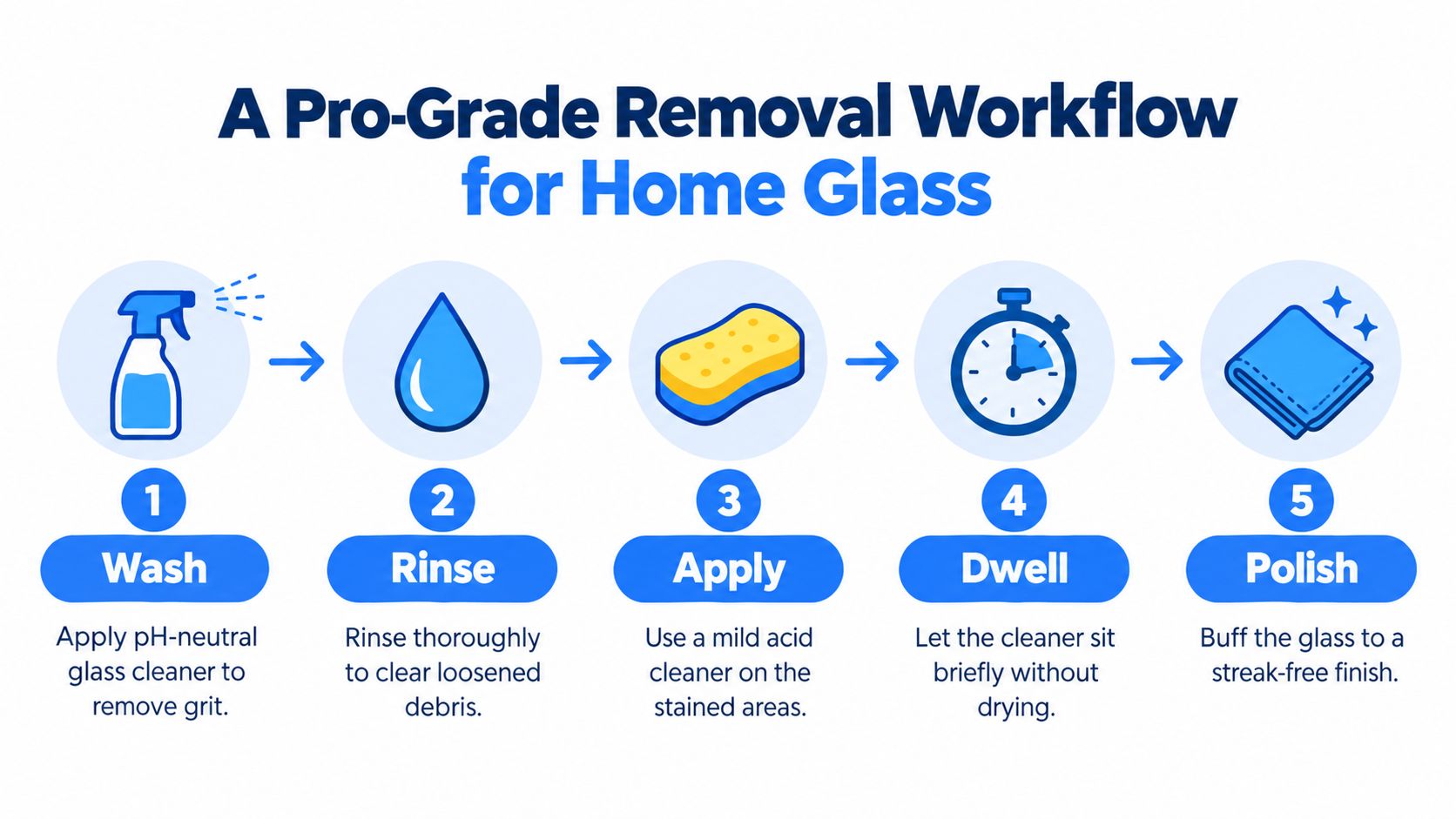
Start by washing the pane with a pH-neutral glass cleaner. The aim is to clear away grit and ordinary dirt so they don't scratch the glass during treatment or disguise the mark you're trying to assess.
Next, compare the glass wet and dry. If the haze fades or changes when the pane is wet, that's a useful sign the mark may be a surface deposit. If it looks unchanged, the glass may be etched and cleaning alone may not restore its clarity. (Industry guidance on wet-versus-dry inspection)
Test small, keep it wet, rinse fully
For a likely mineral deposit, spot-test a glass-safe weak acid on an inconspicuous area. Diluted vinegar is one option, but follow the product label and check compatibility with the glass and nearby materials. Keep the tested area visibly wet for the labeled dwell time. Don't let cleaner dry on the pane.
Gently agitate with microfiber or a white, non-scratch nylon pad. Use light pressure rather than trying to force the mark off. Rinse thoroughly with clean or purified water, then dry immediately with a professional squeegee and a clean microfiber pass. Leftover cleaner or loosened minerals can leave fresh spots as the pane dries.
For readers comparing hard-water marks across glass surfaces, the AVOTTO Mobile hard water spot guide offers a related look at spotting on vehicle paint. For window-specific solution choices and washing basics, see this guide to choosing a window-cleaning solution. The principle remains the same: identify the residue, use a compatible treatment, and rinse the surface clean.
Which Mild Acid Actually Fits Your Stain
I've watched homeowners burn a whole afternoon scrubbing a pane with vinegar when the haze turned out to be etched glass, something no acid will ever lift. So before you pick a product, get the diagnosis right. If the deposit is removable mineral film, start with the gentlest option that can do the job. Fresh, light buildup often responds to diluted vinegar. Older, thicker scale may call for citric acid or a formulated descaler, and each step up in strength raises the stakes for coatings, frames, and nearby surfaces.
Building on the Extension dilution guidance mentioned earlier, a 1-to-4 vinegar-to-water mix is the practical starting point, and that same guidance lists lemon juice and citric acid as workable alternatives.
| Option | Typical Strength | Best For | Watch Out For |
|---|---|---|---|
| Diluted white vinegar | Mild; follow the dilution ratio noted earlier | Thin, recent deposits and small test areas | Odor, limited bite on thick or aged scale, and possible incompatibility with adjacent materials |
| Citric acid mixed with warm water | Weak-acid option; follow the product's directions | A vinegar alternative when odor or material compatibility is a concern | Test first, keep it off sensitive finishes, and rinse thoroughly |
| Formulated phosphoric- or oxalic-acid descaler | Product-dependent, potentially more aggressive | Stubborn scale when the label specifically permits use on glass | Greater risk to coatings, metal, stone, frames, and seals if used incorrectly |
Match the treatment to the job
A shower pane with a small, recent haze is a reasonable candidate for a cautious mild-acid spot test. A thick, aged deposit spread across a large exterior window is a different job. Vinegar often won't deliver enough cleaning power there, and increasing the concentration or dwell time without a plan can harm adjacent materials.
Escalate in order. Vinegar first, then citric acid, then a formulated descaler only if the label allows glass. For a closer look at products built for shower enclosures, this guide to the best limescale remover for glass compares the options. Whatever you choose, read the label and test it in a discreet spot. Never mix an acidic cleaner with chlorine bleach. Take extra care around natural stone, anodized metal, tinted glass, hydrophobic coatings, and other specialty finishes.
One honest checkpoint: if a careful test changes nothing and the glass looks distorted rather than chalky, you're likely looking at etching. Chemistry has a ceiling, and recognizing it early saves the pane.
When DIY Stops Being the Right Call
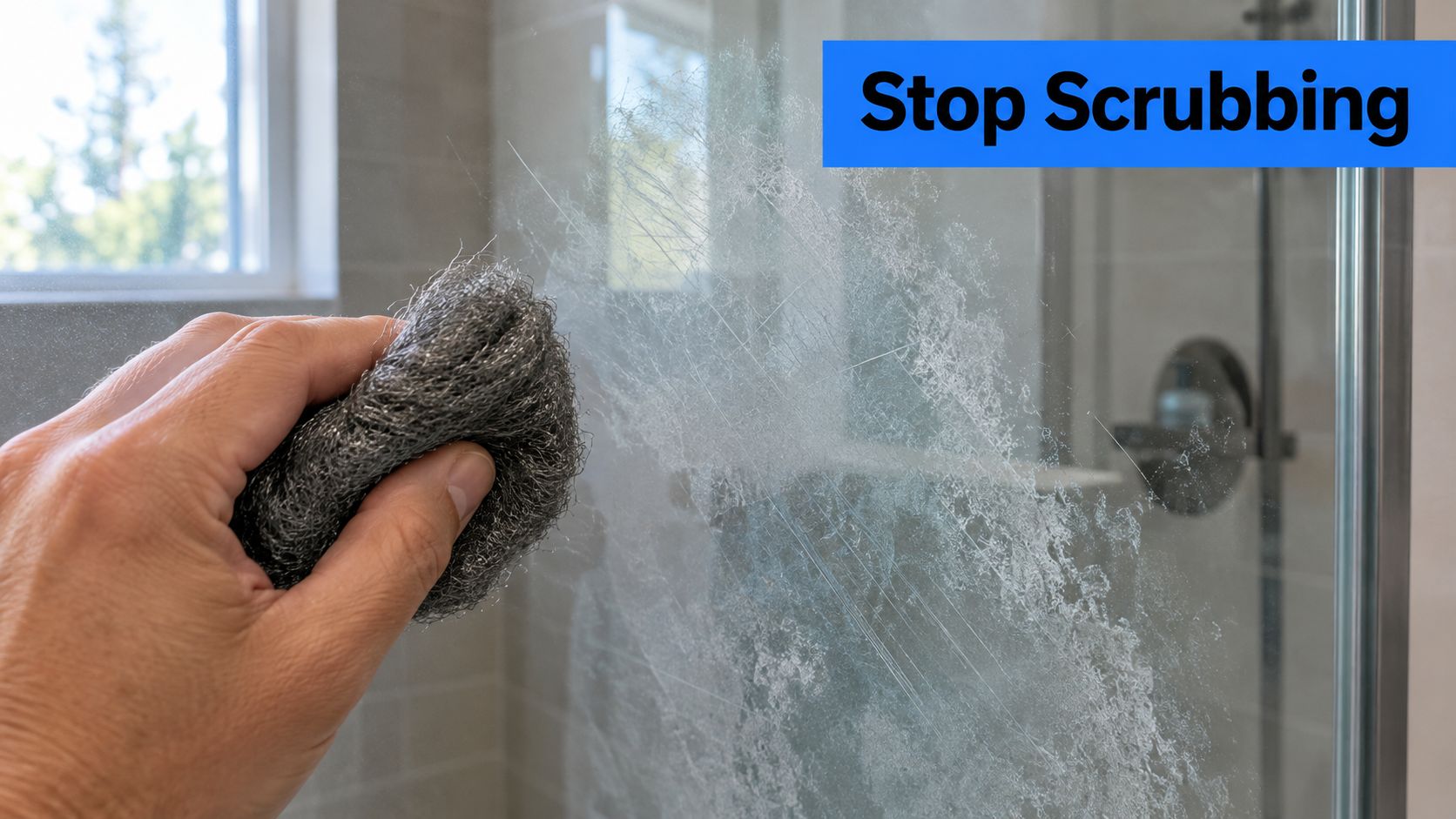
More force isn't a reliable fix for a mineral stain. Abrasive powders and steel wool can scratch glass, and uncontrolled razor scraping can leave permanent drag marks. Prolonged contact with acid may also damage low-emissivity or hydrophobic coatings and harm nearby metal or stone.
Know when to stop
If a careful mild-acid test doesn't change the haze and the glass looks optically distorted rather than chalky, stop escalating. More chemistry may damage the surrounding materials without restoring the pane. Persistent staining deserves an assessment by someone equipped to distinguish a removable deposit from an etched surface.
Access is another reason to call a professional. A homeowner shouldn't improvise from a ladder or reach out from an unsafe position to treat a stain. A trained window-cleaning crew can choose professional squeegees, ladders, water-fed poles, pure water, boom lifts, scaffolding, or rope descent systems to match the pane and the building.
That matters for multi-story residential glass in Phoenix and Tempe, high-rise and mid-rise façades in Denver and Las Vegas, and storefronts in Scottsdale, Boulder, and Chandler. What removes hard water stains depends on both the condition of the glass and whether the work can be done safely. If either the diagnosis or the access is uncertain, leave the treatment to a professional crew.
Prevention That Stops Spots From Coming Back
Removing a deposit doesn't prevent another one if mineral-rich water keeps reaching the same pane. A useful prevention plan looks at the source of the water, how long it sits on the glass, and what happens during the final rinse.
Control the source
In Phoenix and Scottsdale, adjust sprinklers so they don't spray windows. For a commercial façade in Denver or Las Vegas, check whether recurring marks line up with cooling-tower drift, construction rinse water, or another repeated source. If a stain pattern returns in the same place, investigate what is wetting that area before reaching for a stronger cleaner.
For property managers in Boulder, Glendale, or Laughlin, a simple maintenance log can help. Record the water source, weather, affected panes, cleaning date, and how soon the spots return. That record can reveal whether a particular watering cycle or maintenance activity is creating the problem.
Control drying and the rinse
Keep the glass wet during an appropriate short treatment dwell, then rinse with low-mineral or purified water. Squeegee or dry the pane before evaporation leaves fresh residue. A professional crew follows that logic as part of the wash, using tools and technique suited to the size and location of the glass.
USGS explains that pure-water cleaning reduces the dissolved mineral residue in rinse water, leaving less mineral material available to dry back onto the glass. (USGS discussion of pure-water cleaning and mineral residue) Water-fed poles and pure-water systems are useful maintenance tools for exterior glass because the rinse itself contributes fewer dissolved minerals. For a homeowner considering hose-based washing, this guide to cleaning windows with a hose provides related context, though professional pure-water equipment is a different system.
Water treatment may also be part of a broader plan, depending on the property and water supply. For background on that separate plumbing decision, see information about water softener installation in San Antonio. On the glass itself, source control, timely drying, and a low-mineral final rinse help address why spots return instead of only treating the same marks again.
Why a Professional Crew Solves It for Good
When the deposit is thick, the glass may be etched, or the window sits above safe reach, a professional assessment can prevent a failed DIY treatment from becoming a damaged pane. A trained crew can wash with professional squeegees, use water-fed poles and pure water for the rinse, and select access equipment to suit the building. Professional Window Cleaning also offers hard-water stain and mineral-deposit removal as an add-on restoration service using specialized compounds and polishing tools.
The access decision is an engineered safety choice, not a matter of convenience. ANSI/IWCA guidance says rope-descent descents generally shouldn't exceed 300 feet (91 meters) above grade unless another access method can't safely and practically reach the windows. It calls for heightened precautions above 130 feet (40 meters), including attention to wind, suspension time, line movement, and prompt rescue capability. (ANSI/IWCA rope-descent guidance)
Boom lifts have requirements too. OSHA says operators must test lift controls before each day's use, remain firmly on the basket floor, and use the required body belt and lanyard attached to the boom or basket. (OSHA aerial-lift requirements) Property owners can learn more about why to hire a professional window-cleaning company when height, stain condition, or glass type makes DIY treatment a poor risk.
Professional Window Cleaning serves Phoenix, Scottsdale, Tempe, Chandler, Paradise Valley, Glendale, Flagstaff, Denver, Boulder, Arvada, Westminster, Erie, Commerce City, Golden, Las Vegas, and Laughlin. Explore service options for Phoenix, Scottsdale, Denver, or Las Vegas.
If hard-water film is clouding your windows, contact Professional Window Cleaning for a fast quote and help deciding whether the glass needs stain removal, routine washing, or a safer access plan. Schedule online and ask the crew to assess the panes before anyone applies stronger chemicals or abrasives.