




You're standing in front of a storefront at 7 a.m., bucket ready, and your squeegee is leaving a thin line of water on every pull. The glass isn't the problem. The blade edge is nicked, the channel is too wide for the mullion bays, and your tech has to go back with a detailing towel on every pane. By the third shop on the route, you're behind schedule and the sun's already climbing over the facade.
That's how most crews learn the important lesson about picking the best commercial window squeegee. It isn't about finding one tool that wins a demonstration. It's about matching width, blade, and handle to the glass, the access method, and the cost of finishing the job without rework. A squeegee that cuts ladder moves and rewets in Phoenix heat will beat a faster tool that forces extra passes. The same logic holds for a pole route in Denver or a lobby wall in Las Vegas.
If you're buying for a crew, a building, or your own route, start with the job in front of you. Then pick the tool that lets your tech pull clean, predictable strokes, change rubber fast, and stay in a safe working position.
Quick Picks for Storefronts, Mid-Rise and High-Rise Crews
Match the squeegee to the access method and the cost of finishing the job, not to blade brand or sticker price.
For most storefront and office routes, I'd start with a 14 to 18 inch channel, a replaceable natural rubber blade, and a rigid metal channel. That width covers standard panes with few overlap passes and keeps detailing at the frame short. If the crew needs a working sequence for that glass, how storefront routes are cleaned pane by pane shows where the tool sits in the routine.
Width follows the pane. Access follows the building. A wide channel that looks fast in a parking-lot demo costs time if the tech climbs down, shifts a ladder, or rewets a missed edge.
Large plate glass wants a 20 to 24 inch wide-body channel with rear clips so the rubber stays even across a long lobby stroke. Divided lites go the other way. A compact 10 to 12 inch tool stays controllable in narrow bays where a bigger channel rides the frame and leaves water in the corners.
Recommended Squeegee by Job
| Job | Channel width | Blade and handle | Why it fits |
|---|---|---|---|
| Storefront and office panes | 14-18 inches | Replaceable natural rubber blade, metal channel, short handle | Matches most pane widths with few overlap passes |
| Large plate glass and lobby glass | 20-24 inches | Wide-body channel, rear clips, reinforced rubber | Fewer passes across uninterrupted glass |
| Divided lites and tight mullions | 10-12 inches | Compact channel, quick-change blade | Easier control in narrow bays |
| Mid-rise crews on pole systems | 14-18 inches | Quick-lock channel, pole-compatible handle | Reduces ladder time and repositioning |
| High-rise and atrium glass | 12-18 inches | Lightweight stainless channel, pole adapter | Keeps tool weight low for reach work |
| Ground-level retail frontage | 18-24 inches | Stainless steel channel, long handle | Balances speed with corrosion resistance |
Specific sizes make those bands usable. A 12-inch professional stainless-steel model weighs about 0.4 pounds and includes a quick-lock channel and pole compatibility, according to the Global Industrial product listing. That weight suits compact bays and pole work, where extra ounces show up in the shoulders over a full elevation. An 18-inch stainless channel with professional rubber is a sensible default for storefront panes. On light routes where tools get damaged or lost, a cheaper 12-inch squeegee is often the right call. Replacing it costs less than slowing the route to protect a premium head.
Mid-rise and high-rise picks turn on weight, connection, and how often the tech resets. Standardize on a pole-compatible handle and a quick-lock mechanism so one head covers hand work and extension work without spare adapters in the truck. The head that cuts ladder moves and rewetting usually beats the one that finishes a single pane fastest. At ground level, stainless steel earns its place because it handles daily wet use without corroding in the bucket.
Treat the table as a shortlist, not a fleet order. Trial two candidates on one of your own panes, in your own sun and wind, before you buy for every truck.
Blade Materials and Channel Designs That Matter
Think of a squeegee as a system, not a strip of rubber. A rigid holder stabilizes a resilient blade, and that blade pulls water and suspended soil off the glass in one controlled pass. If the holder flexes, pressure wanders. If the blade can't conform, water escapes under the edge.
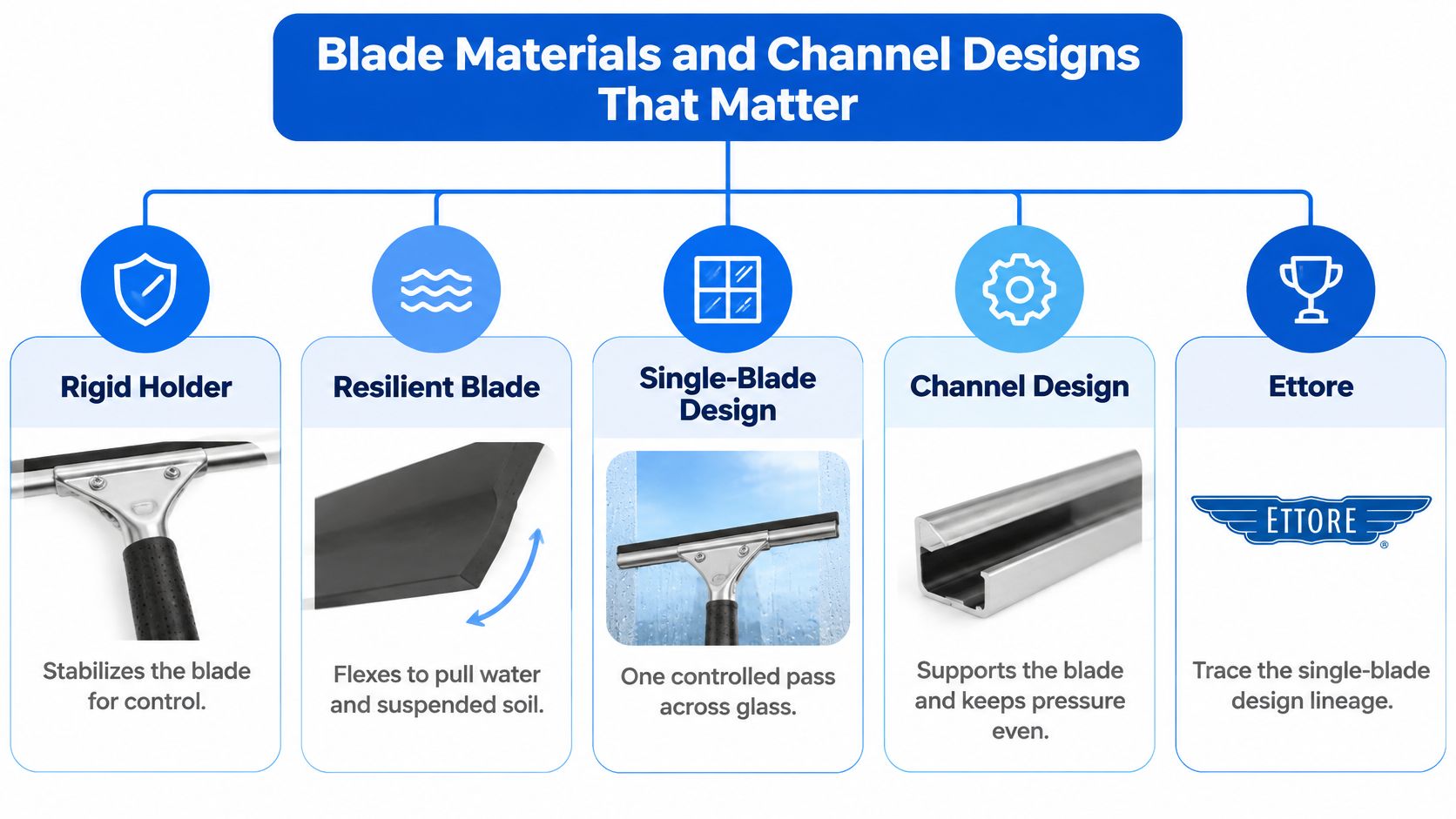
That architecture isn't new. The Wikipedia history of the squeegee traces a major milestone to 1936, when Ettore Steccone patented a lightweight, single-blade design that combined a brass channel with a flexible rubber wiping edge. Earlier Chicago designs used two heavy blades and required loosening 12 separate screws to change them. Steccone's design established principles that still define professional tools, including controlled blade pressure, a consistent contact angle, low weight, and rapid blade replacement.
Channel Metals in Daily Use
Brass has a traditional, balanced feel that many experienced techs like for hand work, but it needs more care to look and perform its best. Stainless steel is the safer standard for wet commercial routes because it resists corrosion when tools live in buckets and truck beds between stops in Scottsdale, Tempe, or Glendale. Plastic channels keep cost and weight down for light-duty or training kits, though they don't give you the same rigid support on long pulls.
Don't buy the widest channel hoping rigidity will solve technique. A durable channel, balanced handle, and predictable flex help a tech repeat the same angle and pressure across storefronts, offices, and large panels.
Blade Materials Compared
| Blade material | Feel on glass | Durability | Best use |
|---|---|---|---|
| Natural rubber | Soft, conforms well to flat glass | Tears and nicks sooner under heavy use | Hand work on routine clean glass |
| Silicone | Firm, slides cleanly | Good heat and wear resistance | Sun-exposed facades and daily routes |
| PVC | Stiff, holds its shape | Lower cost, less flexible | Light-duty and training kits |
| Neoprene | Dense, steady wipe | Good tolerance of oils and solvents | Glass near oily or chemical-exposed areas |
Material name matters less than edge condition. Nicks, curled ends, or hardened rubber create repeating streaks on any channel, and no handle upgrade fixes a damaged edge. Heat also changes the choice. On sun-exposed facades in Phoenix, Chandler, and Las Vegas, a firmer blade often holds its edge better during fast work, while softer rubber can feel smoother on cooler, shaded glass in Flagstaff or Boulder.
That's why replaceable blades are the feature I'd protect in any budget. Your crew renews the wear part, keeps a channel they already trust, and gets back to work without replacing the whole tool.
Channel Width and Handle Systems Matched to Glass
Channel length should follow the pane rather than the brochure.
Professional channels span approximately 5 to 36 inches, with 12 to 18 inches suited to general storefront and office panes and 20 to 36 inches suited to large plate-glass surfaces, according to the Quicksilver professional squeegee listing on Amazon. Matching length to pane width reduces overlap passes and water left at frame edges. Oversized channels become harder to control on divided lites, narrow mullion bays, and residential glass.
Practical rule: A wider channel saves passes on plate glass but costs control on divided lites, so width should follow the pane.
The Four Width Bands
- 10 to 12 inches: Use this for tight sections, entries, and mullion bays where a small head lets the tech turn cleanly without bumping frames.
- 14 to 18 inches: Make this your route standard for storefront and office panes, since it balances coverage and steering on most commercial glass.
- 20 to 24 inches: Reserve this for uninterrupted storefront and plate glass where fewer passes mean fewer overlap lines to detail.
- 30 to 36 inches: Limit this to expansive lobby walls, because tool weight and two-hand control become the constraint before width helps you.
A practical kit doesn't need every size. I'd carry a mid-size head for daily work, a compact tool for divided glass, and one larger channel for uninterrupted panes. That covers a strip mall in Paradise Valley, an office park in Westminster, and a hotel entry in Laughlin without forcing one tool into the wrong bay.
Handles, Grips, and Retention
Look for an ergonomic non-slip grip, a quick-lock channel, and verified pole compatibility if your crew works above hand height. A lightweight stainless model reduces arm fatigue during pole work, and a secure lock prevents the channel from shifting when the tech changes angle at the top of a stroke.
Wide-body channels spread pressure more evenly across the rubber, which promotes a smoother glide on large panes. Rear clips and a retaining pin matter for the same reason. They keep the rubber from sliding sideways during long strokes, so the ends don't drag, curl, or leave a wet tail at the frame. Before standardizing a fleet, test the exact handle and channel on your telescopic pole, not a showroom substitute.
Use Cases for Contractors, Building Owners and High-Rise Access
Buy by buyer and access method, not by product photo. Our commercial work covers office buildings, businesses, hi-rise buildings, retail storefronts, strip malls, and hotels, and each setting pushes the tool choice in a different direction.
Contractors on Ground and Mid-Rise Routes
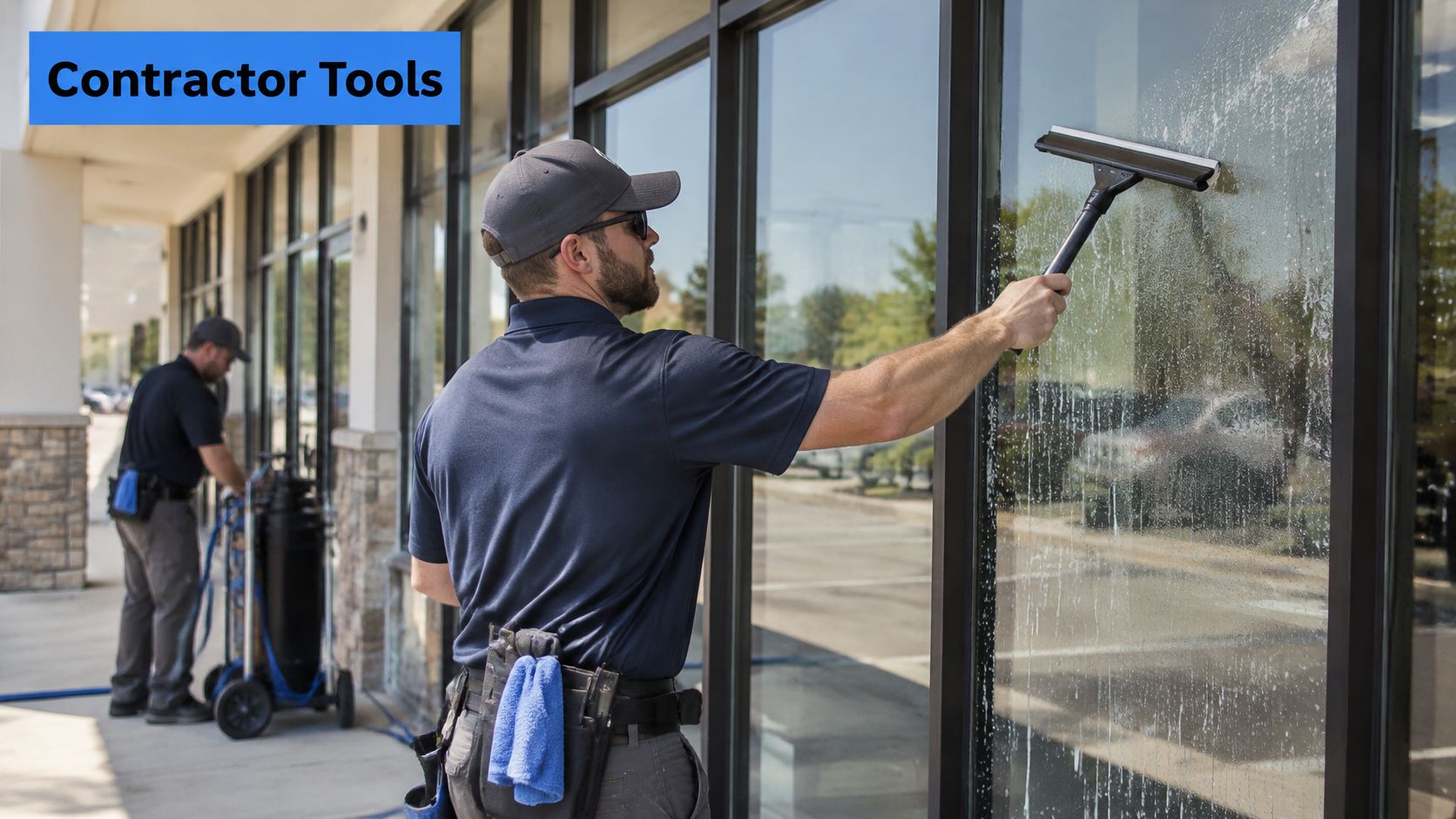
Storefront contractors in Phoenix, Scottsdale, Tempe, and Chandler mostly need a 14 to 18 inch head on a short handle, a 20 to 24 inch head for plate glass, and a compact tool for doors and divided entries. The same kit serves Arvada, Golden, and Erie, where wind can dry solution before the pull is finished and reward a clean edge over extra width. For managers comparing the broader kit around the squeegee, our overview of exterior access and cleaning equipment explains how poles, lifts, and pure water systems fit together.
Mid-rise work changes the priority. The platform sets the handle length, so the squeegee must lock securely to the pole or work comfortably from a lift basket without forcing the tech to lean. OSHA's scaffolding and aerial lift guidance states that only trained and authorized workers may operate aerial lifts, workers must use a body harness or restraint with a lanyard attached to the boom or basket, and operators should set brakes and use outriggers when provided. It also warns against using planks, boxes, or other devices to extend reach above the basket floor. Choose the handle to fit the approved position, never to stretch beyond it.
Ladder work carries the same discipline. Maintain three points of contact, keep loads balanced, and keep metal ladders clear of overhead electrical lines. If a lighter squeegee or a pole-compatible head lets a tech work from a secure position with fewer repositioning moves, that's a safety feature, even if a heavier tool feels faster on the ground.
High-Rise and Owner-Managed Buildings
Rope descent changes planning before anyone touches glass. OSHA's rope descent standard at 1910.27 requires the building owner to provide written confirmation that each anchorage has been identified, tested, certified, and maintained to support at least 5,000 pounds (2,268 kg) in any direction for every attached employee. OSHA also limits rope descent use above 300 feet unless the employer demonstrates that other access methods are infeasible or create a greater hazard. A lightweight, secure squeegee matters on rope, but anchors, training, and the access plan decide whether the job should happen at all.
Building owners in Denver, Boulder, Commerce City, and Las Vegas sometimes buy tools for in-house touch-ups. That's reasonable for ground-level interiors, provided the crew isn't improvising access. Solution choice matters there too, especially on industrial glass where soil and coatings vary, and managers comparing that side of the process can review choosing foam formulations for industrial glass from Material Handling USA before they change chemicals across a property.
Containment is part of the use case. On a Scottsdale commercial job, we used drop cloths and mops to contain water and protect the Venetian plaster walls and window ledges. The best commercial window squeegee won't protect finishes if the crew doesn't control runoff.
Cost Per Job, Not Just Price Per Tool
Sticker price is the easiest number to compare and the least useful one.
Global Industrial lists an O-Cedar Commercial 12-inch window squeegee case of 12 at $100.80, or $8.40 each, in 2026. That's cheap to buy. It tells you nothing about how long the edge stays clean, how many rewets your tech needs, or whether the tool fits the pole your crew already owns.
Five Lines That Set Cost Per Job
- Replacement rubber: Price the blade and track how often your route forces a change, not how long the package implies it'll last.
- Water hauled and used: Extra solution means heavier buckets, more trips, and more runoff to contain around entries and interiors.
- Detailing cloths: Count laundering or disposal, because a squeegee that leaves wet edges creates towel work on every pane.
- Chemical use: Measure concentrate per route, especially when crews add more solution to compensate for a dragging blade.
- Labor time: Watch rewets, extra passes, and ladder or lift repositioning, since minutes at height cost more than minutes at a storefront.
Here's an illustrative example, not a benchmark. Say a low-priced tool needs fresh rubber every week on a gritty route, while a pricier channel holds a clean edge for the full month with the same care. The cheaper tool can cost more in rubber, downtime, and detailing before the month ends. Reverse the conditions on a light interior route, and the budget tool may win because edges stay clean and replacement is painless.
System choices change the arithmetic too. A Sustainable Hospitals Project study summarized by CleanLink reported that microfiber systems reduced daily water use from 21 gallons to 1 gallon and chemical use from 10.5 ounces to 0.5 ounces in a comparable cleaning application. Those figures aren't a window squeegee benchmark, so don't claim a specific squeegee will reproduce them. They do show why you should measure the whole method, including microfiber detailing, purified water, bucket size, and transport, instead of ranking a handle in isolation.
Commercial pricing follows the same logic. Residential window cleaning is priced per pane of glass, while commercial buildings have far more pricing factors, including access, pane size, soil, and schedule. Buy on cost per finished job, and let the cheapest squeegee win only when it still leaves clean edges and fits the approved access method.
How to Maintain Blades and Replace Them on Time
A tech finishes the first bay of a mid-rise and watches the same line return on every pull. The channel is fine. The edge is not. A sharp edge maintained daily will outperform a premium blade that crews abuse for a month. Keep the routine short enough that techs will do it at the truck. On a ladder, boom, or rope, a second pass costs more than a strip of rubber. On a ground-level storefront, I would still run a sound edge until one controlled pass fails, because replacement is cheap and access is not the bottleneck.
The Daily Routine
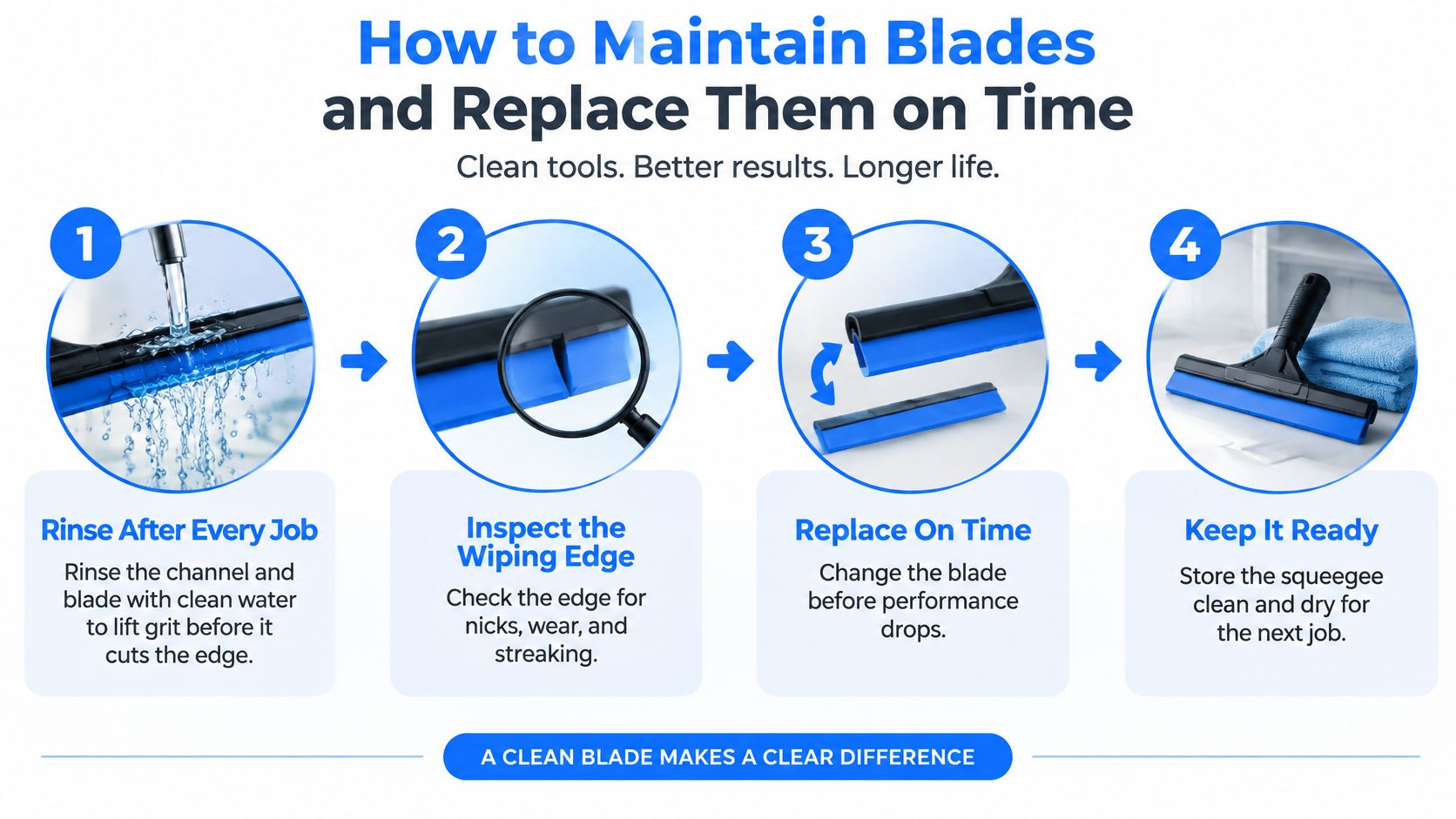
- Rinse after every job: Rinse the channel and blade with clean water to lift grit before it cuts the edge. Desert dust in Phoenix and Las Vegas is abrasive, and dragging it across the next pane can leave both a streak and a damaged blade.
- Inspect in good light: Run your eyes along the wiping edge for nicks, curl, flat spots, or hardening. A flawed edge is the most common reason a tech sees the same line repeat on every pull.
- Check retention: Confirm rear clips are tight and the blade doesn't slide in the channel. Rubber movement changes pressure at the ends, so the center may wipe clean while the corners stay wet.
- Replace when one pass stops working: Change the blade when it no longer wipes clean in one controlled pass, and match the new rubber to the channel length. Hillyard lists the Rubbermaid Commercial replacement squeegee blade as 14 inches wide, so confirm length before ordering a case for mixed channels.
- Store hanging: Hang the tool or protect the edge instead of resting it on the blade in a bucket. Resting pressure creates flat spots that show up as chatter on the next morning's first pane.
Detailing tools deserve the same discipline. Clean, absorbent towels catch the frame water a squeegee can't remove, and our guidance on choosing and caring for window washing towels helps crews keep that finishing step from undoing a clean pull. A wet corner that needs extra wiping on every pane stretches a lift cycle the same way a dull blade does.
Replace rubber on evidence, not on the calendar alone. One missed nick can turn a fast route into a detailing route.
Close the loop with a blade log in each truck. Record the date, channel size, blade material, and job count when a blade goes on and when it comes off. After a few routes in Glendale, Denver, or Flagstaff, you'll see which material survives your soil and temperature, which techs need a refresher on angle and pressure, and when a channel is bending rubber instead of supporting it. That record turns replacement from guesswork into a purchasing pattern you can price against the access method the job uses.
Confirm Your Squeegee Shortlist Before You Buy
Run a trial that resembles your route, not a clean showroom pane.
First, measure the three most common pane widths on the job and match each one to a channel band. Include the awkward door lite and the wide lobby panel, because those extremes reveal whether you need a compact head or a wide-body channel in the same kit.
Second, test two candidates on the same sample pane. Make five passes with each, then check for repeating lines, wet corners, rubber movement, and how much detailing the edge still needs. Swap in fresh rubber if one tool starts with a damaged edge, or you'll reject a good channel for a bad blade.
Third, confirm pole compatibility and the access plan. Lock the exact head to your extension system, work at the intended height from a safe test position, and verify that lifts, ladders, scaffolding, or rope systems match the building's rules. If the job involves high-rise glass, rope descent, or multi-story facades, don't standardize tools for in-house work as a substitute for trained access. Professional Window Cleaning offers Windows Cleaning, High Rise Windows Cleaning and Commercial Window Cleaning Services, is licensed and insured, and is committed to 100% satisfaction for commercial window cleaning, so we can scope work that shouldn't be improvised.
Make three decisions this week:
- Choose the width band: Match it to your most common panes and add only the second size your route needs.
- Pick the blade material: Favor edge life in your heat, soil, and chemical exposure over the softest feel in hand.
- Run the cost-per-job test: Count rubber, towel work, rewets, and minutes saved before you order for the fleet.
If your next job needs more than the right squeegee, from storefront and mid-rise glass to high-rise rope descent work across Arizona, Colorado, and Nevada, our licensed and insured crews can scope the access method and deliver streak-free commercial results. Visit Professional Window Cleaning to request a quote and put your panes on a dependable cleaning schedule.