



Can you polish glass without creating a bigger problem than the scratch itself? That's the question many homeowners skip when they reach for an online polishing kit. A mark may look like a cleaning issue, but removing it can involve taking away the glass surface, affecting coatings, creating distortion, or damaging an insulated unit.
Professional window cleaning starts with a different priority: identify what's on the glass, determine whether the pane is ordinary, tempered, coated, or sealed, then choose the least aggressive method that can restore clarity. Polishing has a legitimate place in glass restoration, but it isn't a universal cure for damaged windows.
Why Polishing Glass Is Usually a Trap
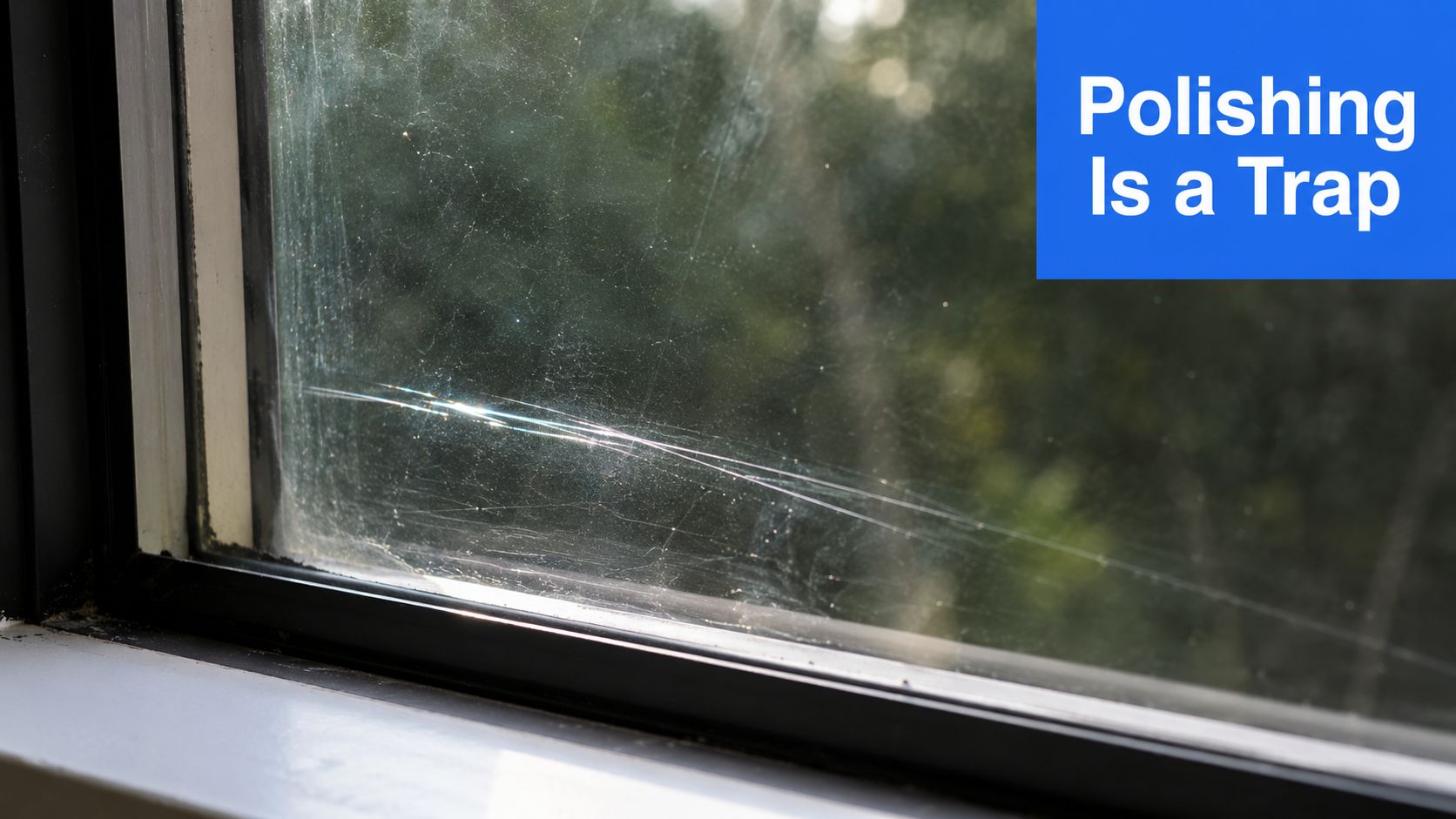
The internet often treats polishing as if glass were automotive paint. Apply compound, buff the area, and the scratch disappears. That comparison is misleading. Glass polishing removes material around the defect until the surface is level again, so the process changes the actual pane rather than just covering or smoothing a finish.
Glass can certainly be polished. The practice reaches back to Mesopotamia and ancient Egypt, where workers used abrasives such as sand, pumice, and emery. A formal plate-glass polishing process developed in France in 1688, and the French system was adopted in England by 1773. By 1800, steam engines powered grinding and polishing tables for plate and cast glass, moving the work from hand labor toward mechanized production. The history is documented in this reference handbook on the history of glass polishing.
That history proves the technique is real. It doesn't prove that a homeowner should polish a modern window in place.
The surface is the asset
A polishing pad can remove the scratch, but it can also create a shallow depression or an uneven transition around it. The result may be a visible lens effect, especially when sunlight, reflections, or interior lighting cross the treated area. On a large pane, a small distortion can be more distracting than the original mark.
Practical rule: If the defect catches your fingernail, or if you can see it changing shape as you move your head, don't assume a small consumer kit will correct it safely.
Polishing also becomes risky when the pane contains a factory coating or belongs to a sealed insulated glass unit. A homeowner may be trying to repair one surface mark while compromising a coating, edge seal, or the visual uniformity of the entire pane. For valuable residential and commercial glass, an assessment is cheaper than experimenting on the asset.
The Chemistry of Glass Removal
Professional polishing compounds usually contain cerium oxide, often called CeO2. The abrasive works mechanically, like extremely fine sanding, while also interacting chemically with silica in the glass. That combination helps a polishing system remove and refine the surface instead of merely hiding the defect. The chemistry and the mechanical action are described in this published study of glass and silica polishing processes](https://pmc.ncbi.nlm.nih.gov/articles/PMC12692836/).
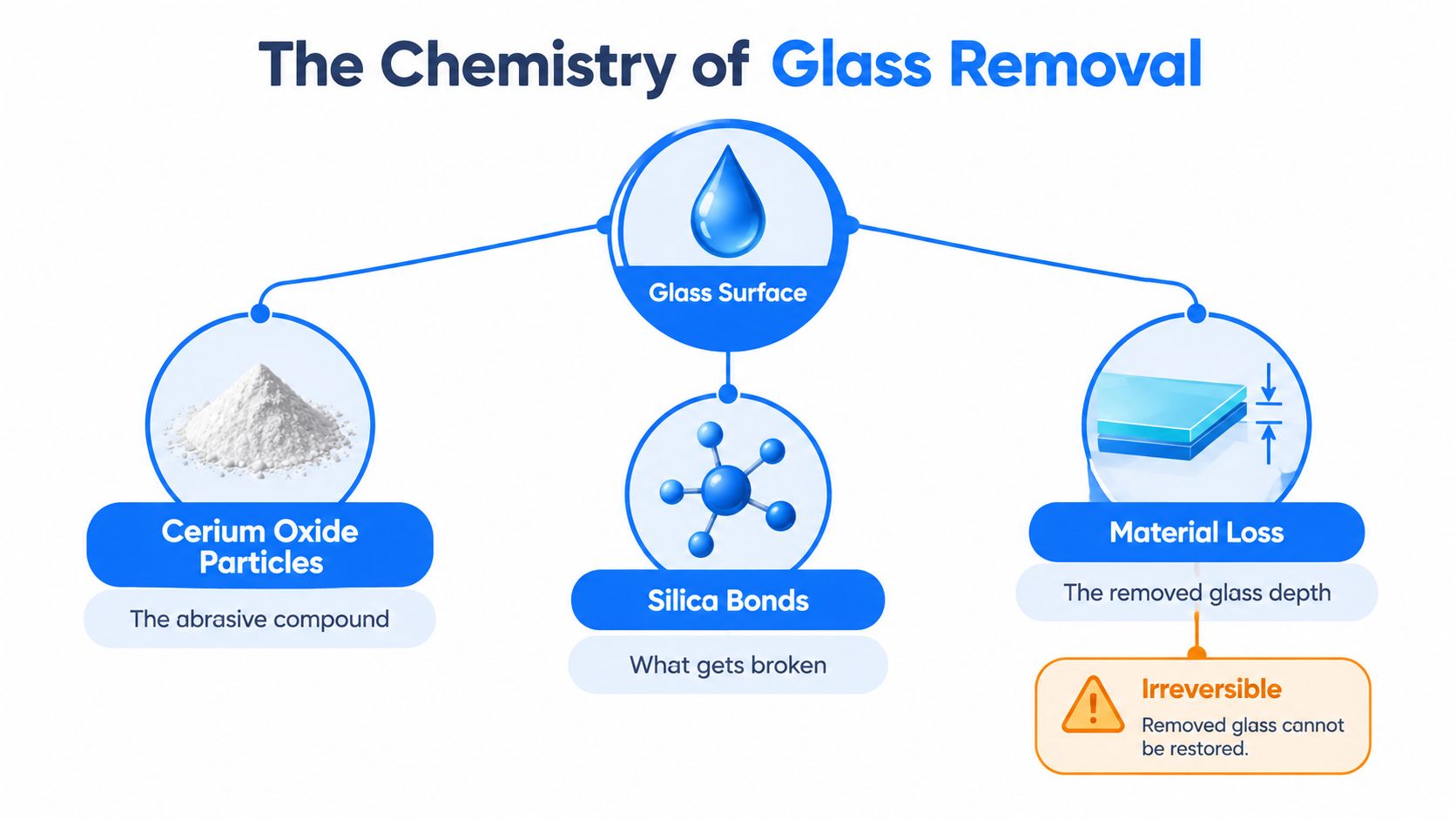
A professional operator controls several variables at once:
- Abrasive particle size determines how aggressively the slurry cuts.
- Pad topography controls the contact pattern across the pane.
- Process chemistry affects how the abrasive interacts with silica.
- Pressure and movement influence whether the repair stays uniform or develops optical distortion.
The objective isn't to grind harder. It's to remove only enough surrounding glass to reach the bottom of the defect, then refine the area to a smooth finish. If the scratch is deep, the surrounding material must be lowered farther. That's where the repair can become uneconomical or visually unacceptable.
Why coatings change the decision
A Low-E coating, a sealed double-pane assembly, or a tempered pane isn't just a thicker version of ordinary glass. The coating may sit on a specific surface, while the insulated unit depends on seals that keep the space between panes functioning properly. Abrasive work on the wrong surface can damage the coating or disturb the seal.
A laboratory polishing result doesn't transfer automatically to a residential window. High-quality optical or fused-silica samples can be polished to exceptionally smooth surfaces under controlled conditions, but field glass has different shapes, coatings, access limitations, and finish expectations. The practical question is not only “can the compound remove glass?” It's “can the operator remove the defect without leaving a noticeable optical or functional problem?”
What Can Actually Be Removed
Before deciding whether to polish, identify whether the mark is on the glass or in the glass. A Phoenix home near a pool is a useful example. Calcium and other mineral residue from repeated water exposure can form a chalky film that looks like a scratch from a distance. If the surface is clean and the mark changes or disappears when wet, you may be looking at buildup rather than a cut in the pane.
That distinction matters because mineral deposits may respond to a careful restoration process, while a true scratch requires controlled material removal. For another practical explanation of surface buildup, see this guide on how to get rid of chalky window haze. You can also compare appropriate cleaning methods in this resource about how to get water spots off windows.
Three useful damage categories
Mineral deposits sit on top of the surface. Hard-water spots, sprinkler residue, and calcium haze may be removable without polishing the glass itself, provided the treatment matches the deposit and doesn't introduce abrasive scratches.
Light haze or shallow etching may be a candidate for professional polishing. Etching can occur when minerals or chemicals remain on the surface and alter the finish. The operator still needs to test a small area and check whether the pane has a coating.
True scratches require more caution. Light superficial scratches may be correctable when enough surrounding glass can be removed without creating distortion. Deep scratches, gouges, cracks, chips, and damage associated with a failed sealed unit aren't ordinary polishing jobs.
Modern glass polishing is generally effective for scratched or dulled glass when the problem is confined to the surface. One restoration source reports that removing scratches from 1/4-inch glass can reduce thickness by only about 2% even under heavy polishing, but that figure doesn't guarantee an acceptable result on every pane. The depth, location, coating, glass type, and required finish still control the decision. See the technical discussion of glass sanding and polishing for the limits of surface restoration.
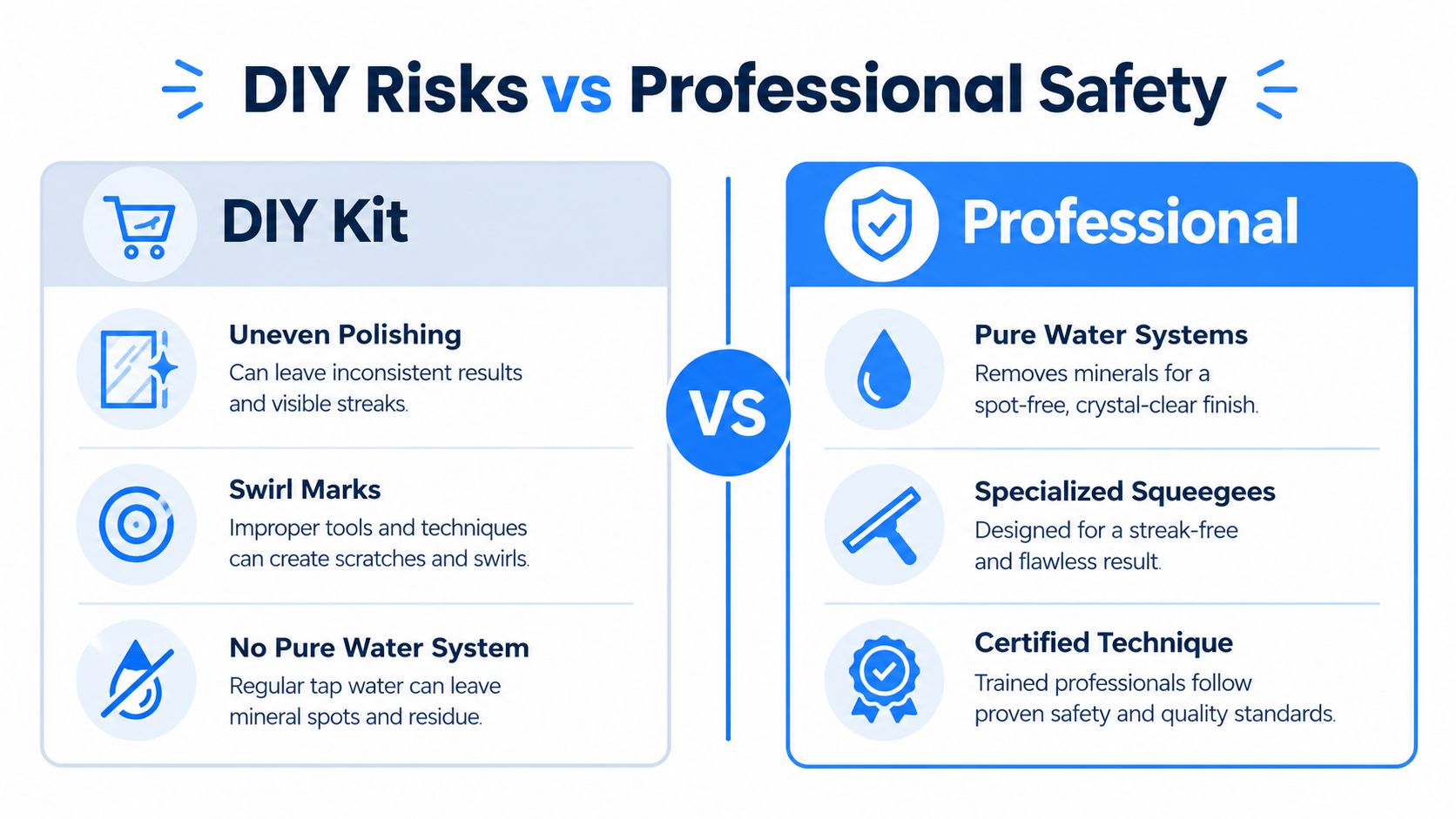
DIY Risks vs Professional Safety
An online kit can make glass polishing look simple because the visible steps are simple: mix compound, attach a pad, and work the mark. The difficult part is judging the pane and controlling the process. A drill-mounted pad can remove material unevenly, build heat in one area, or leave a swirl pattern that becomes obvious when daylight crosses the window.
Arizona adds another concern: thermal shock. Pouring cold water onto hot glass, or rapidly heating a small area with friction, creates uneven temperature stress. That doesn't mean every temperature change will break a pane, but it does mean aggressive DIY work can add risk where the homeowner may not see the stress developing.
Professional window cleaning also prevents many conditions that tempt owners into polishing. Crews use pure-water systems, specialized squeegees, ladders, boom lifts, scaffolding, rope descent systems, and water-fed poles according to the access problem. Proper washing removes abrasive grit and mineral residue before technicians decide whether a mark is damage.
Coated and tempered glass need a separate decision
Advice about polished glass on coated and tempered panes is divided. Some guidance allows for light surface-scratch treatment, while other trade advice warns that tempered glass can't be significantly repaired and that Low-E or sealed double-pane surfaces shouldn't be polished because the coating or seal may be damaged. The distinction between ordinary glass, tempered glass, and coated insulated glass units is covered in this trade discussion of scratches in glass.
| DIY polishing kit | Professional assessment |
|---|---|
| Uneven pressure can create distortion | The technician evaluates glass type and damage |
| A pad may leave swirl marks | Specialized tools support controlled finishing |
| The coating may be damaged unknowingly | Coated and sealed panes receive separate consideration |
| Heat and water changes may stress the pane | The work is planned around site conditions |
Don't treat exterior washing as pressure washing. High-pressure water can force contaminants into seals, damage screens, or drive water where it doesn't belong. Review this explanation of whether you can pressure wash windows before using powered equipment near a window assembly.
The Real Solution for Scratched Windows
The responsible solution starts with diagnosis, not a product purchase. A technician should determine whether the problem is mineral buildup, chemical etching, a superficial scratch, a deep gouge, a failed insulated unit, or a damaged coating. Cleaning may solve residue. Controlled polishing may address limited surface damage. Replacement may be the sensible path when correction would create distortion or threaten the pane's performance.
Professional maintenance also uses the right access method for the building. Pure-water systems use deionization to strip ionized salts and impurities from tap water, producing very low-TDS water. When paired with a carbon pole, one commercial system says this method can clean windows up to five stories high without ladders or lifts. The system is especially useful for exterior glass where safe reach and spot-free drying matter. The mechanics are explained in this overview of pure-water window cleaning.

Access and safety are part of the repair decision
A scratch on a high window isn't just a surface problem. Reaching it safely may require a ladder, lift, scaffolding, or a rope descent system. OSHA defines a rope descent system as a suspension system that allows an employee to descend in a controlled manner and stop at any point during the descent. OSHA distinguishes that system from industrial rope access, so the terms shouldn't be used interchangeably. The distinction appears in this OSHA interpretation of rope descent systems.
OSHA rules require an anchorage capable of 5,000 pounds per worker, and rope descent systems are prohibited above 300 feet unless no other access method is feasible or alternatives create a greater hazard. Those requirements show why high-rise glass work is an access and engineering task, not a casual extension of household cleaning. Separate suspension and fall-arrest systems, correct anchor planning, and avoiding overreach are also essential elements of professional work, as described in this OSHA window-washing safety release.
For homeowners dealing with fogging rather than scratching, the issue may involve moisture between panes and a failed seal. This explanation of why windows fog in Texas offers useful context, even though the same insulated-glass principle applies in other regions. Fogging between panes isn't corrected by polishing the exterior surface.
Professional Window Cleaning provides residential, commercial, mid-rise, and high-rise window cleaning across Arizona, Colorado, and Nevada, using tools such as squeegees, ladders, lifts, scaffolding, rope descent systems, and pure-water equipment. Service areas include Phoenix, Scottsdale, Tempe, Chandler, Paradise Valley, Glendale, Flagstaff, Denver, Boulder, Arvada, Westminster, Erie, Commerce City, Golden, Las Vegas, and Laughlin.
Maintaining Clarity Without the Risk
The safest way to avoid aggressive restoration is to prevent grit, mineral buildup, and residue from becoming a long-term problem. Schedule professional washing before contamination hardens, and ask for an assessment when a mark remains after cleaning. For general product education, this guide can help you find the best streak-free cleaner, while this explanation of what professional window cleaners use covers the tools behind controlled results.
If you're in Phoenix, Scottsdale, Tempe, Chandler, Paradise Valley, Glendale, Flagstaff, Denver, Boulder, Arvada, Westminster, Erie, Commerce City, Golden, Las Vegas, or Laughlin, protect the pane before reaching for a polishing kit.
Professional Window Cleaning can inspect the glass, remove mineral buildup, and clean difficult residential or commercial windows with squeegees, pure-water systems, lifts, scaffolding, and rope descent equipment when required. Visit Professional Window Cleaning to request a quote and choose a safer path before a scratch turns into a costly glass problem.