



A lot of property managers end up in the same spot. The storefront needs attention, the entry concrete is holding grime, the lower window frames look neglected, and tenants don't want a loud gas machine running outside their doors in the middle of the day.
That's where a commercial pressure washer electric setup starts to make sense. It isn't the answer for every property, and it definitely isn't the right choice for every cleaning task. But on the right site, with the right operator, it solves a real problem. You get a cleaner exterior without the noise, exhaust, and extra operational hassle that often come with larger gas equipment.
For window cleaning companies and facility teams, the decision usually isn't about chasing the biggest machine. It's about using the right output around storefront glass, frames, sills, sidewalks, loading areas, and building entrances without creating damage or disruption.
Your Guide to Commercial Electric Pressure Washers
If you manage a shopping center in Scottsdale or a mixed-use building in Tempe, you already know the pressure. The property has to look clean during business hours, but tenants still expect a quiet environment and safe pedestrian access.
That's one reason electric machines have moved into the mainstream. PS Market Research reports the pressure washer market at USD 2,837.1 million in 2023, projected to reach USD 3,911.3 million by 2030 at a 4.8% CAGR, with electric units representing the market's largest power source. In plain terms, more commercial buyers are choosing quieter, lower-emission equipment because it fits how many properties operate.
For exterior maintenance, that matters most on jobs where appearance and timing are tied together. A busy storefront corridor, restaurant patio edge, ground-floor window line, or office entrance doesn't always need maximum force. It needs controlled cleaning, predictable setup, and less disruption.
Where electric fits best
Electric pressure washers earn their keep on work like:
- Storefront perimeter cleaning around entry pads, lower wall sections, and curb lines
- Window frame and sill cleanup where too much pressure can do more harm than good
- Routine sidewalk washing in front of retail bays and office suites
- Touch-up maintenance on properties that need frequent cleaning, not occasional heavy restoration
For teams comparing service options, it helps to look at a provider that already handles professional pressure washing for commercial and residential properties as part of a broader exterior maintenance program.
Practical rule: If the site is noise-sensitive, pedestrian-heavy, or close to occupied indoor space, electric deserves a serious look before gas.
The mistake is assuming electric is either a toy or a replacement for every heavy-duty machine. It's neither. It's a specific commercial tool that works well when the property conditions favor low noise, cleaner operation, and controlled output.
Understanding the Role of Electric Power in Commercial Cleaning
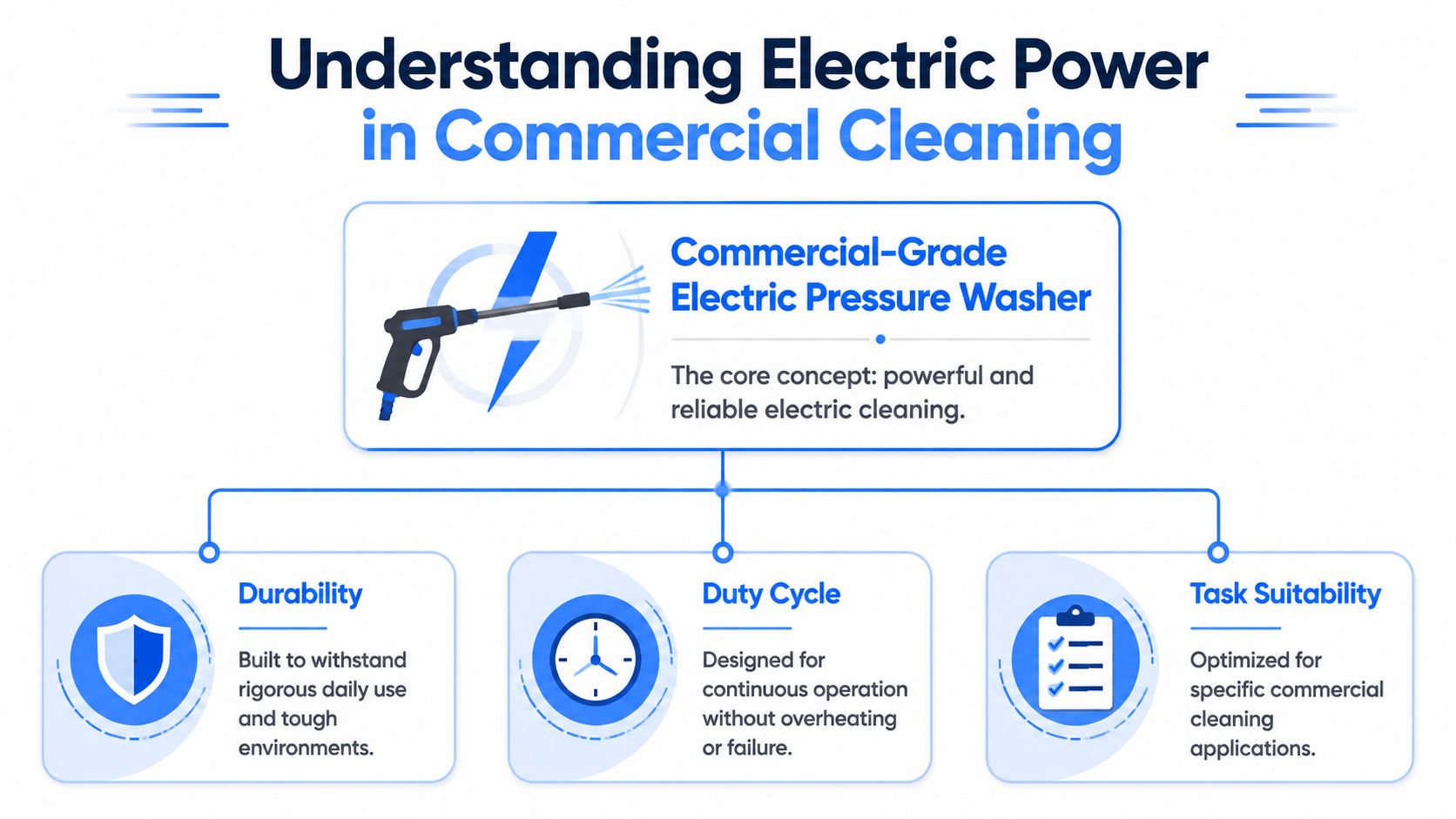
A commercial unit isn't just a homeowner machine with bigger wheels. The difference is closer to the gap between a family sedan and a delivery van. Both move down the road, but only one is built to work all day and take abuse without falling apart.
That same logic applies to pressure washers. A true commercial electric unit is selected for repeated use, more durable components, and a work environment where reliability matters more than marketing labels.
What makes electric commercially useful
The strongest reason to choose electric on a commercial site isn't raw output. It's location suitability.
Pressure King notes that the primary technical advantage of commercial electric pressure washers is indoor suitability because they produce zero exhaust emissions and run quieter than gas models, which makes them a practical fit for warehouses, food facilities, and parking structures. That same advantage carries over to outdoor sites where tenants, guests, or customers are nearby.
On window-focused properties, this matters more than many buyers expect. Crews often work close to doors, vestibules, covered walkways, and lower glass lines. In those areas, quieter operation makes coordination easier. It also reduces friction with retail tenants who don't want a loud engine echoing through a narrow storefront corridor.
Commercial does not mean maximum power
A lot of buyers hear “commercial” and assume they need the strongest machine available. That usually leads to overbuying.
For routine building care, the better question is whether the chosen machine can handle the practical work list:
| Task type | Electric fit | Main reason |
|---|---|---|
| Storefront entries | Strong fit | Lower noise and controlled spray near glass |
| Parking garage cleanup | Strong fit | No exhaust concerns in enclosed areas |
| Window frame washdown | Strong fit | Easier to work safely with lighter output |
| Large-scale stripping or restoration | Weak fit | Output and speed usually favor gas or industrial systems |
Quieter equipment doesn't just keep complaints down. It gives crews more flexibility on occupied properties.
Why facility teams choose it anyway
A commercial pressure washer electric setup is often a strategic choice. Teams pick it because the property environment demands it, not because they believe it can outperform every gas machine.
That distinction matters. If your crew works around storefront glass, pedestrian entries, service corridors, covered retail walkways, or indoor-adjacent spaces, electric can be the smarter operational tool. If the job is heavy buildup across a large exterior with no nearby power constraints, the answer may be different.
Decoding Specs for Real World Commercial Jobs
Specs confuse people because they're usually presented as bragging rights. In the field, they're just decision tools.
PSI tells you how forcefully water hits the surface. GPM tells you how much water is moving through the work area. One affects impact. The other affects rinsing speed and how quickly you can move across a surface without leaving dirty runoff behind.
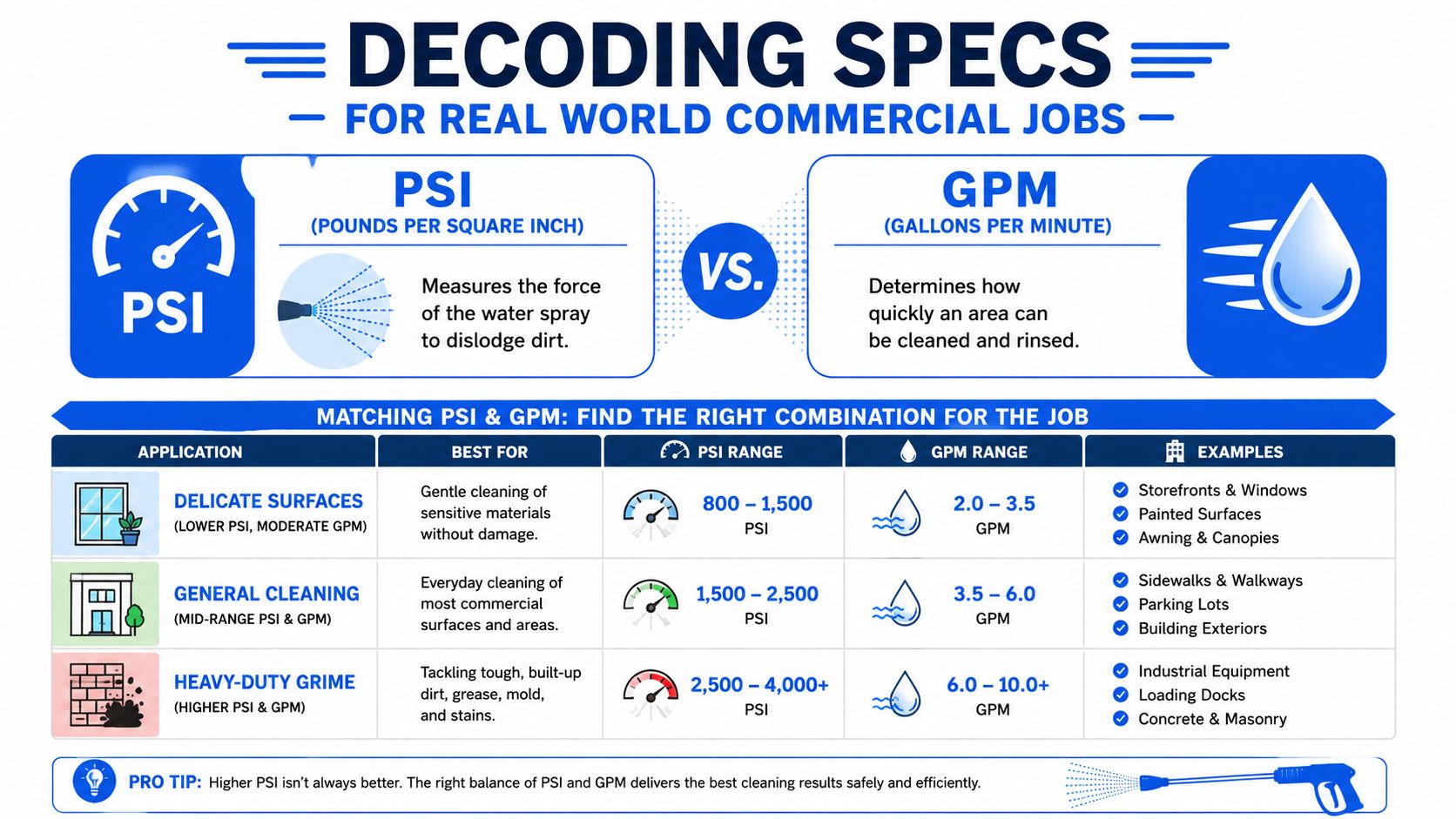
The number range that frames the conversation
That doesn't mean electric fails commercially. It means electric has a lane.
How those specs translate to window-related work
Around glass and frames, too much pressure is often the bigger risk than too little. Seals, caulking, paint, oxidized trim, and soft surrounding materials don't forgive sloppy spraying.
Use this practical guide:
Window frames and sills
Start with the least aggressive setup that still lifts dirt. This is detail work, not brute-force work. The goal is to rinse grime from frame edges, insect debris, and sill buildup without forcing water where it shouldn't go.Storefront glass perimeters
Pressure washing can help on the surrounding surfaces, especially base trim, masonry edges, and entry buildup. It should not replace professional glass cleaning methods. On commercial glass, crews still rely on squeegees, pure water systems, and controlled hand-detailing for the finish.Sidewalks directly in front of windows
Mid-range electric output is often enough for routine maintenance if the buildup is normal foot traffic grime, dust, light organic staining, or beverage residue. If the surface is ingrained with grease or long-neglected soil, productivity drops fast.Building entrances and lower facade sections
Electric works well when the surface is hard, the contamination is moderate, and the crew can stay close to power. It's less effective when the job spreads over long distances or the buildup is severe.
What works and what doesn't
Here's the blunt version.
| Job condition | Electric usually works | Electric usually struggles |
|---|---|---|
| Light to moderate soil | Yes | |
| Close to occupied storefronts | Yes | |
| Near delicate seals and trim | Yes, with careful nozzle choice | |
| Long sidewalk runs with heavy buildup | Yes | |
| Grease-heavy restoration work | Yes | |
| Fast cleaning across large exterior zones | Yes |
A lot of the confusion comes from treating all dirt the same. Dust, pollen, splashback, and routine traffic film are one category. Embedded grease, paint prep, and restoration-level buildup are another.
For owners evaluating surface prep or heavier exterior cleaning needs, it helps to understand when pressure washing before painting changes the job because the prep standard is very different from routine storefront maintenance.
The right spec is the one that cleans the surface without damaging it. That matters more than the biggest number on the box.
Nozzle choice and spray angle matter just as much as machine rating. A careless operator with too much pressure can damage a property fast. A skilled operator with moderate output can clean a surprising amount of commercial frontage safely.
Practical Advantages and On-Site Limitations
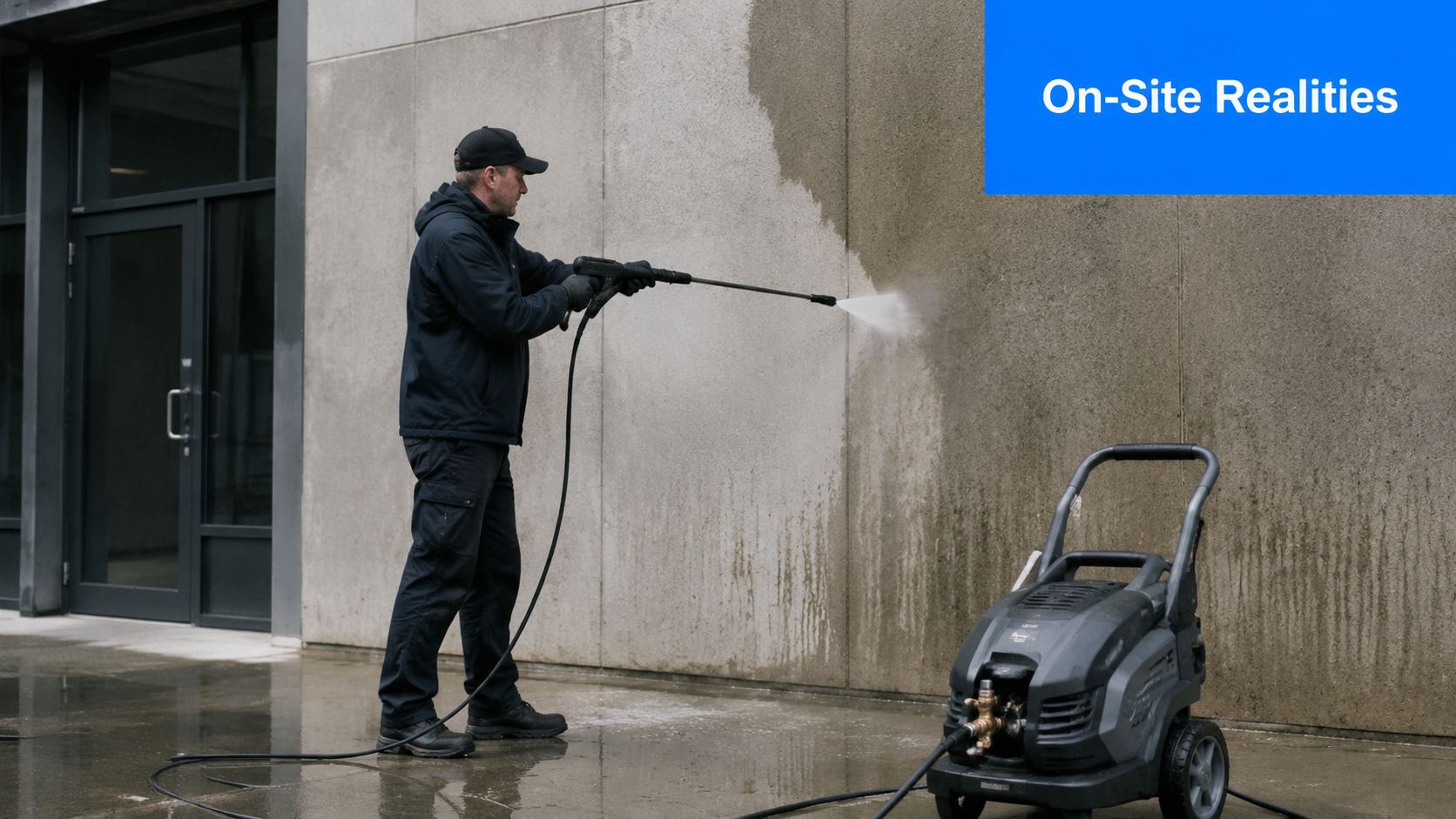
Electric machines are easy to like when you're standing next to one in a small test area. They start easily, run quieter, and don't fill the work zone with engine noise.
Then you bring that same machine onto a long retail strip or a large apartment property, and trade-offs show up.
Where electric is a pleasure to use
On a compact site, electric can feel efficient from the first minute. Plug in, set your hoses, manage your runoff, and get to work.
That's especially true in places like:
- Tempe warehouses where enclosed work zones make zero exhaust a clear advantage
- Covered retail entries where loud equipment would irritate tenants
- Parking structures where ventilation concerns change the equipment choice
- Ground-level office entrances where routine maintenance matters more than speed records
The lower noise profile is a real operational benefit. Crews can communicate more easily. Site staff are less likely to complain. Customers walking into a building don't feel like they're stepping through a construction zone.
Where the cord becomes the job
The weak point is mobility. On larger properties, the pressure washer itself may not be the limiting factor. The outlet is.
That lines up with what crews see every day. The time loss doesn't happen in one dramatic moment. It happens in resets:
- Searching for usable power at each section of a property
- Repositioning extension cords without blocking walkways
- Protecting cords from water paths and foot traffic
- Working around GFCI interruptions or inaccessible outlets
- Breaking workflow every time the next cleaning zone is outside your reach
The honest comparison
For a small storefront row, electric can be smooth and practical.
For a sprawling Phoenix complex with long frontage, scattered outlets, and multiple courtyards, a corded machine can slow a crew down enough that the noise advantage no longer wins.
If your cleaning route keeps forcing the crew to stop and relocate power, the machine is dictating the job instead of supporting it.
That's the deciding point for many properties. Electric often performs well enough at the surface. The question is whether it performs well enough across the whole site.
Essential Safety and Maintenance Best Practices
A pressure washer near commercial windows isn't a casual tool. It can force water past bad seals, scar soft trim, disturb failing caulk, and create slip hazards fast if the operator gets careless.
Electrical safety comes first. Water and power are already a risky combination, so crews need clean cord routing, protected connections, and working GFCI protection. If a plug, connection, or extension setup looks improvised, stop and fix it before the trigger gets pulled.
Protect the building before you clean it
Window cleaning crews learn this early. The dirtiest surface isn't always the toughest surface.
When pressure is in play, the first job is identifying what can be damaged:
- Window seals and frame joints can fail if the spray is too direct or too close
- Painted trim and oxidized surfaces can strip unevenly
- Soft stone, mortar, and aged caulk can erode faster than expected
- Doors, thresholds, and storefront edges can take on water if the angle is wrong
That's why spray angle and distance matter. Operators should test a small area first, keep the wand moving, and avoid concentrating force on one point. Around commercial glass, pressure washing is support work. Final glass cleaning still belongs to professional window cleaning tools like squeegees, pure water systems, ladders, boom lifts, scaffolding, and rope descent systems when access requires it.
For a closer look at the risks, this guide on whether you can pressure wash windows safely is worth reviewing before anyone points a wand at storefront glass.
Damage check: If you see cracked sealant, loose glazing, peeling paint, or aging frame joints, treat that area as fragile until proven otherwise.
Keep the machine reliable
Preventive maintenance is what separates a dependable commercial tool from a headache. A simple routine catches small issues before they turn into downtime. Teams that want a broader operations perspective can review SaberTask's insights on preventive maintenance, which line up with how field crews keep essential equipment working consistently.
A basic electric pressure washer checklist should include:
- Inspect cords and plugs before every use.
- Check hoses and fittings for wear, abrasion, or leaks.
- Clean nozzles so pressure stays predictable.
- Flush the system after dirty work to avoid buildup.
- Store the machine dry and protected so the next job starts without surprises.
Maintenance isn't busywork. It protects uptime, reduces avoidable breakdowns, and keeps spray performance consistent from one property to the next.
Rent Buy or Hire a Professional Crew
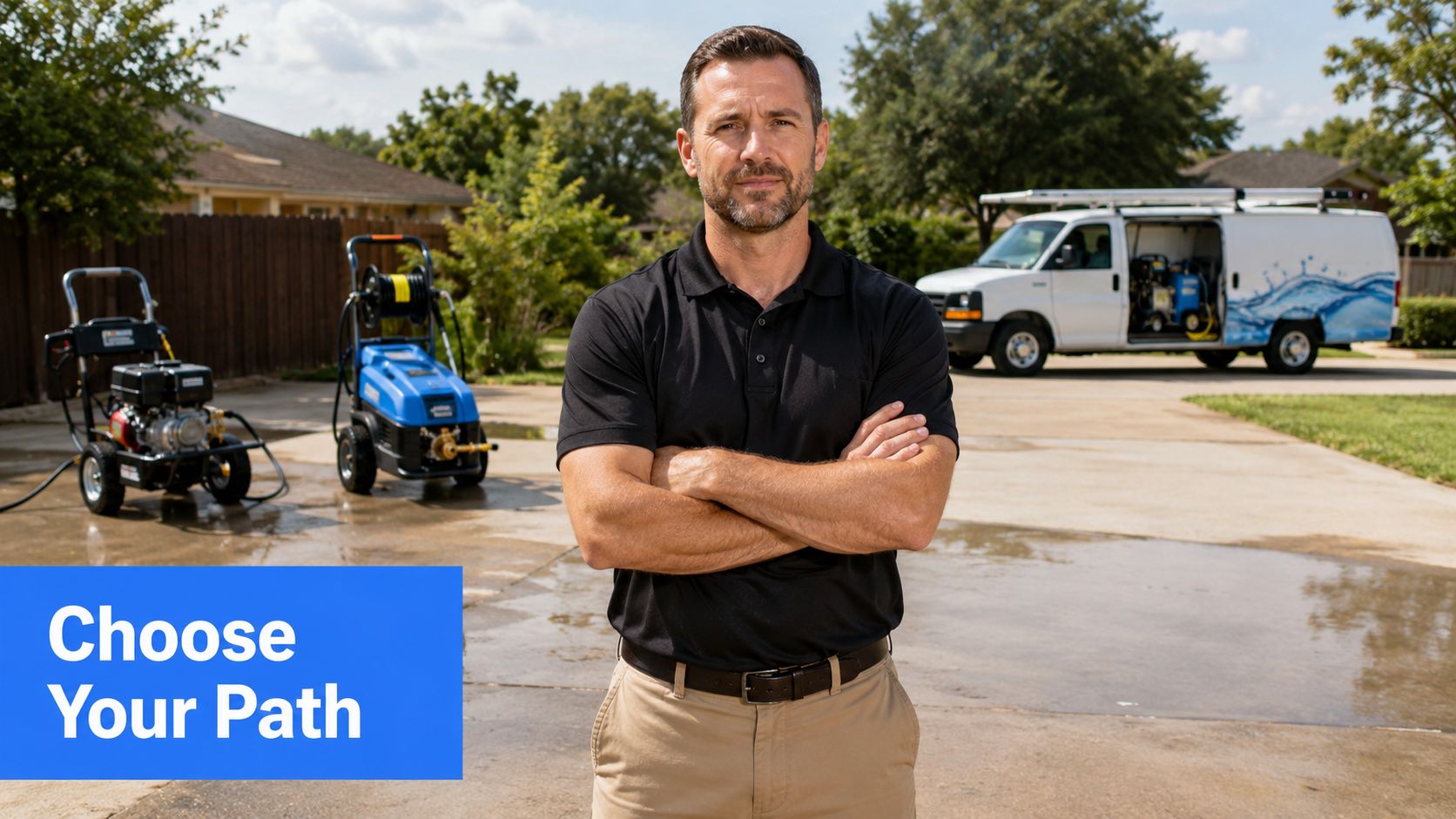
Most property owners have three realistic options. Rent a machine for a short-term need, buy one for in-house maintenance, or hire a crew that already has the equipment, training, and access tools to do the work safely.
The right answer depends less on the machine and more on the property.
When renting makes sense
Renting fits a narrow use case. You have a one-off ground-level cleanup, the work area is easy to access, and someone on site already knows how to operate the machine without damaging surrounding materials.
That can work for a short storefront concrete cleanup or an isolated service area. It's less appealing once the task involves glass lines, customer traffic, extension cords, water control, or multiple surface types in one job.
When buying makes sense
Buying can work for facilities that have an internal maintenance team and a repeatable cleaning routine.
A commercial pressure washer electric unit is usually a reasonable buy when the property has:
- Consistent ground-level cleaning needs in the same zones
- Accessible power where work happens most often
- Staff who understand nozzle selection and surface risk
- No need for high-level access beyond what handheld tools can safely reach
This route works best when the task list stays simple. Storefront pads, lower wall sections, entry walks, and some perimeter cleanup are one thing. Full exterior glass care across mixed-height buildings is another.
When hiring a professional crew is the smarter move
Hiring wins when safety, finish quality, and efficiency matter more than owning a machine.
That includes:
- properties with multi-story glass
- buildings that need lifts or rope descent access
- sites with liability-sensitive pedestrian areas
- projects where pressure washing is only one part of the scope
- jobs where frame cleaning, glass detailing, and difficult access all happen together
In those situations, window cleaning companies bring more than a washer. They bring squeegees, pure water systems, ladders, scaffolding, boom lifts, and rope systems that match the building instead of forcing one tool onto every problem.
For local service planning, property managers often look for crews that already know their market conditions, whether that means storefront and commercial window cleaning in Scottsdale, routine service support in Tempe, or front-range commercial work in Boulder. The same applies across nearby service areas such as Phoenix, Chandler, Paradise Valley, Glendale, Flagstaff, Denver, Arvada, Westminster, Erie, Commerce City, Golden, Las Vegas, and Laughlin.
For companies evaluating how professional service businesses present these capabilities online, expert guidance for power washing websites offers a useful perspective on how service scope, credibility, and local positioning are communicated.
Making the Right Choice for Your Property
The best buying decision usually comes down to four questions.
First, where will the machine be used? Indoor-adjacent and noise-sensitive properties often favor electric. Second, what surfaces are being cleaned? Storefront entries, lower frames, and routine sidewalks require a different approach than heavy restoration work. Third, how often will the tool be used? A recurring maintenance route can justify ownership. A sporadic need usually doesn't. Fourth, what happens if something goes wrong? Around glass, seals, pedestrians, and high access, mistakes get expensive fast.
The biggest gap in most buying advice is that it stays too abstract. PowerWash.com points out that most industry content fails to answer the real buyer question, which is what PSI and GPM range is sufficient for jobs like storefronts or sidewalk cleaning, and that the best choice is about matching output to the surface and task to avoid damage.
That's the right way to think about a commercial pressure washer electric setup. Not as the strongest option. Not as the quiet option alone. As the correct option for specific property conditions and specific work.
If the job is ground-level, routine, and close to available power, electric can be a smart fit. If the job involves difficult access, sensitive glass, or broad exterior cleaning across a large property, a professional crew is usually the safer and more efficient call.
If you need help deciding whether a commercial electric pressure washer is enough for your property, Professional Window Cleaning can assess the site, the surface types, and the access challenges without pushing you into the wrong solution. Their crews handle commercial window cleaning and exterior cleaning work across Arizona, Colorado, and Nevada using professional tools, insured methods, and the right access equipment for everything from storefronts to high-rise glass.