



What looks worse to a property manager: glass that stayed dusty for a week, or a window cleaning crew that creates a safety, access, or liability problem before lunch?
Commercial window cleaning affects far more than appearance. It touches fall risk, tenant flow, roof access, seal and frame condition, water quality, insurance exposure, and the timing of work around business operations. In Arizona, Colorado, and Nevada, those details get tested fast. Hard water leaves mineral spotting, desert dust settles quickly, afternoon heat changes drying times, and wind can turn a routine exterior service into a scheduling problem.
Clean glass is the visible result. The primary focus is controlling risk while protecting the building and keeping service efficient.
From an operations standpoint, poor window cleaning usually fails in predictable ways. Crews show up without the right access plan. They clean in direct sun with the wrong solution or impure water and leave spotting behind. They drag hoses or tools through active entries, disrupt tenants, or miss building rules that should have been confirmed before the truck arrived. Good contractors prevent those problems upstream with planning, site-specific methods, and clear communication.
Managers should also judge vendors by how seriously they treat field safety. Practical habits such as ladder setup, tie-off discipline, and reducing fall risks on job sites matter because one preventable incident can interrupt operations, trigger claims, and put the property team in a difficult position.
The sections below focus on what holds up in real commercial service: compliance, access methods, pure water systems, finish standards, scheduling, equipment inspection, insurance, and site coordination for storefronts, offices, campuses, HOAs, mid-rise properties, and high-rise buildings in harsh, high-visibility markets.
1. OSHA 1910.27 Fall Protection Compliance & Annual Certification
What happens to your property team if a window cleaning crew steps onto the roof with expired training, questionable anchors, or no written fall plan?
That problem shows up before the first pane gets touched. On commercial sites, OSHA 1910.27 compliance is part of vendor screening, liability control, and access planning. In Arizona, Colorado, and Nevada, the weather adds pressure. Heat stresses crews, wind changes exposure, and roof conditions vary by building type, so current training and site-specific planning matter every time.
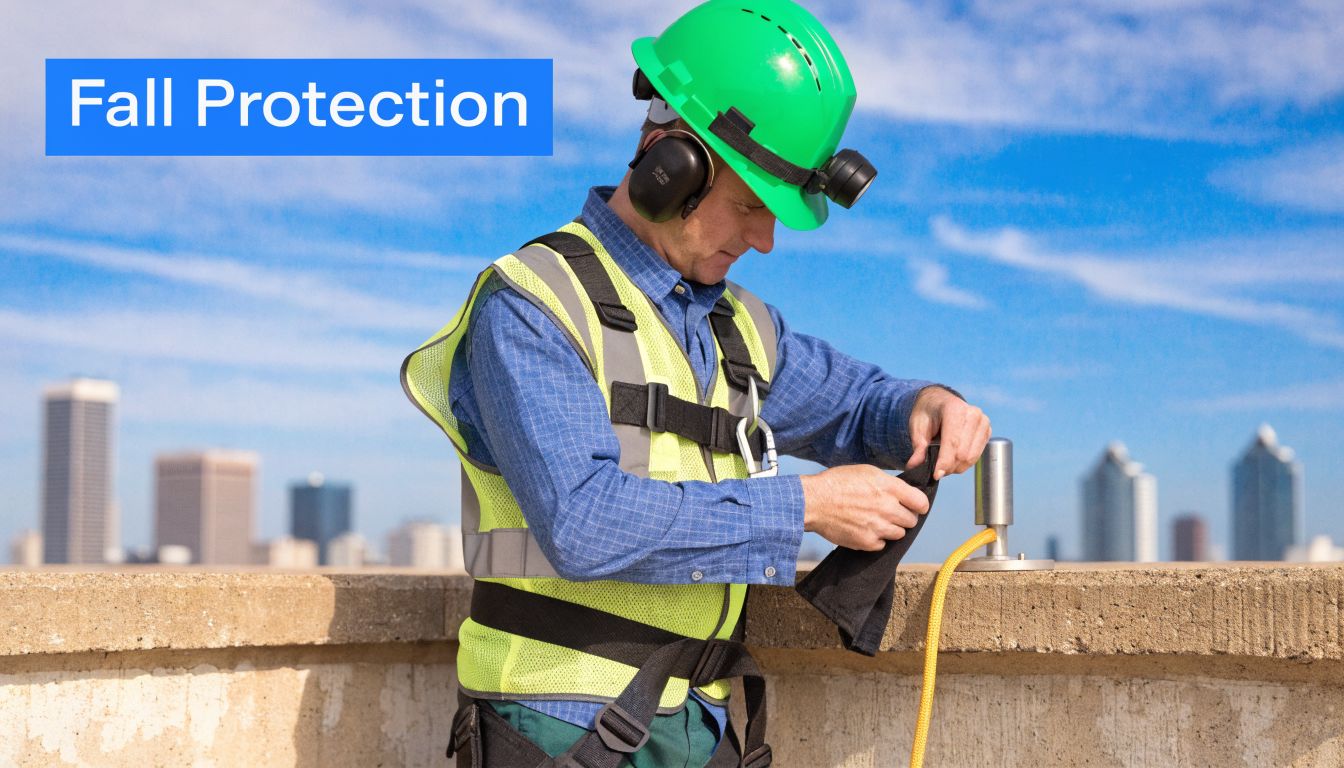
Annual certification is the minimum. Good field performance depends on technicians who know how to inspect tie-off points, transition safely at roof edges, and use the right method for the building. A cleaner can produce excellent glass and still create serious exposure for the client if the crew is weak on fall protection, ladder transfers, or descent procedures.
What managers should verify
Ask for technician-specific training records before approving service, especially for roof access, facade work, atriums, and any job above routine ground-level glass. If a contractor cannot produce clear records quickly, expect the same lack of discipline in the field.
Check three things.
- Current OSHA 1910.27 training records: Verify that each technician assigned to the site has up-to-date documentation, not a generic company certificate.
- Access-method fit: Ladder work, boom lifts, suspended access, and rope descent require different skills. Training should match the actual setup planned for your building.
- Annual review and recertification: Crews need recurring instruction because equipment changes, site conditions change, and bad habits creep in fast.
For higher-risk properties, ask one more question. Who reviewed the anchors, roof layout, rescue considerations, and restricted areas before the visit was scheduled? On a mid-rise office building in Denver or a mixed-use property in Phoenix, that answer tells you whether the contractor runs a real operation or just dispatches whoever is available.
The practical standard is simple. If a vendor expects roof access, they should be able to provide training records, method-specific qualifications, and a clear safety plan without delay. That protects the building, the tenants, and your claims history. It also supports the broader goal of reducing fall risks on job sites, which is one of the clearest differences between a professional commercial contractor and a low-bid crew.
2. Water-Fed Pole Systems & Pure Water Cleaning Technology
For a lot of low-rise and mid-rise glass, the safest job is the one done from the ground. That's where water-fed poles and pure water systems earn their keep. They let crews clean large sections of exterior glass without putting ladders where pedestrians walk or bringing lifts onto every site.
In major commercial markets, adoption of advanced access tools such as water-fed poles and rope descent systems has risen to over 65% among commercial operators in the US and Europe. That tracks with what experienced field teams already know. When the glass, access, and water quality line up, pure water cleaning is faster, safer, and more consistent.
Where pure water works best
Retail centers in Scottsdale, office parks in Chandler, and business campuses in Boulder are good examples. Long runs of exterior glass, limited setup space, and tight tenant schedules all favor telescoping carbon fiber poles and deionized water over constant ladder repositioning.
The technical side matters. Benchmarks in the same market report describe water-fed systems using deionized water at 20 to 40 psi through telescopic poles in the 30 to 60 foot range, with faster cleaning on mid-rise buildings and strong satisfaction with streak-free results when crews maintain the system correctly.
Pure water doesn't forgive lazy maintenance. If filtration slips, the glass tells on you immediately.
What actually makes these systems work
The pole is only half the system. The other half is water quality, brush selection, rinse discipline, and knowing when not to use the method.
- Monitor water purity: Keep TDS low enough that water dries clean. If the filtration is off, mineral spotting comes back fast.
- Use light brush pressure: Scrubbing too hard can spread debris and distort the rinse pattern.
- Choose the method by surface: Water-fed poles are excellent on routine exterior glass. They're not the automatic answer for every interior pane, detail edge, or sensitive finish.
- Combine methods when needed: Strong crews switch between pure water and hand detailing instead of forcing one tool onto every elevation.
This is one of the most practical commercial window cleaning tips for reducing both risk and setup time on broad exterior glass.
3. Professional Squeegee Technique & Streak-Free Finish Standards
A lot of commercial glass still comes down to hand work. Pure water is excellent in the right setting, but interior glass, lobby partitions, entry systems, and detail-heavy storefronts still depend on disciplined squeegee technique.
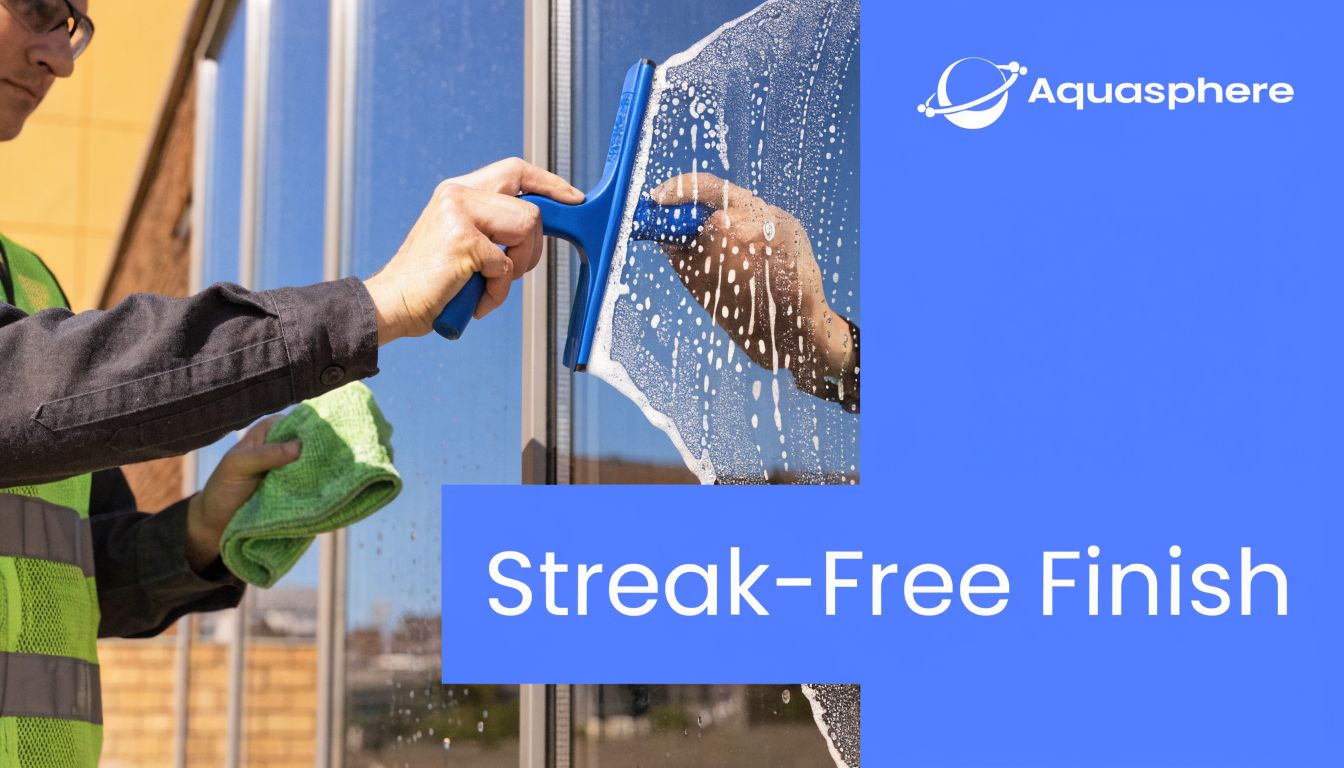
That technique shows up in the result long before a customer can describe it. The line is clean. The edges are tight. There's no drag, no fan marks, no haze at eye level, and no runoff left to dry on the frame. If a company can't execute that consistently, it doesn't matter how polished the proposal looked.
The half-clean problem is real
One of the most common causes of disappointing results is cleaning only one side well. Industry guidance on the “two sides to every window” problem points out that windows still look dirty when one surface is neglected, especially once light shifts and reveals haze, smudges, or exterior film on the opposite side. That's why interior and exterior planning should happen together, not as separate afterthoughts.
For managers in Tempe storefronts, downtown Phoenix offices, or high-visibility Boulder retail, this matters most at entrances, conference rooms, and tenant-facing glazing. Those are the spots where people notice every streak.
- Replace blades early: Worn rubber creates lines, skips, and false “hard water” diagnoses that are really just bad edges.
- Clean top to bottom: Gravity always wins. The sequence should too.
- Detail edges carefully: Most callbacks happen at corners, mullions, and lower edges where water hangs up.
- Use microfiber for final touch-up: Not for the whole job. For edge control and final detailing.
The difference between average and professional work is usually in the last five percent of the pane.
Good hand technique also protects productivity. Rework burns time, ties up crews, and creates tension with tenants who expected the glass to be done right the first time.
4. Rope Descent Systems for Mid-Rise & High-Rise Access
Some buildings can't be cleaned well from the ground or from a lift. Setbacks, narrow access lanes, landscaping, canopies, and complex facades push crews into rope descent systems. On the right property, rope access is the cleanest and least disruptive way to reach glass that would otherwise be slow or impractical.
The equipment standards here are not casual. One market summary describes rope descent systems using dual braided ropes with a 9.5 mm diameter and 25 kN breaking strength, supporting access to hard-to-reach skylights and curtain walls while reducing downtime compared with scaffold-heavy setups in many commercial environments. That's the level of specialization property managers should expect when hiring for mid-rise and high-rise work.
Where rope access makes sense
Downtown Denver towers, Phoenix buildings with architectural setbacks, and Las Vegas properties with limited equipment staging are common examples. In those cases, a boom lift may only reach part of the facade, while rope access allows controlled movement across the full drop.
The trade-off is planning. Rope work requires anchor verification, roof logistics, exclusion zones, communication procedures, and tighter wind judgment than many managers realize.
- Inspect anchor points before scheduling the drop: Don't let the first field conversation happen on the roof.
- Coordinate with engineering or building operations: Roof access rules, tie-off locations, and facade restrictions must be confirmed in advance.
- Use clear crew communication: Radios and agreed signals prevent mistakes during descent and repositioning.
- Protect pedestrian areas below: Ground control matters as much as the rope setup above.
High-rise window cleaning is never just a glass job. It's a rigging job, a safety job, and a building coordination job at the same time.
When a vendor can't explain its rope access plan clearly, the risk usually isn't hidden. It's already visible.
5. Strategic Scheduling & Route Optimization for Multi-Location Contracts
What usually breaks a multi-location window cleaning contract first. Dirty glass, or a route plan that wastes labor, misses access windows, and puts crews at the wrong property with the wrong equipment?
In practice, scheduling drives the result. Clean glass is the visible outcome. Essential preparation starts earlier, with route design, site sequencing, weather calls, access timing, and labor allocation that protect margin and reduce liability.
That matters even more across Arizona, Colorado, and Nevada. Heat changes start times. Wind changes exterior plans. Mountain weather can compress a work window fast, and casino, retail, medical, and office properties all have different tolerance for noise, staging, and tenant disruption.
What efficient scheduling looks like
A strong route plan groups work by geography, building type, and access method. Phoenix high-sun exposures may need earlier exterior work. Las Vegas sites often require tighter coordination around guest traffic and loading access. Denver and Boulder schedules need more weather flexibility than managers in flatter, hotter markets sometimes expect.
Crew matching matters just as much. A technician set up for storefront glass and pole work should not arrive at a site that needs roof access coordination, strict security check-in, or after-hours service. That mismatch creates delays, idle labor, and unnecessary risk.
For recurring contracts, predictability has operational value. Property teams plan around your arrival. Security logs your crew. Tenants adjust to your service window. When the day or sequence keeps changing, the cleaning vendor becomes a disruption instead of a support function.
- Group stops by corridor and service type: Keep Phoenix metro routes tight, and avoid mixing quick storefront work with slower sites that need sign-in, escorts, or staged equipment.
- Schedule around building constraints first: Opening hours, dock access, rooftop availability, and tenant-sensitive periods should shape the route before drive time does.
- Assign crews based on access requirements: Match the site to the crew's equipment, training, and expected production rate.
- Add realistic buffer time: Traffic, elevator delays, badge issues, and locked roof doors are routine operating conditions, not exceptions.
- Build weather contingencies into Colorado and Nevada routes: Have a same-day reshuffle plan when wind, storms, or heat force exterior work to move.
One bad route can damage more than efficiency.
Late arrival can trigger access problems. Missed coordination can leave a crew waiting in a parking lot while paid hours burn. Showing up during peak customer traffic can create slip hazards, complaints, and avoidable friction with building management. For large portfolios, those failures spread quickly from one site to the next.
Why this matters to clients
Clients usually experience scheduling problems as competence problems. The crew is late. Security was not notified. The service window overlaps with a tenant meeting. Glass still gets cleaned, but the account feels poorly managed.
Strong scheduling protects the relationship and the building operation. It reduces callbacks, supports safer work windows, limits disruption, and helps managers keep standards consistent across every location in the contract.
6. Safety Equipment Maintenance & Inspection Protocols
What happens to a cleaning contract when a rope sheath is heat-damaged, a harness has undocumented wear, or a pole clamp fails over a public entry? The glass is no longer the main issue. Exposure, downtime, and liability take over.
Equipment condition has to be managed like risk, not treated like a housekeeping task. In Arizona, Colorado, and Nevada, UV exposure, dust, sharp temperature swings, and sustained heat shorten the service life of ropes, webbing, seals, plastics, and hose assemblies. Gear can look usable and still be unsafe, especially if it has been stored in a truck box, dragged across parapets, or left on a roof through a hot afternoon.
Build an inspection system crews can actually follow
A workable protocol has two layers. The field technician performs a pre-use check before every shift. A competent person performs documented periodic inspections on a set schedule and removes questionable equipment from service immediately. If either step is informal, standards slip fast.
Records matter here. If there is an incident, the question is not whether the company "usually checks" its gear. The question is whether the company can show inspection dates, findings, corrective action, and replacement history. That documentation supports internal accountability and helps frame the insurance conversation with clients and carriers. The ISU Insurance Services business coverage guide is a useful reference for understanding how operational controls and liability exposure connect.
- Use pre-use checklists: Inspect harness webbing, stitching, D-rings, rope condition, lanyards, descenders, carabiner gates, pole sections, clamps, brush sockets, hose connections, and lift tie-off points before work starts.
- Tag equipment by status: Mark gear as approved, pending inspection, or out of service so a crew does not have to guess at 6:00 a.m.
- Set retirement and replacement rules: Follow manufacturer criteria for wear, impact loading, contamination, cuts, glazing, deformation, and age where applicable.
- Store gear to limit damage: Keep ropes, harnesses, and pure-water components out of direct sun, uncontrolled heat, standing moisture, and chemical cross-contamination.
- Document every removal from service: Note the defect, date, inspector, and disposition. Photos help when a supervisor, client, or regulator asks why equipment was pulled or replaced.
Small defects cause expensive problems.
I have seen jobs stall because the primary failure was not the main line or harness. It was a worn buckle, a cracked pole collar, a leaking hose fitting that created a slip hazard in a lobby approach, or a connector that should have been retired weeks earlier. Those are operations failures as much as safety failures. They delay production, force on-site improvisation, and put supervisors in a poor position with property management.
Common blind spots that get missed
Supporting components usually get less attention than they deserve. Crews tend to inspect life-safety gear closely and rush past the rest of the system. On commercial sites, that is a mistake.
Check the parts that take daily abuse. Pole locks loosen. Brush heads split. Hose reels kink and wear through. Roof edge protection goes missing. Labels become unreadable. Anchor point documentation gets separated from the kit. Any one of those issues can stop work, create a compliance problem, or expose the contractor to claims that were avoidable with a disciplined inspection routine.
7. Commercial Liability Insurance & Background Check Requirements
If a contractor works on occupied commercial property, insurance and screening aren't optional extras. They're part of the service. Crews enter tenant spaces, move around parked vehicles, handle access points, and work over public walkways. A clean result doesn't help much if the vendor can't respond properly when something goes wrong.
This is even more important on recurring contracts with HOAs, office buildings, retail centers, and medical or hospitality properties. Managers need to know who is on site, whether they've been screened, and whether the company can produce current proof of coverage fast.
What to require before approving a vendor
Ask for current certificates of insurance and verify that the coverage matches commercial work. Then ask how the company screens field employees who will enter secure or tenant-facing areas. The answer should be direct, consistent, and documented.
The background in this category is straightforward. Companies operating professionally in Arizona, Colorado, and Nevada should be ready to provide those documents without delay, especially for higher-security properties and multi-story contracts.
- Verify insurance before scheduling: Don't wait until the crew is at the building to request certificates.
- Confirm workers' compensation status: High-access work without proper coverage creates immediate exposure for everyone involved.
- Ask about technician screening: Background checks matter for HOAs, office suites, and any property with after-hours access.
- Review coverage annually: As the contractor grows, adds equipment, or takes on more complex buildings, policy limits and endorsements may need to change.
A manager who wants a baseline understanding of policy structure can review this general liability insurance overview for service businesses.
The practical trade-off is simple. The cheapest bid often leaves the thinnest paper trail. That can look fine until there's a damaged facade panel, a worker injury claim, or a security complaint from a tenant.
8. Client-Specific Compliance & Building Access Coordination
A strong cleaning crew can still fail on a commercial account if it ignores building rules. Access windows, dock procedures, parking restrictions, key cards, freight elevator reservations, and security sign-in rules all shape whether the job runs smoothly.
Many generic commercial window cleaning tips fall short in these specific areas. They focus on the glass and ignore the building. In practice, the building often determines the method, timing, crew size, and whether the work can happen at all.
Coordinate the site before the service date
A downtown office tower in Denver may require after-hours access and loading instructions. A medical office in Scottsdale may restrict work near patient entries. A hotel property in Las Vegas may limit visible exterior work during peak guest traffic. HOA communities in Chandler may need resident notification before crews enter common areas or work around balconies.
None of that is difficult if it's handled early. All of it becomes difficult if the crew learns about it in the parking lot.
- Hold a pre-service walkthrough: Confirm access points, restricted areas, water sources, roof rules, and staging zones.
- Create a client-specific site sheet: Include contacts, parking instructions, work-hour limits, and emergency procedures.
- Train the assigned crew on that property: Don't assume field staff will “figure it out” on arrival.
- Respect security protocols exactly: One shortcut at a badge-controlled property can cost the contract.
Why coordination affects cleaning quality
Poor access planning creates rushed work. Rushed work creates missed panes, incomplete detailing, and preventable safety mistakes. Good coordination protects the result because it gives the crew the time and setup conditions needed to work correctly.
That's especially true for regional operators managing sites across Phoenix, Glendale, Paradise Valley, Westminster, Arvada, Erie, Commerce City, Golden, and Laughlin, where each property owner may enforce a different contractor process.
8-Point Comparison: Safety, Equipment & Operations for Commercial Window Cleaning
| Item | Implementation complexity | Resource requirements | Expected outcomes | Ideal use cases | Key advantages |
|---|---|---|---|---|---|
| OSHA 1910.27 Fall Protection Compliance & Annual Certification | Moderate–High, annual recertification and regulatory alignment | Qualified instructors, training time, certification fees ($500–$1,500/tech), record-keeping | Regulatory compliance, large reduction in fall incidents, demonstrable safety practices | Multi-story/high-rise commercial window cleaning and contracts requiring proof of competency | Legal compliance, liability reduction, insurance and client confidence |
| Water-Fed Pole Systems & Pure Water Cleaning Technology | Low–Moderate, equipment procurement plus operator training and maintenance | Water-fed poles, deionized/RO filtration ($3,000–$8,000), hoses, maintenance and water logistics | Faster coverage, streak-free dries, reduced ladder use and fall exposure | Ground-level/low-rise glazing, storefronts, skylights, eco-conscious clients | Improved safety, efficiency, streak-free finish, lower fall-related insurance risk |
| Professional Squeegee Technique & Streak-Free Finish Standards | Moderate, requires months of hands-on training and ongoing practice | Skilled technicians, quality squeegees/blades, training time (6–12 months) | Consistent streak-free results, fewer callbacks, ability to charge premium rates | High-visibility storefronts, premium retail and brand-sensitive properties | Quality differentiation, reduced rework, higher customer satisfaction |
| Rope Descent Systems (RDS) for Mid-Rise & High-Rise Access | High, specialized certifications, building assessments, strict safety controls | Certified rope-access technicians, rigging gear, anchor approvals, higher insurance and supervision | Access to complex/high-rise facades, flexible positioning, reduced reliance on lifts | Mid- to high-rise buildings with setbacks or limited lift access | Reaches areas lifts cannot, potential cost/time savings vs. lift rentals, flexible access |
| Strategic Scheduling & Route Optimization for Multi-Location Contracts | Moderate, software configuration and continuous operational tuning | Scheduling/route software ($200–$500/mo), staff training, GPS/data monitoring | Reduced drive time, higher job throughput, lower fuel and labor costs | Multi-city operations and clustered commercial contracts (e.g., Phoenix/Denver regions) | Improved efficiency, higher crew utilization, better on-time performance |
| Safety Equipment Maintenance & Inspection Protocols | Moderate–High, daily checks plus periodic third-party audits and documentation | Trained inspectors, audit services ($2,000–$5,000/quarter), replacement budgets and storage solutions | Early defect detection, compliance records, extended equipment life, lower incident risk | Operations with heavy PPE/rigging usage (RDS, lifts) and large equipment inventories | Prevents failures, reduces liability, strengthens audit and insurance position |
| Commercial Liability Insurance & Background Check Requirements | Moderate, ongoing policy management and onboarding compliance | Insurance premiums ($3,000–$10,000+), background check services, administrative overhead | Financial protection from claims, required credentialing for clients, vetted workforce | All commercial contracts, HOAs, high-value or insured properties | Transfers financial risk, meets client mandates, improves hiring quality |
| Client-Specific Compliance & Building Access Coordination | Moderate, per-client customization and continuous coordination | Administrative time, access credentials/badges, parking permits, communication protocols | Fewer access delays, preserved contracts, smoother project execution | Corporate campuses, secured buildings, HOAs, guest-facing properties | Strong facility relationships, reduced security incidents, predictable operations |
Your Partner in Crystal-Clear Property Management
What does a window cleaning vendor really protect. Your glass, or your risk profile?
On commercial properties, clean windows are only one part of the job. The bigger issue is whether the contractor can control fall risk, protect finishes, avoid disrupting tenants, and document the work well enough to satisfy building ownership, facilities teams, and insurance requirements. That matters even more in Arizona, Colorado, and Nevada, where dust, sun, wind, hard water, and difficult access conditions expose weak operating systems fast.
A polished proposal does not tell you much. Daily execution does.
Ask direct questions about training records, equipment inspections, access planning, insurance limits, background checks, and how crews are scheduled around occupant traffic. Ask who handles site coordination, who signs off on safety checks, and what happens when weather, locked access points, or lift restrictions change the plan. Those details separate a company that can maintain a commercial account from one that only knows how to wash glass.
The same is true for quality control. A strong provider does not focus on the pane alone. The work should account for frames, tracks, seals, surrounding finishes, runoff control, and the water quality needed to avoid spotting, especially on exterior glass in mineral-heavy service areas. On active properties, the best result is not just a streak-free finish. It is a clean building delivered without complaints, damage claims, access problems, or avoidable callbacks.
The market gives property managers plenty of choices. The hard part is choosing a contractor that can perform safely and consistently under real site conditions, not just under ideal ones.
Use the points in this guide as a screening standard. Look for annual OSHA training, legitimate rope access capability where needed, maintained poles and lifts, documented inspection routines, current liability coverage, vetted technicians, and route planning that matches your building's operating hours. Those are the signs of a contractor that understands commercial window cleaning as asset protection and operational logistics.
Professional Window Cleaning serves commercial properties across Arizona, Colorado, and Nevada, including Phoenix, Scottsdale, Tempe, Chandler, Denver, Boulder, Las Vegas, and surrounding areas. If your property needs recurring service, specialty access, or a tighter scope built around site risk, the next step is a quote based on the building itself, its access constraints, and its maintenance priorities.
Professional Window Cleaning is ready to help with commercial properties across Arizona, Colorado, and Nevada. Visit Professional Window Cleaning to request a quote, review service areas, and schedule a plan that fits your building, access requirements, and maintenance goals.