



At 6:30 a.m. in Phoenix, the glass is already warming up, the pavement is throwing glare, and a crew is unloading ladders before the first storefront opens. In Denver, the same inspection happens in thinner air, with different demands on ropes, seals, and worker fatigue. In Las Vegas and Scottsdale, hard water and heat shorten the service life of rubber, hoses, fittings, and moving parts faster than many crews expect.
Equipment condition sets the tone for the day. A worn ladder foot on decorative concrete, a rope with sun-damaged sheath fibers, or a lift with a slow hydraulic leak can turn a routine job into an injury, a dropped tool incident, or a shutdown in front of the client.
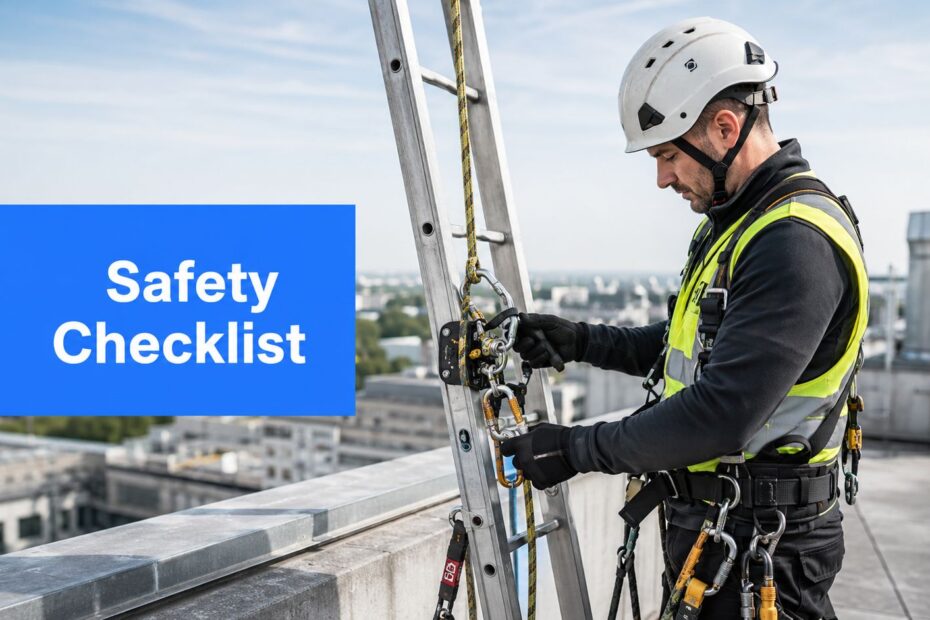
That is why an equipment safety inspection checklist belongs at the truck, on the site, and in the supervisor's hands before work starts. For professional window cleaning, the check is tied directly to fall exposure, equipment reliability, public protection, and whether the crew can finish the job without forcing a bad tool through another shift.
In Arizona, Colorado, and Nevada, the inspection standard has to match local conditions. UV exposure dries and cracks rubber and webbing. Extreme heat changes fluid behavior and speeds up wear on seals. Altitude in Colorado affects worker output and can expose weaknesses in systems that looked fine at ground level in the yard. Hard water leaves mineral buildup that interferes with moving parts, locks, and connections. OSHA requires employers to inspect equipment, maintain it in safe condition, and remove defective gear from service. On our crews, that means the inspection is practical, job-specific, and documented well enough to hold up after an incident review.
1. Squeegee Blade Condition and Edge Sharpness
A squeegee looks simple until you hand one to a technician who has to produce clean glass all day in heat, glare, and mineral-heavy water conditions. Then every defect in that rubber edge shows up fast. A nicked blade leaves lines. A hardened edge makes the technician push harder. That extra force travels straight into the wrist, forearm, and shoulder.
In Chandler, Scottsdale, and Las Vegas, hard water changes the way blades wear. The same is true on sun-baked routes in Phoenix, where heat can age rubber faster than crews expect. I'd rather replace a blade early than ask a technician to fight glass with a bad edge for half a shift.
What to check before the first pane
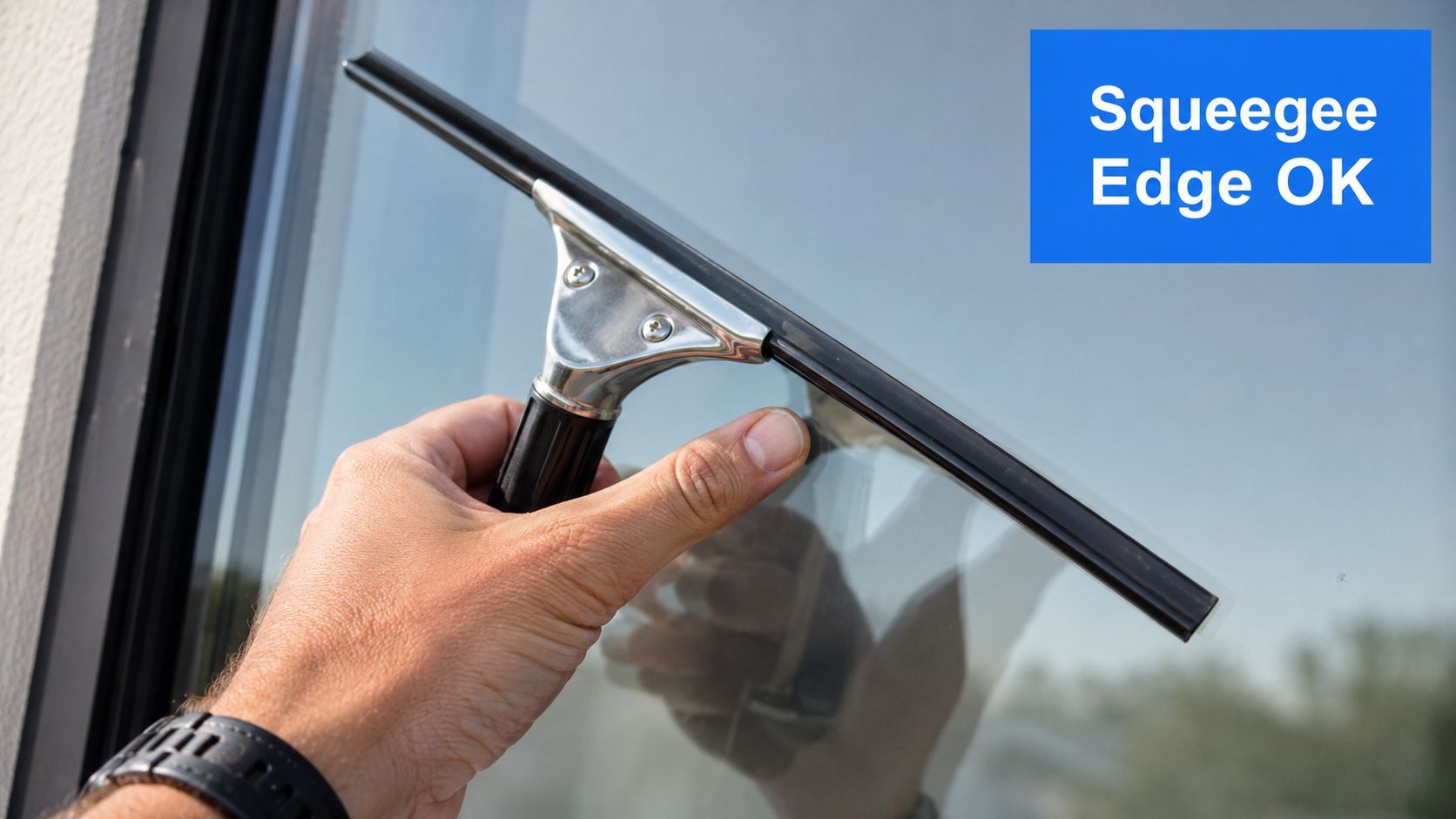
Hold the blade under bright light and inspect the full edge. Then run a fingernail lightly across it. If your nail catches, the blade is already telling you it's done.
- Look for visible damage: Any nick, crack, flat spot, or uneven wear means the blade comes out.
- Check straightness: A warped blade won't track evenly across the glass, especially on larger commercial panes.
- Match blade to water conditions: Keeping separate squeegees for different water conditions helps crews avoid unnecessary wear and inconsistent drag.
- Store rubber correctly: Don't toss blades loose with metal tools where edges get cut before the job even starts.
Field habit: If a technician has to lean into the glass to make the blade perform, the problem usually isn't technique. It's the rubber.
A Denver crew can catch tiny edge cracking before it becomes a streaking problem on reflective glass. A Phoenix crew can rotate blades more aggressively on long commercial routes. Both habits protect quality, but they also protect the body. Good squeegee inspection is part of an equipment safety inspection checklist because fatigue and awkward force add up over a full day of professional window cleaning.
2. Ladder Base and Rung Structural Integrity
A technician steps off the truck in Phoenix at 7 a.m. The ladder looks serviceable from ten feet away. By 7:10, a missing foot pad or a hairline crack at a rung joint can turn a routine storefront job into a slip, a fall, or a workers' comp claim.
Ladders stay in heavy rotation on residential work and low-rise commercial routes, so crews stop seeing risk. That is usually when inspection standards drop. In Arizona, Colorado, and Nevada, the environment speeds up wear. UV exposure dries out foot material and weakens plastic parts. Hard water leaves mineral buildup around rivets and locks. In Colorado, freeze-thaw cycles and altitude swings expose small defects faster, especially on ladders stored in open truck racks or unconditioned shops.
OSHA expects ladders to be inspected for visible defects before use, and window cleaning crews should treat that as the minimum, not the full standard.
What to inspect before the ladder leaves the ground
Start at the base, because that is where a lot of field failures begin. Foot pads need full contact, even wear, and secure attachment. On polished concrete in Las Vegas, worn feet can skate. On uneven pavers in Scottsdale or slope transitions in Denver suburbs, a damaged shoe can shift just enough to kick the rail out of line.
Then work upward with your hands, not just your eyes.
- Check both feet and shoes: Look for missing tread, hardened rubber, uneven wear, loose hardware, or packed debris.
- Inspect side rails for bends, twists, cracks, and crushed spots: Sight down each rail in full light and run a hand along the length.
- Test every rung connection: Each rung should feel solid under light pressure, with no movement, separation, or clicking at the joint.
- Confirm spreaders and locks engage fully on stepladders: If they hesitate, bind, or fail to seat cleanly, pull the ladder from service.
- Look for corrosion, oxidation, and mineral deposits: Hard water residue around fasteners can hide deterioration and make moving parts stick.
- Check labels and duty rating: If the rating is unreadable, crews lose a quick way to verify whether the ladder matches the task and load.
One detail crews miss in desert markets is heat distortion. A ladder left on a truck rack through a long Arizona summer can develop subtle rail warp or brittle components even if it never took a hard impact. In Colorado, I worry more about ladders that look clean but have been through moisture, road grit, and cold storage. Different climate, same rule. If the structure is questionable, it stays off the job.
For teams comparing access equipment by task, this guide on ladders for window cleaners gives useful context.
A ladder problem rarely starts at the top. It starts where the ladder meets the ground, and where crews decide to ignore small movement.
Document the inspection in the equipment log with the ladder ID, date, defects found, and final status. Pass, repair, or remove from service. No vague notes. That paper trail matters when supervisors are rotating gear across crews in Tucson, Denver, or Henderson, and it helps keep a tagged-out ladder from finding its way back onto the truck two days later.
3. Rope Descent System RDS Harness Webbing and Hardware
A technician steps onto a roof in Phoenix at 6:30 a.m., and the harness already feels hot from the truck box. By noon in Las Vegas, the same gear has taken hours of UV and reflected heat. In Denver, the problem can be different. Dry air, cold mornings, and rooftop abrasion still shorten the life of webbing and hardware. RDS gear has to be inspected for the conditions it works in, not for the condition crews assume it is in.
For rope descent work, the pre-use check is hands-on and deliberate. OSHA 1910.27 and ANSI/IWCA I-14.1 set the framework, but the inspection decision happens at the harness in front of you. If webbing is cut, glazed, stiff, chemically contaminated, or abraded, that harness comes out of service. If a connector gate hesitates, drags, or fails to lock positively, the descent does not start. Teams handling high-rise window cleaning access and rope descent work need that standard every day, especially on multi-building routes where gear gets moved, packed fast, and exposed to hard use.
Hands-on checks that matter
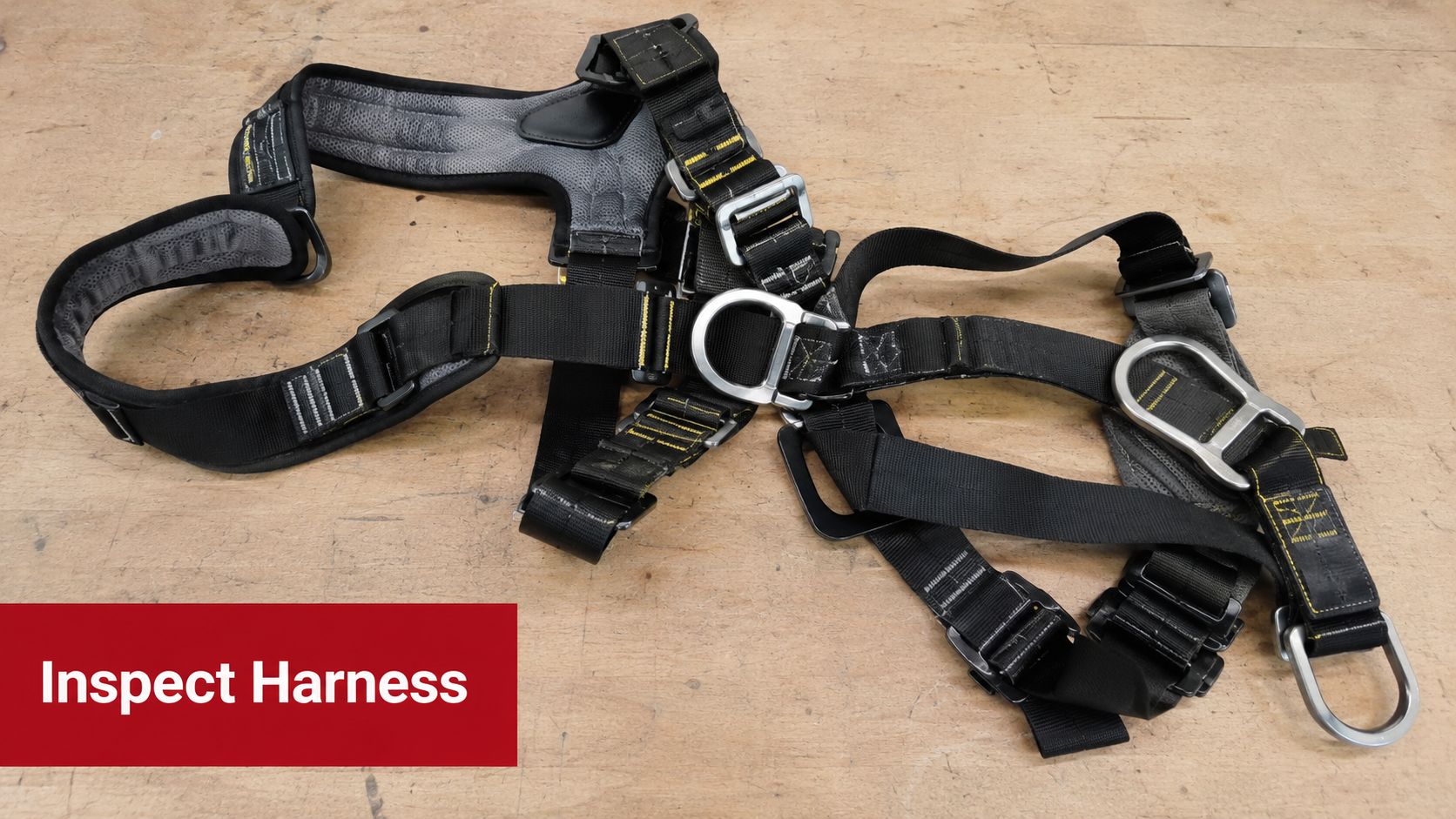
Start with the webbing. Bend it into a shallow U-shape and run your fingers along both faces, edges, and stitched terminations. Heat and sun in Arizona and Nevada often show up as fading, stiffness, or a slightly glazed surface before crews notice an obvious tear. In Colorado, I pay close attention to abrasion, grit wear, and hardware that has seen moisture and temperature swings in storage.
Then check every metal component under load-free movement.
- Inspect load-bearing webbing: Look for cuts, frayed edges, pulled stitching, burns, glazing, brittleness, and chemical damage.
- Check buckles and adjusters: They should thread, seat, and hold without slipping.
- Test carabiners and connectors: Gates must open smoothly, self-close, and fully lock every time.
- Inspect D-rings, side rings, and attachment points: Remove the harness from service for cracks, corrosion, sharp edges, deformation, or looseness.
- Review labels and traceability: If the manufacturer label, serial number, or inspection record is unreadable, the competent person loses a key part of the approval decision.
Rope and harness age do not always track together. A newer harness that sat in extreme heat can be less trustworthy than older gear stored correctly and documented well.
Inspection frequency also needs layers. The user performs a pre-use check before every setup. A competent person documents periodic inspections at the interval required by the employer's program and the manufacturer. Retirement decisions should follow manufacturer criteria for service life, damage, shock loading, contamination, and storage history. If crews want a better technical reference for how pressure testing is handled on hydraulic systems used elsewhere in access equipment, this expert guide on hydraulic pressure testing is useful context, but it does not replace the manufacturer inspection criteria for fall protection gear.
Write the result in the equipment log with the harness ID, date, inspector, defect found, and final disposition. Pass, remove from service, or destroy if required by company policy and manufacturer guidance. In rope work, vague notes create repeat exposure. Clear records keep damaged gear off roofs in Tucson, Denver, and Henderson.
4. Boom Lift and Scissor Lift Hydraulic System Seals and Fluid Levels
The platform is six stories up, the glass is wet, and the lift starts drifting or jerking on descent. That is how a minor hydraulic problem turns into a rescue, a dropped work zone, or an OSHA conversation no contractor wants. In Arizona, Colorado, and Nevada, heat, dust, hard use, and long sun exposure push seals and hoses harder than many crews expect.
For window cleaning work, this inspection has to be more than a quick walk-around. OSHA requires aerial lifts to be inspected before use, and the manufacturer's inspection points still control the final decision. On our crews, any sign of active leakage, damaged hose covering, or unexplained fluid loss puts the machine out of service until maintenance clears it.
Hydraulic checks that matter before the platform leaves the ground
Start at the fluid reservoir sight glass or dipstick, based on the manufacturer's procedure. Fluid that reads low can mean a simple service issue, but it can also mean the machine has been losing oil through a fitting, hose, or cylinder seal. In desert markets like Phoenix and Las Vegas, small leaks often collect dust fast, so a dirty, greasy patch around a fitting deserves a closer look.
Then inspect the system in the places crews usually miss.
- Check fluid level at the approved inspection point: Park on the surface and in the machine position required by the manual. A false reading wastes time and can hide a real problem.
- Inspect hoses for abrasion, cracking, blistering, and sun damage: UV and heat age rubber faster in Arizona and southern Nevada. A hose rubbing on the boom or guard structure will not improve with another shift.
- Look at fittings, valve blocks, and cylinder ports: Dampness, oil tracking, or dirt stuck to wet residue often shows the start of a leak.
- Check cylinder rods and seal areas: Scoring, pitting, or wetness at the rod end can point to seal failure. In hard water areas, residue on the machine can also mask fresh leaks, so wipe and recheck if needed.
- Inspect the ground under the lift before startup and after function tests: New drips matter. So do old stains if the service log does not explain them.
- Review the maintenance record: Repeated topping-off is not normal wear. It is a sign the machine needs diagnosis.
Altitude adds another layer in Colorado. Cold mornings followed by warm afternoons can change how a marginal seal behaves, and rented equipment that ran fine at one site can show weakness at the next. Crews working high access glass should match the machine to the task and the exposure. This overview of window cleaning for high windows gives useful context on when lift access makes sense.
For recurring leaks, pressure loss, or intermittent hydraulic behavior, this expert guide on hydraulic pressure testing is useful background. It does not replace the lift manufacturer's service procedure or the inspection criteria in your company program.
One rule keeps people safe. If the lift leaves a new leak, surges during function testing, or shows a damaged hydraulic component, it does not go up.
Write the result in the equipment log with the lift ID, hour meter, date, inspector, defect found, and final disposition. Clear records matter on multi-crew commercial work in Tucson, Denver, and Henderson, especially when one operator's “minor seep” becomes the next operator's platform failure.
5. Water-Fed Pole Extension Locks and Couplings
A tech is 35 feet out on a water-fed pole in July, the glass is baking, and one section starts to creep. He tightens his grip, shifts his stance, and now his attention is split between the pane and the pole. That is how a ground-based system turns into a strain injury, a slip hazard, or a dropped section near a client entry.
Water-fed poles reduce ladder and lift exposure, but only if the locks and couplings hold their position every time. In Arizona and Nevada, sun, heat, and hard water wear these systems faster than many crews expect. In Colorado, cold mornings, altitude, and big storage-temperature swings can change how clamps bite and how telescoping sections move. A pole that felt fine in the shop can act very different by first light on site.
Start with a full extension and retraction cycle before work begins. Run every section through its full travel. Pay attention at full reach, because that is where worn locks, ovalized tubing, and dirty clamp faces show up.
- Check extension locks under load: Twist-locks should cinch with normal hand force and stay put when the pole is lightly flexed. Lever clamps should close firmly without overtravel or wobble.
- Verify push-button or pin engagement: The lock should seat fully in the hole with a clear, positive engagement. Partial engagement is a defect.
- Inspect couplings and hose connections: Look for weeping, mineral scale, split O-rings, cracked collars, or fittings that rotate too freely.
- Look for UV and abrasion damage: Faded resin, hairline cracks, rough wear spots, and softened clamp pads are common on poles stored in desert yards or truck racks.
- Check section movement: Tubes should slide cleanly without grinding, binding, or sudden drop-through.
Hard water deserves extra attention in Phoenix, Chandler, Henderson, and Las Vegas. Scale builds up inside quick-connects, around threads, and on sealing surfaces. That buildup causes slow leaks and pressure loss, but it also leads crews to overtighten fittings and force locks that should have been cleaned or rebuilt. I have seen a simple crusted coupling turn a controlled pole into a jerky, unstable one by mid-shift.
Operator control matters here too. A long pole with marginal locks forces the worker to compensate with shoulders, wrists, and foot position. Fatigue follows. Then the brush stops tracking straight, rinse quality drops, and the worker starts making corrections instead of staying in control. That is the point to stop, lower the pole, and correct the defect.
OSHA still expects defective equipment to be removed from service, even when the task is performed from the ground. If a section slips, a lock does not engage cleanly, or a coupling leaks enough to affect control, tag the pole out and log the defect. On commercial routes across Tucson, Denver, and the Las Vegas Valley, that record should include the pole ID, the section or fitting that failed, the date, the inspector, and whether the pole was repaired or replaced before returning to service.
6. Scaffolding Frame and Platform Fastener Security
Scaffolding failures usually start at the connection points. One loose pin, one bad brace connection, one platform board that seemed “good enough,” and the whole system loses the margin crews rely on. On multi-story work in Phoenix, Denver, Boulder, and Las Vegas, that's not a technicality. It's the difference between a stable platform and an incident scene.
Scaffolding also tends to sit between trades, between projects, and between weather conditions. That makes inspection more than a setup task. It becomes a condition check on stored components, transported components, and reassembled components.
Connection points deserve the closest look
Start with the hardware. Bolts, clips, pins, lock washers, and brace connections should all be visually checked before assembly and verified again once loaded into their actual configuration. If a fastener rotates by hand when it shouldn't, the problem isn't minor.
- Check critical fasteners: Look for looseness, corrosion, stripped threads, or mismatched hardware.
- Inspect braces under light pressure: They should hold position without flexing or shifting out of alignment.
- Walk every platform section: Soft spots, movement, and uneven seating all mean stop and correct.
- Verify guardrail attachment: The rail should stay firm under downward pressure.
If the scaffold needs “just one more pin later,” it isn't ready now.
Crews in Denver and Boulder often deal with moisture, temperature swings, and storage conditions that reveal corrosion and board warp. Crews in Phoenix see sun exposure and long dry storage cycles that can hide damage until reassembly. Different environments, same rule. Every frame and every deck section gets inspected before the first worker loads the platform.
Records matter after the setup
A good scaffold inspection doesn't end with “looks okay.” Photos of critical connection points, documented defects, assigned corrective action, and release authorization all matter. The strongest inspection systems answer five questions in one record: who inspected, what failed, what interim control was used, what corrective action was completed, and who authorized closure. That's how teams stop recurring defects instead of rediscovering them on the next project.
7. Personal Protective Equipment PPE Condition and Certification Status
PPE is the last barrier after planning, access selection, and equipment inspection. That doesn't make it less important. It makes condition and fit even more important, because damaged PPE gives workers false confidence right when other controls have already been stretched.
For professional window cleaning in Arizona, Colorado, and Nevada, PPE also takes abuse from sun, dust, grit, reflective glare, repeated washing, and constant loading in and out of trucks. A hard hat that spent months baking in a vehicle isn't the same hard hat it was when it was issued.
What gets inspected, not assumed
Hard hats need a shell check and suspension check. Safety glasses need lens clarity, frame integrity, and proper fit. Gloves need real grip, not polished-over palms that look usable until they hit wet aluminum or smooth glass. High-visibility vests need reflective performance, not just bright color.
- Inspect hard hat shell and suspension: Cracks, brittleness, loose suspension, and impact damage mean retirement.
- Check eye protection closely: Scratched lenses reduce visibility and encourage risky head movement and posture.
- Test glove grip: If the surface is slick, flat, or separating, it won't help when hands are wet.
- Verify labels and tags are legible: Certification and identification can't help if no one can read them.
For companies building formal programs, this overview of fall protection training requirements helps connect PPE use with broader safety expectations.
Good PPE still fails in a weak culture
The strongest PPE program is the one where technicians speak up before the shift starts. If the vest is faded, if the glasses distort vision, if the harness tag is unreadable, the answer isn't “use it today and swap it later.” The answer is replacement now.
That culture matters because checklists only work when crews have time and support to use them properly. In practice, the right approach rests on effective tools, targeted training, and enough time to inspect thoroughly. Without those three pieces, any checklist becomes admin work instead of hazard control. That's especially true in window cleaning, where crews move between ladders, lifts, ropes, pure water systems, and public-facing job sites in the same week.
7-Point Equipment Safety Inspection Comparison
| Item | Implementation complexity | Resource requirements | Expected outcomes | Ideal use cases | Key advantages |
|---|---|---|---|---|---|
| Squeegee Blade Condition and Edge Sharpness | Low–Moderate, visual and tactile checks each job; trained eye for micro-damage | Spare blades, bright light, storage, routine replacements | Streak-free results; reduced application force and technician fatigue | Routine residential and commercial window cleaning, high-volume jobs | Improves cleaning quality and efficiency; extends equipment life |
| Ladder Base and Rung Structural Integrity | Moderate, hands-on inspection, functional testing, periodic retirement | Inspection tools, replacement ladders, documentation/logs | Stable access; prevents fall incidents and equipment failure | Residential and low‑rise commercial access where ladders are primary | Prevents falls; supports full equipment loads and stability |
| Rope Descent System (RDS) Harness Webbing and Hardware | High, requires OSHA/ANSI-trained inspectors and documented protocols | Replacement harnesses/hardware, storage, re-certification, trained personnel | Prevents catastrophic falls; meets regulatory and insurance requirements | High‑rise and mid‑rise rope descent operations on commercial buildings | Life‑saving protection; strong regulatory compliance evidence |
| Boom Lift and Scissor Lift Hydraulic System Seals and Fluid Levels | High, technical fluid and pressure checks by certified technicians | Hydraulic fluid, seals/hoses, certified maintenance, proper disposal | Controlled lift operation; prevents sudden elevation loss and spills | High‑rise lift access, rental fleets, pressure‑sensitive jobs | Ensures operational safety and prevents environmental contamination |
| Water‑Fed Pole Extension Locks and Couplings | Low–Moderate, functional extension/coupling tests and cleaning | O‑ring/spare sections, cleaning supplies, periodic replacements | Secure pole extensions; leak‑free water delivery and reduced failures | Low‑rise residential and low‑rise commercial cleaning to avoid ladders | Enables ladder‑free cleaning; conserves water and reduces recovery incidents |
| Scaffolding Frame and Platform Fastener Security | Moderate–High, assembly inspection, fastener torque checks, load testing | Trained crew, wrenches/torque tools, spare fasteners, inspection records | Stable work platforms; prevents platform shift or collapse | Multi‑story commercial projects and prolonged exterior work | Allows safe, efficient prolonged work; protects personnel and property |
| Personal Protective Equipment (PPE) Condition and Certification Status | Low–Moderate, routine visual checks and certification tracking | Replacement PPE, training, administrative tracking system | Reduced head/eye/fall injuries; consistent compliance | All projects as primary defensive measure for crews | Broad injury prevention; ensures compliance and visibility standards |
Beyond the Checklist Building a Culture of Safety
At 2 p.m. in Phoenix in July, a ladder shoe that looked acceptable at the yard can start slipping on hot, polished concrete. In Denver, thinner air and fast afternoon weather changes can turn a routine suspended job into a different risk profile by mid-shift. In Las Vegas, hard water buildup and constant heat shorten the service life of moving parts faster than many crews expect. A checklist still matters in all three places, but it only works if the crew has clear authority to stop the job the moment equipment or site conditions fall outside safe limits.
That standard has to be real on the ground. If a technician says a ladder foot is worn, a pole clamp is not holding, or harness webbing feels stiff from sun exposure, the work stops until someone verifies the condition and makes the correction. Schedule pressure cannot override that call. I have seen small defects turn into expensive incidents because someone wanted to finish one more drop, one more elevation, or one more building face before pulling gear out of service.
Documentation is part of that safety culture, but paperwork alone does not protect anybody. Useful records show the time, equipment ID, who found the defect, how serious it was, what corrective action was assigned, and who cleared the item to return to service. Photos help, especially with cracked rung caps, glazing on rope, UV-damaged webbing, and corrosion that crews in Arizona, Colorado, and Nevada see regularly from sun, mineral deposits, and temperature swings. Those records also support OSHA compliance by showing that inspections, removals from service, and corrective actions were handled consistently instead of informally.
Clients should ask about that process. Property managers, facility teams, and homeowners hiring a window cleaning contractor in Phoenix, Scottsdale, Denver, Las Vegas, or surrounding areas should ask who performs pre-use inspections, how damaged equipment is tagged out, and what training crews receive for ladders, lifts, rope descent systems, scaffolding, and PPE. A contractor that takes safety seriously will answer directly and explain the process without hesitation.
Site communication matters too. Exclusion zones, overhead work notices, and access restrictions need to be obvious to the crew, building occupants, and the public. Clear on-site communication is a universal safety principle, and this industrial safety signage in Adelaide guide is a useful example of how seriously companies treat visible warnings and controlled access, even outside our service area.
Good window cleaning depends on the same discipline that prevents injuries and property damage. Inspect the equipment. Record the defect. Pull unsafe gear from service. Correct the problem before work resumes. That is how crews protect people, stay aligned with OSHA requirements, and keep jobs running safely in the heat, altitude, and mineral-heavy conditions common across Arizona, Colorado, and Nevada.