



Forget the wobbly ladder you pull out of the garage once a year. When you see a professional window cleaner scaling a building, you're not just watching someone with a squeegee—you're seeing a highly trained technician using a specialized arsenal of professional tools. For them, reaching difficult windows isn’t about taking risks; it’s about calculated precision using ladders, boom lifts, scaffolding, rope descent systems, and pure water to wash windows.
How Professionals Reach Every Window Safely
For a real pro, a ladder is just one tool in the toolbox. The true story behind cleaning windows at height, whether it's a two-story home in Scottsdale or a commercial complex in Denver, is about mastering safety, efficiency, and picking the right access method for that specific job. That means knowing when a ladder is the perfect tool, and more importantly, when it's time to switch to something safer and more effective.
The industry's commitment to safety has completely changed the game. Modern training and better technology have transformed a field that was once notoriously hazardous. Back in the 1990s, OSHA data revealed that U.S. window cleaners faced a shocking 1-in-10 annual injury risk from ladder falls alone. Today, thanks to mandatory annual OSHA 1910.27 training, fatalities have plummeted by an incredible 85%. You can read more about these industry safety statistics on GetJobber.com.
A System of Safety and Precision
A professional window cleaning company doesn't just show up and start climbing. Their entire service is built on a foundation of strict safety protocols and specialized equipment. It's an approach designed to get every window perfectly clean without putting their technicians, your family, or your property at risk.
This system is built around three core pillars:
-
Specialized Ladders: These aren't your average hardware store ladders. They're designed for maximum stability on all sorts of tricky surfaces.
-
Strict Safety Protocols: Every technician lives by these rules. No exceptions.
-
Advanced Alternatives: For situations where ladders are impractical or unsafe, the pros have other tools ready to go, including boom lifts, scaffolding, and rope descent systems.
When it comes to the tallest structures, ladders are off the table entirely. This is where technicians use highly sophisticated methods, relying on skills like those detailed in our guide on professional rope access window cleaning.
Ultimately, professional window cleaning is a science. It’s about assessing each property's unique challenges—from the delicate landscaping at a Paradise Valley home to the steep slopes of a property in Boulder—and then selecting the precise tool to deliver a perfect, safe shine. Let's dive into the specific ladders, safety rules, and modern alternatives that define how the pros get the job done right.
The Specific Ladders Window Cleaners Trust
Walk into any hardware store, and you'll see a dozen different types of ladders. But for a professional window cleaner, the standard A-frame just doesn't cut it. Our toolkit is filled with specialized ladders, each chosen for a specific job to guarantee safety, stability, and a perfect, streak-free view every single time.
The real workhorse of our fleet is the extension ladder. This is our go-to for safely reaching those second and third-story windows on residential homes and commercial storefronts. Built from rugged yet lightweight materials like fiberglass or aluminum, a good extension ladder lets a technician get to the perfect height and angle to make sure every corner of the glass is spotless.
Specialized Ladders for Unique Challenges
But what happens when the ground isn't perfectly level? For a house built on a slope in a city like Golden or a property with tricky landscaping, a standard extension ladder becomes a liability. That's when we bring out the sectional ladders (also known as stack ladders). These are made of multiple smaller sections that lock together, allowing us to build a ladder to the exact height needed. More importantly, they often have adjustable feet to create a rock-solid base on uneven terrain.
Then there are the interior jobs that seem impossible, like cleaning a massive foyer window perched right above a grand staircase. An extension ladder won't work, and a stepladder won't reach. The hero here is the articulating ladder. With its clever hinged joints, it can be configured into all sorts of shapes—like a small scaffold or an angled A-frame—to safely bridge the gap over stairs where no other ladder could be securely placed.
The choice of ladder is never random. It’s a calculated part of a larger safety system that includes proper setup, regular inspections, and ensuring the technician has the right training for that specific piece of equipment.
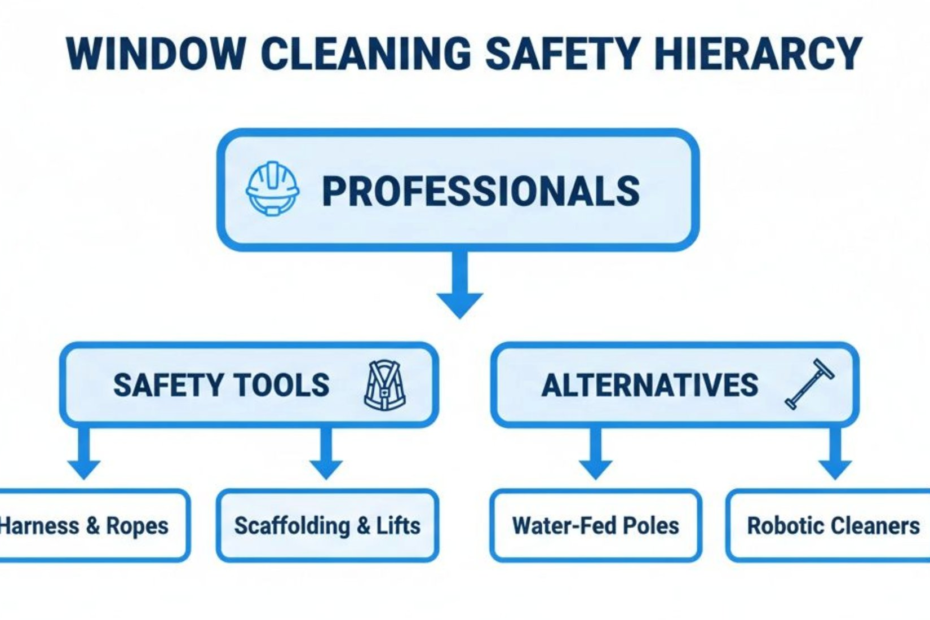
The following diagram shows how professionals think about job site safety, starting with the safest methods first.
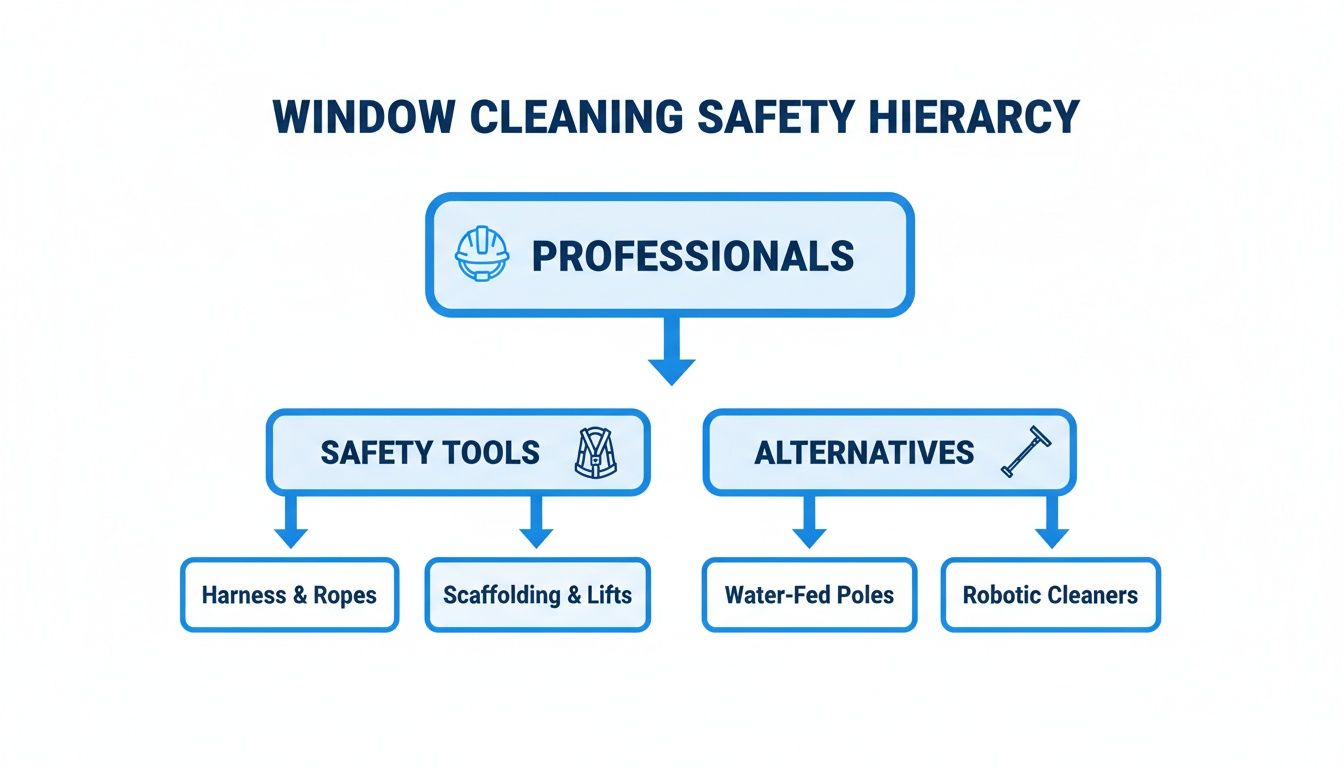
This hierarchy makes it clear: while having the right safety gear is non-negotiable, a true pro’s first decision is knowing which method is safest for the job—and that often means finding an alternative to ladders altogether.
Comparing Professional Window Cleaning Ladders
To make sense of the options, here's a quick breakdown of the common ladder types trusted by professional window cleaners, what they’re used for, and the safety features that matter most.
| Ladder Type | Primary Use | Best For | Key Safety Feature |
|---|---|---|---|
| Extension Ladder | Reaching upper-story windows | Standard two and three-story buildings with flat ground | Locking mechanisms (rungs) and non-slip feet |
| Sectional (Stack) Ladder | Assembling custom heights | Properties with uneven terrain or sloped ground | Multiple interlocking sections and adjustable leveling feet |
| Articulating Ladder | Versatile interior access | Awkward spaces like stairwells or above obstacles | Multi-position locking hinges for stability in various shapes |
| A-Frame / Step Ladder | Low-level interior & exterior work | Ground floor windows or interior glass partitions | Spreader bars that lock the ladder in an open position |
Each ladder in our arsenal is chosen to solve a specific access challenge. This commitment to using the right tool for the job is what separates a professional service from everyone else.
Of course, ladders are just one piece of the puzzle. They are part of a much larger collection of equipment we rely on. You can learn more about the complete toolkit in our overview of professional window cleaning tools.
Why OSHA Compliance Is A Homeowner's Best Friend
When a professional window cleaner sets a ladder against your house, their movements are guided by more than just experience—they’re following a strict set of safety standards. These rules, laid out by the Occupational Safety and Health Administration (OSHA), are your biggest assurance that the job gets done right, and more importantly, without anyone getting hurt.
For homeowners and property managers in places like Phoenix or Las Vegas, hiring a company that lives and breathes OSHA compliance is the single most important decision you can make. It’s the difference between a professional service and a risky gamble.
Think of an OSHA-certified technician the same way you’d think of a licensed pilot. Both go through tough, continuous training to handle risk in high-stakes environments. This isn’t a one-and-done certificate; it's an ongoing commitment to safety that protects the technician, you, and your property from serious liability.
Cornerstone Rules of Ladder Safety
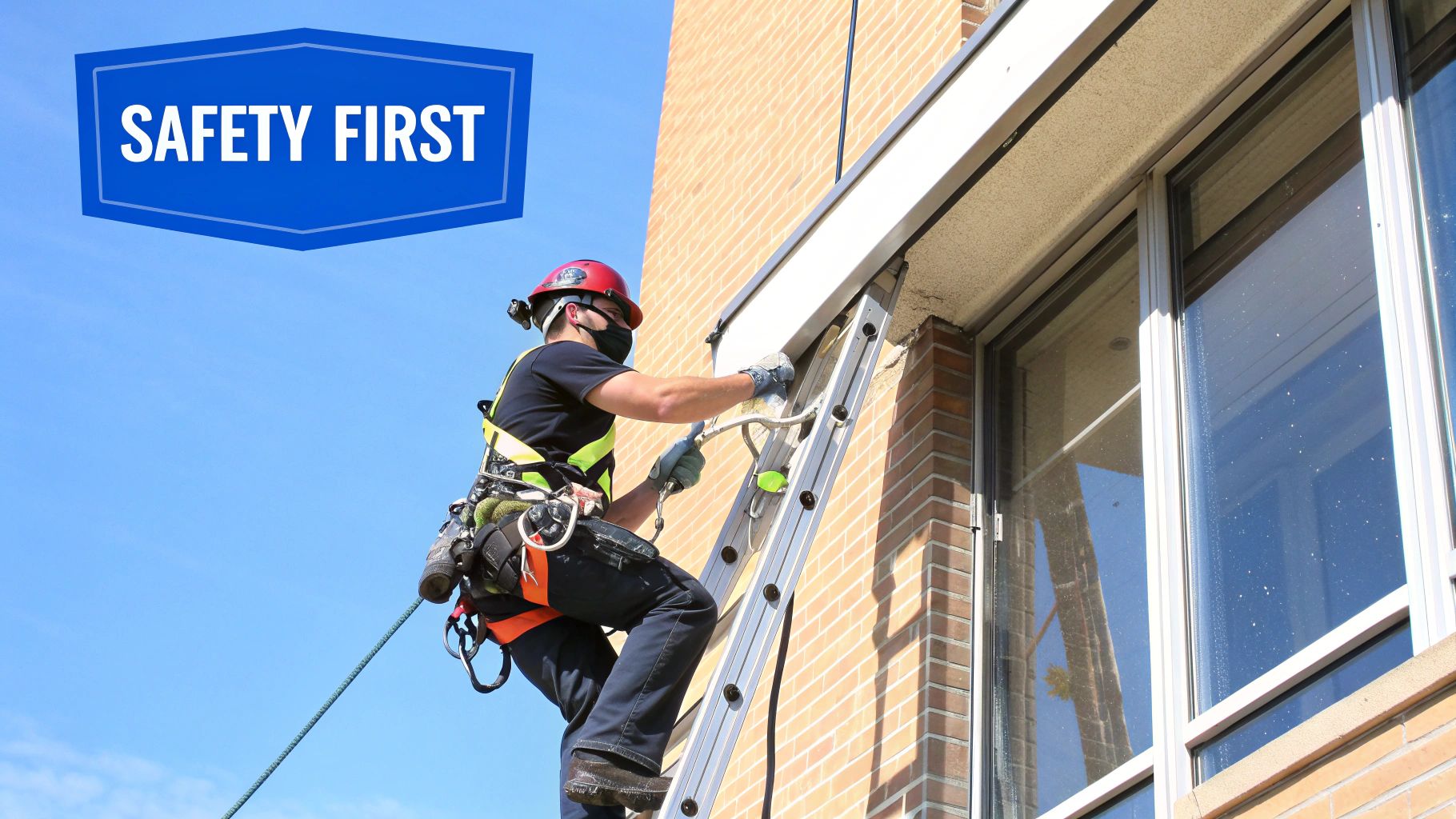
You don't have to be a window cleaner to spot a pro. There are two fundamental OSHA rules that form the bedrock of safe ladder use. When you see a technician following them, you know you’re in good hands.
-
The Three Points of Contact Rule: This is the golden rule of ladder stability. While climbing or coming down, a technician must always keep three points of contact on the ladder. That means two hands and one foot, or two feet and one hand. It creates a stable triangle of support that dramatically cuts the risk of a slip or fall.
-
The 4-to-1 Angle Rule: The angle of a ladder is everything. For every four feet of height the ladder reaches, its base needs to be one foot away from the wall. This specific angle is the sweet spot that keeps the ladder from slipping out from under the worker or tipping backward.
A technician who sticks to these rules isn't just "being careful." They're demonstrating professional training and a deep respect for a safe job site. It’s this discipline that separates a true professional from a handyman with a ladder.
Your Protection Against Liability
Hiring an uninsured or poorly trained person to work on your property is a huge financial risk. If an accident happens, you could find yourself on the hook for medical bills and damages. That's why verifying a company's insurance and OSHA training is non-negotiable.
Before these standards were taken seriously, ladder-related accidents were tragically common. In the 1970s, OSHA reported over 100 fatalities annually from falls during window cleaning, with ladders involved in a staggering 40% of those cases. This led to the 1971 OSHA 1910.27 regulation, which mandated secure ladder use and harnesses—a change that slashed deaths by 65% by 1985.
When a company invests in annual OSHA training and full insurance coverage, they are investing in your peace of mind. It’s a clear signal that they take responsibility for their team's safety, removing that burden from you.
This commitment to safety goes far beyond ladders. It applies to all high-access work, including the critical practice of ensuring a building is safe with certified roof anchor testing. If you want to understand how legitimate companies prove their safety credentials, it’s worth looking into what an Occupational Health and Safety (OHS) certification entails. It shows just how deep a real commitment to safety goes.
When Ladders Are The Wrong Tool For The Job
Any experienced pro knows the best ladder for many jobs is no ladder at all. While they’re a core part of our toolkit, a ladder isn’t always the safest or most effective way to get your windows sparkling. Plenty of situations demand a different approach—one that better protects our crew, your home, and your property.
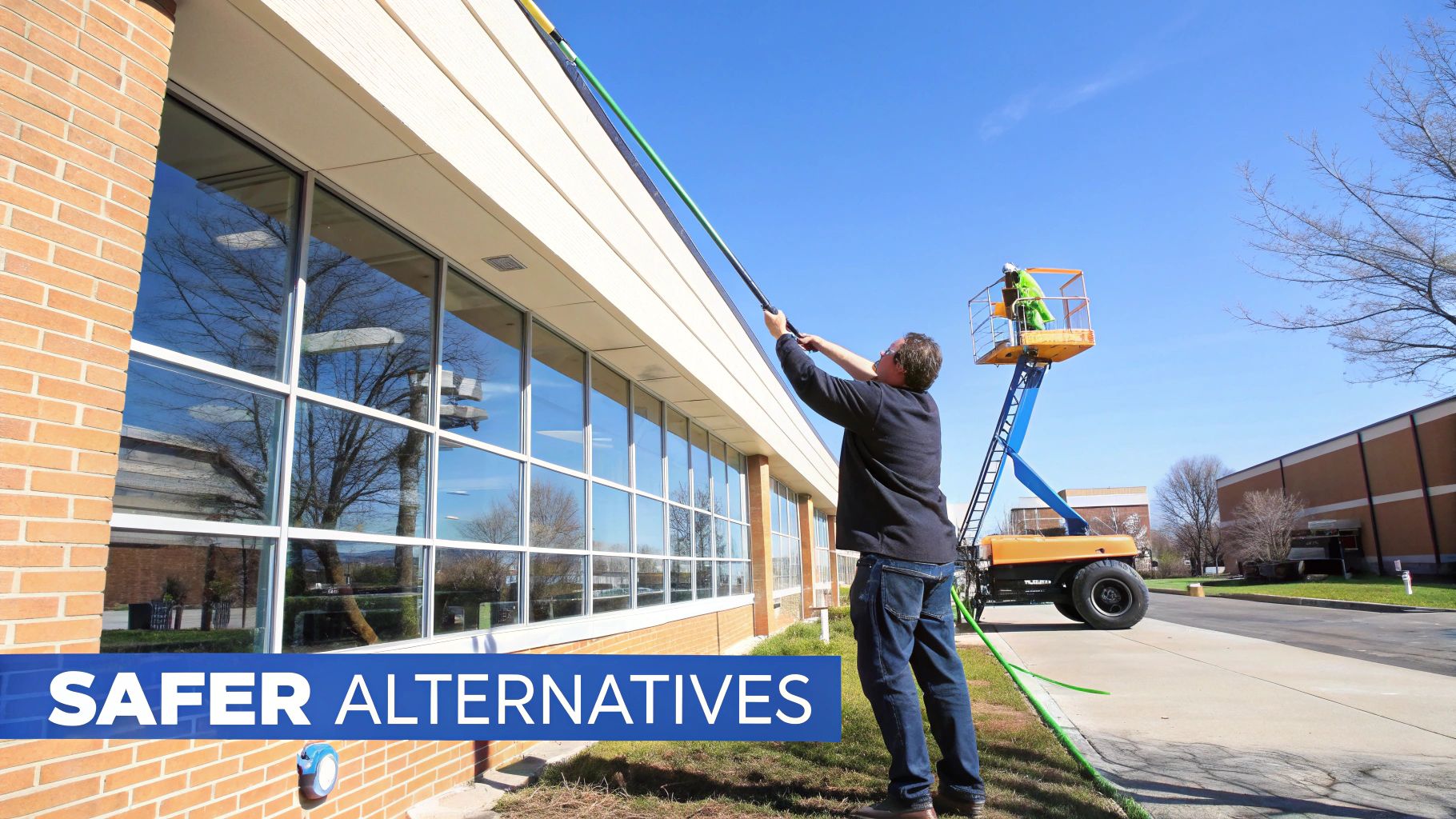
This is especially true when working around delicate landscaping, over intricate architectural features, or on soft, uneven ground. Setting up a heavy ladder on a perfect lawn or in a prized garden bed is just asking for trouble. For these tricky spots, modern alternatives deliver a flawless finish without leaving a trace.
Modern Alternatives For Safer Access
When ladders get sidelined, we bring in a new set of high-tech tools designed for maximum safety and efficiency. These methods let our teams achieve incredible results on even the most complex properties.
Water-Fed Poles
The most common ladder alternative is the water-fed pole system. This fantastic piece of technology uses lightweight, extendable carbon fiber poles to pump purified water right to the glass. A special brush scrubs away all the dirt, and because the water is completely deionized, it dries to a perfect, spot-free shine. No squeegee needed.
A water-fed pole lets our technicians clean windows up to five stories high, all while keeping their feet firmly on the ground. It’s safer, often faster, and incredibly effective.
Lifts and Aerial Work Platforms
For larger commercial properties—think office buildings in Tempe or retail centers in Arvada—we bring in the heavy hitters. Boom lifts and scissor lifts give our crews a stable, elevated platform to work from. This allows them to methodically clean huge sections of glass with traditional, professional squeegees, ensuring every window gets the same hands-on attention.
Rope Descent Systems
But what about the tallest high-rises in downtown Denver or the resort towers of Las Vegas? When even a boom lift can't reach the top, our highly trained technicians turn to advanced rope descent systems. This specialized skill, often called rope access, involves using a complex setup of ropes, harnesses, and anchors to safely navigate a building’s facade, delivering a perfect clean from the penthouse down to the lobby.
Knowing which tool to use for every unique situation is what separates the amateurs from the pros. You can see a full comparison of these modern approaches in our guide to water-fed poles vs. traditional methods.
To make it even clearer, we've put together a simple table to help property owners understand which method is right for their building.
Choosing The Right Window Access Method
This table breaks down common scenarios and the best tool for the job, explaining why a professional would choose one method over another.
| Situation | Best Access Method | Why It's Chosen |
|---|---|---|
| 1-3 Story Home with Delicate Gardens | Water-Fed Pole | No ground disturbance, safe for technicians, excellent results without ladders tearing up the lawn. |
| 4-5 Story Apartment Complex | Water-Fed Pole or Small Boom Lift | WFP is fast and efficient for this height. A lift may be needed for stubborn stains or complex architecture. |
| Mid-Rise Office Building (6-10 stories) | Boom Lift | Provides a stable platform for multiple technicians to work efficiently on large glass panels. |
| High-Rise Skyscraper (10+ stories) | Rope Descent System | The only practical and safe method to access the entire facade of very tall buildings. |
Ultimately, a true window cleaning professional has a complete toolbox of solutions—not just a ladder. They assess the property, consider the risks, and select the safest, most effective method to make your windows shine.
Your Checklist For Hiring A Window Cleaning Service
Hiring a professional window cleaning service should give you peace of mind, not a new set of worries. To make sure you’re bringing a safe, reliable, and genuinely skilled team to your property, you need to ask the right questions before they ever set a ladder against your wall.
Think of this as your simple, straightforward checklist for making a smart hiring decision. Whether you own a home in Phoenix, AZ, manage a commercial building in Denver, CO, or oversee a sprawling resort in Las Vegas, NV, these are the non-negotiables. A true professional will have confident, immediate answers for every single point.
Insurance and Training Verification
First things first: safety and liability. These are the most critical questions you can ask, because an accident involving an uninsured worker on your property could quickly become your financial nightmare.
-
Can you provide proof of General Liability and Workers' Compensation insurance? Don't just take their word for it—ask for a current Certificate of Insurance. General Liability protects your property from damage, and Workers' Comp covers their employees if they get hurt on your job. Never, ever skip this step.
-
Are your technicians annually trained and certified for OSHA safety standards? A reputable company doesn’t just do a one-and-done safety meeting. They invest in ongoing education, especially for the people using ladders, lifts, and other access equipment. This shows a deep-seated commitment to a safe work culture.
Methods and Professionalism
Once you've confirmed they're properly insured and trained, it's time to dig into their actual process and business practices. The way they answer these questions will tell you everything you need to know about their expertise and how much they value their customers.
A truly reliable service thinks about more than just the glass. They consider the entire customer experience, often using tools like live receptionist services for small businesses to ensure they never miss a call, even when the whole crew is out on a job. It's a small detail that speaks volumes.
Your goal is to hire a company that has a plan for everything—from answering the phone to safely accessing a third-story window. This indicates a well-run operation that values both its clients and its employees.
Ask them to get specific about their approach to your property. Will they be using traditional ladders and professional squeegees, or does the job call for a pure water system operated from the ground? For more complex properties in places like Scottsdale or Boulder, do they have proven experience with boom lifts or even rope descent systems? Their ability to match the right tool to the job isn't just a sign of professionalism—it's a sign of a true expert.
Putting It All Together: Flawless Views, Delivered Safely
So, what's the big takeaway here? It's simple: ladders are still an essential tool in a window cleaner’s arsenal, but they’re only one part of a much bigger picture.
True professionalism isn’t just about having the right ladder. It’s a complete system that weaves together rigorous training, modern tech like pure water systems, and an unshakeable commitment to safety. The goal isn't just to get the windows clean; it's to deliver that brilliant, streak-free shine without putting anyone—or anything—at risk.
The only way to guarantee a truly worry-free shine is to hire a team that is certified, fully insured, and brings years of hands-on experience to your property. This decision transforms a potentially hazardous job into a seamless, professional service, whether it's for a home in Paradise Valley, AZ, or a commercial building up in Boulder, CO.
The Professional Promise
A truly professional company doesn't just promise clean glass—they promise reliability, accountability, and total peace of mind. This commitment is built on a few core principles that protect you, the property owner, from the moment we arrive until the job is done.
-
Verified Safety Protocols: Our technicians live and breathe OSHA guidelines. That means everything from nailing the 4-to-1 ladder angle to choosing the right access equipment for every unique situation is second nature.
-
Comprehensive Insurance: We carry full general liability and workers' compensation coverage. In the highly unlikely event of an accident, you are completely protected from any and all liability. No exceptions.
-
Guaranteed Satisfaction: A job isn't finished until you are 100% satisfied with the sparkling, streak-free results. It’s as simple as that.
For property owners across Arizona, Colorado, and Nevada, this professional approach is our promise of unmatched safety and reliability. We build trust by being transparent and delivering consistently excellent results, every single time.
Ultimately, hiring a professional team is an investment in your peace of mind. From the moment our crews pull up in cities like Tempe or Chandler, you can relax, knowing that every single step is being handled with expert care.
The result? A flawless view achieved the right way—safely, efficiently, and without a single compromise.
Your Questions About Ladder Use, Answered
Even after we've walked through our methods, we find homeowners still have some very specific—and very important—questions about how ladders will be used on their property. It's your home, after all. Here are the honest answers to the questions we hear most often.
Will Ladders Damage My Home or Landscaping?
This is probably the number one concern we hear, and it’s completely valid. We’ve all seen what an amateur with a heavy ladder can do: dented gutters, scratched siding, and crushed flowerbeds are all too common.
That’s why a professional team is different. We take multiple precautions to leave your property completely untouched. We use specialized, padded ladder mitts that slip over the top rails, creating a soft cushion that prevents any scuffs or scratches on your home's exterior.
More often than not, we also use ladder stand-offs. These clever devices brace against the wall or roof itself, completely bypassing your gutters and putting zero pressure on them. And before any ladder goes up, our first step is always finding stable, clear ground for careful placement.
Is It Safe For Your Team To Work In Extreme Weather?
Absolutely not. The safety of our technicians is our top priority, and that means we have a zero-tolerance policy for working on ladders in hazardous weather. We never take that risk. Our protocols are fine-tuned for the specific climates in the areas we serve.
-
Arizona Heat: During the intense summer months in Phoenix and Glendale, we start our days early to work in the cooler morning hours, keeping our team safe and hydrated.
-
Colorado Winters: For our clients in places like Denver and Westminster, the first sign of ice, snow, or dangerously high winds means we reschedule. A slippery ladder is a non-starter.
-
Nevada Wind: In windy spots like Laughlin, we keep a constant eye on the forecast. Strong gusts can turn ladder work unstable in a heartbeat, and we won't risk it.
Are Ladders My Only Option For High Windows?
Not at all. In fact, for many homes with third-story windows or tricky architectural features, ladders are often not the best tool for the job. The key is a professional site evaluation to figure out the safest and most effective approach for your specific property.
The safest and most efficient solution is often a modern, ladder-free alternative. We always assess the job to select the method that best protects both our team and your property.
For homes in communities like Paradise Valley or up in Flagstaff, we frequently use our water-fed pole systems. These amazing tools let us clean windows up to five stories high, all while our feet are firmly on the ground. By using purified water, we get a perfect, spot-free finish without ever leaning a ladder against your home.
Ready for a streak-free shine without the worry? The team at Professional Window Cleaning has the training, tools, and commitment to safety to make your windows sparkle, no matter how high they are.