




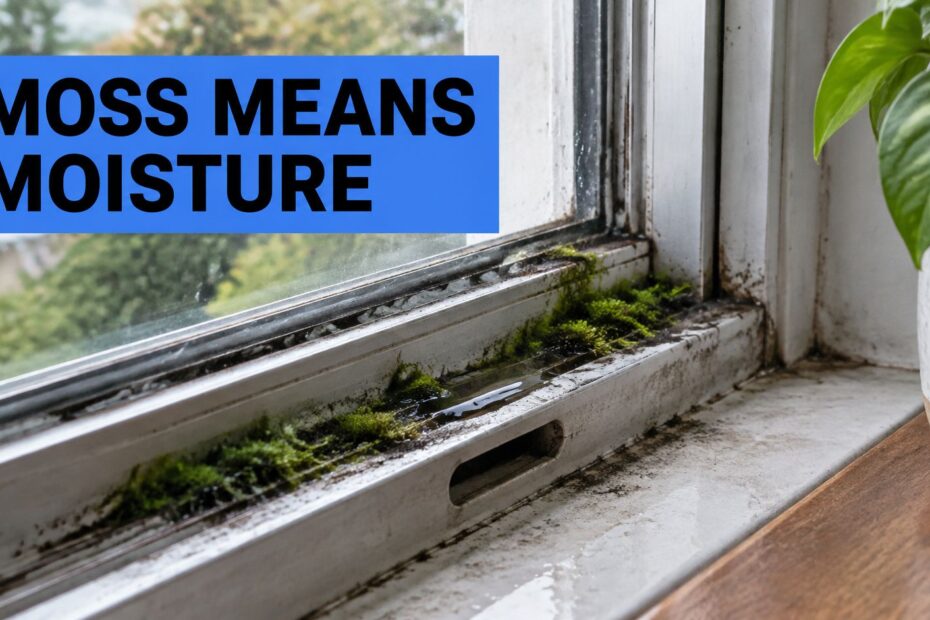
Moss in a window track is not a housekeeping failure. It is a report that water is sitting longer than the sill was built to allow. A green line along the recess means the track stayed damp. It does not mean someone skipped the dusting.
Scrubbing the growth and walking away leaves the cause in place. Spores and small fragments settle again on the same wet film. I would trace the water before I touch the growth.
The diagnosis is the same on a ground-floor slider and on a shaded commercial façade in Phoenix, Scottsdale, Denver, or Las Vegas. What changes is how you reach the track, and whether the moisture is rain, irrigation, a failed joint, or condensation on cold glass.
Why Moss Grows in Window Tracks
Moss growing in window tracks is a drainage clue before it is a cleaning job.
Moss is a nonvascular plant. It has no xylem or phloem, so it cannot move water up through roots the way a shrub does. It absorbs moisture and nutrients across its surface. Wind drops spores and small fragments into the recess. If that spot stays damp and shaded, the fragments anchor and spread.
A west-facing slider can take a monsoon squall in the Valley, or a spring shower along the Front Range. Rain runs into the track. A sprinkler adds a second dose. Condensation adds a third on cold glass. Dirt plugs the drain slots, so the water sits. The track works like a shallow bathtub with a slow drain, and the green edge marks the level the water kept reaching.
The U.S. Environmental Protection Agency recommends keeping indoor relative humidity below 60%, ideally between 30% and 50%, because higher humidity drives condensation and biological growth. Moderate room air can still wet a cold frame when the glass and metal stay cooler than the room.
Visible moss points to recurring wetness, shade, restricted drainage, or a mix of those three. Wipe the green off and leave the water path untouched, and the same film returns on the same damp line.

A check you can run today. After rain, or after the sprinklers finish, look at the track the next day.
- Still glossy a full day later: The recess is holding water. That is the condition moss needs.
- Dry by afternoon on a sunny wall, wet on the shaded one: Shade and weak airflow are doing as much as the storm.
- Wet only beside one head: Irrigation overspray is feeding that sill, not the weather.
Practical rule: If the track is still wet a day after water arrived, treat it as a drainage or shade problem and find the feed.
Tell Moss Apart From Mold, Algae and Mineral Deposits
Green does not automatically mean moss. A track collects dust, pollen, dead insects, standing water, and weather film. The right response depends on what you are looking at.
Sort the film before you clean
Moss forms small leafy clumps, green to yellow-green, that grip the surface. You can often lift a tuft with a fingernail and see a tiny plant, not a stain.
Algae is a slick green or black film, often on glass and sills. It smears. It doesn't hold a leafy shape.
Mold is fuzzy or powdery in patches and smells musty. It shows up where condensation or a leak keeps a surface damp, including the room side of the frame.
Mineral deposits form a white crust that doesn't wipe away easily. In hard-water markets that crust is often spray and evaporation, not biology. Our guide to what removes hard water stains covers that crust on glass without turning the track into a pond.
Dirt with organic debris is a crumbly grey layer. Vacuum it before you wet anything, or you just make mud.
| Appearance | Likely Identity | Response |
|---|---|---|
| Small leafy green to yellow-green clumps gripping the surface | Moss | Clean, dry and fix the water source |
| Slick green or black film on glass and sills | Algae | Clean and dry, then check for persistent wetness |
| Fuzzy or powdery patches with a musty smell | Mold | Assess before cleaning; porous material may need removal |
| White crust that does not wipe away easily | Mineral deposit from hard water | Remove gently and check the water source |
| Crumbly grey layer mixed with debris | Dirt with organic matter | Vacuum debris, then clean and dry |
Small, accessible growth on a hard track can be cleaned and dried, then the moisture cause fixed. Growth on porous trim or drywall beside the track needs assessment before any brushing. That material may need to come out, not just get wiped.
Repeated regrowth calls for a look at the building envelope or the ventilation, not another pass with a brush. On offices, multifamily buildings, and high-rises, tracks are often out of reach. Document the condition with dated photos and assign the work among janitorial, maintenance, glazing, and HVAC teams. Improvised bleach on an upper floor is a poor substitute for that handoff.
Visible growth alone doesn't prove dangerous indoor air. Recurring growth is evidence of a moisture path, and that path should not be ignored.
Find Where the Water Is Coming From
Work out the water source before you touch the growth. Scrubbing alone leaves the cause in place, and a clean track that refills in a week hides a building problem behind a tidy sill.
Start by locating the growth. Exterior track after storms, room-side track near the glass, one window only, or a run beside an irrigation zone. Each pattern points somewhere different.
| Symptom | Likely Source | Quick Check |
|---|---|---|
| Growth on the exterior track after storms | Rain or blocked weep holes | Pour a measured cup of water in and time how long it takes to drain |
| Growth beside an irrigation zone | Sprinkler overspray | Run that zone and watch where the spray lands on the sill |
| Growth on the room-side track near the glass | Condensation from indoor humidity | Measure indoor relative humidity with a hygrometer |
| Stains or soft trim below one window | Failed sealant or frame joint | Probe the caulk line for gaps or softness |
| Growth returns within weeks of cleaning | Active water path still present | Recheck drainage and flashing before cleaning again |
| Shaded track that stays damp for days | Slow evaporation in shade | Compare with a sunny track on the same wall |
Read the track like a drain test
If water pools after rain, pour a measured cup into the track and time the exit through the exterior weep openings. A track that still holds that water the next day has a drainage problem. Debris in the weep channel is the usual culprit. A crushed sill or a blocked exterior slot is the less obvious one.
Room-side growth calls for a different check. Run a hygrometer near the window and look at the glass on cold mornings. The EPA brief guide on mold and moisture treats moisture as the controlling factor for indoor mold and notes that condensation on windows can signal too much humidity indoors. Occupants often read that film as poor housekeeping. It is more often a humidity or envelope issue, and better ventilation or longer window-opening time can reduce it.
Stained or soft drywall and trim below one window point past the track. Probe the caulk line for gaps. If the wall itself is wet and you can't see the entry, spotting hidden water leaks at home is a more useful next step than another cleaning. Aggressive washing without that check can conceal a failed joint.
Growth that returns within weeks means the water path is still active. Write a short note before you move to fixes: which side, how long water sat, whether trim is soft, and what the hygrometer read. That list keeps the next visit from starting over.
How to Clean and Dry the Track Safely
The aim is to remove the growth and the debris that holds water, not to flood the track. High pressure around seals and interior-facing tracks pushes water behind the frame. A low-volume rinse does not.
Check the identification table before step 1. If the growth has reached drywall, porous trim, or the room-side sill, stop. Assess that material before brushing or rinsing.
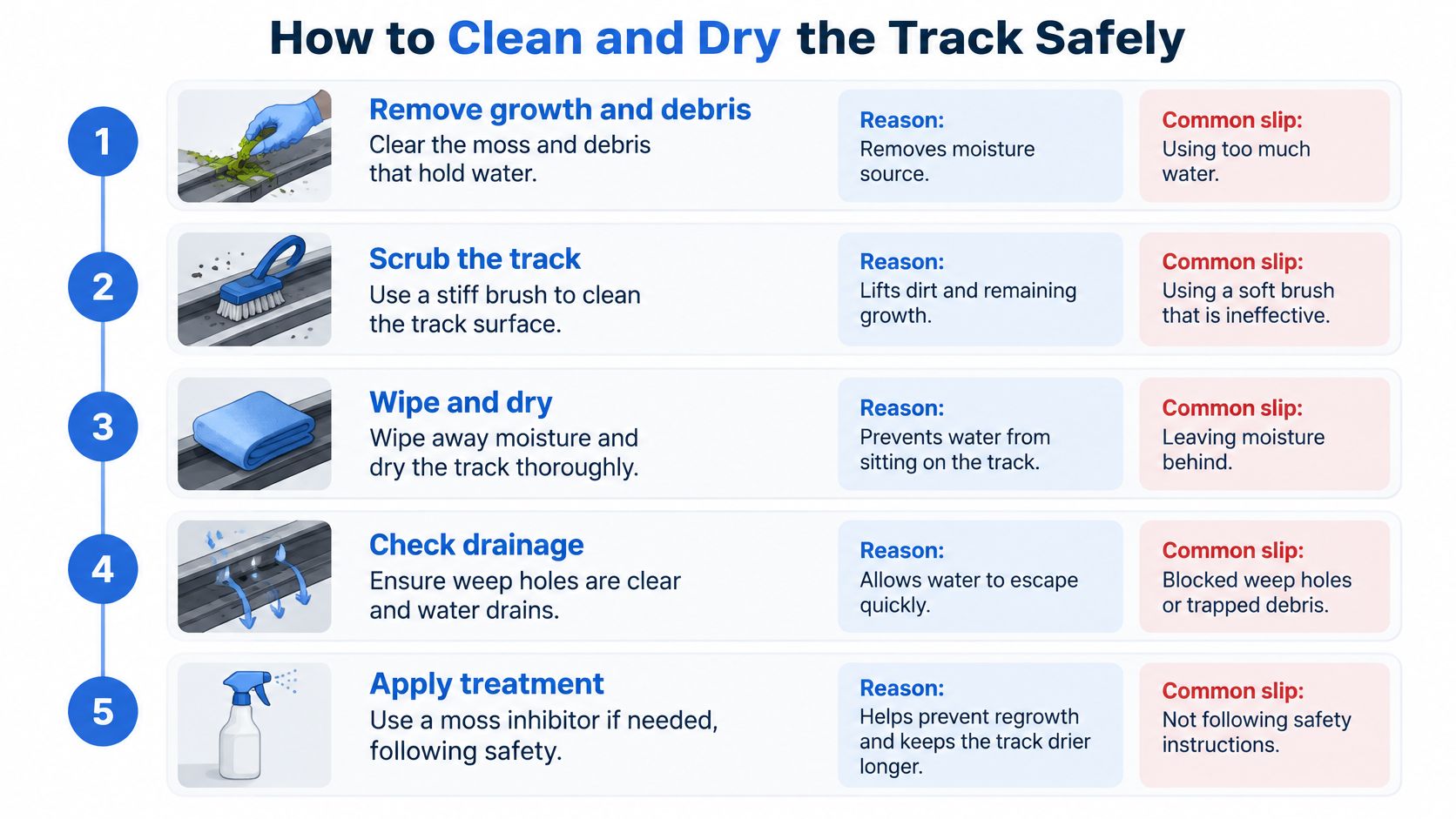
- Photograph the track and mark the extent of growth. You need a before image so you can tell whether the patch shrinks after the water is gone. Skipping the photo makes the next visit a guess.
- Vacuum loose debris, dead insects, and dust with a brush attachment. That material is the sponge. Leave it, and any rinse just redistributes mud toward the weep slots. A shop vacuum with a narrow nozzle reaches the corners a cloth misses.
- Dampen the track with pure water at low pressure, from a water-fed pole or a hand sprayer. Pure water lifts film without leaving a residue that holds the next spore. The slip is a pressure washer or a wide-open hose. Both drive water under the frame.
- Loosen the growth with a nonmetallic brush, working along the track so debris moves toward the drain. Plastic or brass-bristle detail brushes won't score anodized aluminum the way steel does. Don't saw across the weep slots or you'll pack them tighter.
- Rinse with a low-volume flow aimed at the exterior weep openings, and watch the water leave. Rinsing from the inside pushes water toward the wall cavity. If nothing exits outside, stop and clear the slot before you add more water.
- Dry the track with a microfiber cloth and let it air for 24 hours before you close the sash. A closed, wet track recreates the bathtub overnight. On a white mineral film that remains after the biology is gone, a measured dose of window cleaning concentrate on a cloth beats soaking the sill. Keep it off drywall and fabric.
- Check the track after the next rain. A clean, drained track shows no standing water, no green film, and open weep slots you can see daylight through. If water sits again, the source is still active and cleaning has done its part.
Residential crews should leave the sill dry. We don't leave water behind, track dirt onto carpets, or spill cleaner on floors. On plaster and stone ledges, drop cloths and a mop matter as much as the brush.
Fix the Water Source So Moss Stops Returning
Cleaning removes today's growth. The fix stops the next one. Most of those fixes are simple once you know which water you are chasing. Chemical treatment alone loses, because water and debris left in the track keep the surface wet long enough for spores to establish.

The University of Maryland Extension describes moss as a plant without true roots or a vascular system. It absorbs water across its tissues, and rhizoids only anchor it. Spores germinate in a persistently moist crack. Debris that blocks weep openings leaves a thin film of rain, wash water, or condensation against the sill. Drainage is the fastest way to move that volume of water. Clear the designed weep channels before you wipe the green.
A nonmetallic brush and a controlled low-volume rinse pull organic sediment without forcing water behind the frame. Afterward, confirm that water exits the exterior openings. If the track re-wets with those slots open, look at failed sealant, frame joints, flashing, irrigation overspray, or condensation.
That last point matters in dry markets. Phoenix, Las Vegas, and Denver can have low outdoor humidity and still hold water in a shaded track after a storm, a wash, or nighttime condensation. Check shade and airflow, not just the sky.
| Cause | Fix | Call a Professional When |
|---|---|---|
| Blocked weep holes | Clear with a thin nonmetallic probe, then a low-volume rinse | Holes sit inside the frame or block again within a month |
| Irrigation overspray | Adjust sprinkler heads or add a shield so spray misses the sill | Overspray continues after two adjustments |
| Failed sealant or frame joint | Remove loose caulk, dry the joint fully, reseal with exterior-rated sealant | Stains or soft material appear in the wall or trim below |
| Room-side condensation | Lower indoor humidity to 30-50% and run exhaust fans during showers and cooking | Glass stays wet on most winter mornings |
| Shaded track that stays damp | Improve airflow, trim nearby shrubs and keep debris cleared | Track stays damp for days even after drainage is clear |
For a multi-story façade, fold the weep check and the sealant look into a commercial building maintenance checklist so janitorial washing doesn't get blamed for an envelope defect.
Keep a 30-day log. After each rain, look at the track and note whether it stayed dry. Two dry cycles in a row mean the path is interrupted. A wet note means you fixed the wrong source.
Decide Whether to Fix the Track Yourself or Call Pros
Fix it yourself when four things are true at once. The track is at ground level or easy to reach. The growth covers a small area of hard material. The track drains within a day. No staining or softness shows in the trim below.
Call a professional crew when any of those fail. Upper floors that need a ladder, boom lift, scaffold, or rope descent system are not a weekend job. So is growth that returns after two careful cleanings, stains or soft trim under the window, or a multi-story building that needs documented access.
Crews wash with squeegees and pure water, and they reach glass with ladders, boom lifts, scaffolding, and rope descent systems. Frames and seals get checked before the glass is washed. For rope descent, OSHA requires the building owner to confirm in writing that every anchorage has been identified, tested, certified, and maintained to support at least 5,000 pounds in any direction for each attached employee. Arrange that paperwork before the crew arrives. Professional Window Cleaning is licensed and insured, and interior window service includes cleaning frames and vacuuming tracks.
Match the job to the city page for your market. That includes Phoenix, Scottsdale, Tempe, Chandler, Glendale, Paradise Valley, and Flagstaff in Arizona. Denver, Boulder, Arvada, Westminster, Erie, Commerce City, and Golden in Colorado. Las Vegas and Laughlin in Nevada.
After the work, watch the track for a week and through two rains. Dry slots and no new green mean the water path is closed.
Professional Window Cleaning washes glass and clears frames and tracks for homes, storefronts, and multi-story buildings across Arizona, Colorado, and Nevada, using pure water, squeegees, and the access gear the height requires. If moss in a track is telling you the sill stays wet, we can clean the growth and flag the drainage or seal issue behind it. Visit Professional Window Cleaning to schedule service in your city.