



If you manage a shop, restaurant, or office with glass at street level, you probably already know the routine. You open the door, look across the front, and catch the same things every morning, streaks, water marks, a tired seal at the frame, maybe a crack that wasn't there last week. That front glass is doing more than showing off the interior, it's a storefront window, a specific building system with limits, maintenance needs, and cleaning requirements that can affect safety as much as appearance.
The Window Every Shop Owner Passes Every Day
The first thing most owners notice is not the framing or the glazing details, it's the mess. Rain leaves trails, dust settles along the bottom rail, and the glass starts looking flat even when the interior is bright. Any crew lead who has worked storefronts for years knows the same pattern. Once the front starts looking neglected, customers assume the same about the business behind it.
That definition matters because a storefront is part display, part entry, and part weather barrier. Preservation guidance describes early shop fronts as designed display space facing the sidewalk, with raised platforms typically 3 to 6 feet deep and transparent openings meant to pull the street into the store visually. That same street-facing purpose still shapes how owners use the glass today, and it changes how the system should be cleaned, maintained, and protected.
Practical rule: if the glass, frame, seals, or drainage paths are ignored, you're not just losing curb appeal, you're inviting maintenance trouble.
A lot of owners talk about storefronts like they're decoration. The field says otherwise. They are the most visible part of the building and often the easiest place to spot trouble early, from failed sealant to a loose glazing stop, before a small issue turns into water intrusion or a safety problem.
For owners who want their front glass cleaned on a schedule that fits their building, Professional Window Cleaning works on storefronts across Arizona, Colorado, and Nevada, including Phoenix, Scottsdale, Tempe, Chandler, Paradise Valley, Glendale, Flagstaff, Denver, Boulder, Arvada, Westminster, Erie, Commerce City, Golden, Las Vegas, and Laughlin.
What a Storefront Window Is
A storefront window is a non-load-bearing commercial glazing system at ground level, usually built for retail, restaurant, office, or showroom fronts. Trade guidance describes it as an assembly of doors and windows designed for heavy use, with field-assembled aluminum framing instead of a factory-made residential window unit (CCPIA fenestration guidance).

From the outside, a storefront can look like a simple glass face. In practice, it is a commercial system with a clear structural limit. The building above the opening carries the load, while the storefront assembly carries its own weight and resists wind on the face of the building. That distinction is why a storefront cannot be treated as a casual swap-in part, and why frame changes or glass changes need review before anyone starts work.
What makes it different from a house window
A residential window usually comes as a packaged unit. A storefront is built on site to fit a commercial opening, handle daily traffic, and connect with doors, transoms, and the surrounding frame. The trades do not get much room for error there.
If a property owner treats it like a house window, trouble starts fast. Water management and structural fit are the first places to suffer, and those problems can spread into the frame, adjacent finishes, and the entry itself.
Why the distinction matters for maintenance
Cleaning crews and maintenance teams do more on a storefront than wipe glass. They work around frame joints, seals, and drainage details that do not exist on most home windows, and those parts are where failures usually show up first. The wrong cleaner, the wrong access method, or rough handling around the frame can leave damage that does not show up right away. That is why storefront care needs a commercial mindset, not a residential shortcut.
The Parts That Make Up a Storefront
From the sidewalk, a storefront can look like one flat sheet of glass. In the field, it's more like a layered assembly, and each piece tells you something about how the system is holding up. If a crew can name the parts, they can diagnose the problem faster and keep the repair conversation grounded in facts.
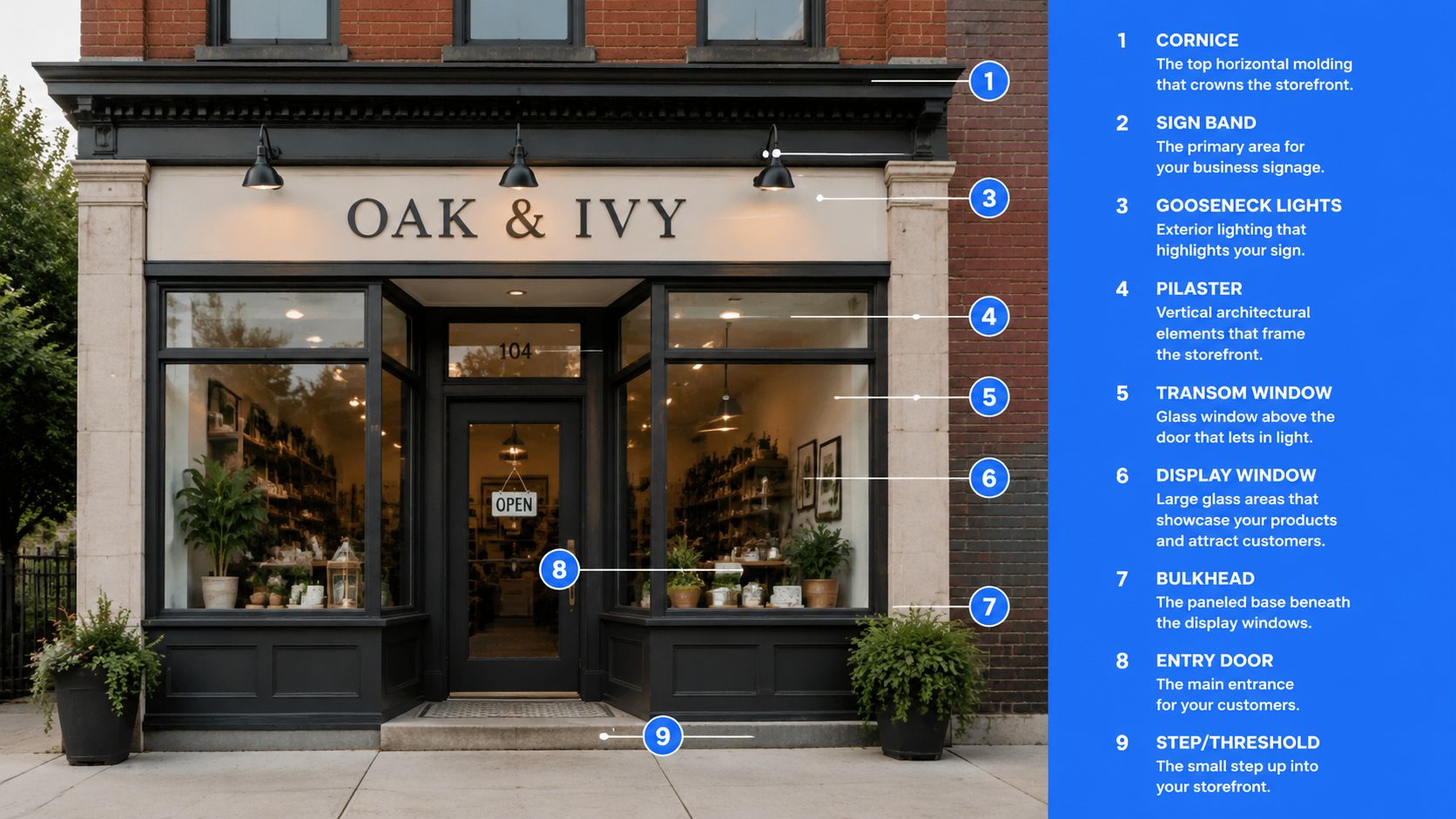
Common storefront parts include the sill at the bottom, vertical mullions that divide panels, horizontal transoms over doors or near the ceiling line, glazing stops that hold the glass, and the glass itself. Doors and transoms are often integrated into the same aluminum frame, so one weak spot can affect the whole front.
Preservation guidance also describes early shop windows as self-contained display areas with raised platforms typically 3 to 6 feet deep, built to attract passers-by and make merchandise visible from the street (San Francisco storefront preservation guidance). That historic display function is still part of the modern commercial front, even if the materials have changed.
A cleaner sees the surface. A good tech also checks the edge conditions, because those are where leaks start.
Water that gets past the outer seal doesn't disappear. It usually ends up at the sill, where it has to drain out cleanly or sit where it shouldn't.
Some systems include weep holes or drainage paths at the sill so moisture can exit the frame. If those openings are blocked with debris, old sealant, or painted-over residue, water has a harder time getting out. That's one reason storefront maintenance is about more than glass clarity, it's about keeping the assembly usable.
Storefront vs Curtain Wall vs Window Wall
These three systems get mixed up all the time because they all use large glass panels, but they're not built for the same job. A storefront is usually a single-span structure and is often chosen because it's lower cost, while curtain walls are better for buildings taller than three stories or where stronger performance requirements apply (Building Enclosure Online).
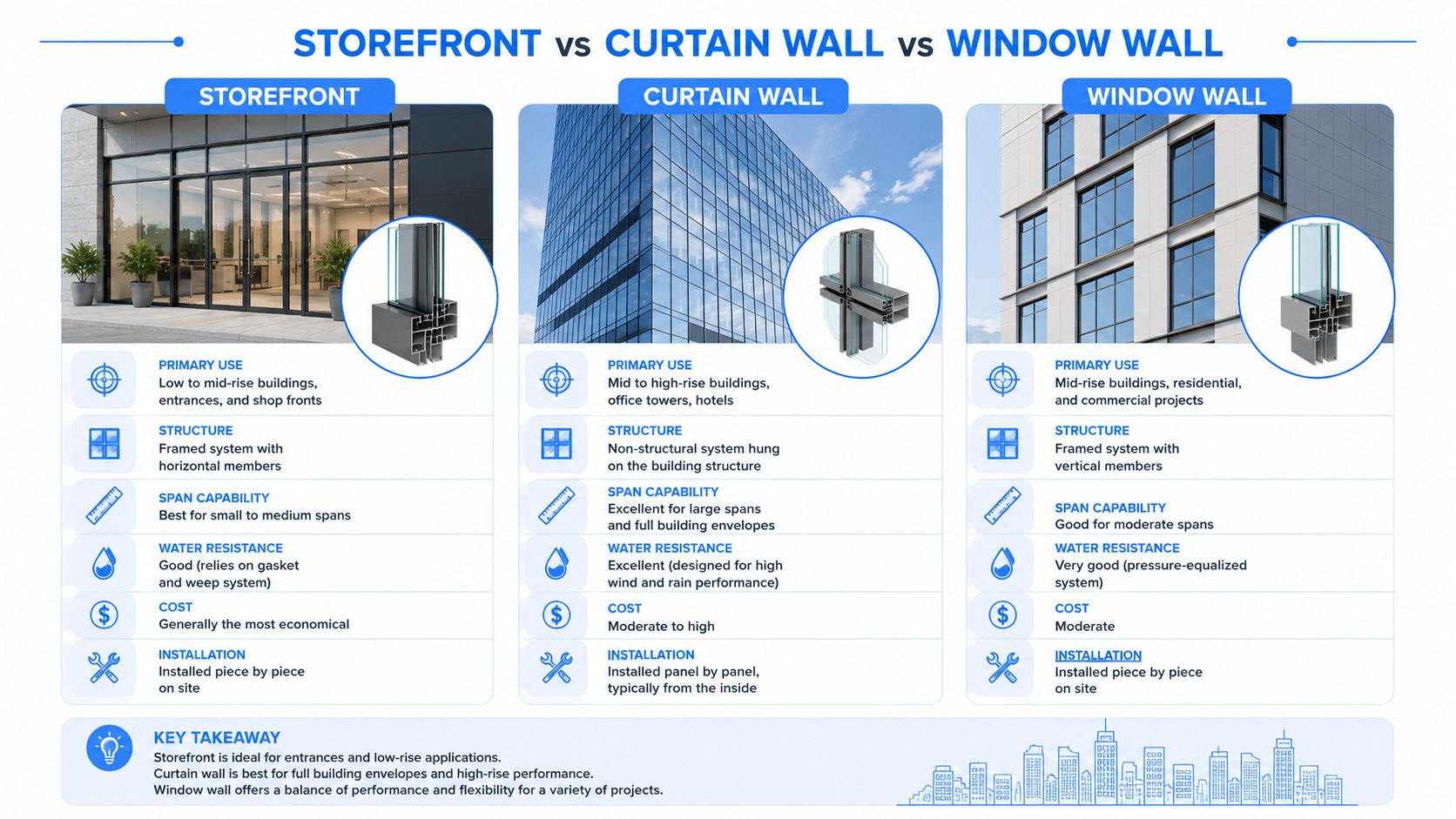
Storefront
Storefronts are usually used on the first floor, sometimes the second, and they're built for ground-level entry and display. They're practical for retail fronts, restaurants, and office lobbies where the goal is visibility, access, and a clean commercial face to the street.
Curtain wall
Curtain wall systems step in when the façade needs more performance and the building gets taller. They're a different class of assembly, and they're not interchangeable with a storefront just because both use aluminum and glass.
Window wall
A window wall sits between floor slabs instead of spanning the full height in the same way a storefront does. That changes how the load is handled and how the system integrates with the building.
For property owners, the wrong label leads to the wrong scope. I've seen people ask for a storefront fix on a façade that clearly needs a different system, and that usually wastes time before the actual problem gets addressed. If access is part of the decision, the cleaning plan changes too, because a low storefront can often be cleaned with squeegees and ladders, while taller or harder-to-reach glass may call for lifts or rope access.
How Storefronts Handle Water and Pressure
Storefronts are built for commercial use, but they're still limited systems. They're commonly tested around 10 psf wind pressure under ASTM E331/E1105-based methods, which is why they're often used on the first or second floor rather than as multi-story exterior walls (BE-CI storefront guidance).
That limit is one reason property owners should never assume a storefront can be treated like a taller façade. The frame, glass, sealants, and anchoring are all working inside a narrower performance range. If the building exposure changes, or if the system starts showing movement, the safest answer is a review, not a guess.
Water management is just as important. Many storefronts rely on sill weeping and drainage paths so any moisture that gets inside the assembly can drain back out. If those paths clog, water may stay trapped longer than it should, and leaks become harder to trace.
Practical rule: clean glass without blocking drainage details, and inspect sealant lines after work is done.
Many storefronts are also flush-glaze systems, so there may be no projecting stop at all. The glass can sit front, center, or back in the framing pocket depending on the design. That means a cleaner or maintenance tech has to pay attention to the edge conditions, not just the face of the glass.
For owners who want a more detailed look at access methods and equipment choices, this guide to water-fed pole window cleaning systems is a useful starting point. The main point is simple, storefronts need careful cleaning, not aggressive shortcuts. Pressure washing the wrong surfaces or blasting joints without understanding the system can create more problems than it solves.
Why Storefront Windows Matter for Business
A storefront window does more than show products. It shapes how people read the business before they touch the door. Retail research treats storefront window displays as both sales promotions and advertising, with effects tied to attention, store entry, and sales activity (AUT storefront window research). That is why the front glass is part of the customer's first decision to walk in.

The commercial storefront window sector was estimated at USD 1.6 billion in 2022 (AUT storefront window research). That puts the system in the commercial category owners budget for, maintain, and replace, not in the category of decorative glass that can be ignored until it fails.
What owners should watch
Dirty, cloudy, or damaged glass cuts sightlines into the business. A failed seal or a front that looks neglected sends a different message, one about deferred maintenance instead of care. That applies whether the property is a café, a salon, a medical office, or a boutique.
Storefronts also affect capture rate, the share of passersby who enter the shop, and retail guidance often points to healthy averages in the 5% to 10% range (AUT storefront window research). I do not treat every front like a lab test, but the trade-off is plain. Clear glass helps people see inside, and that visibility can support the kind of foot traffic a business wants.
Front presentation also ties into broader customer engagement. The BonusQR retail platform is one example of how retail teams look at visibility, entry behavior, and customer interaction together. The glass still has to do its part first, and that starts with a front that can be seen clearly from the sidewalk.
How Professionals Clean Storefront Windows
A professional storefront job starts with access, not soap. On ground-level glass, a crew usually works with squeegees, applicators, buckets, ladders, or short step access. For harder-to-reach panels, cleaners may switch to water-fed poles, boom lifts, scissor lifts, or rope descent systems, depending on height, access, and the building layout.
The right method depends on the building, not the calendar. A dusty retail front in Phoenix may need a different rhythm than a quieter office façade in Boulder, and a busy restaurant entry may need more frequent attention than a low-traffic professional suite. If you're trying to decide whether pressure washing belongs anywhere near your glass, this window cleaning and pressure washing guide helps separate the two jobs.
Common storefront cleaning situations
| Setting | Typical Method | Recommended Frequency |
|---|---|---|
| Busy street-level retail front | Squeegee work, ladder access, or pure water where reach is limited | Often monthly in dusty or high-traffic locations |
| Office or showroom with moderate exposure | Squeegee or water-fed pole cleaning | Quarterly often fits many properties |
| Upper panels or hard-to-reach glass | Water-fed poles, boom lifts, or rope descent systems | Set by exposure and access needs |
Pure water systems matter because they remove the minerals that cause streaking. That's why they're useful on exterior glass where a spotless rinse matters and direct hand-finishing at height isn't practical. A crew that knows how to protect frames, sills, and surrounding surfaces will also clean the details that affect drainage and appearance, not just the center pane.
Facility teams comparing maintenance habits can also use a guide for facility managers to think through what belongs in a glass-care plan and what doesn't. The cleaner should still choose the method based on the system in front of them.
Choosing a Storefront Window Cleaner You Can Trust
A storefront cleaner should be insured, and the crew should be background-checked and drug-free. Their training should cover fall protection and access work, because commercial glass can turn a simple service call into a safety problem if the crew is not prepared. Price matters, but it should come after those checks.
Equipment is the next tell. A company that shows up with squeegees, water-fed poles, rope descent systems, or boom lifts can handle more than a quick wipe on a ground-floor pane. That matters on properties with mixed heights, awkward entries, or upper glass that cannot be reached safely from the ground.
Local experience also matters in real work. Crews that clean in Arizona know what dust and hard water do to glass. Crews in Colorado understand seasonal weather and how it changes exterior cleaning. Teams in Nevada deal with bright exposure and fast buildup on street-facing windows.
For owners who want a single point of contact for commercial glass service, Professional Window Cleaning's company overview is a straightforward place to review scope and service coverage. The test is still simple, ask for proof before anyone starts work.
Ask for insurance, access plan, and training records before the first appointment.
What to check before you hire
- Insurance and safety training: Confirm the company can show current coverage and yearly training.
- Right access gear: Look for ladders, pure water systems, lifts, or rope descent capability when the building needs it.
- Scheduling and response: Fast quotes, easy booking, and on-time arrival matter on properties with tenants or daily foot traffic.
- Maintenance awareness: The crew should understand sealants, sills, and drainage, not just the glass face.
- Service fit: Make sure the provider works on storefronts, retail façades, offices, and restaurants, not just homes.
Storefronts use sill drainage and are typically limited to about 10 psf of pressure resistance in testing, which is why they are commonly used on first- or second-floor applications rather than taller facades (WECANMAG storefront guidance). That limit is a good reason to hire people who understand the system, because storefront glass is not the place for guesswork or rough handling.
If your storefront glass needs a proper commercial clean, schedule it with Professional Window Cleaning. The team handles storefront windows with the right tools for the job, from squeegees and ladders to lifts, rope access, and pure water systems. If you want a crew that understands how storefronts work and how to protect them, visit the site and request a quote.