

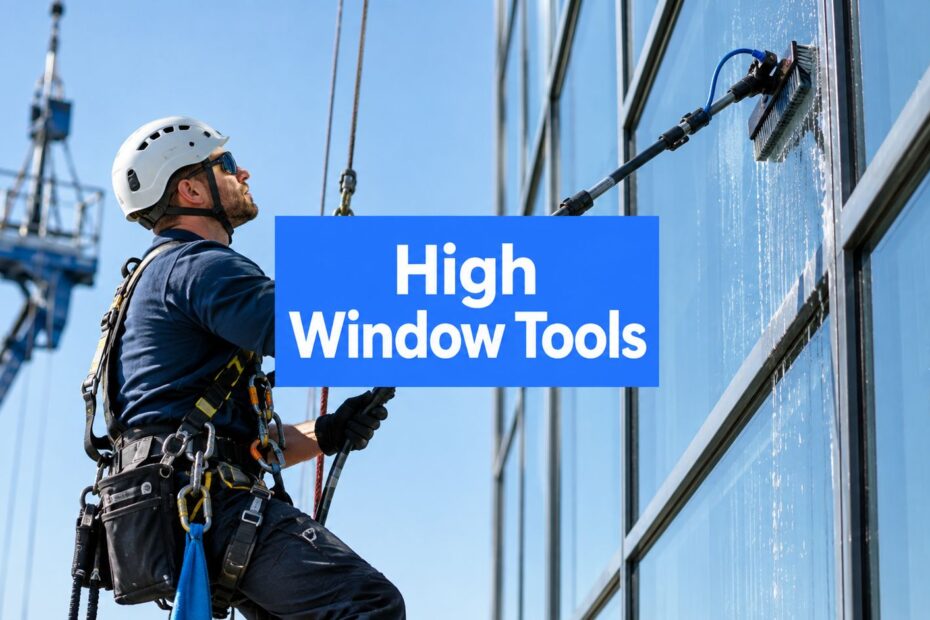
A second-story window may be reachable from the ground with a pure-water pole, while the next pane may sit behind a courtyard, above a sloped roof, or beyond the safe working height of a pole. That difference changes the equipment plan completely. The right choice may be a traditional squeegee on an extension pole, a ladder, a boom lift, scaffolding, or a rope descent system.
This guide focuses on professional window washing tools for high windows, including water-fed poles, purified-water systems, professional squeegees, and the access equipment crews use on residential, commercial, mid-rise, and high-rise buildings. The practical choice depends on height, glass condition, building layout, ground conditions, operator skill, wind, pedestrian exposure, and the safety controls available on site.
The list starts with the service decision itself, then compares specialist poles and traditional tools by the situations where they work best. It also covers setup demands, limitations, replacement parts, transport, and the point at which a property owner should stop comparing tools and request a site-specific assessment from a qualified window cleaning company.
1. Professional Window Cleaning
A Phoenix storefront with a 25-foot setback may look manageable from the sidewalk, yet a pole can become awkward when the glass sits behind landscaping, parked vehicles, or an uneven surface. In that situation, a boom lift may give the crew better positioning and control than a longer pole, provided the site allows safe setup.
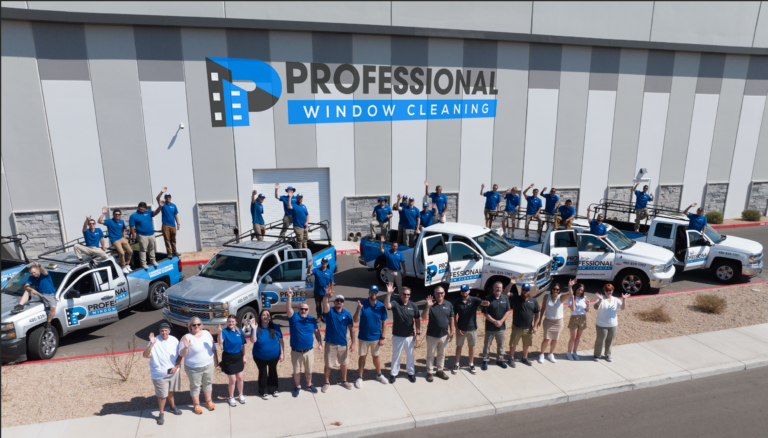
The most useful window washing tools for high windows depend on the building, not a single preferred system. Professional Window Cleaning serves residential, commercial, mid-rise, and high-rise properties across Arizona, Colorado, and Nevada. The crews work with water-fed poles, professional squeegees, ladders, boom and scissor lifts, and rope descent systems, matched to the building and access conditions.
A water-fed pole suits exterior glass with clear ground access and a surface that responds well to brush cleaning. The technician stays on the ground, but wind, obstructions, height, and poor water quality can limit the method. A lift offers closer access to a façade and supports detailed work, though it requires delivery space, setup time, ground assessment, and controls for pedestrians and vehicles. Rope descent systems apply only where the building, anchors, equipment, and trained personnel support a planned suspended-access operation.
What the service brings to difficult buildings
Professional Window Cleaning reports experience with jobs ranging from hard-to-reach skylights to complete multi-story façades. The company states that its technicians receive annual OSHA 1910.27 training from Expert Safety Services, and that crews are background-checked, drug-free, and fully insured. For high-access work, those controls matter alongside tool selection, particularly near public areas, fragile landscaping, complicated roof conditions, or exposed edges.
The company offers quotes, online scheduling, on-time crews, and a 100% satisfaction guarantee, as well as pressure washing and specialty equipment rental in select markets. Lift availability depends on the local market and current demand, so the quote should confirm whether the required machine can reach the work area.
Practical rule: If a job needs a lift, rope system, exclusion zone, or anchor review, compare contractors by their site planning and safety controls, not only by the equipment they advertise.
Strengths and limitations
- Broad capability: Crews handle homes, storefronts, facility glass, mid-rise properties, and high-rise façades.
- Safety preparation: Training, insurance, background checks, and drug-free employment policies support controlled service.
- Convenient scheduling: Quotes and online booking simplify the first assessment.
- Regional coverage: Service focuses on Arizona, Colorado, and Nevada, including Phoenix, Scottsdale, Tempe, Chandler, Paradise Valley, Glendale, Flagstaff, Denver, Boulder, Arvada, Westminster, Erie, Commerce City, Golden, Las Vegas, and Laughlin.
- Quote-based pricing: Rates depend on access, pane count, water requirements, equipment, and site conditions.
For a property owner, a qualified crew can determine whether a pole, ladder, lift, or suspended-access system fits the site. Visit Professional Window Cleaning to request a quote or discuss a difficult access situation.
2. Unger nLITE Water-Fed Pole System
The Unger nLITE is a professional pure-water pole system for exterior glass that can often be cleaned while the operator stays on the ground. The system uses a brush head supplied with purified water through the pole. The brush agitates dirt, and the mineral-free water dries without the spotting associated with ordinary tap water. Unger lists water-fed pole systems for high exterior glass and describes the method as a way to reach windows up to 65 feet high in suitable conditions. Unger's water-fed pole range provides the manufacturer's product details.
The nLITE line is a sensible choice for commercial crews and facility teams that need a supported ecosystem rather than a one-off pole. Carbon and HiMod carbon options allow operators to balance stiffness, weight, and reach. Goosenecks, angle adapters, jets, and brush choices help the operator keep the brush aligned on different glass elevations.
Where it works best
nLITE equipment is well suited to exterior glass with clear ground access, manageable wind, and a surface that responds to brush cleaning. It's especially useful for repetitive work on homes, storefronts, schools, offices, and low to mid-rise façades where moving a lift would slow the crew or create a larger work zone.
The accessory ecosystem is a practical advantage. Replacement parts and compatible components are widely available through U.S. distributors, so a broken hose, worn brush, or damaged fitting doesn't necessarily take the whole system out of service.
What operators need to watch
The branded system generally carries a premium compared with house-brand alternatives. A complete setup also requires more than the pole itself. The operator needs a purification system, hose, reel, water source, and a plan for moving and storing the equipment.
A long pole isn't automatically safer or faster. Wind can turn a high-reach pole into a control problem, and extended use can create shoulder and back fatigue. For a closer look at operating choices, see this guide to water-fed pole window cleaning. The nLITE is a strong professional option, but it still depends on the building, the glass, and the person holding it.
3. Tucker USA Water-Fed Poles and Kits
Tucker USA takes a bundle-oriented approach to pure-water window cleaning. Its catalog includes pole materials, brushes, scrub pads, and reverse-osmosis/deionization systems, giving contractors a way to assemble a complete setup from one established U.S. supplier. The product range includes Standard, High Modulus carbon, and hybrid constructions, with high-reach kits extending to 70 feet and above according to the supplied product specifications. Tucker USA's water-fed pole collection shows the available configurations and accessories.
The Alpha brush line and scrub-pad options are useful when the glass needs more agitation than a maintenance clean. First cleans often involve dust, construction residue, mineral deposits, or neglected frames. A brush selected for that work can save time compared with trying to complete every job with the lightest maintenance head.
Why crews consider Tucker
Transparent online specifications and pricing make it easier to compare pole construction and bundle contents before contacting a distributor. U.S. support, documentation, a distributor network, financing options, and a two-year pole warranty also help contractors outfitting more than one operator.
The system suits teams that want to standardize equipment while keeping choices open. A contractor can select a lighter setup for routine residential work and a stiffer, higher-reach configuration for commercial façades.
The trade-off at high reach
Tucker's high-reach kits can be heavier than niche ultralight poles at comparable lengths. That difference becomes noticeable during long routes, particularly when the brush is held above the operator's head for repeated passes.
Water delivery can also become the limiting factor. Long poles and hose runs may need a reliable water supply or a booster pump to maintain useful flow. Before buying, check the building's tap pressure, the hose route, the purification stages, and where the cart will sit during work. A pole that reaches the glass but delivers weak flow won't perform like the specification suggests.
For a crew that values parts access and clear bundle information, Tucker is practical. It isn't the lightest option in every configuration, but it offers a straightforward path from equipment purchase to daily service.
4. XERO Pure and XERO Water-Fed Poles
XERO combines reverse-osmosis and deionization purification with a direct-to-pro water-fed pole ecosystem. The XERO Pure is a three-stage RO/DI system, and the manufacturer describes configurations that can operate without a pump for one user under many conditions. The system is marketed with a 12-year warranty, while the broader catalog includes poles, hoses, reels, brushes, and replacement filters. Product information is available from XERO Products.
This setup appeals to operators who want clear service information and non-proprietary replacement filters. A system is easier to keep working when the contractor can source standard consumables instead of waiting for a brand-specific component. XERO also publishes practical height guidance, including approximately 40 feet on line pressure with the XERO Pure under suitable conditions.
Transport is part of the purchase
The purification cart needs a place in the vehicle and a stable position at the job. That sounds minor until a crew is loading poles, hose reels, brushes, and safety equipment for several properties in one day. Cart weight and storage space should be reviewed before ordering, particularly for residential operators working from smaller vehicles.
A booster pump becomes more useful for taller work, longer hose runs, or sites with inconsistent supply. The operator should test flow at the actual building rather than assuming the source will perform the same way as a shop demonstration.
High-reach water-fed work succeeds when water delivery, pole control, and ground access all work together. The pole is only one part of the system.
XERO's strength is its serviceability and clear product ecosystem. Its limitation is that a mobile RO/DI cart still creates setup and transport demands. For routine second-story and moderate commercial work, that's often a reasonable exchange. For isolated upper glass with poor ground access, a lift or rope-access assessment may make more sense.
5. IPC Eagle HydroTube and HydroCart Pure-Water Systems
IPC Eagle builds pure-water systems around mobile commercial workflows. The HydroTube, HydroCart, and Pro variants give facility teams options ranging from compact units to larger carts with pump configurations. The systems use RO/DI purification and are designed to work from typical tap pressure, with modular pump upgrades available on certain models. The manufacturer's HydroCart product information explains the available form factors and configurations.
This equipment is less about choosing a single pole and more about building a dependable water-delivery station. That distinction matters on campuses, retail centers, commercial properties, and recurring routes where crews need consistent setup rather than a lightweight kit for occasional use.
Match the cart to the route
A compact HydroTube can suit a smaller vehicle or a technician handling shorter routes. A larger HydroCart or Pro unit may provide a more suitable platform for daily commercial work, additional capacity, or a pump upgrade. The correct choice depends on how far the cart must travel across the property, how many operators will draw from it, and whether the vehicle can accommodate the frame.
Commercial-duty components and an established U.S. presence are useful for facility maintenance departments that need support and replacement parts. The equipment is also easier to standardize when several technicians work across different buildings.
Don't ignore loading and movement
Pricing and model availability can depend on the distributor, so specification review is important before purchase. Larger carts may require substantial vehicle space, ramps, or a lift-gate. A system that performs well at the glass can still be a poor operational choice if one person can't safely unload and position it.
Operators should also plan hose routes around doors, drive lanes, landscaping, and pedestrian traffic. For practical operating guidance, see how to use a water-fed pole window cleaning system. IPC Eagle is a strong fit for facility teams that value configurable, mobile pure-water equipment, provided the cart matches the property and vehicle.
6. Ionic Systems HYDRA Water-Fed Poles
The Ionic Systems HYDRA range is aimed at professional operators who spend substantial time on high-reach water-fed work. The carbon poles are designed around stiffness and weight balance, with working heights ranging from approximately 25 feet to more than 80 feet in the supplied product information. The Ionic Systems water-fed pole range includes pole sections, goosenecks, brushes, and related accessories.
A stiff pole gives the brush more predictable movement on the glass. That helps when the operator needs to clean around mullions, reach into corners, or maintain contact across a large pane without the pole bending excessively. HYDRA equipment is particularly relevant to commercial specialists who already understand purified-water flow and high-reach ergonomics.
Control matters more than headline reach
A pole that can touch a high pane isn't necessarily the best tool for the job. At extreme extension, wind loading, hose drag, and brush pressure can reduce control. The operator may also experience fatigue long before the pole reaches its stated working height.
Ionic Systems places emphasis on electrical safety literature and training for high-reach use. That's important around service drops, overhead lines, rooftop equipment, and other conductive hazards. Crews need a site-specific exclusion plan, not just a carbon pole and a clear view of the glass.
When to choose another method
Premium pricing can be justified for a specialist who uses the pole frequently and values refined handling. It may be harder to justify for an occasional user, especially when U.S. availability and lead times depend on distributors.
For glass obstructed by balconies, deep recesses, roof edges, or courtyards, a lift or rope descent system may provide better positioning. HYDRA is a high-quality pole option for suitable ground-based work, but it doesn't remove the need to evaluate the façade before choosing access.
7. Gardiner Pole Systems Super-Lite and Xtreme Poles
Gardiner's Super-Lite and Xtreme carbon poles target professional window cleaners who want to reduce fatigue during long-reach work. The U.K.-based manufacturer provides detailed specifications, component-care information, goosenecks, and brushes through Gardiner Pole Systems.
The appeal is straightforward. A lighter pole can be easier to hold, reposition, and transport over a long day, particularly when the work involves many windows at similar elevations. Stiffness remains important because an ultralight pole that flexes excessively can make brush placement slow and frustrating.
A good fit for experienced operators
Gardiner equipment is often chosen by cleaners who already understand water-fed pole technique and want to refine the handling characteristics of their kit. The detailed documentation helps an operator maintain pole sections and replace components before small damage becomes a larger failure.
The system's light weight can reduce fatigue, but it doesn't make extreme reach effortless. The operator still needs to manage wind, hose drag, overhead hazards, and the force required to scrub dirty frames. A very light section may also require more careful storage and handling than a heavier commercial pole.
The U.S. buying decision
U.S. availability commonly depends on distributors or import channels. That can affect delivery time, shipping cost, warranty handling, and access to replacement parts. A contractor should confirm those details before standardizing a crew around the system.
Gardiner is a strong choice when pole ergonomics are a priority and the buyer is comfortable maintaining a specialist setup. It's less convenient for a property owner seeking a local, one-off solution. On difficult buildings, hiring a trained service remains more sensible than learning high-reach technique around an expensive pole.
8. REACH-iT Poles and RO/DI Bundles
REACH-iT and Future of Cleaning offer bundled equipment for operators who want to purchase a working water-fed setup without assembling every component separately. Packages can combine an RO/DI system, pole, brush, hose, and tubing. The Future of Cleaning product range also includes specialty brushes, screen-cleaning tools, and accessories intended to improve the workflow around frames and screens.
The bundled approach helps residential and mid-rise contractors get started with fewer compatibility questions. A pole, brush, hose, and purification system selected to work together generally creates a smoother first setup than mixing components from several suppliers without checking fittings, flow, or pole weight.
Where the system adds value
Specialty brushes, including RADIAL series options, can help crews address frames, screens, and recurring buildup. Ergonomic design is another focus. For a technician spending much of the day on glass, brush shape, pole balance, hose routing, and handle position affect productivity and comfort.
The packages make sense for teams that value education and a ready-to-work purchase. They can also simplify training when every operator uses the same brush and connection arrangement.
The ecosystem limitation
Bundled systems work best when the operator stays within the brand's component ecosystem. That can reduce compatibility headaches, but it may limit flexibility when a contractor wants to combine a different pole, brush, reel, or filter system.
Premium pricing also needs to be weighed against route economics and service frequency. A specialist package can be worthwhile for a professional crew, while a property owner with a single difficult window should usually hire a window cleaning service instead of building a complete RO/DI setup. REACH-iT is most useful when speed, ergonomics, and a complete initial kit matter more than minimizing the purchase price.
9. Ettore REA-C-H Extension Poles and Traditional Tools
Traditional tools still have a place in high-window work. Ettore's REA-C-H extension poles accept squeegees, washers, scrapers, and angle adapters, allowing a trained operator to scrub and squeegee glass from a lower position. The Ettore all-purpose extension pole range is widely distributed and uses common quick-connect arrangements.
This approach can be practical for interior glass, exterior panes at lower elevations, and jobs where purified-water equipment isn't suitable. It also gives the operator direct control over the amount of solution, agitation, and finishing. For skilled technicians, a traditional squeegee can produce excellent results on glass that needs detailed work rather than a quick maintenance pass.
The operating trade-off
The method requires more technique at height than a water-fed pole. The operator needs to control the washer, squeegee angle, solution runoff, and final detailing while working through an extension pole. A slight change in angle can leave water behind or make the squeegee harder to control.
Ettore offers two- to four-section poles in multiple lengths, along with combination-tool compatibility such as the BackFlip. Parts are easy to find, which helps crews keep common replacement channels, rubbers, washers, and tips in service.
Traditional extension tools are affordable and versatile, but they don't turn an unsafe reach into a safe one.
They're a reasonable option for appropriate second-story work when the operator has stable positioning and a controlled setup. They aren't a substitute for a lift, scaffolding, or rope system on very high or obstructed glass. Learn more about what professional window cleaners use before selecting a traditional extension setup for a difficult building.
10. Moerman Excelerator 2.0
The Moerman Excelerator 2.0 is an adjustable, pivoting squeegee handle designed for skilled pole work. Paired with an extension pole and a mop or FliQ pad, it lets an operator scrub and squeegee high interior or exterior glass without relying on a pure-water system. The manufacturer's Excelerator 2.0 information describes its adjustable pivot and compatibility with Moerman channels, rubbers, and attachments.
The pivoting handle is the central feature. It allows the operator to adjust the working angle and use fanning techniques on glass that would be awkward with a fixed handle. That can reduce repositioning and make a traditional workflow faster for someone who has practiced the movement.
Skill determines the result
The Excelerator 2.0 isn't a beginner shortcut. Operators need to learn how the pivot responds through an extension pole, how much pressure the channel needs, and when the pad has picked up too much solution. Some users experience wrist fatigue while they develop the technique, particularly if they compensate for poor pole position by overworking the handle.
The tool also retains the limits of traditional cleaning. The crew must manage solution, runoff, detailing, and access to the glass. It doesn't provide the same ground-based rinse-and-dry workflow as a pure-water pole.
For an experienced window cleaner, the Excelerator 2.0 can improve control on suitable high glass. For an owner or manager choosing equipment for an unfamiliar façade, it's better treated as a specialist tool within a broader access plan rather than the main answer to every high-window problem.
Top 10 High-Reach Window Washing Tools Comparison
| Service / Product | Core features | Target audience | Key benefits / USPs | Price & availability |
|---|---|---|---|---|
| Professional Window Cleaning | Full-service regional contractor (AZ/CO/NV); commercial, residential, mid/high-rise; lifts, rope descent, WFP; OSHA-trained, insured; online quotes/scheduling | Homeowners, storefronts, property managers, facility teams | Safety-first crews, 22+ years, local offices, on-time + 100% satisfaction, ~4.9★ (2k+ reviews) | Regional coverage; no public fixed pricing, fast transparent quotes; equipment rental in select markets |
| Unger nLITE Water-Fed Pole System | Modular carbon poles, nLITE brushes/goosenecks, integrates with Unger purification | Professional window cleaners, facility crews | Durable handling at height; large accessory ecosystem; easy U.S. parts access | Premium brand pricing; full systems cost multiple thousands; widely stocked in U.S. |
| Tucker USA Water-Fed Poles & Kits | Poles to 70'+ (Std/HiMod/hybrid), Alpha brushes, RO/DI bundles, 2‑yr pole warranty | Contractors outfitting crews, high-reach pros | Transparent specs/pricing, strong U.S. support & financing | Mid–premium; heavier than ultralight poles; good U.S. availability |
| XERO Pure + Poles (XERO Products) | Three-stage RO/DI carts, non-proprietary filters, 12‑yr warranty, full pole/brush catalog | Pros wanting plug‑and‑play purification carts | Clear performance guidance, serviceable filters, responsive support | Sold direct in U.S.; cart weight/transport planning; booster pump may be needed for >3 stories |
| IPC Eagle HydroTube / HydroCart | RO/DI systems tuned for tap pressure, modular pump upgrades, multiple cart sizes | Facility maintenance teams, commercial crews | Multiple form factors for mobile workflows; commercial-duty construction | Distributor-dependent pricing/availability; heavier carts need vehicle space |
| Ionic Systems HYDRA Poles | Carbon poles to 80'+, extensive accessories, electrical safety docs | High-rise specialists, commercial window cleaners | Stiff yet balanced sections for precise control; strong reputation | Premium pricing; U.S. availability via distributors, lead times may vary |
| Gardiner Pole Systems Super-Lite / Xtreme | Ultralight Super-Lite/Xtreme carbon poles, detailed specs & care guides | Pros doing long-reach jobs wanting less fatigue | Extremely light to reduce operator fatigue; comprehensive documentation | UK-based brand; U.S. supply via distributors/importers |
| REACH‑iT Poles & RO/DI Bundles (Future of Cleaning) | Bundled RO/DI + pole + brush kits, specialty brushes, ergonomics focus | Residential & mid-rise pros, new teams | All‑in‑one starter kits speed setup; ergonomics & process education | Bundle pricing leans premium vs entry kits; simplifies initial purchase |
| Ettore REA‑C‑H Extension Poles & Traditional Tools | Aluminum extension poles (2–4 sections), quick-connect tips, squeegees/washers | DIY, indoor cleaning, low-rise exterior (to ~2–3 stories) | Affordable, widely available, easy replacement parts | Budget-friendly retail pricing; ideal for light-duty jobs |
| Moerman Excelerator 2.0 | Adjustable pivoting squeegee handle, compatible with Moerman channels/FliQ pads | Skilled operators using trad scrub‑and‑squeegee techniques | Greater control and faster finishing for experienced users | Mid-priced accessory; learning curve for optimal use |
Choose Access Before You Choose Equipment
The first decision is not which brand of pole to buy. It's whether the window can be cleaned safely and effectively from the ground. A pure-water pole is efficient when the exterior glass is compatible, the operator has stable ground-level access, the reach is manageable, and wind and overhead hazards can be controlled. It avoids ladder placement and can cover repetitive glass quickly, but it still requires training, water management, pole control, and a clear exclusion zone.
Traditional extension tools fit a different working pattern. An Ettore pole or Moerman Excelerator 2.0 can be useful for lower reaches, interior glass, detailed edges, and situations where pure water isn't practical. The operator needs stronger technique because solution management and finishing remain part of the process. A traditional tool may be inexpensive to purchase, but a low equipment price doesn't change the access risk.
Ladders, lifts, scaffolding, and suspended systems each solve a different positioning problem. A boom lift can reach outward over a setback. A scissor lift provides a platform where the surface is suitable and the work stays mostly vertical. Scaffolding can support longer projects with repeated access, but it needs a proper erection and use plan. A rope descent system allows a worker to descend in a controlled manner and stop at any point. OSHA describes the system as typically including a roof anchorage, support rope, descent device, carabiners or shackles, and a chair or seat board, and distinguishes it from an industrial rope access system. OSHA's interpretation of rope descent systems provides that definition.
Use the building configuration as the filter
Ground-based poles make sense for unobstructed façades, suitable exterior glass, and reachable elevations. Lifts become more appropriate when the façade has setbacks, deep recesses, balconies, or glazing that requires the operator to work close to the pane. Rope descent requires a compatible building, verified anchors, a suitable load path, trained technicians, and controls for people and property below.
Fall exposure is the reason access planning deserves serious attention. OSHA-related reporting has cited 88 window-cleaning accidents over a 15-year period, including 62 fatalities, while another report identified seven window-washer deaths nationwide during 2022 and 2023. HealthDay's window-washer safety reporting identified ladder mishaps as the leading cause, including entanglement with overhead electrical lines.
Work-at-height guidance also favors the safest feasible access method first. In the United States, rope descent systems are capped at 300 feet above grade unless no other method is feasible or safer, as explained in this high-rise window cleaning access guide. Owners should expect a professional plan to address anchors, load paths, weather, fragile frames, electrical hazards, pedestrian traffic, and exclusion zones before work at height begins.
Compare the full job cost
A quote depends on more than the tool. Height, pane count, glass condition, interior and exterior scope, ground access, water supply, hose distance, equipment transport, setup time, frequency, and local conditions all affect the work. A pole may have a lower equipment footprint, but a long setup, difficult hose route, or slow brush control can change the labor calculation. A lift may cost more to mobilize, yet finish a façade more efficiently when the glass is obstructed or requires close inspection.
The global building window cleaning systems market was valued at USD 2,067.5 million in 2024 and is projected to reach USD 5,930.91 million by 2032, with a projected 14.08% CAGR, according to Wise Guy Reports' market information. That source places North America at 33%, Asia Pacific at 31%, and Europe at 29% of the market. The broader direction is clear: professional buyers are evaluating automation, safety, and environmental efficiency alongside price.
Know when to call a service
Request a professional assessment for high-rise façades, difficult or sloped ground, skylights, fragile frames, complex exterior architecture, overhead electrical lines, occupied pedestrian areas, or any job involving a lift, scaffolding, or suspended access. A qualified crew can decide whether a pole is appropriate, verify whether the glass and frame can tolerate the cleaning method, and establish the controls needed before work starts.
Professional Window Cleaning serves property owners and facility teams in Phoenix, Scottsdale, Tempe, Chandler, Paradise Valley, Glendale, Flagstaff, Denver, Boulder, Arvada, Westminster, Erie, Commerce City, Golden, Las Vegas, and Laughlin, with availability varying by location and equipment demand. The company's crews use water-fed poles, professional squeegees, lifts, ladders, and rope descent systems according to the building and access conditions. For additional workplace access context, review the Safety Space access guide.
Don't choose equipment from the ground-level view alone. Share photographs, elevations, access constraints, glass type, and the required service area with a professional window cleaning company, then compare the proposed method, safety plan, setup, and total quote.
Professional Window Cleaning handles residential, commercial, mid-rise, and high-rise glass with water-fed poles, professional squeegees, lifts, and rope descent systems across Arizona, Colorado, and Nevada. Visit Professional Window Cleaning to request a fast quote and arrange a safer, site-specific plan for your high windows.