



A water fed pole hose is the part people notice only after something goes wrong. The brush is up on the glass, the pole looks fine, and then the line kinks at a joint, drags across a walkway, or starts leaking at the connector while you're trying to finish a storefront before opening hours. On a real job in Phoenix or Scottsdale, that hose decides whether the rinse stays steady or the whole setup turns into a stop-and-fix problem.
What matters is that the hose isn't just a tube. It's the control line between the pure water source, the telescopic pole, and the brush head, and it has to stay light, flexible, and reliable while the pole is moving overhead. Get the hose right and the brush stays fed. Get it wrong and you'll feel it in your shoulders, your timing, and the finish on the glass.
What a Water Fed Pole Hose Actually Does on the Job
A technician on a Phoenix storefront usually finds out fast if the hose setup is weak. The pole goes up, the brush starts rinsing, and then a small leak or a snag steals pressure right when the top panes need a clean flush. At that point, the hose stops being a background part and becomes the difference between a smooth pass and a restart.
The hose is part of the cleaning system, not an accessory
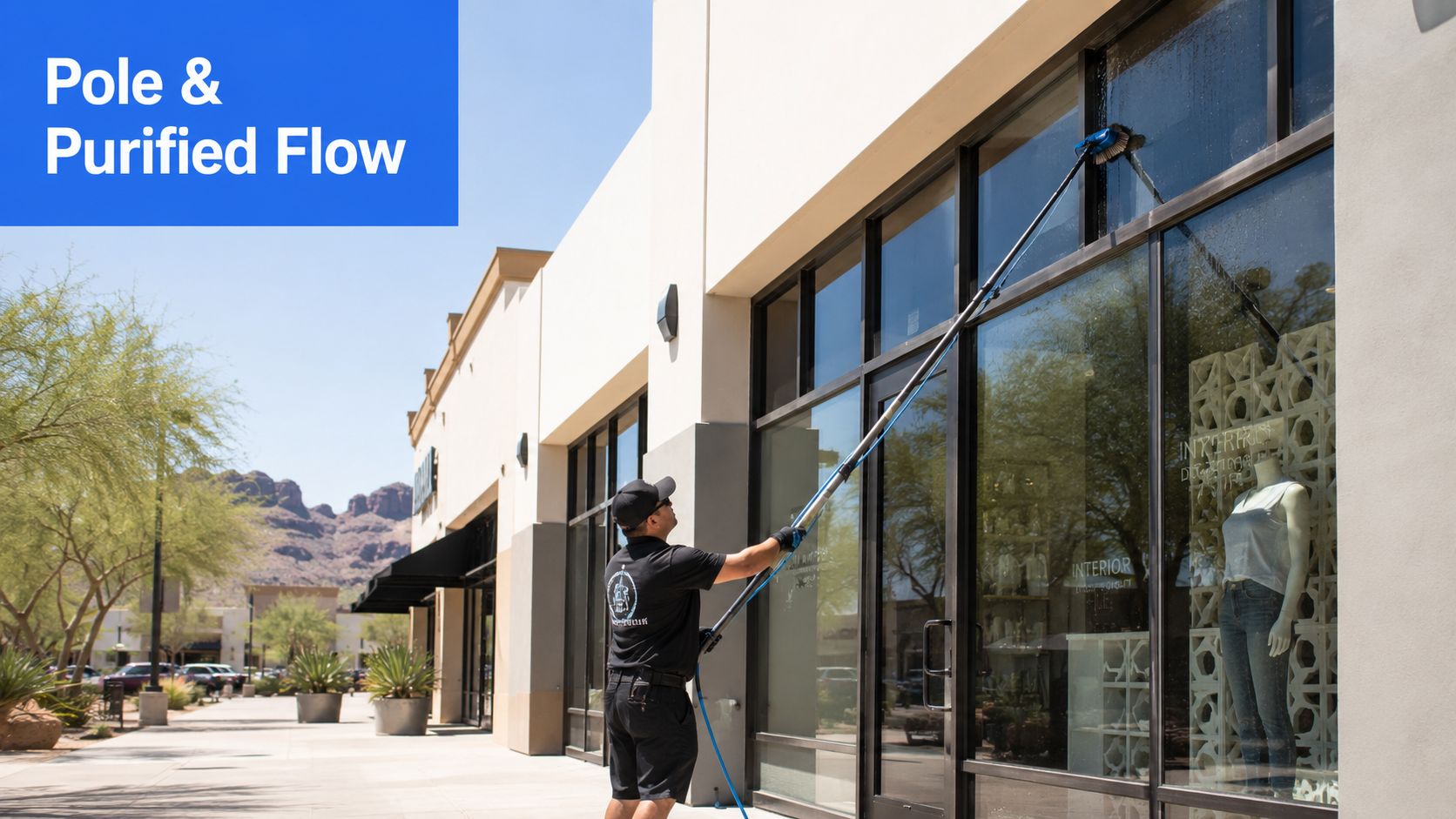
The best way to think about a water fed pole hose is as the delivery path inside a system that already depends on balance. Pure water comes from the source, moves through the hose, and reaches the brush head where the rinse happens. If the hose is too heavy or too restrictive, the pole becomes harder to steer and the rinse becomes less predictable.
That matters on mixed commercial routes in places like Tempe, Chandler, and Las Vegas, where one stop may be a low storefront and the next may be a taller office façade. A hose that feeds cleanly on the first job can still become a problem if it snags on landscaping, scrapes a wall edge, or adds too much pull as sections extend. The line has to move with the pole, not fight it.
Practical rule: if the hose feels like it's slowing your brush work down, it's already costing time somewhere else.
The hose sits inside a three-part workflow
The pole, hose, and water source have to match. Water-fed pole cleaning only works well when the source is producing cleaned water, the pole can extend without binding, and the hose can stay light enough to follow every movement. That's why operators who switch from traditional methods to pure water often notice the hose before they notice anything else, especially on higher glass where arm fatigue shows up fast.
The system has a long history behind it too. Water-fed pole window cleaning traces commercial origins back to the 1950s, when Irv Tucker introduced a car-and-home washer kit with a 3-foot to 6-foot pole in Cedar Rapids, Iowa, then moved into commercial use in the 1960s and reached places like Canada, New Zealand, and Australia by the 1970s (brief history of water-fed poles). That context matters because the hose evolved along with the pole, and the modern version has to serve a much more demanding workflow than the early tools did.
For a deeper look at the full system, see water fed pole window cleaning system.
How a Water Fed Pole Hose Works With Poles and Pure Water
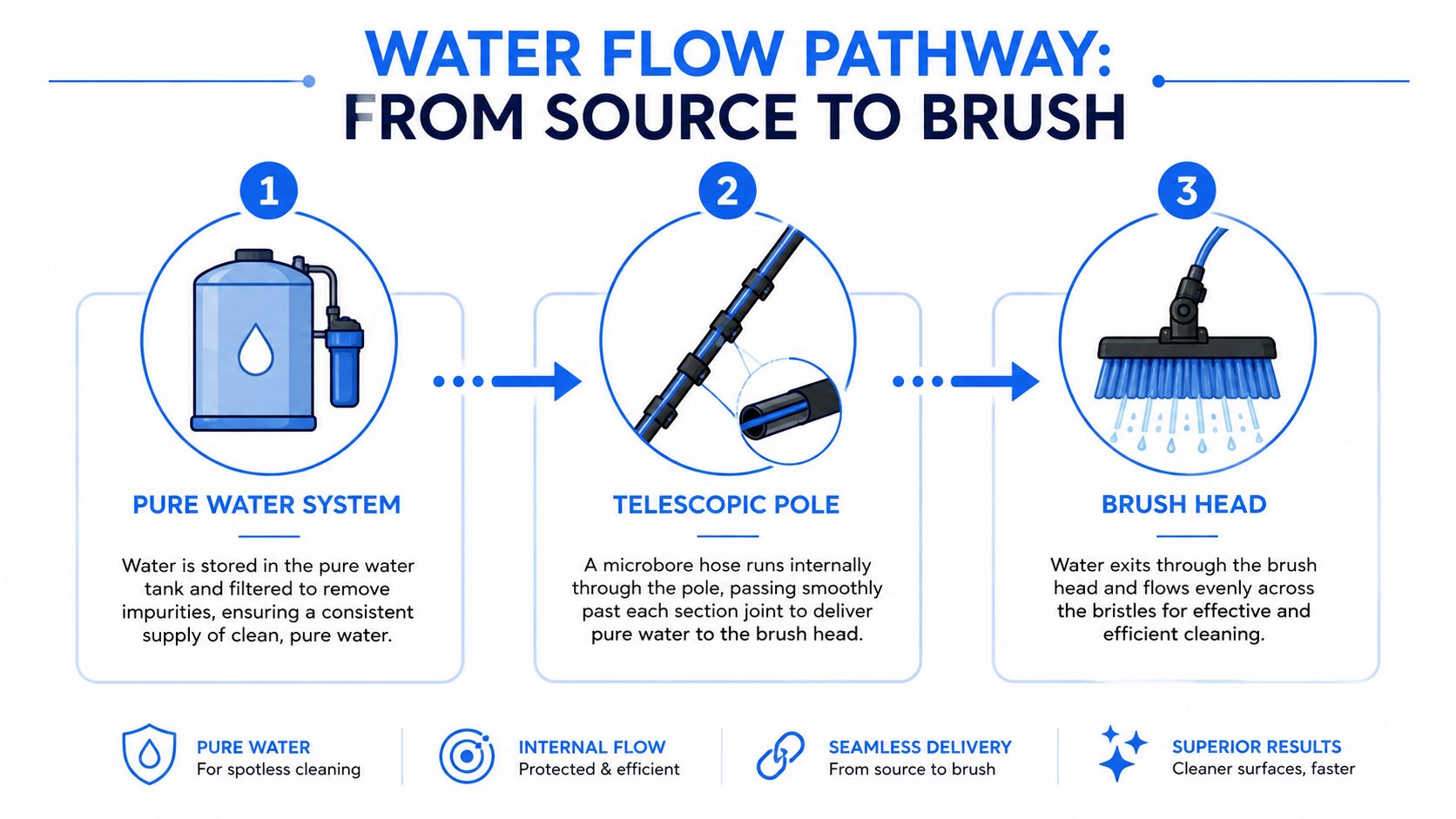
A proper pure-water setup doesn't start at the brush. It starts at the treatment source, then moves through the pump, into the hose, and up the pole before it reaches the jets in the brush head. If any part of that chain is mismatched, the finish on the glass changes with it.
Pure water is the point of the system
The whole reason crews use this setup is that purified water leaves less behind on the glass. The hose's job is to move that water reliably, not to add volume for the sake of it. In practice, that means the hose needs to be small enough to live inside or alongside the pole without turning every extension into a wrestling match.
Modern carbon-fibre poles are built around that idea. Historical accounts of the 1997 system launched by Craig Mawlam describe a telescopic pole paired with a water purification system, which helped define the modern pure-water approach still used today (window cleaning revolution history). By the early 2000s, carbon-fibre poles were showing up in major cities, and the method became established in the trade.
Microbore geometry exists for a reason
The hose inside many poles is usually a microbore line. A common specification is 5/16-inch outer diameter with 3/16-inch inner diameter, which is about 8 mm OD / 4.7–5 mm ID and often made in polyurethane, with temperature tolerance from -75°F to 155°F (hose spec details). That size isn't arbitrary. It keeps the line light enough to travel inside telescopic sections while still surviving the bending and motion that come with normal cleaning.
At the same time, the smaller line has to be fed with a system tuned for it. A microbore hose does not behave like a big supply hose. It moves less water, but it also keeps the pole easier to control overhead. That's why the hose matters as much as the brush choice or pole material.
The hose is the veins of the pole. If the veins are too narrow for the job, the brush dries out. If they're too heavy, the whole arm gets tired before the glass is done.
Internal routing versus external routing
On higher-end carbon-fibre setups, the hose often runs internally. On entry-level aluminum gear, it's more common to see the hose run externally because the pole design is simpler and the routing is easier to inspect. Either way, the working principle stays the same. The hose has to supply the brush without binding, and the cleaner has to manage drag as sections move.
For a plain-English overview of what crews use alongside this setup, take a look at what professional window cleaners use.
Common Materials, Sizes, and Fittings for Pole Hose
Most buyers don't need a lab notebook, they need a spec sheet that makes sense. The first thing to look for is size, because the diameter of the hose affects how it handles in the hand, how much flow reaches the brush, and how much effort the pole takes overhead. The most common professional setup sits in the microbore range, and polyurethane is a strong choice when flexibility matters more than bulk.
What the common sizes actually mean
One practical supplier lists 8 mm outer diameter and 5.5 mm inner diameter pole hose, with lengths of 5 m, 10 m, 15 m, 20 m, 25 m, 30 m, and 100 m, plus a temperature rating from -20°C to +60°C and a maximum pressure of 10 bar (GVS Pro hose specifications). Those numbers are useful because they tell you what the hose can physically do, not just how it sounds in a catalog.
For buyers comparing different hose families, it helps to separate pole hose from supply hose. If you're browsing general plumbing hose options, browse plumbing hose options can be useful for understanding how hose categories differ, even though the needs of window cleaning are more specific than standard plumbing.
| Common Water Fed Pole Hose Sizes at a Glance | Typical Use | Flow Range | Best For |
|---|---|---|---|
| 3/16-inch ID, 5/16-inch OD microbore | Lightweight pole feed | 0.3–0.5 GPM | Short residential work and lighter overhead handling |
| 1/4-inch ID pole hose | Higher-flow pole feed | 0.5–0.8 GPM | Heavier contamination and faster rinsing |
| 3/8-inch ID supply or reel line | Main feed to the pole hose | Not specified here | Longer runs where the goal is supply, not pole control |
Fittings matter more than people think
A hose can be the right size and still fail if the fittings don't match the pole and brush. Quick-connect couplers save time on the truck and at the jobsite, but only if they're compatible with the rest of the setup. Hose tails and brush-end adapters also need to fit cleanly, because leaks usually show up at the joins first.
Temperature also matters in the field. A hose rated for cold-to-hot conditions can handle a wider spread of work environments, which is useful when the same crew works early-morning jobs in Flagstaff and later-day routes in Laughlin. The wrong material gets stiff, worn, or harder to route, and that slows the whole day down.
The right length depends on the route, not the catalog
Short residential runs in Phoenix usually don't need the same hose length as a multi-structure commercial route in Las Vegas. That sounds obvious, but crews still get burned when they buy based on the biggest property they've ever seen instead of the longest normal run they work. The smart move is to match the reel length to the route, then leave enough margin for access changes, gates, and awkward building layouts.
Matching Hose Flow and Diameter to the Job
A pole hose choice changes the pace of the whole job. A smaller line is easier to manage overhead and keeps the setup lighter, while a larger line pushes more water and can rinse faster. The trade-off shows up fast on tall work, where extra stiffness and weight start to wear on the operator and the hose can fight the pole instead of following it.
The numbers that drive the choice
For microbore work, 3/16-inch ID / 5/16-inch OD hose is commonly used at about 0.3–0.5 GPM under typical operating pressure. 1/4-inch ID pole hose usually sits closer to 0.5–0.8 GPM and is often chosen for residential work up to about 40 ft. That difference may look small on paper, but on glass it changes how fast dust, pollen, and loose debris clear off the surface. flow guidance
What the Common Sizes Mean
Smaller hose gives the operator more control. It bends easier, stays out of the way better around frames and corners, and is less tiring when the pole is extended for long stretches. The downside is plain enough, if the rinse load is heavy, a small line can leave the tech waiting on the brush instead of moving on to the next pane.
Larger hose moves more water, but the pole feels it. Extra stiffness makes repeated extensions less pleasant, and the line can tug at the brush when the operator is trying to feather around tight edges. I have seen crews switch up a size too soon and end up with slower, clumsier work even though the rinse was stronger.
Field rule: use the smallest hose that still gives you a clean rinse at the brush. A bigger line has to solve a real problem to justify the extra weight and drag.
Match the hose to the part of the system it serves
Experienced cleaners often keep 3/8-inch ID hose on the supply reel and run a smaller line to the pole so the tool stays manageable overhead. That split makes sense because the reel line and the pole line do different jobs. The reel line can be larger because it stays on the ground or on the truck side of the system. The pole hose has to move with the operator, so control matters as much as flow.
For a commercial route manager, the decision usually comes down to the glass in front of the crew and the conditions around it. Short retail runs and easy access favor a lighter line. Heavier soil, more reach, or a tougher rinse can justify moving up a size. The wrong call does not always fail loudly, sometimes it just shows up as slower production, more fatigue by noon, and a crew that has to work harder to keep pace with the route. That is part of the same labor picture covered in setting commercial window cleaning prices.
Buying Criteria, Installation, and Routing Best Practices
A hose can be the right size on paper and still slow a crew down if it is hard to route, hard to couple, or awkward to live with all day. Buy for the pump, the pole, the brush, and the sites on your route, not for a generic setup that only works in ideal conditions. If the line is too stiff, too short, or mismatched at the fittings, the crew pays for it in lost minutes and extra fatigue every shift.
What to check before you buy
Pressure rating comes first, because the hose has to stay within the limits of the pump and the rest of the system. Temperature range comes next, especially for crews working across Arizona, Colorado, and Nevada in different seasons. Then check fitting compatibility with the pole and brush so the truck is not carrying a pile of adapters for every job.
Use the hose spec sheet the same way you would use any other labor input. It shapes setup time, rinse speed, and operator fatigue, which feeds directly into how you plan labor and route pricing in setting commercial window cleaning prices. A hose that saves strain on the operator can matter more than a hose that looks impressive in a catalog.
A simple installation routine saves repairs
Flush new hose before it goes into service. That clears loose material and gives you a chance to catch a defect before the line is hidden inside a pole section or wrapped onto a reel. Cut clean, attach quick-connects without overtightening, and check the ends again after the first few jobs, because a fitting that felt tight on the bench can work loose once the hose starts moving under load.
Routing through pole sections needs the same discipline. If the line kinks at the joints, pump capacity will not fix it. The hose has to travel with the extension, not bunch up where the sections telescope, and it should slide without rubbing hard against the inside of the pole.
Jobsite routing is a safety issue, not just a convenience issue
Public walkways are where hose planning gets tested. A safety guide for Water-Fed Pole use warns that hoses can create trip hazards, should cross walkways only when essential, and need to be laid flat, signed, indicated, or covered, with the site inspected first and reassessed if conditions change (WFP safety guidance). That matters on commercial sites where the route shares space with customers, deliveries, carts, or parked cars.
- Take the hose to the far side first: This cuts backtracking and keeps the working line out of your own feet.
- Lay it flat across walkways only when needed: A flat hose is easier to see and less likely to snag than one left in loops.
- Use covers or signage where the public crosses: That is basic liability control, not overkill.
- Lift it over walls or route around corners when possible: Dragging across rough edges shortens hose life and adds friction.
A good route also keeps the hose out of the operator's way at the base of the pole. Leave enough slack to move, but not so much that the line becomes something to step on, snag, or twist around your boots. On cold mornings, that same routing discipline helps because a straighter, drier line is easier to drain and less likely to stiffen in place.
Maintenance, Troubleshooting, and Freezing Precautions
A hose doesn't usually fail all at once. It drifts into problems through kinks, worn seals, or storage habits that slowly beat it up. Good crews stay ahead of that by handling the hose like a consumable that deserves care, not like a part that can be abused until it quits.
What to do between jobs
Roll the line without tight bends. Drain it before storage so water isn't sitting in the hose longer than it needs to. Inspect quick-connects for hairline cracks, and replace O-rings before they fail mid-job. Those small parts are cheap compared with the time lost when a line starts spraying at a connector halfway through a route.
If flow drops, don't blame the hose first. Check the TDS meter and the rest of the pure-water system before assuming the line is restricted. A bad reading upstream can look like a hose problem downstream.
Common field problems and quick fixes
- Reduced flow: Check for kinks, then verify the source water and pump settings before replacing hose.
- Spraying at the joints: Re-seat the fitting and inspect the O-ring or connector body for damage.
- Hose popping out of the brush: Confirm the adapter size and make sure the connection is fully engaged.
Freezing is the one issue that can turn a normal morning into a delay, especially on colder routes in Flagstaff, Boulder, and Denver. Drain the line at the end of the shift, keep reels in a heated van when possible, and run low-flow warm water through the system before the first window if conditions call for it. A hose that's left wet and cold overnight is asking for stiffness, brittleness, and annoying startup problems.
Storage habits decide replacement timing
A hose that's used hard but stored properly usually lasts longer than a hose that's used lightly but kinked every night. Watch the fittings first, then the body of the line, then any recurring flattening where the hose bends in storage. If a hose keeps needing attention, it's usually cheaper to replace it than to keep paying for downtime.
When to Call a Professional Window Cleaning Service
A single-story home with easy water access is one thing. A two-story building with landscaping, public walkways, or liability exposure is another. Once the glass gets higher, the access gets awkward, or the site starts involving more than a simple ground-level reach, the value shifts from owning the hose to having a crew that knows how to use it safely.
Professional crews bring more than a pole and hose. They're trained, insured, and equipped for water-fed poles, traditional squeegee work, rope descent systems for taller glass, and boom or scissor lifts for atriums and other hard-to-reach areas. If you're weighing DIY access against a finished result, the gap usually shows up in safety, speed, and the quality of the final rinse. For a practical homeowner reference, see clean windows with hose.
If you're in Arizona, Colorado, or Nevada and need a quote, start with the local service area that matches your property: Phoenix, Scottsdale, Tempe, Chandler, Paradise Valley, Glendale, Flagstaff, Denver, Boulder, Arvada, Westminster, Erie, Commerce City, Golden, Las Vegas, and Laughlin.
If your building needs reliable glass care and you want the job handled with the right access, the right gear, and a crew that knows how the hose affects the whole setup, visit Professional Window Cleaning. We bring the equipment, the training, and the field experience to keep pure-water work moving cleanly from setup to final rinse.