



Most storefront window cleaning prices fall between $40 and $75 per visit for small recurring accounts and $150 to $500 per service for typical small-business jobs. Those figures are a starting point, not a final quote, because glass area, access, condition, scope, and service frequency change the economics quickly.
A retailer usually asks for pricing after noticing fingerprints on the entry door, dust across the display glass, or a competitor's cleaner working down the same block. The practical question isn't only, “What will one cleaning cost?” It's, “What will this location cost to maintain on a reliable route, and what will the crew need to do safely?”
Storefront work typically involves professional squeegees, ladders, water-fed poles, and, where necessary, boom lifts, scaffolding, or rope descent systems. In reachable exterior applications, pure water can remove dissolved minerals without detergent residue, as explained in this overview of pure water window cleaning. The right method depends on the building, not on a one-size-fits-all price.
What Storefront Window Cleaning Actually Costs
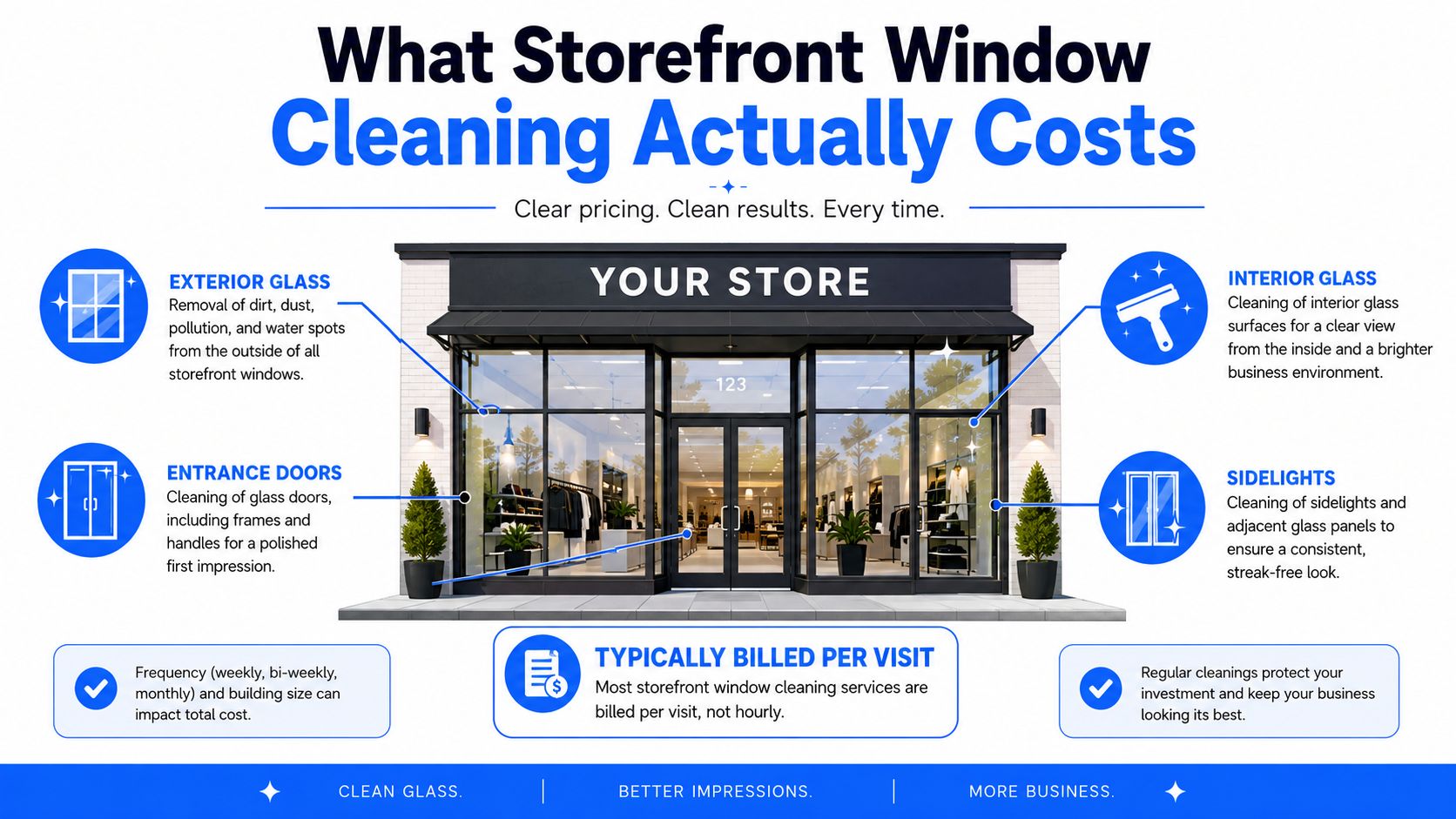
Storefront window cleaning usually means the exterior and interior glass on a ground-floor retail façade, including entrance doors and adjacent sidelights. Most small shops are billed per visit, rather than as a single project, because the same glass is maintained on a weekly, biweekly, or monthly route.
For small recurring accounts such as boutiques and cafés, a typical storefront flat rate is $40 to $75 per visit, according to this commercial window-cleaning pricing guide. Broader commercial benchmarks place small-business services in the $150 to $500 per-service range, while one- to two-story exterior work is often priced around $3 to $6 per pane, with inside-and-outside service around $4 to $8 per pane in the same pricing references.
Those ranges describe different scopes. A compact shop with easy ground-level glass may sit near the flat-rate range. A mid-sized location with more panes, interior access, doors, sidelights, or heavier soil can move toward the broader small-business range. Large commercial or high-rise work can reach $1,000 to $5,000 or more per cleaning when specialized access is involved, as outlined in this commercial window cleaning cost calculator.
Three numbers can describe the same storefront
A quote might use a per-window rate, a per-pane rate, a square-foot rate, or an hourly fallback. Commercial guides place storefront and small-business benchmarks around $5.50 to $15 per window, $2 to $8 per pane, $0.50 to $2.50 per square foot, or approximately $35 to $60 per hour when the layout or access is unpredictable, according to this commercial window pricing guide.
The number on the invoice becomes meaningful only when the scope is clear. For a second opinion on broader commercial budgeting, compare the explanation in this guide to the cost to clean windows, then ask each provider whether the rate includes doors, interior glass, frames, and access setup.
The Three Common Pricing Models
Competitive storefront bids usually use one of three structures. The best model depends on whether the façade is repetitive, divided into many small sections, or made from broad sheets of continuous glass.
| Pricing Model | Typical Rate | Best For | Watch Out For |
|---|---|---|---|
| Per window | $4 to $10 per window | Small boutiques with a few large, similar windows | A “window” may contain several panes |
| Per pane | $2 to $6 per pane | Historic façades and divided-light glass | Counting small sections can raise the total |
| Per square foot | $0.10 to $0.40 per square foot | Big-box stores, groceries, and continuous plate glass | The quote may exclude doors, frames, or interior glass |
Per-window pricing is easy for a retailer to check. A boutique with several large display windows and a straightforward entrance can usually understand the invoice without measuring every section. The drawback appears when one window contains multiple independently cleaned panes. A bid that sounds inexpensive per window may not reflect the actual amount of glass.
Per-pane pricing handles divided lights more accurately. Older main-street buildings, cafés with small rectangular sections, and façades with repeated muntins often fit this model. The cleaner counts each glass section because each section requires its own squeegee passes, detailing, and edge work.
Square-foot pricing suits broad façades. A grocery store or big-box retailer may have long, uninterrupted plate-glass runs where counting panes adds administrative work without improving accuracy. The provider still needs to confirm whether the measurement covers only exterior glass or both sides.
Practical rule: Choose the pricing unit that matches the glass layout. A simple façade deserves a simple billing model, while divided lights and complicated access need more detail.
Hybrid quotes aren't automatically a problem. A provider may price exterior plate glass by area, interior glass by pane, and difficult door or transom work separately. For broader facility budgeting, commercial cleaning pricing from Facility Management Insights offers useful context on why commercial scopes need clear units and exclusions.
What Changes the Price on Your Specific Building
Two storefronts can have similar glass area and produce different quotes. The difference usually comes from time spent positioning equipment, moving around obstacles, protecting the public, and reaching glass safely.
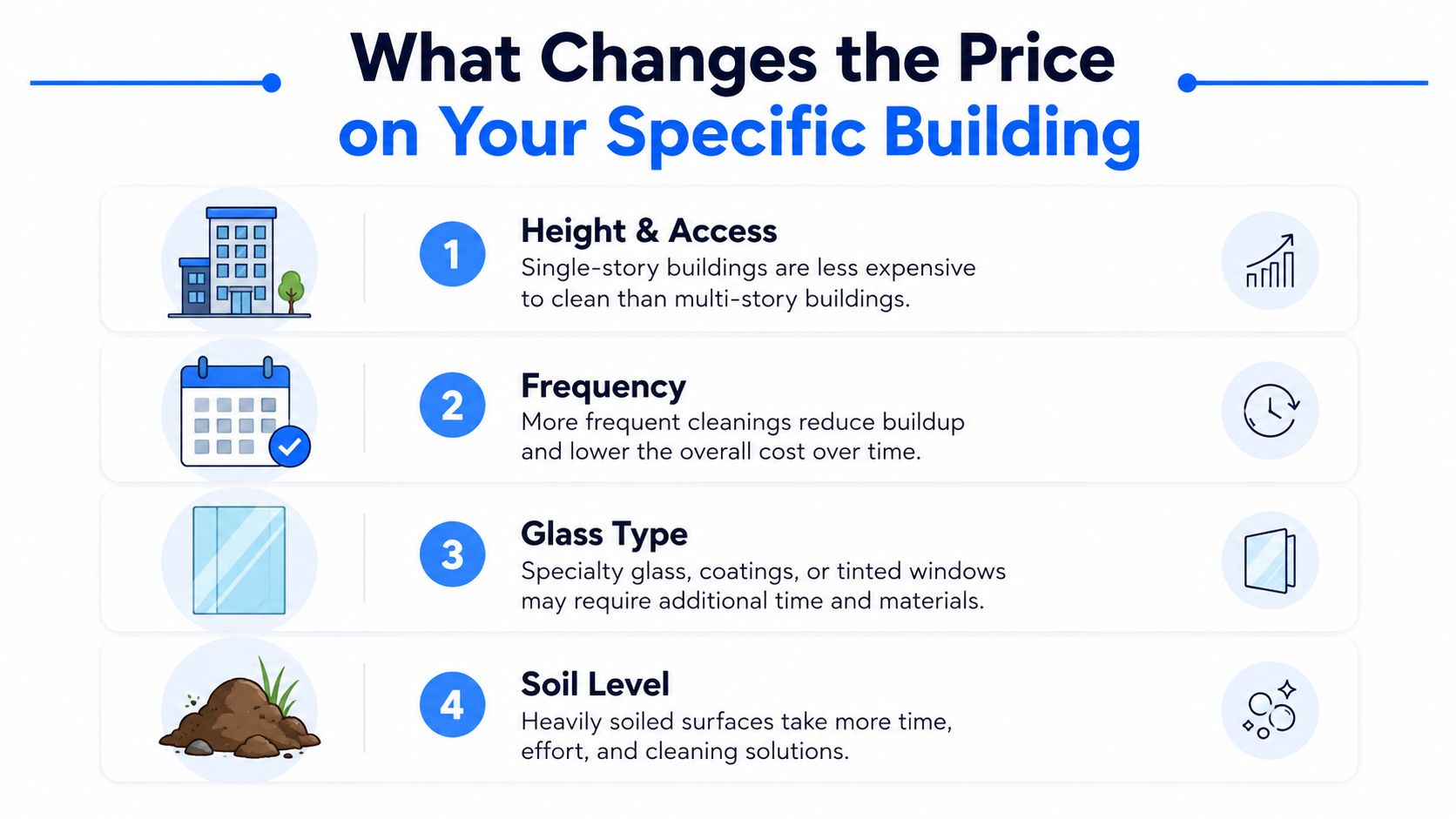
A single-story shop with level sidewalk access, an available hose connection, and unobstructed panes is easier to service than a two-story façade above planters or an awning. Ladders may be appropriate for some sections, while a water-fed pole may be faster and safer for reachable upper glass. A lift, scaffolding, or rope descent system becomes a separate access decision when the glass can't be reached from the ground.
Access changes the labor plan
Look closely at the space between the crew and the glass. Planters, railings, security cameras, uneven paving, parked vehicles, and narrow walkways all force extra setup. A wide sidewalk and clear access reduce repositioning, while a crowded entrance makes the crew work around customers and employees.
Glass configuration matters just as much. A continuous 6-by-8 plate-glass window is straightforward to clean, while divided lights, casements, French-door glass, and multiple sidelights create more edges and more individual sections. The same façade can also require different methods on the inside and outside.
Frequency controls the condition
Weekly and biweekly service generally keeps soil from building into a heavier restoration task. A quarterly visit may require more agitation, detergent, or spot treatment, especially where dust, hard-water residue, construction particles, or vandalism resin have accumulated.
Route density also matters. If a cleaner already services neighboring retailers in the same area, the provider may be able to reduce travel and setup waste. That's why a lower per-visit rate on a dense route can produce better economics than a higher one-off rate at an isolated location.
For upper reachable glass, review the practical considerations in this guide to a water-fed pole setup. It's a method choice, not a guaranteed surcharge or substitute for a site assessment.
Worked Price Examples for Real Storefronts
Worked examples make storefront window cleaning prices easier to evaluate because they show how frequency and configuration interact. The following profiles are planning examples based on the specified scope and assumptions, not fixed quotes.
| Storefront profile | Assumptions | Per-visit price | Monthly cost at typical frequency |
|---|---|---|---|
| Small boutique | 12-foot-wide façade, two large display panes, one glass door, one transom, weekly route | $55 to $75 | $220 to $300 |
| Corner café | 30-foot façade, divided-light windows, one French door, small awning soffit, biweekly service | $120 to $180 | $240 to $360 |
| Auto-parts shop | 60-foot façade, tall industrial glass, security bars, sidewalk setup, monthly service | $300 to $500 | $300 to $500 |
Profile A, the compact boutique
The boutique has a narrow frontage and a small number of large glass sections. Weekly route scheduling keeps the display glass in maintenance condition, while the transom adds a modest access and detailing requirement. The price stays near the lower recurring-account range because the glass is repetitive and the setup is limited.
Profile B, the corner café
The café has more surface area, but the divided lights create the larger labor issue. Each small section adds edge work, and the French door increases touchpoint cleaning around a busy entrance. The awning soffit can restrict ladder placement, so the biweekly price reflects both configuration and positioning.
Profile C, the auto-parts shop
The auto-parts location has a longer façade and tall industrial glass. Security bars interrupt access, and the sidewalk setup takes more planning than a clear retail frontage. Monthly service also allows more soil to accumulate between visits, so the quote sits at the upper end of the small-business benchmark.
Use these profiles by replacing the assumptions with your own facts. Count the glass, identify access restrictions, and state the desired frequency before comparing the final numbers.
What a Quote Usually Includes and Excludes
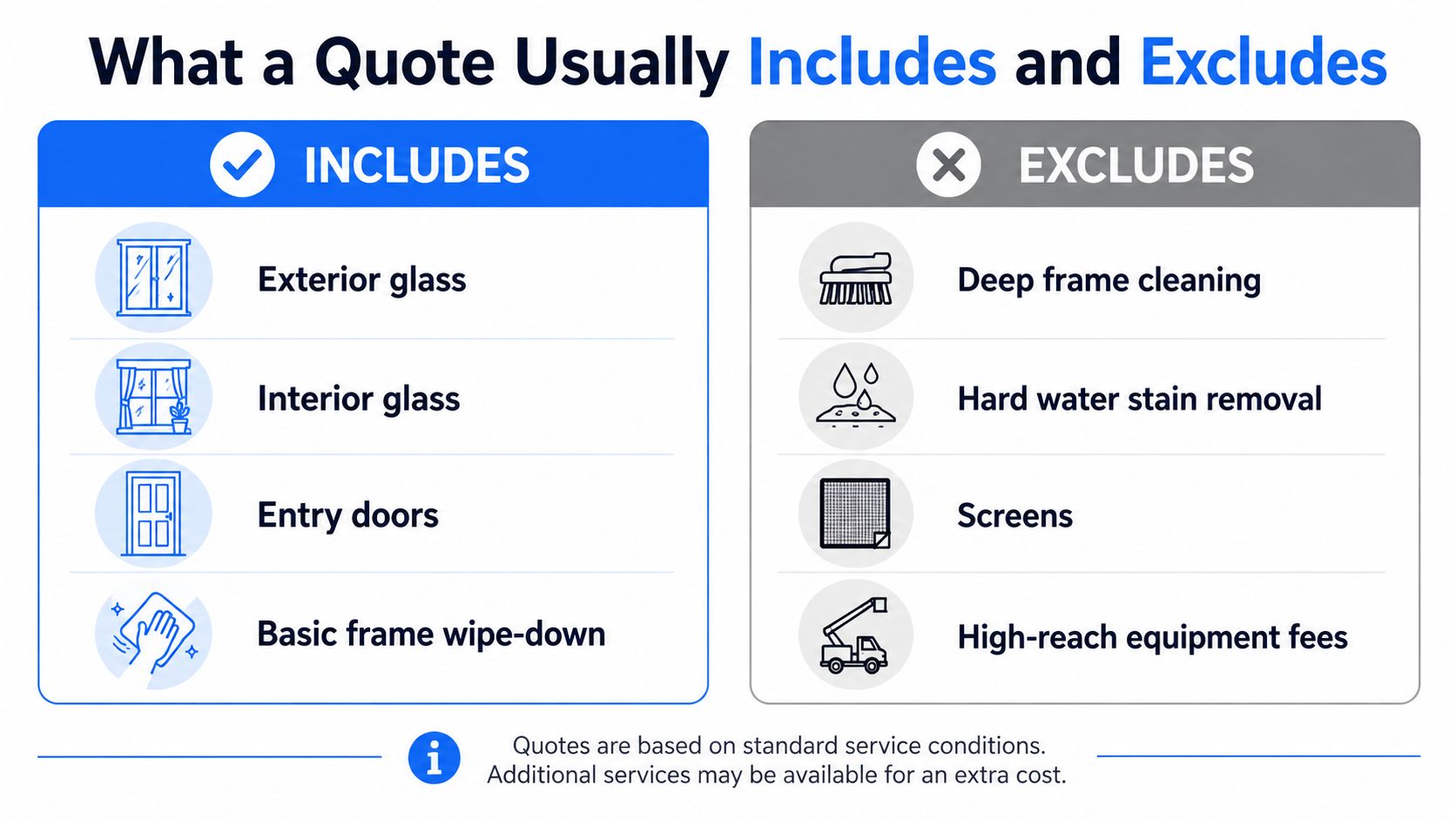
Quotes that look identical can cover very different work. A standard maintenance visit commonly includes exterior glass, accessible interior glass reachable from the floor, basic professional squeegee work, entrance doors, and a light wipe or spot-rinse of frames and sills.
That scope doesn't necessarily include restoration or specialty access. Hard-water deposits, paint, construction overspray, adhesive, stickers, and mineral buildup require additional treatment beyond routine glass cleaning. A first-clean visit may also take longer than recurring maintenance because the crew has to establish a clean baseline.
Ask about the quiet exclusions
Before accepting a quote, ask the provider to mark each item as included, excluded, or separately priced:
- Screens: Removal, washing, drying, and reinstallation may not be part of ordinary storefront service.
- Tracks and frames: Track vacuuming, deep frame cleaning, and detailed sill work often require extra labor.
- Specialty glass: Skylights, isolated transoms, upper panes, and glass behind obstructions may need separate access planning.
- Stain removal: Hard-water or mineral deposit treatment is different from ordinary washing.
- Surface residue: Paint, construction dust, decals, stickers, and vandalism resin should appear as separate scope items when present.
- Equipment access: Glass requiring a lift, scaffolding, or rope access shouldn't be hidden inside a basic ground-level rate.
The most useful question is simple: “What will the crew do if they find a stain or obstruction that isn't covered?” A written answer prevents a low initial number from becoming an unexpected invoice.
How to Get an Accurate Quote
A reliable quote starts with better information. Before calling, photograph the storefront from the sidewalk and from inside the business. Include the full façade, doors, transoms, awnings, landscaping, security bars, and any upper glass.
Then prepare a short scope sheet:
- Count the windows and panes. Note whether each opening is a single large section or divided into smaller lights.
- Estimate dimensions. Rough width and height are enough for an initial planning conversation.
- Separate interior and exterior work. Say whether staff areas, display glass, entry doors, and sidelights need service.
- Flag access issues. Mention uneven sidewalks, planters, customer traffic, locked gates, alarms, and limited parking.
- State the frequency. Ask for pricing at the schedule you're considering, not only a one-time cleanup.
Share the same package with at least three providers and request an itemized bid. Comparing only the bottom line hides scope differences. A provider may appear cheaper because it excluded interior glass, frames, doors, or difficult access.
Five questions belong on every call
- What's included? Ask for the exact glass and surfaces covered.
- What's excluded? Confirm treatment for screens, tracks, stains, decals, and upper panes.
- Is there a minimum service charge? This matters for compact storefronts and isolated stops.
- What happens after a cancellation or lockout? Get the rescheduling and billing policy in writing.
- What proof of insurance arrives with the crew? Property managers often need documentation before work begins.
An on-site walkthrough is preferable for any storefront above one story, any location with French doors, or any façade where awning clearance is uncertain. For broader property issues that may involve damage or post-incident work, this commercial restoration services guide provides useful context, but routine window cleaning should remain a separately defined scope.
You can also compare the practical budgeting questions in this window cleaning services cost guide before requesting bids.
Contracts, Negotiation, and Credentials That Matter
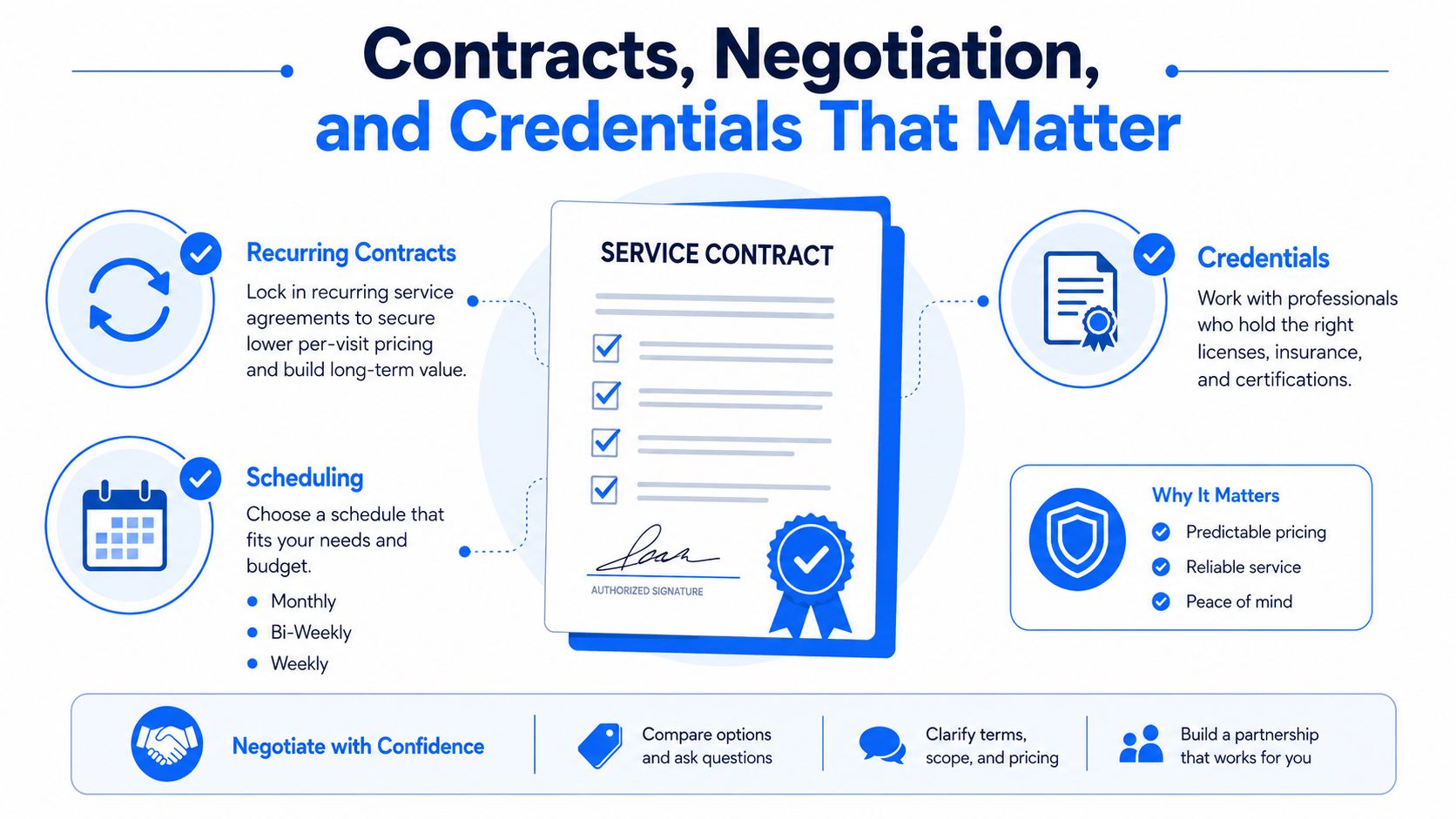
A recurring contract changes the economics because the crew can plan the route, reuse access knowledge, and reduce uncertainty between visits. The value isn't just a discount on one cleaning. It's the combination of predictable scheduling, lower soil buildup, and fewer emergency requests before inspections, openings, or busy retail periods.
Monthly, biweekly, and weekly schedules should be quoted separately. Weekly service often runs 25% to 40% below a true one-off when the account fits efficiently into a route, according to the supplied commercial pricing guidance. The actual contract still depends on scope, access, condition, and whether the location is clustered with other stops.
Negotiate the conditions, not just the rate
A retailer can improve the quote by offering useful operating flexibility:
- Multiple locations: Bundling stores can reduce duplicated travel and administrative work.
- A 12-month term: A longer commitment gives the provider predictable route revenue.
- ACH payment: Reliable payment reduces collection friction.
- Flexible access windows: Early morning or off-peak access can help the crew work without customer interference.
- Neighboring accounts: Coordinating service with nearby tenants may improve route density.
A low price doesn't compensate for unsafe access or unreliable attendance. For work above ground level, ask for general liability insurance with at least $1 million per occurrence, workers' compensation for crews working above six feet, OSHA fall-protection training, ANSI/IWCA International Window Cleaning Association certification, and a written safety plan. These credential thresholds and requirements should be verified directly with the provider and your property manager.
For rope descent systems, OSHA guidance requires the building owner to inform employers in writing that each anchorage has been identified, tested, certified, and maintained to support at least 5,000 pounds in any direction for each attached worker. That makes anchor documentation a compliance issue, not just an equipment preference. Ask for certificates of insurance, comparable retail references, background-check confirmation for after-hours workers, and the crew's safety documentation before approving this work.
Next Steps for Pricing Your Storefront Service
Start with the facts a cleaner needs to price the stop. Measure the approximate total glass area, count panes, note divided lights, list door glass and transoms, and identify any glass above 12 feet. Photograph both sides of the façade so a remote estimate reflects the same conditions you see on site.
Next, obtain three written quotes from insured local providers. Compare price per visit, frequency, included scope, exclusions, access method, and contract terms, rather than comparing monthly totals alone. Confirm whether hard-water treatment, post-construction residue, screen work, and frame detailing are included or billed separately.
Choose the schedule that matches your traffic, exposure, and appearance standard. A busy café or high-touch entrance may need weekly attention, while a lower-traffic office may fit a less frequent route. The right contract keeps the glass maintainable and makes the invoice easier to forecast.
Finish the process with a credentials check and a 90-day review. Document attendance, scope completion, missed areas, access problems, and customer disruption. That record gives you real performance information for the next negotiation instead of relying only on the lowest initial quote.
Professional Window Cleaning serves commercial properties across Arizona, including Phoenix, Scottsdale, Tempe, Chandler, Paradise Valley, Glendale, and Flagstaff, as well as Colorado locations including Denver, Boulder, Arvada, Westminster, Erie, Commerce City, and Golden. Service is also available in Las Vegas and Laughlin, Nevada, using professional squeegees, ladders, lifts, rope descent systems, and pure water methods where appropriate.
Professional Window Cleaning can review your storefront scope, access conditions, and preferred service frequency to prepare a practical commercial quote. Visit Professional Window Cleaning to request pricing for recurring storefront service and discuss the right equipment for your building.