



A property manager in Phoenix can be looking at a three-story stucco facade while sprinkler mist leaves fresh mineral marks across the lower panes. The ladder is already at its useful limit, the sidewalk is active, and the afternoon heat is drying every drop before the operator can reach the next section. That's the point where a water-fed pole deserves consideration, but not because it's a magic wand.
How to use water fed pole window cleaning comes down to matching the system to the glass, the access, the weather, and the soil on the building. A professional crew may use pure water and a pole for reachable upper glass, then switch to squeegees, ladders, lifts, scaffolding, or rope descent when the site demands closer control.
What Water Fed Pole Cleaning Is
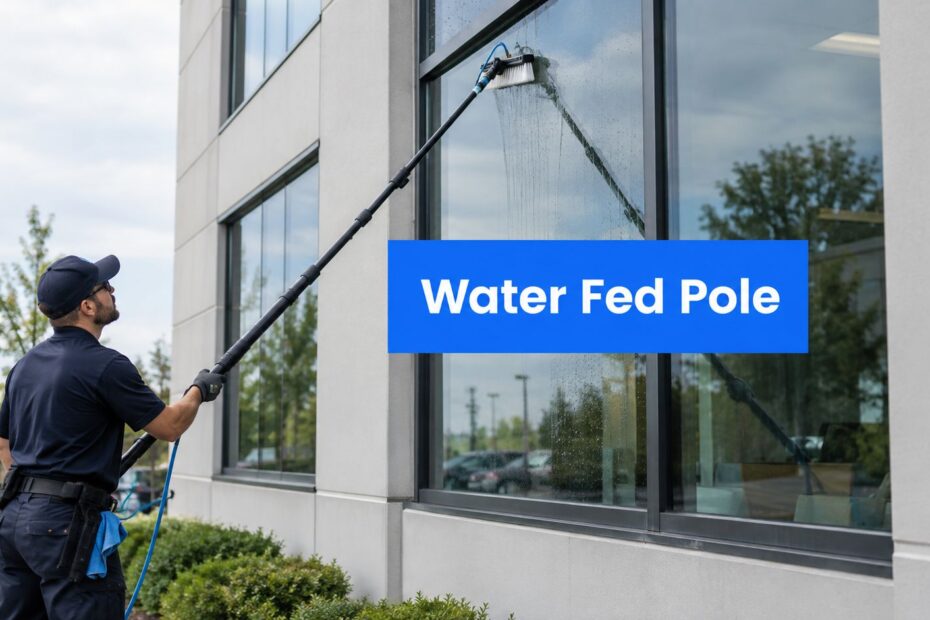
How to Use Water Fed Pole Window Cleaning comes down to matching the system to the glass, access, weather, and soil on the building. A water-fed pole moves much of the work to the ground, using a telescoping or modular pole, usually aluminum or carbon fiber, with a soft-bristle brush at its tip. A hose runs through or beside the pole, carrying purified water from a filtration unit to the brush. Depending on the setup, a pump provides pressure, or a gravity-fed tank supplies the flow.
The purification unit typically uses reverse osmosis, deionization, or both to remove dissolved minerals from tap water. Those minerals can leave white deposits after drying. Pure water has a much lower dissolved-solids load, so the rinse film can evaporate without the detergent residue associated with traditional washing. The history of water-fed pole systems traces the basic consumer system to 1955, commercial use to the 1960s, and early international adoption by the 1970s.
The water does most of the finishing
The brush loosens dust, pollen, insect residue, and ordinary surface soil. Purified water carries that material down the pane. The operator does not dry the glass with a cloth. The final rinse must be controlled so clean water, rather than dirty brush water, is the last material touching the surface.
A major development arrived in 1997, when U.K. cleaner Craig Mawlam launched a telescopic system combining pole reach with water purification. The approach became mainstream in the early 2000s and is now widely used for residential and mid-rise commercial work because it can dry without spotting when water quality and technique are right, as described in this history of pure-water window cleaning.
Practical rule: Pure water makes spotless drying possible. It does not remove paint, construction debris, cured hard-water scale, or every bonded contaminant by itself.
Arizona and Colorado conditions expose that limitation quickly. A sun-baked Phoenix storefront may carry sprinkler minerals, desert dust, and baked-on residue that require more agitation or restoration tools. A Denver office park may have lighter airborne soil but still bring fast drying, hard-water supply issues, or landscaping that restricts access below the glass. Use the pole when the glass is reachable, the soil suits brush cleaning, and the rinse can be controlled before the pane dries. Bring in squeegees, a lift, or rope descent when the surface needs closer control or the pole cannot deliver a reliable finish.
Choosing the Right Pole and Setup
A water-fed system is only as efficient as its weakest component. A stiff carbon fiber pole with poor water delivery still performs badly, while an aluminum pole with a well-matched brush can work very well at modest height.
Pole material and usable reach
Aluminum poles usually cost less and can be perfectly serviceable for low and moderate work. Their weakness appears at full extension, where additional flex makes the brush harder to track across edges and mullions. Carbon fiber poles weigh less for comparable reach and stay more rigid, which becomes important beyond two stories. The operator spends less effort correcting bend and less time chasing brush movement that drifts away from the intended line.
Reach isn't the same as pole length. Working height is roughly the pole length minus the operator's height and the loss created by the operating angle. A 30-foot pole may put the brush on glass around 22 to 24 feet above the ground, depending on stance and facade geometry. For the average cleaner, practical ground reach is about 65 feet, while lightweight materials generally push the useful ceiling only slightly higher, usually not beyond about 70 feet, according to this water-fed pole reach guidance.
| Pole Setup Comparison | Best Reach | Weight | Best For |
|---|---|---|---|
| Aluminum pole | Moderate, depending on configuration | Heavier at extended lengths | Ground-floor, residential, and lower commercial glass |
| Carbon fiber pole | Extended commercial reach | Lighter and more rigid | Multi-story glass and long production days |
| Modular pole | Configurable by section | Varies by sections used | Crews that need several working heights |
Brush, hose, and water delivery
Brush choice changes how the operator contacts the glass. Boar hair and flagged nylon provide useful agitation for general work, while pencil jets and tapered heads help reach frames, mullions, gaskets, and narrow joints. A brush that's too aggressive can create unnecessary friction, while one that's too soft may struggle with compacted dust.
Hose routing should avoid sharp bends, doorways, and pedestrian paths. Quick-disconnects make brush changes and troubleshooting faster. A reel keeps long runs manageable, but it must unwind without creating a trip hazard. Gravity feed can work with a short, straightforward run and enough elevation difference. A pump becomes more useful when the hose run is long, the pole is high, or the delivery pressure drops at the brush.
The crew should size the filtration and delivery system for daily volume, not just for the tallest pane. The wrong combination turns a small storefront into a slow setup, while a properly matched rig can make a four-pane group feel routine. This water-fed pole setup guide shows how the pole, hose, brush, and purification components function as one working system.
Brush Technique That Leaves a Clean Finish
Stand square to the window with your feet about shoulder-width apart. Keep the pole base planted, your hips facing the glass, and your arms below shoulder height whenever the reach allows it. A front-on stance lets the brush track flat. If you twist your torso or reach sideways, the brush tends to skate off corners, and the pole starts controlling you instead of the other way around.
Begin with the upper section, especially along the top frame and edge where airborne soil often collects. Use a feather-light pass first. That pass lifts loose grit and bonded dust without grinding it across the glass. A second pass can use slightly firmer pressure to spread the bristles into the edges, seals, and frame lines, but pressure should remain controlled rather than forceful.
Keep the brush moving with the water
If frames and sills are part of the service, clean them deliberately before the final rinse. Dirty frame runoff can return to glass that already looks clean. If frames aren't included, leave them alone rather than partially agitating them and allowing contaminated water to drain over the pane.
Work downward in a steady pattern. An S-pattern can help move loosened soil toward the bottom edge, while straight vertical or horizontal strokes give better control on broad commercial panes. Keep a wet leading edge so the purified water carries the suspended soil instead of allowing isolated patches to dry. The rinse should push dirty water off the lower edge, not sweep it back over finished glass.
For nylon or hybrid brushes, lightly resting the brush on the glass during the rinse can reduce splatter. With a natural boar-hair brush, the bristles can retain contaminants, so rinsing off the glass helps keep dirty brush water away from the final surface.
Read the sheet, not just the brush. If the water sheets evenly, your angle and flow are probably working. If it breaks into dry patches or runs back across clean glass, adjust before the pane flashes dry.
Low humidity on a Denver morning can shorten the working window. A 110-degree Phoenix afternoon can do the same through heat and direct sun. Slow the rinse, adjust the pole angle, and work smaller sections when the glass begins drying before the water has carried soil away. The professional window-cleaning tool guide provides additional context on how water-fed equipment fits alongside other professional tools.
Water Quality and Pure Water Targets
A water-fed pole only delivers a clean finish if the water at the brush is clean enough. The operator should test the delivered water, not assume that a good reading at the tank represents what reaches the glass after passing through a hose and pole.
Professional guidance treats 0 ppm TDS as the standard, while industry guidance commonly targets 0 to 5 ppm at the brush end. Many operators change DI resin when output reaches about 10 ppm, and dissolved minerals above that range make visible spotting more likely, as explained in this TDS meter guidance for window cleaners. Another industry reference describes the practical target as 0 to 5 ppm and warns that readings above 10 ppm can dry into white spots or film, so the meter needs to be checked at the point of delivery, not only at the source.
Test after the system has run
Turn the system on and let it run for at least 60 seconds before testing at the pole. That flush clears TDS creep and any water that has been sitting in the hose or pole. Then test the output flow at the brush end. If the reading is no longer within the working target, stop and service the purification system before committing to the elevation.
| TDS Targets and What They Mean On the Glass | Visible Result on Glass | Operator Response |
|---|---|---|
| 0 ppm | Best condition for spotless drying | Proceed, while maintaining proper agitation and rinse control |
| 0 to 5 ppm | Cleaning-grade water for routine work | Monitor output during the job |
| About 10 ppm | Spotting becomes more likely | Check the meter, flush the system, and consider changing DI resin |
| Above 10 ppm | Mineral residue may dry on the glass | Stop and correct water quality before continuing |
A dusty Phoenix job can load the system quickly, particularly when incoming tap water carries a substantial mineral burden. A Denver office park may appear cleaner but still expose weak resin when the source water has higher dissolved solids. Watch the first south-facing pane for a faint tide line during afternoon drying. That visual cue can confirm a problem before the meter reading becomes obvious.
DI tanks create a practical waste and maintenance trade-off. Single-use or exchange-style tanks can simplify handling, while refillable systems may suit crews with steady volume and a process for resin replacement. The correct tank size depends on daily water demand, not pole reach. A small route with a tall pole may use less water than a low-rise property with many panes.
Safety Conditions and When to Switch Methods
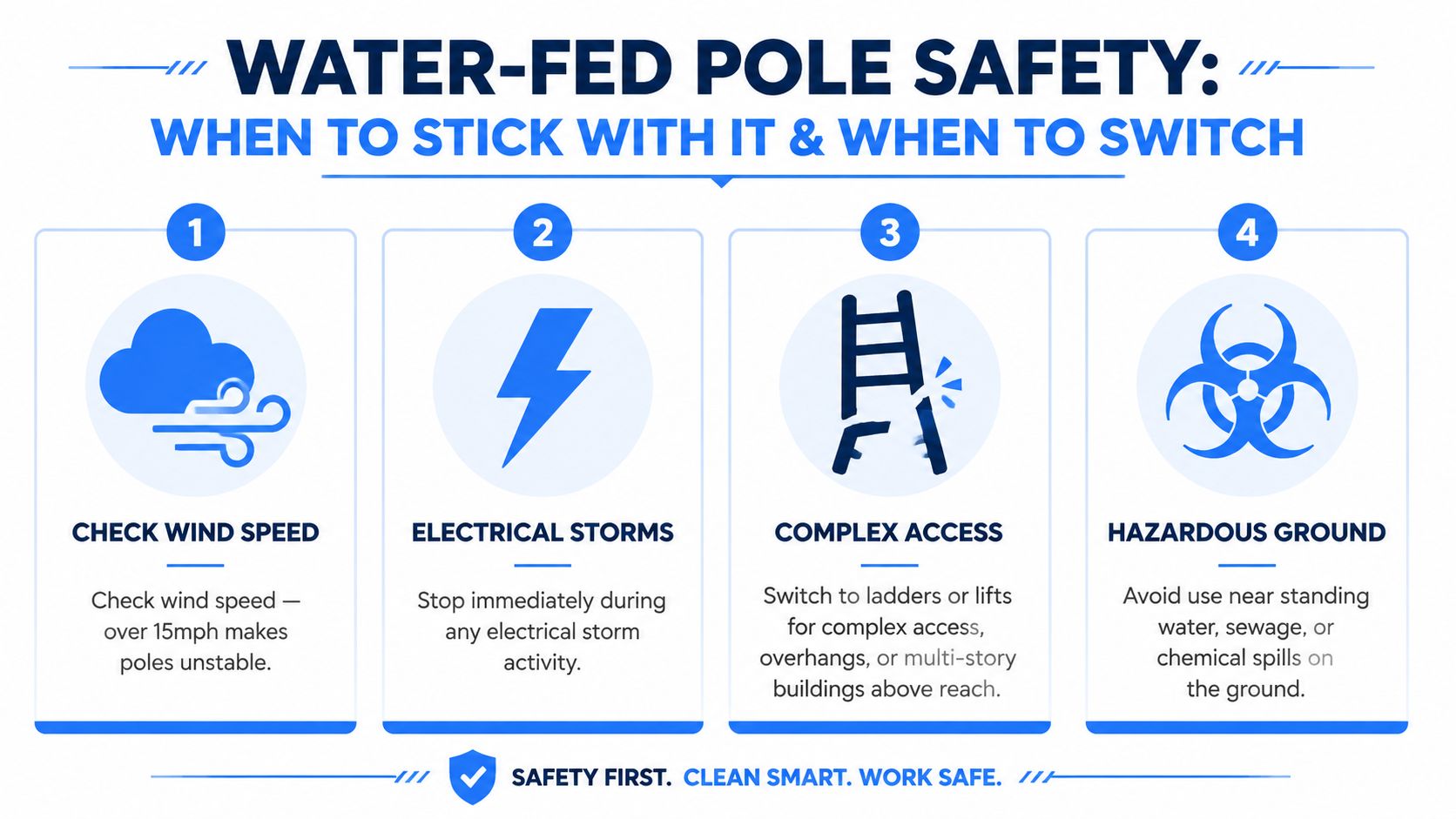
A water-fed pole keeps the operator on the ground, but that doesn't make every site safe. The pole can become difficult to control in wind, create an electrical hazard near overhead lines, obstruct public movement, or place the operator beside unstable ground and active traffic.
The U.K. Health and Safety Executive guidance says to avoid water-fed pole work in high winds, near overhead power lines, during thunder and lightning, or with defective equipment. It also calls for public areas to be cordoned off when needed. The best-practice guidance for window cleaners recommends a front-on stance, arms below shoulder height, whole-body movement, a vertical pole with its base on the ground, and a starting position roughly half a pole length from the building.
Make the access decision before extending the pole
A sustained wind above roughly 15 mph can turn a 30-foot pole into a sail. That threshold is a site decision rather than a universal promise, but it's a useful warning point for a crew lead. Stop for overhead power lines within reach of any conductive section, active loading docks where the pole blocks sightlines, or public sidewalks without a workable pedestrian exclusion zone.
Arizona crews also need a heat plan for outdoor work above 105°F. Colorado work near energized lines requires strict proximity controls, and the safe choice may be to use a different access method or decline the elevation. Fall protection requirements can still affect setup activities, including the technician who climbs to establish a pump station. OSHA rope descent rules also limit use above 300 feet unless the employer can show no other method is feasible or safer, while rope workers must stay within 6 feet of the suspension point and need stabilization provisions above 130 feet, as set out in this OSHA rope descent safety reference.
The pole is safer only when the site makes it safe.
Use the pole when the glass is reachable from the ground, the weather is calm, the equipment is sound, and pedestrians can be controlled. Switch to a scissor lift or boom when taller panes face wind exposure or fragile glazing. Use rope descent or an industrial swing stage only when access is blocked and the system is properly planned.
Before extending the first section, review the weather, lines, traffic, ground conditions, equipment, water flow, exclusion zone, and emergency access. A short on-the-spot risk assessment helps the lead pause before a routine storefront turns into an avoidable incident.
Troubleshooting Streaks and Spots
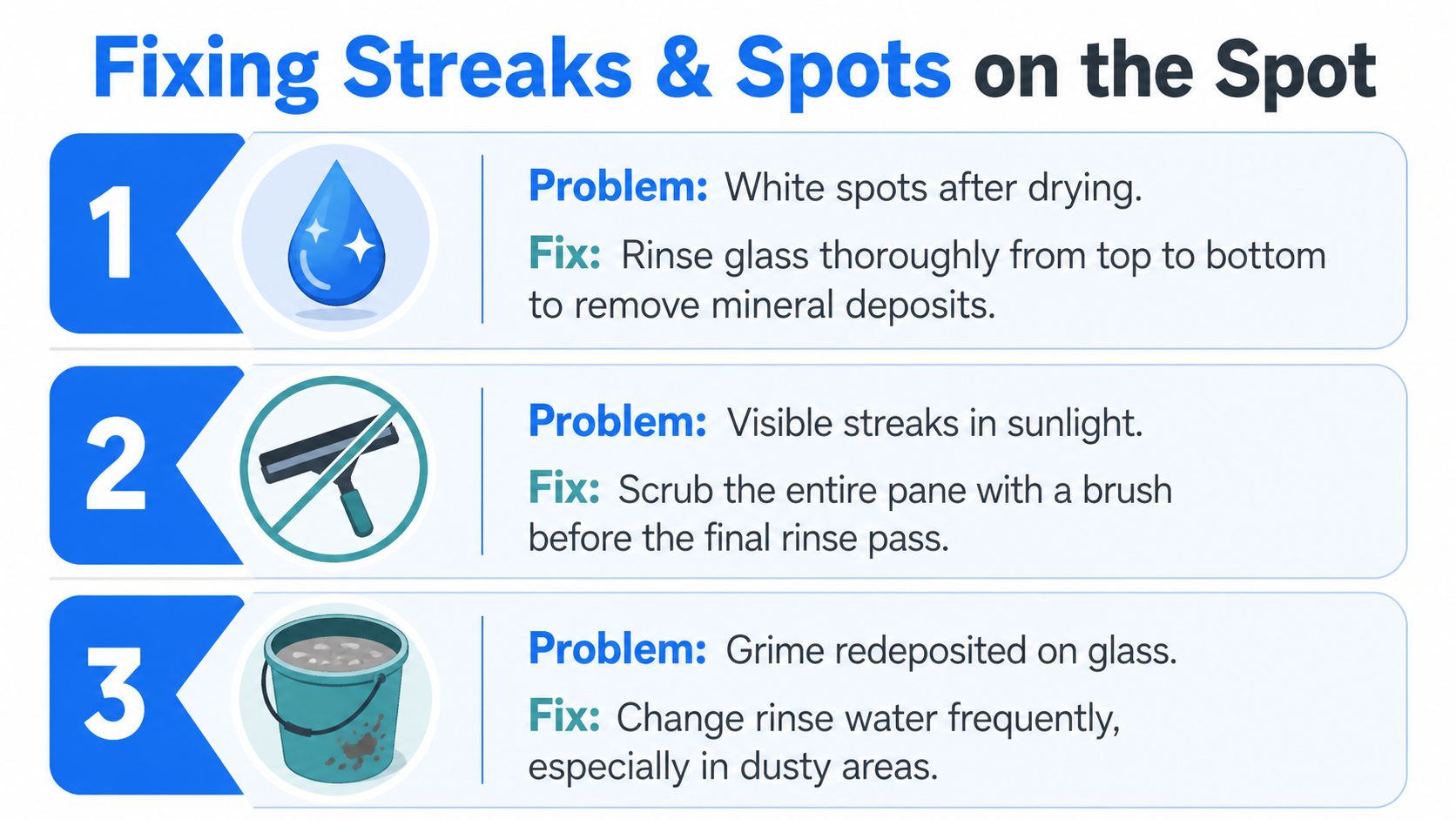
Spotting after a water-fed clean usually points to either water quality or process control. Uniform white spots across several panes suggest exhausted resin or TDS drift. Check the brush-end reading first, then inspect the system for leaks, bypassing filters, or water that wasn't flushed before the pole went onto the glass.
Vertical streaks usually indicate an incomplete rinse. The operator may have missed the side edges, allowed the brush to carry dirty water through the final pass, or rinsed too quickly for the water curtain to push soil down. Return to the top, agitate lightly, and rinse from the upper edge down with a pattern that reaches both sides and the bottom.
Diagnose the glass before scrubbing harder
Dirty frames and mullions reveal a contact problem. The brush may have crossed the center of the pane without reaching the gasket, joint, sill, or ledge. On a first clean, those edges can hold enough soil to contaminate the rinse. Make a deliberate frame pass, then inspect representative panes after drainage.
Direct sun changes the timing. On a Phoenix afternoon, glass can dry before the rinse carries away every mineral or soil particle. Heat doesn't make poor technique disappear, and it can expose a marginal water reading that might not show on a shaded pane. In Colorado, hard-well-water spotting can leave residential glass with a heavy mineral load, and pure water cleaning may not remove an established deposit without restoration work.
Arizona also brings mineral dust that bonds to glass after monsoon storms. That soil often needs more controlled agitation rather than brute force. If a second light brush pass and a clean rinse don't improve the finish, stop and test the water again instead of scrubbing harder.
The safest field test is simple. Clean one representative pane, let it dry fully, and inspect it under raking light before committing to the rest of the elevation. This exposes spotting, missed edges, runs, and residue while the correction is still small. For established deposits and related treatment options, this guide on removing water spots from windows helps separate routine cleaning from restoration work.
When to DIY and When to Call a Professional
A homeowner can reasonably consider a rented DI system and a 22-foot pole for ground-floor residential glass under 12 feet, light dust, and accessible parking. That combination keeps the work close to the ground and makes water delivery, brush control, and final inspection manageable.
The decision changes with height and contamination. Anything beyond two stories, construction fallout, hard-water staining, or post-tint adhesive calls for a professional crew with the right access and restoration tools. A water-fed brush is excellent for ordinary soil, but it isn't a universal substitute for scrapers, specialty treatments, squeegees, lifts, or rope systems.
Regional conditions change the schedule
Phoenix dust storms can reset a cleaning schedule to every 4 to 6 weeks. Denver UV can bake sealant residue onto glass and may require resin polishing or more detailed correction. In Las Vegas, hard-water overspray from nearby misters can leave mineral crusts that pure water alone won't remove.
A professional quote should identify more than the number of windows. Ask whether the crew will test pure water at the brush, detail frames and sills, identify hard-water or construction contamination, carry liability insurance, and use an OSHA-compliant setup. Professional Window Cleaning is one regional option that uses water-fed poles alongside lifts, rope descent systems, and professional squeegee techniques for residential and commercial work across Arizona, Colorado, and Nevada.
| DIY vs. Professional Water Fed Pole Cleaning | DIY / Rented System | Professional Crew |
|---|---|---|
| Suitable access | Ground-floor and low, accessible glass | Multi-story, difficult, or restricted access |
| Water quality | Owner monitors a rented or portable DI system | Crew tests delivered water and manages filtration |
| Contamination | Light dust and ordinary soil | Construction debris, mineral deposits, adhesive, and difficult residue |
| Safety planning | Homeowner controls a smaller work area | Crew plans exclusion zones, equipment, traffic, and access |
| Method flexibility | Mostly limited to the rented pole | Can combine poles, squeegees, ladders, lifts, scaffolding, and rope descent |
| Inspection | Homeowner checks visible finish | Crew evaluates representative panes, edges, frames, and drying behavior |
Before signing, ask who will perform the work, what happens if pure water doesn't remove an existing stain, how public areas will be controlled, which access method the crew expects to use, and whether the quote includes frames and sills. Those answers tell you whether the company is selling a repeatable process or just arriving with a long pole.
Professional Window Cleaning matches water-fed poles with squeegees, ladders, lifts, scaffolding, and rope descent when the building or conditions demand a different method. Visit Professional Window Cleaning to request service for residential, storefront, office, mid-rise, or high-rise glass in Arizona, Colorado, and Nevada.