



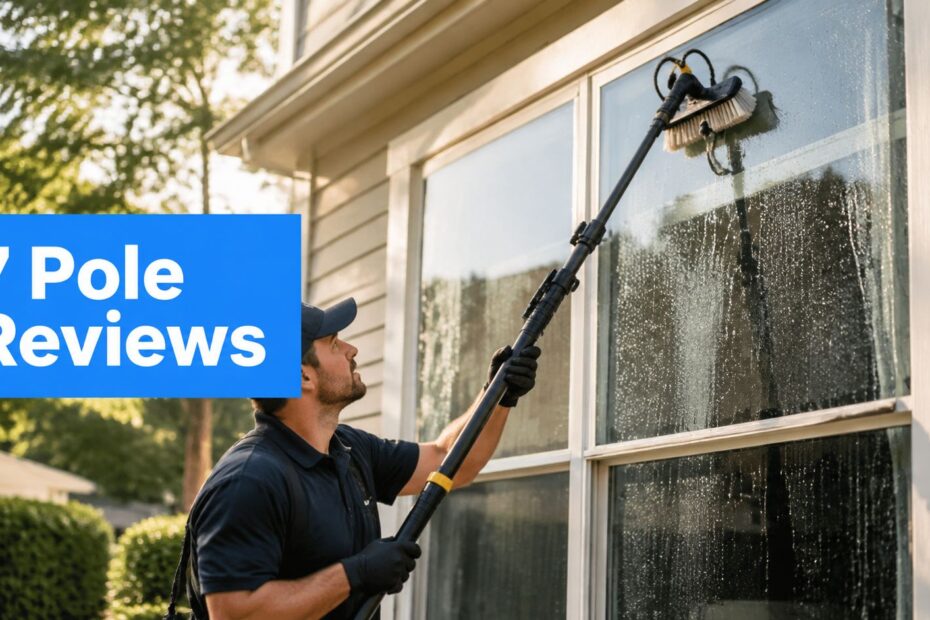
What do water fed pole window cleaning reviews really tell you about the company you're hiring? Most search results combine equipment reviews, retailer ratings, professional forums, and customer testimonials, even though a property owner needs answers about workmanship, safety, access, scheduling, and accountability. A highly rated pole can't compensate for poor water purification, careless frame preparation, or an access plan that doesn't fit the building.
Read reviews in two layers. First, assess the equipment: reach, rigidity, weight, brush control, fittings, and water quality. Then assess the service provider: whether crews know when to use pure water, squeegees, ladders, boom lifts, scaffolding, or rope descent systems. That distinction matters across Phoenix, Scottsdale, Tempe, Chandler, Paradise Valley, Glendale, Flagstaff, Denver, Boulder, Arvada, Westminster, Erie, Commerce City, Golden, Las Vegas, and Laughlin, where building height, hard-water conditions, glass type, and site access can vary sharply.
The following list ranks useful review and buying resources through a window-cleaning service lens, not as a simple equipment popularity contest.
1. Professional Window Cleaning
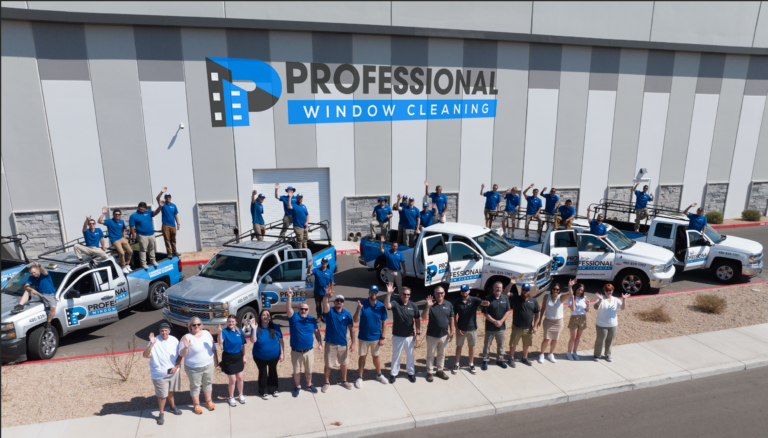
Professional Window Cleaning stands apart from equipment catalogs because it connects water-fed pole capability with the complete service decision. The regional provider has operated since 1999 and serves homeowners, retail storefronts, property managers, facility teams, and high-rise owners across Arizona, Colorado, and Nevada. Its crews combine purified-water systems with professional squeegees, ladders, boom lifts, scaffolding, and rope descent systems, selecting the access method according to the building rather than forcing every job into a single tool.
The company's service range includes residential, commercial, mid-rise, and high-rise window cleaning, along with pressure washing and, when available, specialty equipment rentals. Listed equipment includes a 65-foot Genie boom lift, a 32-foot scissor lift, and a 95-foot Reachmaster Falcon atrium spider lift. Availability depends on location, scheduling, and whether the equipment is already assigned to another project, so customers should confirm access needs during quoting.
Safety credentials deserve more attention than a generic star rating. Professional Window Cleaning says its technicians are annually trained and certified in OSHA 1910.27 by Expert Safety Services, and that crews are background-checked, drug-free, and fully insured. The company also offers a 100% satisfaction guarantee, fast quotes, online scheduling, and on-time service.
Service-quality test: A water-fed pole review matters most when the provider can explain why that method suits your glass, elevation, frames, and surrounding property.
What the review profile can and can't prove
The company cites thousands of reviews and an overall 4.9 rating, including about 1,900 or more reviews on its site, with strong BBB and social-platform ratings. Those figures are useful signals of customer experience, but they don't replace questions about the specific service being booked. Ask whether recent reviews mention exterior glass, multi-story work, frame cleaning, punctuality, and post-service inspection.
Pricing isn't presented as one flat rate. Exact costs depend on the size, height, access complexity, and condition of the project, although the site provides industry guidance and per-pane estimates for homeowners. For a practical explanation of the company's method, see its guide to water-fed pole window cleaning.
Pros
- Safety and trust: Annual OSHA 1910.27 training, Expert Safety Services certification, background checks, drug-free technicians, and full insurance.
- Full-service capability: Residential, commercial, mid-rise, and high-rise work using poles, lifts, rope systems, scaffolding, and squeegees.
- Convenience: Fast estimates, online scheduling, on-time crews, and a 100% satisfaction guarantee.
- Regional coverage: Local service across major Arizona, Colorado, and Nevada markets.
Cons
- Custom pricing: Customers need a project-specific quote rather than a universal price list.
- Regional availability: Specialized equipment and certain services depend on location and scheduling.
For owners comparing providers, Professional Window Cleaning is the strongest entry on this list because it treats water-fed poles as one part of a broader, safety-led window-cleaning operation. Readers researching marketing language can also browse these cleaning business slogans.
2. J. Racenstein Water Fed Pole Buying Guide
What should a water-fed pole review reveal before you hire a window-cleaning company? J. Racenstein's water-fed pole buying guide helps translate equipment descriptions into questions about service scope. It compares pole materials and product categories, including hybrid and carbon-fiber options, and points readers toward Gardiner and ProTool products.
Its practical value lies in matching reach, stiffness, weight, and job type. Equipment suited to low residential work may behave differently on a taller commercial elevation. The guide also covers high-reach equipment, accessories, and pure-water systems, helping readers distinguish a complete setup from a pole-only purchase.
Read buying advice as a scope tool
Customers do not need to purchase the equipment, but they can use the same criteria to assess a contractor. Ask how high the crew expects to work from the ground, whether the pole stays rigid at that elevation, and how technicians manage sections that flex under brush pressure.
The specifications show why these questions affect handling. One listing describes a 15-foot pole weighing 1.5 pounds, with three sections, 25 feet of hose, and a 54.5-inch collapsed length. A 26-foot version weighs 3.5 pounds, uses five sections, and includes 36 feet of hose. These figures appear in the PWP Hybrid Water Fed Pole listing.
Use the guide's examples to identify accessories and compare equipment categories, but check brand recommendations against product-page reviews and independent practitioner discussions. The guide emphasizes selected brands, so it should not be treated as a complete cross-brand market survey.
For a booking decision in Arizona, Colorado, or Nevada, ask the provider to describe the planned setup before accepting a quote. Confirm the working height, water-purification method, brush choice, hose arrangement, and any sections that require lifts, rope systems, or other access equipment. Professional Window Cleaning's water-fed pole setup explanation provides useful context for evaluating those answers. The clearer the contractor is about access and configuration, the easier it is to compare scheduling, regional availability, and the limits of the quoted service.
3. WindowCleaner.com Understanding Water Fed Poles
Which details in water-fed pole reviews indicate dependable window-cleaning service rather than a favorable equipment impression?
WindowCleaner.com's water-fed pole guide provides useful background on aluminum, fiberglass, hybrid, and carbon poles, linking each material to different job demands. That context matters because a review of a pole can change significantly with elevation, workload, access, and the type of exterior surface being cleaned.
The site also points readers to XERO product lines with customer reviews and feature notes. Its community forum contributes practitioner feedback, while training and high-reach resources provide more context than a short retail listing. These materials help separate equipment observations from evidence about an actual cleaning service.
Why material matters to service quality
A lighter pole may reduce fatigue during routine work. Greater reach, however, makes rigidity, balance, and brush control more important. The guide's material examples include 100 GPa carbon composite for working heights up to 33 feet, 210 GPa carbon 24K up to 52.5 feet, and HiMod carbon at 180 GPa up to 65 feet. The figures illustrate how to read reviews: a stiffness rating has practical meaning only when matched to the working height and the technician's handling.
A homeowner can use the guide's residential categories to understand why a provider selects a particular pole length. The equipment alone does not establish service quality. Landscaping, balconies, rooflines, and fragile finishes may affect positioning, rinsing, and whether additional access equipment is required.
For bookings in Arizona, Colorado, or Nevada, use reviews to form specific questions. Ask whether the quoted method keeps the technician at ground level, how the provider manages high or obstructed windows, and what happens if the planned pole cannot reach safely. Then compare the answers with ratings, safety credentials, scheduling reliability, guarantees, and regional availability. XERO's broad professional community and multiple price tiers are useful reference points, but independent forums and service-specific reviews provide a better check on whether product feedback reflects consistent field work.
4. ABC Window Cleaning Supply WaterFed Pole Guide
ABC Window Cleaning Supply's WaterFed Pole Guide addresses a common source of bad equipment choices, the difference between a pole's stated length and its usable working height. Its pole-length calculator and explanation of angle and flex are particularly helpful for buyers who might otherwise choose a system that looks long enough on paper but doesn't reach the intended glass comfortably.
The guide compares aluminum, fiberglass, hybrid, carbon, and Hi-Mod carbon. It also links to product pages containing specifications, reviews, and downloadable resources. That makes the site practical for narrowing requirements, even though it doesn't rank individual models in a single head-to-head list.
Use the calculator to question service claims
A provider doesn't need to use the longest pole available. The right choice depends on where the technician can stand, how much pressure the brush requires, the building's setbacks, and whether the glass can be rinsed cleanly. Excess length can introduce flex and handling problems, while insufficient reach can push crews toward ladders or lifts.
That distinction is especially relevant for commercial properties. Industry guidance says water-fed poles can let crews work from ground level, reduce ladder usage by about 80% on residential jobs, and cut completion time by up to 40% compared with traditional squeegee methods. The same guidance describes use on windows up to about 90 feet high. These figures are from WindowCleaner.com's professional water-fed pole guidance, and they should be read as operational benchmarks, not guarantees for every building.
ABC's brand-agnostic approach is a strength for first-time research. The limitation is that readers must move from the educational guide to individual product pages for detailed model comparisons. For a service booking, use the material guidance to ask better questions, then judge the company by its proposed access plan and finished-work reviews.
5. Tucker USA Water Fed Poles
Tucker USA's water-fed pole collection is a manufacturer-focused resource with a broad selection of carbon, high-modulus carbon, and hybrid poles. Product pages publish prices, ratings, review counts, kits, accessories, and information about support, returns, warranties, and financing. That makes the site useful for comparing configurations within one product family.
The collection covers reach options from roughly 27 to 70 feet, with different materials aimed at different handling and stiffness requirements. Because each product page concentrates on Tucker equipment, the ratings are most useful for identifying repeated issues or strengths within the brand, not for proving that Tucker is superior to Gardiner, ProTool, XERO, or another manufacturer.
Equipment reviews versus contractor reviews
A customer can use manufacturer reviews to ask whether a provider maintains its equipment properly. Look for evidence that brushes, clamps, hose connections, and pole sections are inspected and replaced when needed. A professional crew should also understand that a functioning pole doesn't automatically produce clean glass. Water purity, brush technique, frame preparation, and the final drying check affect the result.
Professional guidance commonly frames effective pure-water cleaning around a TDS reading near 0 ppm. A setup guide recommends DI-only systems when source water is under 150 ppm, single-membrane RO/DI systems from 150 to 300 ppm, and dual-membrane RO/DI systems at 300 ppm or more. Those configuration thresholds are detailed in J. Racenstein's professional pure-water setup guide.
The relevance for homeowners and facility managers is direct. Ask whether the provider tests water quality and how technicians confirm the glass has dried cleanly. If the answer focuses only on pole length or brand, the review evidence is incomplete.
Readers who want to understand the supporting equipment can also review Professional Window Cleaning's water-fed pole pump information.
6. Home Depot Unger Lock-On Water-Flow Pole and Brush Combo
The Unger Lock-On water-flow pole and brush reviews provide a useful mass-market baseline. The listing combines a hose-fed aluminum pole, a Lock-On brush connection, and an on/off flow valve with a large volume of time-stamped buyer reviews and customer questions.
That volume can help identify recurring complaints about leakage, thread fit, flow control, or connection durability. It's a different kind of evidence from a professional service testimonial. Retail buyers describe ownership and basic use, while window-cleaning customers need to judge consistency across an entire property, including frames, ledges, high elevations, and difficult access points.
Where this kit fits
The aluminum construction and hose-fed design make the Unger combo more appropriate as a straightforward, low-cost tool than as a complete commercial water-fed pole system. It's heavier and less rigid than professional carbon systems, and it isn't a strong choice for above-two-story work or continuous all-day commercial use.
That doesn't make the product irrelevant. The reviews can reveal the failure points that matter in any water-fed setup. A service provider should be able to explain how it prevents leaks, secures fittings, manages hose movement, and controls water flow during detail work. If a contractor's equipment appears improvised or the crew can't answer basic maintenance questions, the retailer feedback becomes a warning rather than a recommendation.
Easy retail returns and local availability may suit a property owner handling a limited, low-access task. They don't establish that the tool is suitable for a multi-story building, a large storefront program, or glass requiring careful inspection. For those projects, review the provider's training, insurance, access equipment, and service guarantee instead of comparing consumer kits alone.
7. Window Cleaning Resource Community
The Window Cleaning Resource Community offers the most candid field perspective in this list. Professional users discuss Gardiner, Tucker, SimPole, Unger Carbon Tech, and XERO, often focusing on stiffness, weight, clamps, extensions, warranties, and how poles behave after extended use.
Forum threads are especially useful because they include troubleshooting and follow-up discussions. Users talk about flex at high reach, clamp breakage, section wear, wind, salt, and hard-water conditions. That kind of detail can reveal reliability issues that a polished product page may not mention.
Read disagreement as useful evidence
Community advice varies by poster, job type, climate, and equipment age. Older discussions may refer to discontinued models, and conflicting opinions are common. Those limitations don't make the forum unreliable. They mean readers should compare the date, current product model, working height, and conditions before applying a comment to their own project.
The forum also helps explain why ergonomics deserve a place in water fed pole window cleaning reviews. UK HSE guidance recommends whole-body movement, elbows kept close, alternating arms, limited time on long poles, and additional recovery measures when working at height. The guidance is available through this professional discussion referencing HSE recommendations.
For a customer, the conclusion is not that longer poles are unsafe by default. It's that a capable provider should manage fatigue and positioning rather than treating maximum reach as a simple productivity benefit. On taller facades, the crew's work method, rotation practices, and access alternatives can affect both finish quality and safety.
7-Source Water-Fed Pole Reviews
| Item | Implementation complexity | Resource requirements | Expected outcomes | Ideal use cases | Key advantages |
|---|---|---|---|---|---|
| Professional Window Cleaning | Low for client (hire service); high operational complexity for provider | Certified crews, lifts/rope systems, insurance, scheduling systems | Streak‑free, safety‑compliant results for routine and high‑access jobs | High‑rise, commercial storefronts, property managers, homeowners wanting turnkey service | Certified technicians, full‑service capability, strong reviews and fast estimates |
| J. Racenstein – Water Fed Pole Buying Guide | Low (research-focused) | Time to read, compare specs and embedded price examples | Clear purchase benchmarks, reach/scoping guidance and brand comparisons | Buyers planning pole purchases and budgeting for reach needs | Detailed side‑by‑side comparisons, price examples, reach recommendations |
| WindowCleaner.com – Understanding Water Fed Poles | Low (educational + community) | Time to review guides, forum engagement for practitioner input | Job‑type recommendations, product links and training resources | First‑time buyers, buyers wanting community validation and training | Structured guidance, active pro community, multiple price tiers and promos |
| ABC Window Cleaning Supply – WaterFed Pole Guide | Low (practical guidance) | Use pole‑length calculator, consult product pages and specs | Accurate length selection and material trade‑off clarity | Buyers avoiding under‑sizing and needing practical height calculations | Pole‑length calculator, clear material/height guidance, U.S. support |
| Tucker USA – Water‑Fed Poles | Moderate (product selection across SKUs) | Budget for carbon/Hi‑Mod poles, accessories; warranty/support checks | Professional‑grade poles with visible ratings and published prices | Pros comparing models within a single established brand | Broad SKU range, on‑site ratings/prices, U.S. support and bundles |
| Home Depot – Unger Lock‑On Pole & Brush Combo | Very low (retail purchase) | Low budget, local pickup/returns, large review set | Mass‑market baseline performance; heavier, hose‑fed limitations | DIY homeowners, quick low‑height jobs, budget replacements | Hundreds of buyer reviews, easy returns, wide retail availability |
| Window Cleaning Resource Community | Low (research & Q&A) | Time to search threads, verify dates and follow‑ups | Real‑world longevity insights, troubleshooting and brand comparisons | Pros seeking long‑term field feedback and problem solving | Practitioner‑level reports, multi‑year threads, candid reliability signals |
Turn Review Patterns Into a Safer Booking Decision
Equipment suitability and service-provider trust are separate decisions. A pole may have strong reviews for stiffness or low weight, yet the company using it may lack the training, insurance, water-purity controls, or access equipment needed for your building. Conversely, a provider may own excellent equipment but still need a squeegee, ladder, lift, scaffolding, or rope descent system for specific glass and elevations.
Rope descent work requires particular scrutiny. OSHA 1910.27 limits a suspended worker's reach to 6 feet in any direction from the suspension rope's centerline, according to the IWCA rope descent safety document. Washington's codified rule also calls for a second skilled person at the jobsite for rescue readiness and limits descent height to 300 feet, unless alternative access isn't feasible or would create greater hazard. These requirements show why a provider's safety credentials matter more than a generic statement that it “handles high-rise windows.”
Use this booking checklist:
- Verify city coverage: Confirm the company serves the actual property location in Phoenix, Scottsdale, Tempe, Chandler, Paradise Valley, Glendale, Flagstaff, Denver, Boulder, Arvada, Westminster, Erie, Commerce City, Golden, Las Vegas, or Laughlin.
- Ask about method selection: Find out whether water-fed poles suit the building, glass, frames, and exterior conditions.
- Confirm access planning: Ask how the crew will handle difficult elevations, setbacks, atriums, skylights, balconies, and areas beyond pole reach.
- Request a written estimate: Make sure the scope identifies interior or exterior glass, frames, screens, access equipment, and any scheduling conditions.
- Check credentials: Confirm insurance, technician training, safety procedures, and rescue planning where rope descent is proposed.
- Review recent service feedback: Prioritize comments about the same type of window-cleaning work, not only equipment ownership.
- Clarify the guarantee: Understand how the company handles missed panes, spotting, access limitations, or return visits.
Professional Window Cleaning offers residential, commercial, mid-rise, and high-rise window cleaning throughout its regional markets, using water-fed poles alongside professional squeegees and specialized access systems. Visit the Phoenix window cleaning service page or the relevant local page for Scottsdale, Tempe, Chandler, Paradise Valley, Glendale, Flagstaff, Denver, Boulder, Arvada, Westminster, Erie, Commerce City, Golden, Las Vegas, or Laughlin to confirm availability and request a project-specific estimate.
Professional Window Cleaning combines purified-water systems, professional squeegees, lifts, scaffolding, and rope descent methods for residential, commercial, mid-rise, and high-rise work. Visit Professional Window Cleaning to request a quote, confirm service in your city, and discuss the safest access plan for your windows.