

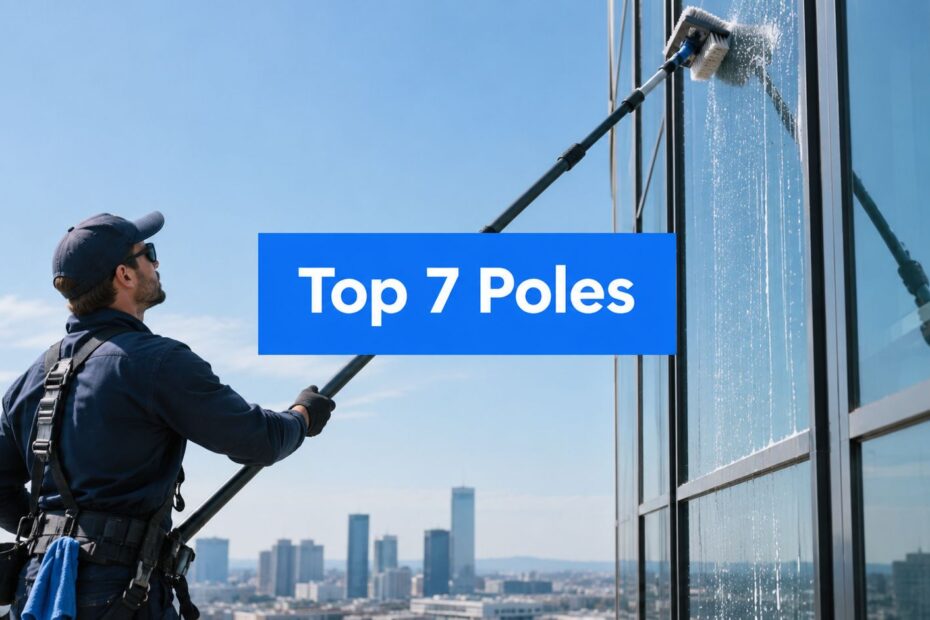
Which is the best water fed pole window cleaning option, the longest carbon pole, or the system that matches the building? Reach is only one part of the decision. Water quality, access, hose distance, crew capability, pole control, and site safety determine whether pure-water cleaning is efficient or a poor fit. Complete systems work well for routine exterior glass on residential and low- to mid-rise properties. Complex elevations may still require professional squeegees, ladders, boom lifts, scaffolding, or rope descent systems. The seven options below range from full regional service to equipment platforms from Unger, Tucker, XERO, IPC Eagle, Gardiner, and Reach-iT. If you're hiring in Phoenix, Scottsdale, Tempe, Chandler, Paradise Valley, Glendale, Flagstaff, Denver, Boulder, Arvada, Westminster, Erie, Commerce City, Golden, Las Vegas, or Laughlin, assess service coverage and access before choosing.
1. Professional Window Cleaning
For some properties, hiring a trained crew that can switch between pure water, squeegees, and mechanical access is more practical than buying a pole. The decision depends on the building, frequency of cleaning, storage, water treatment, and safe access to each elevation.
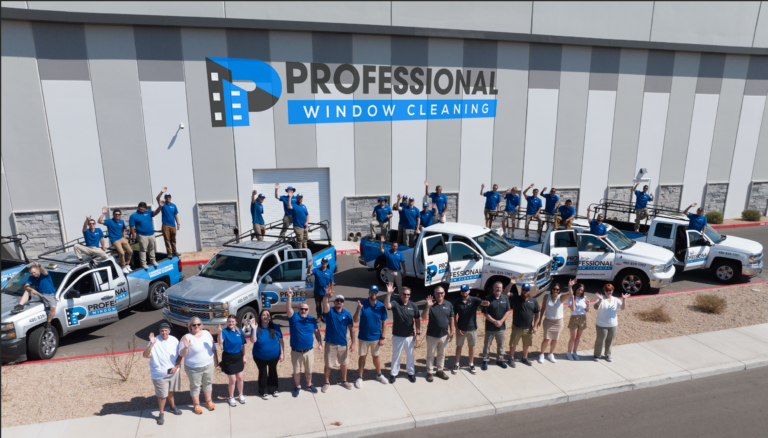
Professional Window Cleaning serves Arizona, Colorado, and Nevada, including residential, storefront, commercial, mid-rise, and high-rise work. The company has operated since 1999 and combines water-fed poles with professional squeegees, ladders, boom lifts, scissor lifts, an atrium spider lift, scaffolding, and rope descent systems. That range can suit a project with ground-level storefronts, difficult skylights, and upper glass on the same elevation.
For a homeowner in Phoenix or Scottsdale with accessible exterior windows, a compact pure-water setup may be reasonable. A storefront in Denver, a mid-rise in Boulder, or a high-rise in Las Vegas creates different demands for transport, crew access, fall protection, and equipment selection. Properties in Flagstaff, Colorado, and Nevada may also require planning around local conditions and building layout rather than pole reach alone.
Technicians are described as background-checked, drug-free, fully insured, and annually trained on OSHA 1910.27 by Expert Safety Services. The company also lists fast quotes, online scheduling, on-time crews, and a 100% satisfaction guarantee. Its website reports thousands of mostly 4.9-star reviews, including about 1,700 local reviewers and an overall 4.9 rating across about 1,932 reviews. These figures come from the company's own customer review information, so they represent provider-reported social proof, not an independent rating study.
Why service can beat ownership
Owning equipment involves more than purchasing a pole. The system must be transported, maintained, supplied with resin, operated safely, and stored. A service provider handles those tasks and can choose the access method pane by pane.
Field rule: A water-fed pole is a method, not a guarantee that every window should be cleaned from the ground.
Professional Window Cleaning also supports pressure washing and may rent specialty access equipment when available, including a 65 ft Genie boom lift, a 32 ft scissor lift, and a 95 ft Reachmaster Falcon atrium spider lift. Availability depends on location. Website pricing is guidance rather than a fixed menu, with example hourly and pane-based formulas. The final quote varies with access, glass condition, height, and scope.
The limitation is geographic. This is a regional provider, and specialty equipment is not guaranteed at every office. For jobs that combine storefront glass, skylights, and upper floors on one elevation, compare service coverage, access methods, insurance, crew training, and the cost of owning equipment for occasional work.
For related exterior-glass maintenance ideas, see Fillaree's glass cleaning tips.
2. Unger HydroPower Ultra Systems and nLITE Poles
Need a matched system without assembling every component yourself? Unger offers a practical route. The HydroPower Ultra DI range pairs with nLITE carbon and HiMod poles, creating options for residential work, storefronts, and accessible low-rise buildings.
Its swap-out resin-bag design keeps routine purification maintenance straightforward. Preconfigured Entry, Professional, and Advanced kits also pair the tank, pole, brush, hose, and related components, reducing compatibility issues for first-time buyers.
Best fit for straightforward purchasing
Availability is a major advantage. United States dealers commonly stock Unger equipment, while the company provides package information that helps buyers compare configurations before ordering. Replacement parts and resin are also easier to source when several distributors carry the same product line.
DI-only purification can cost more over time in areas with high dissolved-mineral content because the resin handles more of the purification work. Test source-water TDS before choosing a tank. Pure-water guidance commonly treats water below 10 ppm TDS as effective for cleaning, while water above 50 ppm has a much higher risk of spotting and mineral deposits as it dries, according to Streamline's pure-water guidance.
Pole stiffness affects brush control, especially on taller residential elevations and commercial glass. Unger's nLITE carbon options address that concern. Professional lines cover working heights from about 33 ft to 65 ft. The same Unger USA water-fed pole range lists professional feed pumps around 2 to 4 gpm at 100 to 160 psi, useful reference points when comparing hose length, flow, and pressure needs.
For practical installation guidance, Professional Window Cleaning explains its water-fed pole setup. Unger suits operators serving residential routes, storefronts, and accessible low-rise work across Arizona, Colorado, or Nevada. A regional provider may be a better fit for occasional mid-rise or high-rise work where lift access, crew training, and insurance matter more than owning a complete system. Unger becomes less attractive when local water conditions make DI purification expensive or when a buyer needs a heavily customized commercial cart from the outset.
3. Tucker USA Rival V2, H2Pro, and Fill N Go
Tucker USA gives professional crews more room to configure the purification and delivery side of the system. Its lineup includes stainless Rival V2 and H2Pro RO/DI carts, tank-based Fill N Go systems, carbon poles, brushes, jets, goosenecks, hose reels, and accessories.
The Rival V2 uses a four-stage RO/DI cart format across several kit levels. The H2Pro adds options such as booster pumps for users who need more flow or pressure. That distinction matters on larger properties, where hose distance and elevation can reduce delivery performance before the water reaches the brush.
A useful platform for changing job types
A small residential operator might prefer a tank-based Fill N Go system because it's simple to load and deploy. A commercial crew working on campuses or multi-story buildings may value an RO/DI cart with a pump, even though it occupies more vehicle space and takes more effort to move.
Tucker's US-based support, visible return and FAQ information, and parts network are meaningful advantages for a working company. Buyers can select equipment according to source-water TDS, desired flow, and hose length rather than accepting one fixed configuration.
Choose the pump for the route, not the brochure: Long hose runs and taller work can make a higher-volume setup more useful than a lighter starter cart.
The trade-off is decision complexity. Rival V2, H2Pro, Fill N Go, booster pumps, and multiple pole packages create plenty of choice, but a first-time buyer can struggle to see which differences will affect actual production. The cart format is also heavier and bulkier than a DI-only tank kit.
Before buying, compare the equipment choices with Professional Window Cleaning's water-fed pole window cleaning reviews. Tucker fits operators who expect their work mix to grow, need US support, and want the option to add pumping capacity rather than replace the entire system.
4. XERO Pure Systems and XERO Poles
XERO's appeal is its upgrade path. The XERO Pure three-stage RO/DI cart can run from typical line pressure, while a booster pump remains available when the job demands more reach or faster rinsing. The brand also offers carbon poles and bundles that combine the cart, pole, and hose.
That makes XERO a sensible choice for a cleaner who doesn't want to buy the most advanced setup on day one. Start with a matched package, learn the workflow, then add pumping or pole upgrades as the route develops.
Where performance depends on the site
XERO's out-of-box results depend on source-water pressure and TDS. A system that performs well at one property may need a pump at another, particularly when the operator is pushing water through a long hose or working higher on a building. Buyers should test their supply instead of assuming the cart alone will provide identical flow everywhere.
The accessory ecosystem is another advantage. Poles, brushes, hose components, and upgrade parts give users flexibility, while the active XERO user community provides practical feedback about setup and technique. That community can help an owner identify whether a problem comes from purification, pressure, brush selection, or operator method.
The compromise is weight and refinement. User discussions often compare XERO's pole options with lighter premium alternatives, and the lightest pole isn't always the best value at a given price. A slightly heavier setup may be acceptable for occasional residential work but become tiring on a full commercial route.
XERO works well for homeowners, small window-cleaning businesses, and crews that want a gradual move from basic exterior glass to taller work. It's less suitable when a buyer needs a fully specified high-production setup without testing water pressure first. Explore the current XERO Pure systems and poles before matching the package to the building.
5. IPC Eagle HydroTube and HydroCart RO/DI Systems
IPC Eagle takes a modular commercial approach. The lightweight HydroTube provides a portable RO/DI platform, while the HydroCart offers a compact cart format with optional ECO-Boost pump modules in electric or gas configurations.
That distinction is valuable for commercial crews that need the same purification platform to serve different sites. A team may use a lighter setup for accessible storefronts, then add pumping capacity for longer hose runs, higher elevations, or a larger campus route.
Built for serviceability
The HydroCart's modular design lets operators increase flow and elevation capability without abandoning the cart. Parts, warranty information, and distributor support also matter more as equipment becomes part of daily production rather than occasional homeowner use. A commercial operator needs to know who can supply replacement components when a system is down.
IPC Eagle's main weakness is purchasing clarity. Retail pricing and ordering are commonly handled through distributors, so buyers may need to contact a dealer for a complete configuration instead of comparing a single published price. The cart platforms also weigh more and take up more room than DI-only tank systems.
A practical application would be a property-services company cleaning several buildings on one site. The crew can choose a portable HydroTube for simpler work or a HydroCart with an ECO-Boost pump where hose distance and height justify the added footprint.
Mid-rise work rewards capacity only when the crew can move it efficiently. A powerful cart that stays in the truck because it's cumbersome isn't a productive system.
Review pump selection and operating considerations in Professional Window Cleaning's water-fed pole pump guide, then compare the available IPC Eagle systems through a regional distributor.
6. Gardiner Pole Systems SLX and Xtreme
Gardiner concentrates on the equipment operators hold throughout the day, especially the pole and brush. The SLX range uses carbon construction to balance weight, stiffness, and cost. The Xtreme line is aimed at higher stiffness-to-weight performance. Square-Lock clamps, capsule jets, and compatible fittings complete the pole setup.
These are specialist components, not complete water-fed systems. Buyers still need an RO/DI cart or DI tank, hose, pump where required, and suitable brush hardware. That separation suits experienced professionals who already understand their purification requirements and want to improve pole handling without replacing equipment that still works.
Why stiffness changes the job
Long poles flex. More flex can make it harder to keep the brush aligned, maintain edge contact, and control the rinse. Carbon composite and high-modulus carbon construction help retain brush control while reducing unnecessary effort. Gardiner's SLX and Xtreme pole range reflects that design priority.
Ergonomics is Gardiner's main appeal. An SLX may suit residential routes and storefronts where repeated handling matters, while an Xtreme can make longer residential work or mid-rise access easier when added stiffness justifies its cost. In Arizona, Colorado, or Nevada, a regional professional service provider may be more practical for occasional high-rise work, where the customer avoids buying a separate purification system and managing long-pole safety.
The trade-off is configuration work. A working operator must match the pole to an existing water system, brush, hose, and pump, then confirm replacement-part access before relying on it for daily production. Reseller pricing and stock can vary, so compare the complete setup rather than the pole alone.
Safe technique still matters. UK industry guidance advises whole-body movement, elbows close to the body, hands below shoulder height, alternating arms, and limited time on very long poles such as 60-foot poles. The HSE window-cleaning best-practice guide also notes that water-fed poles can reach 20 meters or more, making training important. Gardiner suits operators who already own dependable purification equipment, not homeowners seeking one box with every component.
7. Reach-iT and Future of Cleaning Bundles
Reach-iT, sold through Future of Cleaning, emphasizes complete kits and brush selection. Packages can include hybrid poles, hose, brushes, and RO/DI equipment, giving new operators a faster route to a field-ready setup.
The brush range is particularly relevant when the glass isn't the only surface being cleaned. Radial brushes and accessories such as Rocker and Solar options are designed for different frame profiles, deep sills, and related exterior surfaces. That can help a crew avoid forcing one brush to handle every substrate.
A practical entry point for new crews
Bundle-focused purchasing reduces compatibility guesswork. A new operator can select a package, connect the hose, and learn a matched workflow instead of assembling a pole, brush, gooseneck, fittings, and purification components from separate manufacturers.
The limitation is customization. Teams that want a very specific pole, pump, hose reel, or brush combination may need to mix brands. Promotions can also change the effective value of a bundle, so compare the actual components rather than judging the package by its headline price.
Technique still decides the finish. Professional guidance recommends starting at the top, agitating frames during the first service when they're included, rinsing thoroughly, and revisiting panes for spotting after drainage and evaporation. The operator must also inspect for broken panes, failed seals, loose trim, active leaks, and fragile facade elements before putting a brush against the building. The most recent water-fed pole technique guidance also emphasizes documented inspections, regular cleaning of pole sections, and avoiding high winds or overhead power lines.
Reach-iT suits a new residential or storefront route that needs a complete, brush-flexible package. It's less compelling for an experienced commercial crew that already has compatible equipment and wants to specify every component independently.
Top 7 Water-Fed Pole Systems Comparison
| Item | Implementation complexity | Resource requirements | Expected outcomes | Ideal use cases | Key advantages |
|---|---|---|---|---|---|
| Professional Window Cleaning | Low for customers; service-based execution | Insured trained crews, specialty access equipment (lifts, ropes) | Consistent professional clean; safety-focused; satisfaction guarantee | Residential to high‑rise projects needing on-site crews | Local presence + heavy equipment, strong reviews, safety protocols |
| Unger HydroPower Ultra + nLITE poles | Low–Medium; preconfigured kits simplify setup | DI tanks, swap‑out resin bags, nLITE carbon poles, brushes | Reliable pure‑water rinses with predictable performance | Buyers wanting turnkey pure‑water kits and clear pricing | Matched kits, broad dealer network, MSRP guidance |
| Tucker USA (RHG) | Medium; cart systems require setup and transport | RO/DI carts (Rival V2/H2Pro), optional booster pumps, carbon poles | High‑capacity purification for longer runs | Professional crews needing booster pumps and varied flows | Wide kit range, US support, high‑volume options |
| XERO Pure + XERO poles | Low–Medium; cart runs off line pressure (pump optional) | 3‑stage RO/DI cart, poles, optional booster pump | Upgradeable system with community‑tested workflows | Users seeking upgrade path from entry to pro setups | Bundles, strong user community, accessory ecosystem |
| IPC Eagle HydroTube / HydroCart | Medium; modular with optional pump modules | Portable RO/DI carts, electric/gas ECO‑Boost pumps | Durable commercial performance for mid‑rise/long hose runs | Commercial crews needing pump upgrades and serviceability | Modular pump add‑ons, dealer support, rugged platforms |
| Gardiner Pole Systems (SLX, Xtreme) | Low (pole purchase only); requires separate purifier | Ultra‑light carbon poles, clamps, capsule jets; pairs with RO/DI | Reduced operator fatigue; superior reach and control | Pros prioritizing ergonomics and reach on long jobs | Best stiffness‑to‑weight, professional ergonomics |
| Reach‑iT / Future of Cleaning | Low; bundle‑centric, field‑ready kits | RO/DI bundles, hybrid poles, radial brushes, accessories | Fast startup and productivity improvements | Teams new to water‑fed poles or needing frame/solar tools | All‑in‑one kits, focused brush ecosystem, training resources |
Match the System to the Job
Start with the building, not the brand. A DI-only setup may suit a route with favorable source water and modest demand. An RO/DI system can make more sense where TDS is higher or resin consumption would become a recurring operating concern. Test the water, then compare purification stages, replacement resin, flow, pressure, and the availability of parts in your region.
Pole choice follows reach and control. Carbon and high-modulus carbon poles reduce flex compared with less rigid materials, but the lightest option isn't automatically the best option. Match the pole to the highest routine window rather than buying excessive reach. Professional guidance says water-fed systems are used from ground level at heights up to 60 ft, or 20 m, and warns against using an oversized pole for a smaller window because overreaching reduces control and safety. See the Federation of Window Cleaners safety guidance for that operational limit.
Then account for hose-run length, pump requirements, transport, storage, and crew fatigue. Professional systems commonly use feed pumps in the 2 to 4 gpm at 100 to 160 psi range, but the correct specification depends on the pole height, hose distance, jets, and site supply. A compact tank may be convenient for residential work, while a powered cart may be more productive on a commercial campus.
Pure water also doesn't solve every glass problem. Hard-water deposits, paint, plaster, concrete, stickers, and other bonded contaminants may need scrapers, specialty tools, chemical treatment, or restoration. First-service frame agitation can also increase the work because dirty runoff may continue draining onto the glass. A good operator plans the cleaning sequence and checks the panes after water drains and evaporates.
When hiring is the safer choice
Choose a complete kit for repeatable, accessible exterior work where the operator can control the pole and inspect the glass from the ground. Hire Professional Window Cleaning for skylights, fragile facade elements, multi-story glass, high-rise work, complex access, or any project requiring ladders, lifts, scaffolding, rope descent systems, or trained crews.
Rope descent work has its own regulatory requirements in the United States. OSHA 29 CFR 1910.27 requires building owners to provide written notice that each anchorage has been identified, tested, certified, and maintained to support at least 5,000 pounds in any direction for each worker attached, with certification completed by a qualified person. OSHA also restricts rope descent systems above 300 feet, or 91 m, unless the employer can show that no other access method is feasible or that another method creates a greater hazard. Review the OSHA rope-descent standard before treating rope access as a simple alternative to pole cleaning.
Request a quote from Professional Window Cleaning when the project involves mixed elevations, unusual access, or a commercial schedule. Local service pages are available for Phoenix, Scottsdale, Tempe, Chandler, Paradise Valley, Glendale, Flagstaff, Denver, Boulder, Arvada, Westminster, Erie, Commerce City, Golden, Las Vegas, and Laughlin.
Professional Window Cleaning combines pure-water poles with squeegees, ladders, lifts, scaffolding, and rope descent systems for residential, commercial, mid-rise, and high-rise glass across Arizona, Colorado, and Nevada. Visit Professional Window Cleaning to request a quote and match the access method to your building safely.