



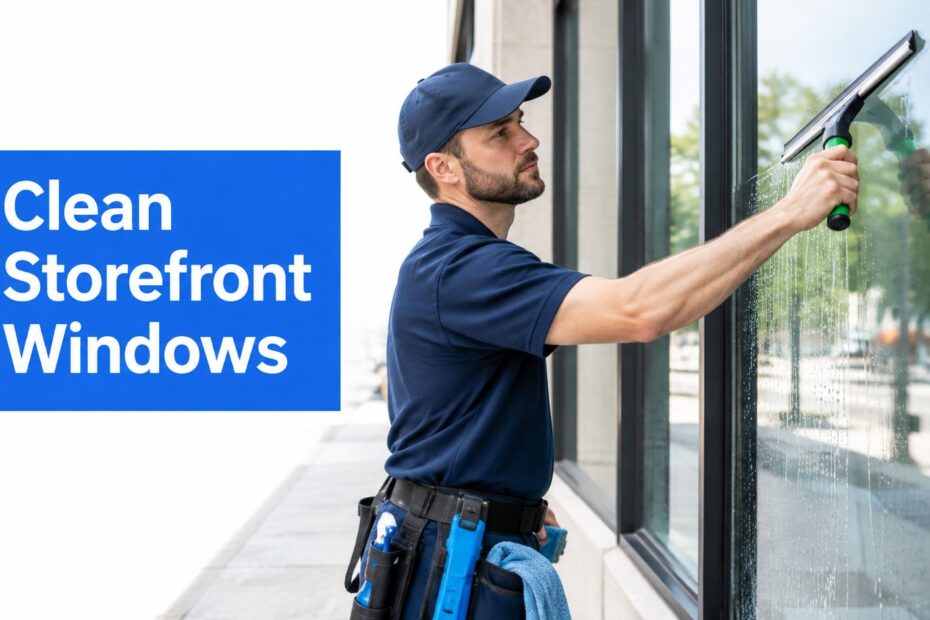
A property manager can usually spot the problem before opening the door. Dust has dried into diagonal streaks, irrigation has left pale spots across the lower panes, and fingerprints cover the entry glass. With customers arriving soon, a quick wipe may make the surface look better from inside, but the sidewalk view often exposes every remaining mark.
Storefront glass takes more punishment than residential glass. It faces street dust, road film, sprinkler overspray, intense sun, and constant contact around doors and display areas. In Arizona, Colorado, and Nevada, those conditions can turn a clean pane into a visibly neglected one faster than many owners expect.
Professional storefront window cleaning relies on squeegees, scrubber sleeves, pure-water systems, water-fed poles, ladders, boom lifts, scaffolding, and rope descent systems. The right method depends on the building, the glass, the water quality, and the access conditions. This guide explains how to clean storefront windows with a workflow that protects the finish and produces a consistent result.
Why Storefront Windows Need a Professional Approach
A property manager may see a clean entry from inside, while sunlight from the pavement reveals drips, haze, and a cloudy lower corner. Storefront glass is judged at eye level by passing customers, so a small finishing error can make a maintained business look neglected. Grit dragged across the pane can also create fine scratches, while mineral residue becomes harder to remove after repeated drying.
The Glass Association of North America cleaning guidance calls for soaking glass with clean water and a mild, non-abrasive solution. Heavy debris should be rinsed away before scrubbing. Scrapers, abrasive cleaners, prolonged dirt buildup, and metal contact can damage the surface. Tinted and coated glass should be cleaned out of direct sun when possible, since rapid drying leaves residue and streaks.

Why the environment changes the job
In Phoenix and Las Vegas, heat can dry a cleaning solution before the first pass is complete. Irrigation overspray leaves mineral deposits, and desert dust collects in tracks, seals, and sill channels. Denver, Boulder, and nearby Colorado properties add road film, seasonal debris, and temperature changes. Flagstaff and other higher-elevation sites may require colder-weather planning for solution handling, equipment, and access.
Water quality changes the result. Ordinary tap water can dry with minerals on the pane, so professional crews may use pure-water systems with water-fed poles for exterior work. Squeegees remain useful where close control is possible, while boom lifts or other access equipment may be required when upper glass cannot be reached safely from the ground.
Glass type also matters. Tinted, coated, and low-E panes require compatible chemistry and gentle handling. Treating every storefront as ordinary clear glass can leave residue, damage a coating, or cause a callback.
Practical rule: Professional cleaning controls contamination, surface type, water quality, access, and drying conditions together.
The storefront assembly includes more than the visible pane. A closer look at what a storefront window includes helps clarify why frames, seals, sills, and glass each need the right cleaning step.
Choosing the Right Method for Your Storefront
No single tool is right for every commercial façade. A traditional squeegee gives a highly controlled finish, while a water-fed pole can make exterior work safer and faster when the ground is clear. Pure water is central to that second method because it allows the pane to dry without the mineral residue ordinary water can leave behind.
Height and pedestrian traffic usually decide the method before cleaning chemistry does. A single-story entry with unobstructed pavement may suit a squeegee and short ladder. A taller façade may call for a water-fed pole, scissor lift, boom lift, suspended scaffold, or rope descent team.
| Method | Max Reach | Best For | Key Trade-Off |
|---|---|---|---|
| Traditional squeegee, bucket, and scrubber | Reach depends on ladder or extension tools | Clear finishes on accessible storefront panes, doors, and display glass | Requires close access and careful traffic control |
| Water-fed pole with pure water | Can reach exterior glass several stories from the ground when conditions allow | Upper panes, awkward exterior access, and areas where avoiding ladders helps | Depends on purified water and unobstructed ground access |
| Scissor lift or boom lift | Reach depends on the selected certified lift | Tall façades, broad upper glass, and work beyond pole reach | Needs stable setup space, clearance, coordination, and sometimes permits |
| Rope descent system | Depends on the building and certified access design | High or difficult façades where anchors and descent routes are suitable | Requires verified anchors, trained technicians, rescue planning, and strict compliance |
Matching the tool to the glass
A squeegee remains the choice when the cleaner needs close control around mullions, corners, decals, and heavy soil. The method became a professional standard after Ettore Steccone invented the light brass-handled, single-blade squeegee in 1936, replacing heavier and less efficient designs. This account of squeegee history also notes that rubber-bladed squeegees were already in use by the turn of the twentieth century.
Water-fed poles reduce ladder exposure for exterior work and are useful across retail centers where the pavement stays open. Their trade-off is water quality. If the water isn't properly purified, the pane may dry with spotting rather than a clean finish. For technique and equipment considerations, this guide explains how to use a water-fed pole for window cleaning.
The decision rule is straightforward. Use a squeegee for accessible glass and detailed interior work, a pure-water pole for suitable exterior reach, a lift when height and pane size demand a stable platform, and rope access only when the building's engineered access system and trained crew support it.
Preparing the Frames, Sills, and Glass Surface
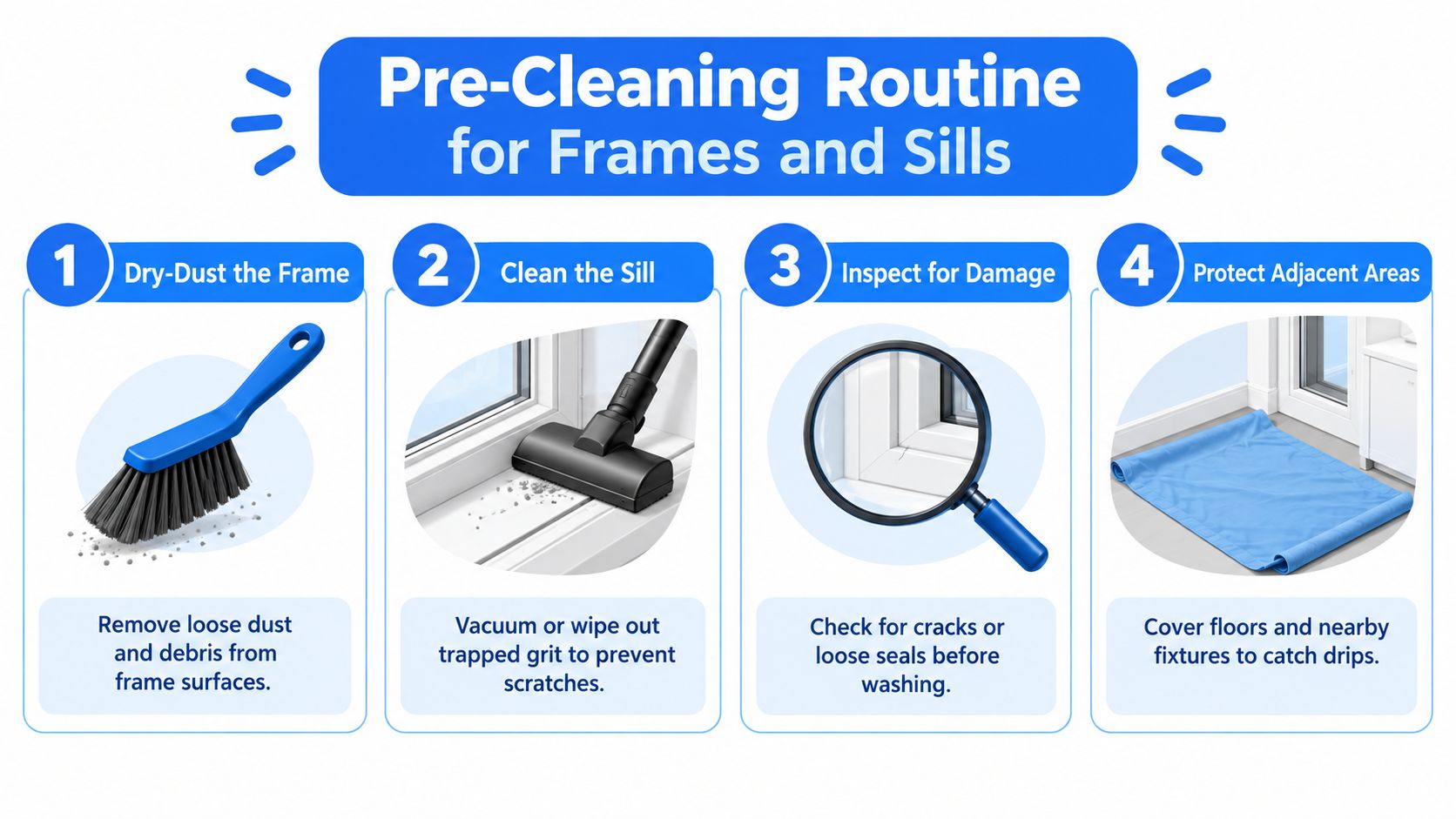
A clean storefront starts below the glass. Frames and sills collect grit, insects, cobwebs, and dried residue. If that material reaches the applicator sleeve, it can spread soil or scratch the pane during scrubbing.
Dry-dust the frame first, then vacuum or wipe the sill. Clear the weep holes so trapped debris does not hold dirty water against the lower edge or create uncontrolled runoff. Check seals, corners, and glazing beads for loose sections or cracks before applying any solution. This inspection is especially useful on older retail façades, where sun exposure can make sealants brittle.
Preparing the work area
Cover or move floor mats, display fixtures, signage, planters, and nearby merchandise before washing. Retail glass often sits above polished flooring, electrical equipment, or products that cannot tolerate runoff. Keep towels, a wet vacuum, or containment materials ready where water could travel.
For routine washing, use a mild, neutral solution. A small amount of mild dish soap in warm water can lubricate the pane. An isopropyl alcohol mix may help with certain adhesive or oily films. Confirm compatibility before using either on tinted, coated, or low-E glass. Avoid ammonia and abrasive products when the manufacturer or glass specification requires gentler chemistry.
Preventing a dry start
Direct Arizona and Nevada sun can shorten the working window, while Colorado wind can dry solution quickly and carry dust back onto a wet pane. Pre-wet one manageable area, scrub it evenly, and remove the solution before it flashes dry. Wetting an entire façade at once can leave the cleaner chasing partially dried residue from pane to pane.
Rinse heavy debris away before agitation. This protects the glass and gives the later squeegee pass a cleaner, more predictable surface. On mineral-prone sites, use properly purified water for water-fed work, since untreated water can dry into spotting even after loose dirt has been removed.
Squeegee Technique for Streak-Free Glass
The squeegee works because its rubber edge removes a continuous film of water. The result depends more on blade condition, angle, pressure, and overlap than on how much cleaning liquid is added.
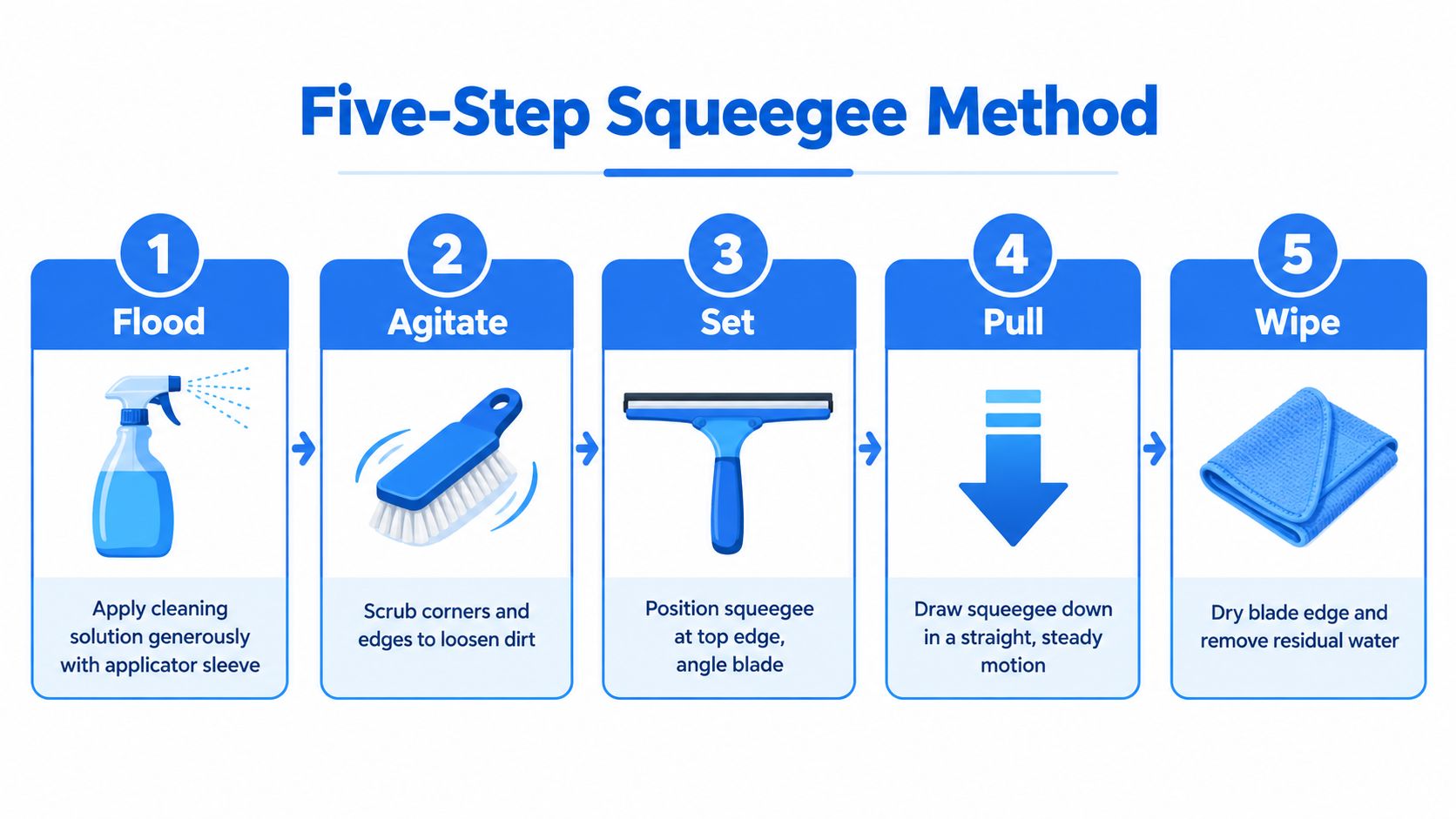
Use this repeatable sequence:
- Flood the pane. Apply solution generously with an applicator sleeve so the full working area stays wet.
- Agitate the edges. Scrub corners, seals, and the perimeter where grime usually remains after a quick wash.
- Set the channel. Place the squeegee at the upper edge with the rubber held at about a 45-degree angle, as recommended in professional technique guidance from Good Cleaner.
- Pull steadily. Make a controlled pass without stopping halfway across the working band.
- Wipe the blade. Dry the rubber with a lint-free microfiber before the next stroke.
Controlling bands and pressure
On a large pane, work in overlapping vertical bands from top to bottom. Leave enough overlap to prevent dry lines between passes, but don't drag the channel through dirty water that has already collected below. Some cleaners use a fan or figure-eight motion for broader coverage, while others prefer straight pulls because they make missed lines easier to identify.
A consistent blade angle matters. Unger's squeegee guidance notes that a 30-degree angle can also work successfully in practice, particularly when the operator maintains contact and keeps the pane uniformly wet. The exact angle matters less than consistency.
Blade control matters more than arm force. Too much pressure can distort the rubber edge and leave water behind. Too little pressure lets the blade skip.
Detail immediately after the main pass. Fold a clean microfiber into a small fingertip pad and wipe the top, sides, lower corners, and sill line. If the rubber has a nick, flip the channel or replace it. One damaged section can draw a visible line across every pass.
Shade timing helps in sunny markets. Clean shaded elevations first, use cool water when appropriate, and keep the solution from drying before removal. For a visual demonstration of the process, watch this professional squeegee technique video.
Tackling Hard Water, Mineral Film, and Tough Grime
Southwestern storefronts often need diagnosis before cleaning. A pale ring beneath a sprinkler head points to mineral deposits, while construction adhesive requires a different approach. Cloudiness can also indicate mineral film rather than ordinary dirt.
Start by identifying the deposit and testing a small, inconspicuous area. For routine soil, use a mild, pH-neutral, ammonia-free cleaner. On tinted or coated glass, avoid assuming vinegar or another acidic product is safe. Recent commercial glass maintenance guidance for hard-water regions warns that acidic products may damage some commercial-glass finishes.
| Stain Type | Best Treatment | Application Tool | Cautions |
|---|---|---|---|
| Light mineral spotting | Compatible commercial hard-water treatment, tested first | Soft applicator or non-abrasive pad | Confirm compatibility with tinted or coated glass |
| Heavy or bonded mineral deposit | Specialist restoration process | Trained technician with approved restoration tools | Etching may not respond to ordinary cleaning |
| Construction film or adhesive | Non-ammoniated cleaner and controlled plastic tool where appropriate | Plastic razor or specialty scraper | Never use metal against the glass |
| Urban grime and road film | Pre-rinse, mild solution, agitation, and squeegee removal | Hose or pure-water rinse, sleeve, squeegee | Remove loose grit before scrubbing |
Water quality affects the finish, especially in Arizona and Nevada, where mineral-heavy rinse water can dry into visible residue. A water-fed pole supplied by a properly maintained pure-water system can reduce spotting during regular exterior work, but it will not dissolve bonded deposits or repair etched glass.
Treating the cause, not just the mark
Adjust sprinkler heads that spray the storefront whenever the irrigation layout allows it. Otherwise, cleaning only removes the mark temporarily, and the same spray creates another deposit. After restoration, a professional may suggest a compatible protective treatment, but a sealant cannot reverse existing etching or replace irrigation control.
Sun changes the working window. Clean shaded elevations first, keep the glass wet, and remove mineral-laden water before it evaporates. Colorado storefronts can face similar problems from irrigation, construction residue, and road film, even when conditions are less desert-like than Phoenix or Las Vegas.
Use a non-abrasive pad for light deposits and a controlled plastic scraper for suitable adhesive removal. Heavy mineral buildup calls for a trained technician with approved restoration tools, particularly where tinted, coated, or already etched glass is involved.
If normal soil removal leaves the glass cloudy, stop polishing and reassess the surface. The pane may need specialist restoration, and some etching may be permanent.
Working at Heights on Storefronts Safely
A second-story transom, clerestory, or high entry panel changes the job from routine glass cleaning to access planning. The safest tool is the one that reaches the pane without forcing a worker to overreach, stand in an unstable position, or work directly above pedestrians.
A-frame ladders can suit short interior-side panes when the floor is level, the ladder is properly positioned, and another person controls the area. Extension ladders require secure placement and clearance. Water-fed poles can reduce ladder use for exterior panes, but only when the ground path is open and the operator can maintain control without contacting people, vehicles, signs, or utilities.
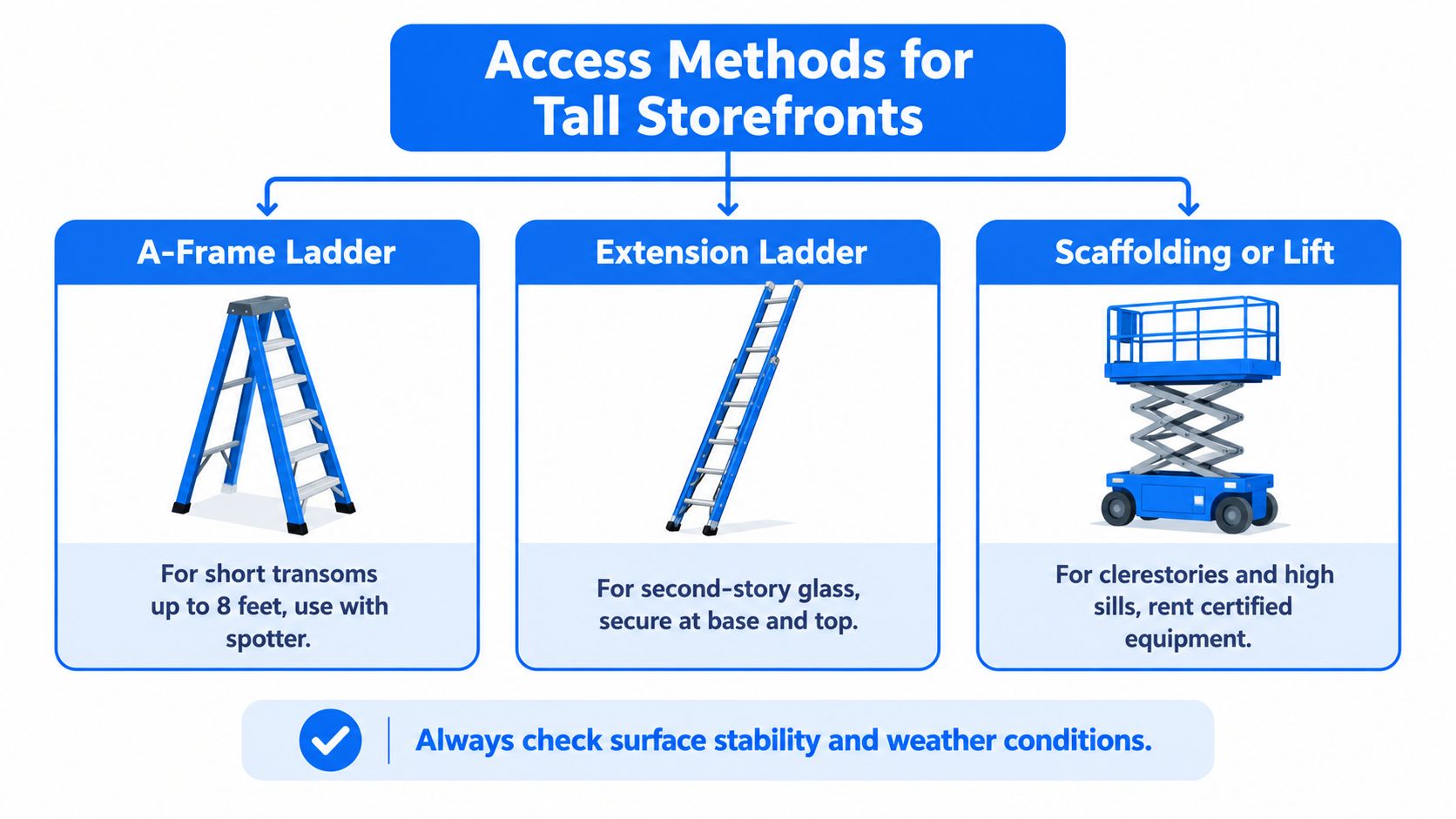
Building an access decision
Use the site, not a generic height estimate, to choose equipment.
- Ladders: Suitable only where footing, setup, reach, and pedestrian separation are controlled. OSHA ladder requirements, including 1910.23, should be part of the planning process.
- Water-fed poles: Useful for exterior glass when a technician can work from a stable surface with clear overhead and ground access.
- Boom and scissor lifts: Appropriate for tall or broad façades when a parking lot, setback, or closed work zone allows safe positioning. Check overhead utilities and equipment clearance first.
- Scaffolding: A practical option for sustained work on broader commercial elevations, but the scaffold must be certified, assembled, inspected, and used under applicable requirements.
- Rope descent systems: Appropriate only when the building has verified anchors, a suitable descent route, rescue planning, and technicians trained through recognized systems such as IRATA or SPRAT.
For rope descent systems, OSHA requires written building-owner confirmation that each anchorage has been identified, tested, certified, and maintained to support 5,000 pounds in any direction for each attached worker. The documentation must be based on annual inspection by a qualified person, with certification at least every ten years, according to OSHA's rope descent standard.
What a responsible crew verifies
When descents exceed 130 feet, stabilization must be provided at the work location, and each employee must use a separate, independent personal fall-arrest system, as described in the applicable rope-descent requirements. Suspended scaffolds and powered platforms also bring their own regulated-equipment requirements under OSHA interpretations for window-cleaning work, including compliance with applicable scaffolding and powered-platform rules. See OSHA's interpretation of suspended access equipment.
Before anyone ascends, the property should have a documented Job Hazard Analysis, traffic controls, weather checks, fall-protection decisions, utility-clearance review, and proof of professional liability and workers compensation coverage. If those details aren't visible, the access plan isn't finished.
When to Hire a Professional Window Cleaning Crew
The work belongs with a professional crew when the glass extends beyond a single story, ladders would be positioned over customer traffic, the panes have Low-E or ceramic coatings, or the building has enough glass that consistency matters more than a one-time cleanup. Large pane counts also create a practical problem. A property manager may spend more time coordinating access, protecting merchandise, and correcting missed edges than the cleaning itself.
Professional teams bring equipment that most businesses shouldn't buy for occasional use, including pure-water systems, water-fed poles, boom lifts, scissor lifts, scaffolding, and rope descent systems. They also bring trained operators and documented procedures for working around pedestrians, vehicles, tenants, and sensitive building finishes.
What to verify before approving a quote
A low price isn't useful if the scope excludes the panes that customers notice most. Ask for a written proposal that identifies:
- Insurance: Proof of general liability and workers compensation coverage.
- Training: IWCA certification or equivalent documented training, plus equipment-specific qualifications.
- Safety planning: A written safety plan and Job Hazard Analysis for high or high-traffic work.
- Relevant experience: References for comparable storefronts, façades, glass types, and access conditions.
- Scope: Clear inclusion of interior and exterior glass, doors, frames, sills, ledges, decals, and spot treatment.
- Scheduling: Service windows that protect opening hours, events, tenants, and pedestrian movement.
- Condition limits: Separate identification of hard-water removal, construction residue, adhesive, or restoration work.
Pricing is commonly structured per pane, per visit, or through a recurring route. Recurring service keeps soil from becoming heavily bonded and makes access planning more predictable. A business may choose weekly, biweekly, monthly, or quarterly service based on traffic, exposure, and appearance standards, but the right interval should follow the property rather than a generic calendar.
For managers researching providers outside the Southwest, this resource on finding window cleaning in Simi Valley is useful because it highlights the same questions about scope, access, and provider selection.
Hiring a crew is best understood as risk transfer, not an added maintenance expense. You're paying for controlled access, suitable tools, surface-safe methods, reliable scheduling, and a documented process that protects people and property.
Professional Window Cleaning offers commercial storefront service with squeegees, pure-water systems, water-fed poles, lifts, and other access equipment for properties across Arizona, Colorado, and Nevada. Review your glass, height, water quality, and traffic conditions, then visit Professional Window Cleaning to request a quote for a safe, streak-free storefront cleaning plan.