

You're standing in a parking lot in Scottsdale looking up at glass that hasn't been touched in months. The ground floor is a storefront you could squeegee in minutes. The second floor sits behind landscaping. The fourth floor has a setback, afternoon sun, and wind coming off an open lot. Same building, same dirt, three completely different equipment decisions.
That's the reality of exterior window cleaning equipment. The best setup isn't the most expensive pole or the biggest lift. It's the most reliable combination of reach, water control, access, and safety for the specific panes in front of you. A ground-level ranch in Chandler, a retail front in Denver, a mid-rise office in Las Vegas, and a high-rise tower don't reward the same kit, and treating them as equivalent wastes money and creates risk.
This catalog organizes 10 professional options around real job conditions instead of presenting a generic shopping list. You'll see where water-fed poles and pure water handle the work from the ground, where traditional squeegee technique still wins, and where a job stops being a pole job and becomes a lift, scaffold, or rope-descent job for trained crews. History explains the split. As buildings grew taller and glass curtain walls in the 1950s made windows fixed parts of the envelope, exterior access replaced interior opening, driving mobile platforms and fall protection that later informed rope access, as traced in J. Racenstein's history of window cleaning equipment development. Pole-based washing moved from homes into commercial work, then advanced again when telescoping poles were integrated with water purification.
Whether you're equipping a crew, comparing bids, or deciding if a property should be handled in-house, use this as a field guide. For a comparable regional example of service-based work, see window cleaning services in Ventura County. Then match each system below to your building, your water, and your access limits.
1. Unger nLITE Poles + HydroPower Pure Water Systems
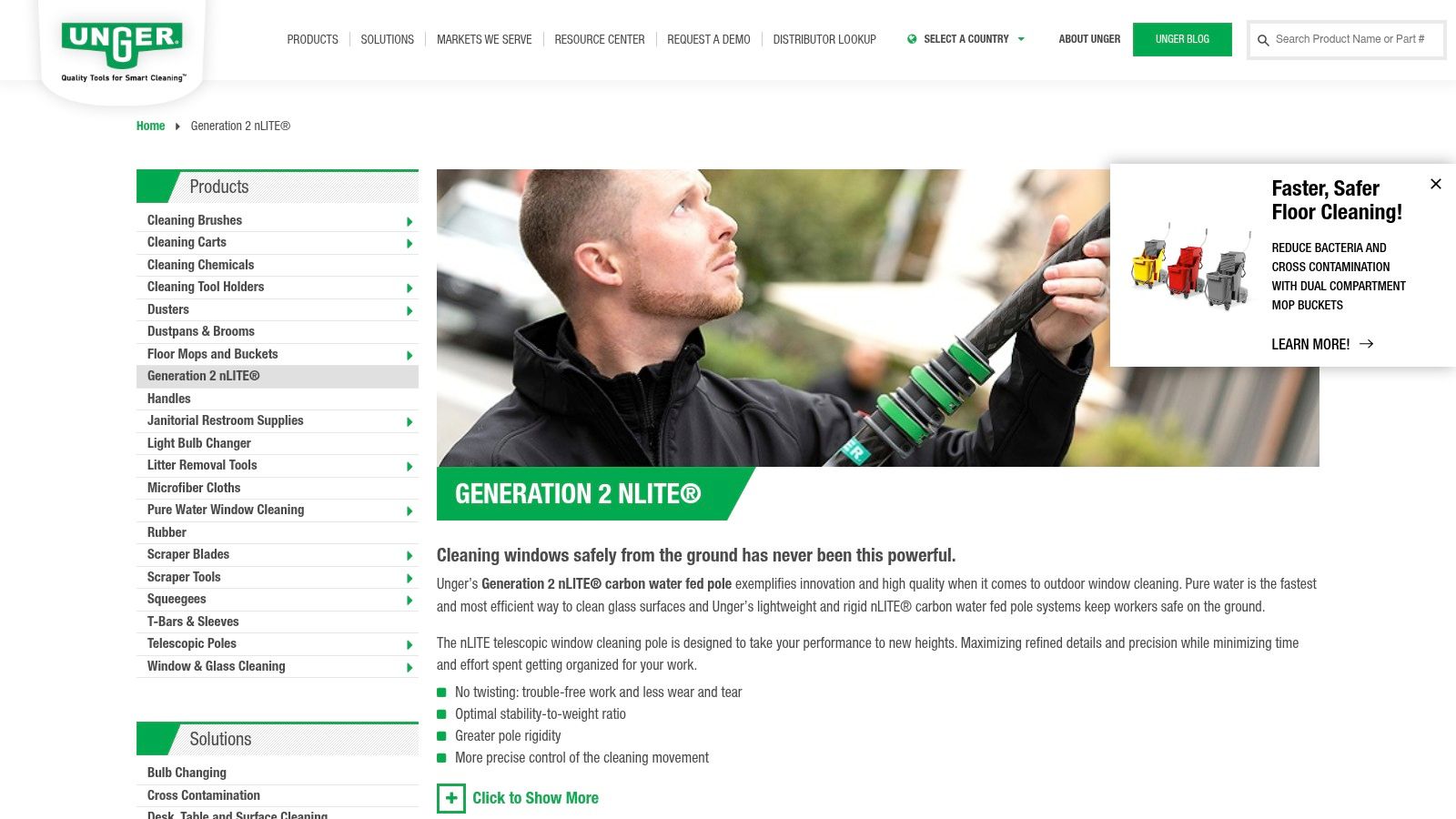
Unger works best when you want one coordinated ecosystem rather than a pole from one brand, purification from another, and fittings that almost match. The nLITE poles pair with HydroPower DI or RO/DI purification for ground-based exterior cleaning up to about five stories, which covers a large share of residential and mid-rise work in Phoenix, Tempe, and Boulder without putting anyone on a ladder.
What You're Actually Buying
- Pole choice: Lightweight, rigid poles in multiple carbon and HiMod grades and lengths, so you can match stiffness to your routine height instead of overbuying.
- Purification choice: HydroPower DI and RO/DI options for different water conditions and production needs.
- Faster resin changes: Quick-change resin bags designed to reduce downtime between jobs.
- Complete system parts: Compatible brushes, hoses, flow regulators, and carry kits that are built to work together.
The practical strength is support. US parts and training resources are available, and modular kits simplify both initial selection and field repairs when a clamp or fitting fails mid-route. If you're researching how this category fits a broader setup, this guide to the best water-fed pole window cleaning approach is a useful companion before you commit to a configuration.
The trade-off is price and complexity. Unger carries premium pricing compared with some competitors, and RO/DI configurations add cost and maintenance, especially in high-TDS areas common across Arizona and Nevada where mineral-rich water punishes undersized filtration. Don't buy the purification stage on price alone. Buy it for your local water.
For crews that value a single, well-supported platform and plan to grow from houses into commercial routes, Unger is a strong default. Start with the pole length you'll use weekly, not the longest pole you might need once a year. Explore the range at Unger's Generation 2 nLITE product line.
2. Tucker (RHG Products) Water-Fed Poles, Brushes, and RO/DI Systems
Tucker, from RHG Products, appeals to operators who want US-made systems and ready-to-run packages sized for different crew structures. Instead of forcing you to assemble everything from scratch, Tucker sells poles, brushes, and purification as matched working kits, including vehicle-mounted options for crews running full days away from a shop.
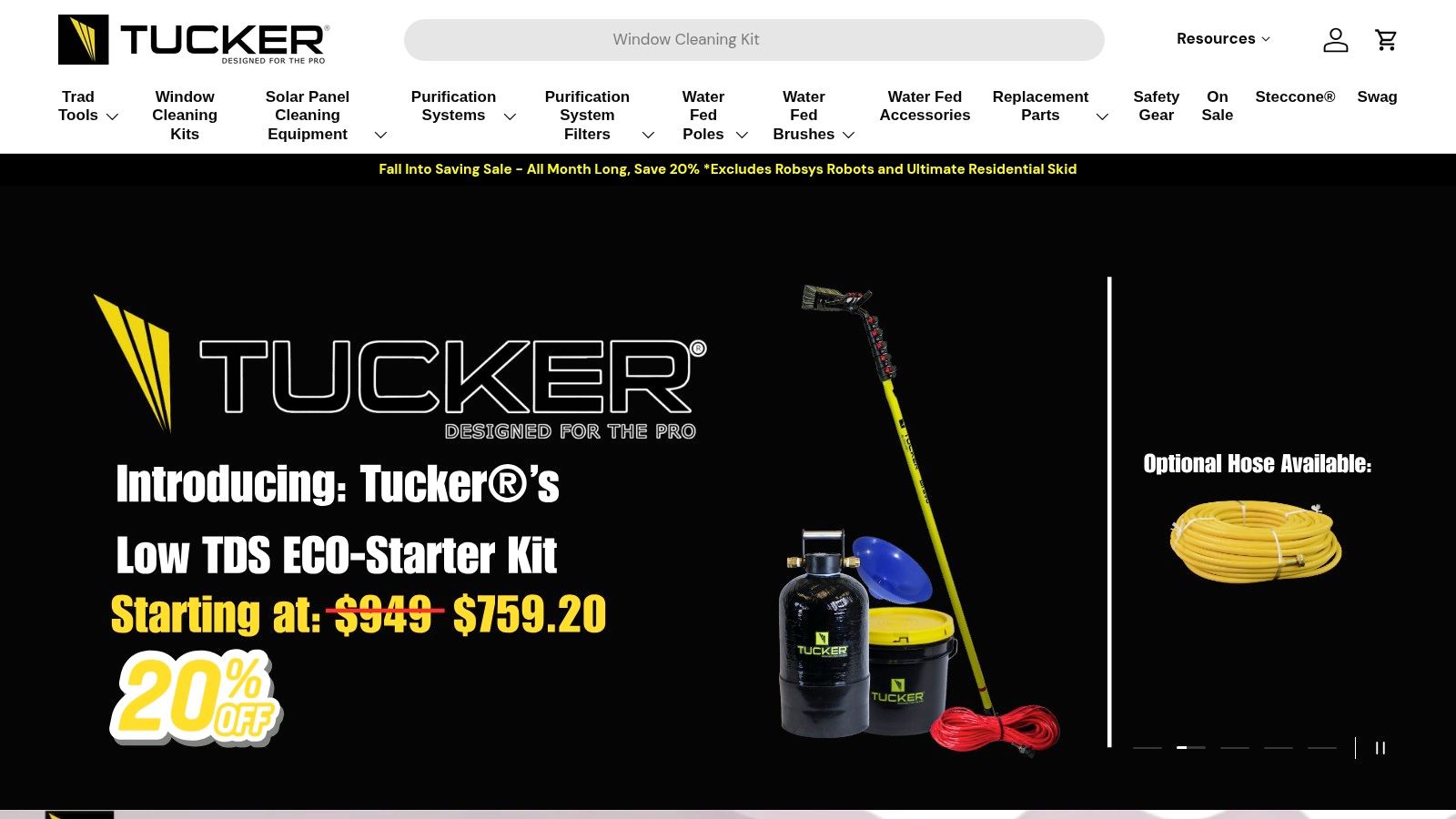
The lineup includes carbon poles in multiple sizes, a brush range for different glass and solar-cleaning needs, and three- and four-stage RO/DI systems, including dual-user kits. Purification systems carry a two-year warranty and are assembled in the USA, with support from the company's Colorado headquarters. That matters if you're operating around Denver, Arvada, or Golden and want domestic support rather than overseas lead times.
Flow is the selling point crews notice first. Tucker kits are designed for strong water flow and faster rinsing, which helps on dusty desert glass where you need enough rinse volume to float loosened soil off the pane before it dries. The range also covers Fill 'N' Go vehicle-mounted systems, so a two-person commercial crew isn't dragging a residential cart across a campus all day.
Field test: Judge a purification system by rinse quality at your longest hose run, not by how it performs on a short test in the shop.
There are honest limits. Tucker poles may be heavier than some ultra-high-modulus competitors at extreme heights, and that extra weight compounds over a full day of overhead work. Premium packages also require a substantial initial investment, so a part-time residential operator may not recover the cost quickly.
Choose Tucker when you want proven, flow-forward kits and the option to scale from single-operator residential work to dual-user commercial production. See current configurations at Tucker's official store for poles and RO/DI systems.
3. XERO Poles and XERO Pure RO/DI Systems
XERO built its following by making the upgrade path clear. You can start with a compact residential pole, move into longer commercial work, and keep adding capability without abandoning your original investment. For newer operators in fast-growing markets like Erie, Commerce City, and Glendale, that clarity matters as much as the hardware.
Range and Upgrade Logic
The pole family spans carbon, HiMod, and UHMod options from about 30 to over 70 feet, with upgrade paths across the Pro, Micro, and Destroyer lines. Paired XERO Pure RO/DI systems come with selection guidance based on local TDS and usage, plus training and documentation for water-fed best practices. That guidance is valuable because pure water only works when the purification matches the source water.
The underlying science is simple. The U.S. Geological Survey explains that dissolved solids commonly consist of minerals or salts in water, and when mineral-bearing water dries on glass, those materials can remain as deposits, as described in the USGS fact sheet on dissolved solids in water. Reducing those solids before rinsing is what lets glass dry clear without hand wiping every pane.
XERO's advantages are competitive pricing, frequent equipment bundles, a broad US assortment, and extensive user feedback you can learn from before buying. The drawbacks are practical rather than technical. Some premium pole variants and lengths may periodically be out of stock, and multi-operator setups or long hose runs may require additional pumps or hoses beyond the base kit.
If you're building a first serious pure-water setup and want room to grow without overspending on day one, XERO deserves a close look. Size your pump and hose package for your longest realistic run, not your average house. Browse the lineup at XERO water-fed poles at Window Cleaner.
4. IPC Eagle HydroCart and HydroTube Pure Water Systems
IPC Eagle targets the production end of pure-water work. Where a portable DI tank suits a small residential route, the HydroCart platform is built for higher output and longer commercial days, while the HydroTube gives mobile crews a lighter option for smaller jobs. You're choosing between portability and sustained production, and IPC lets you pick within one brand family.
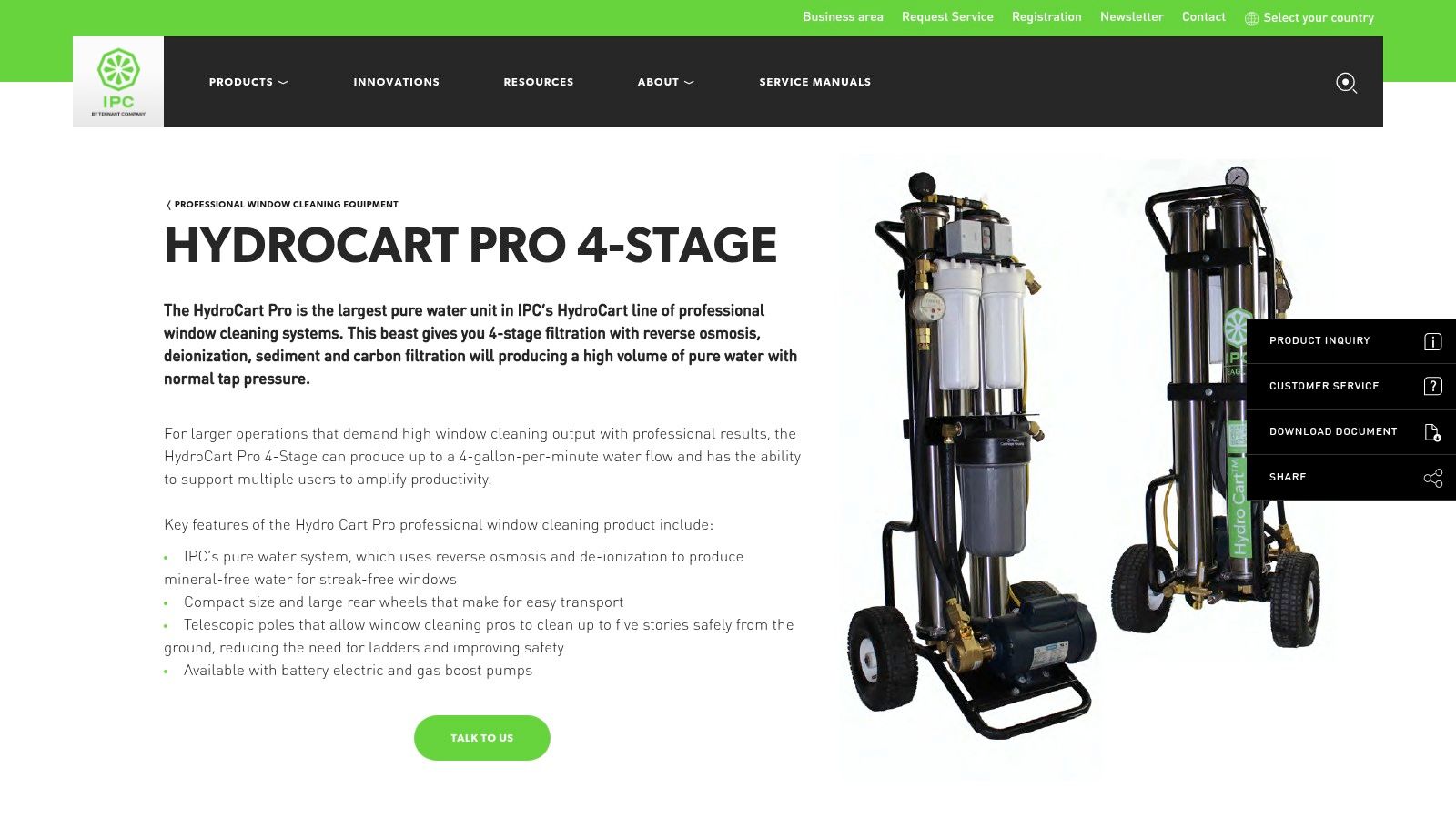
- Purification: RO/DI purification across the professional range.
- Power options: Electric or gas options on HydroCart models for sites with different utility access.
- Mobile option: A portable HydroTube for lighter, mobile work where a full cart is unnecessary.
- Configuration range: Multiple configurations for different water quality and job requirements.
Output needs context. Technical guidance indicates professional water-fed systems commonly operate around 8 to 10 bar pump pressure and 3 to 8 liters per minute, although requirements vary by pump and hose configuration, according to DataHorizzon Research data on window-cleaning equipment technology. That same directional market estimate places water-fed poles at roughly 52% of global technology adoption, compared with about 18% for rope access, 22% for traditional squeegee methods, and 8% for automated robotic systems. Treat those shares as planning signals, not audited usage rates, and log your own water use, windows per hour, spotting rework, and downtime.
IPC systems are durable and field-proven, with an established parts and service network. The friction is purchasing. Equipment is often sold through distributors with pricing by quote, and heavier carts may be excessive for small residential routes in neighborhoods where you're moving every twenty minutes.
Pick IPC Eagle when commercial volume justifies cart-based production and you want distributor support behind the purchase. Review specifications at IPC Eagle's HydroCart product page.
5. Gardiner Pole Systems
Ask experienced pole operators what matters at full extension and most won't say maximum length. They'll say stiffness. A whippy pole wastes energy, scrubs unevenly, and exhausts shoulders. Gardiner, a UK-origin brand with a strong US following through distributors, built its reputation on lightweight, rigid poles that stay controllable at extended reach.
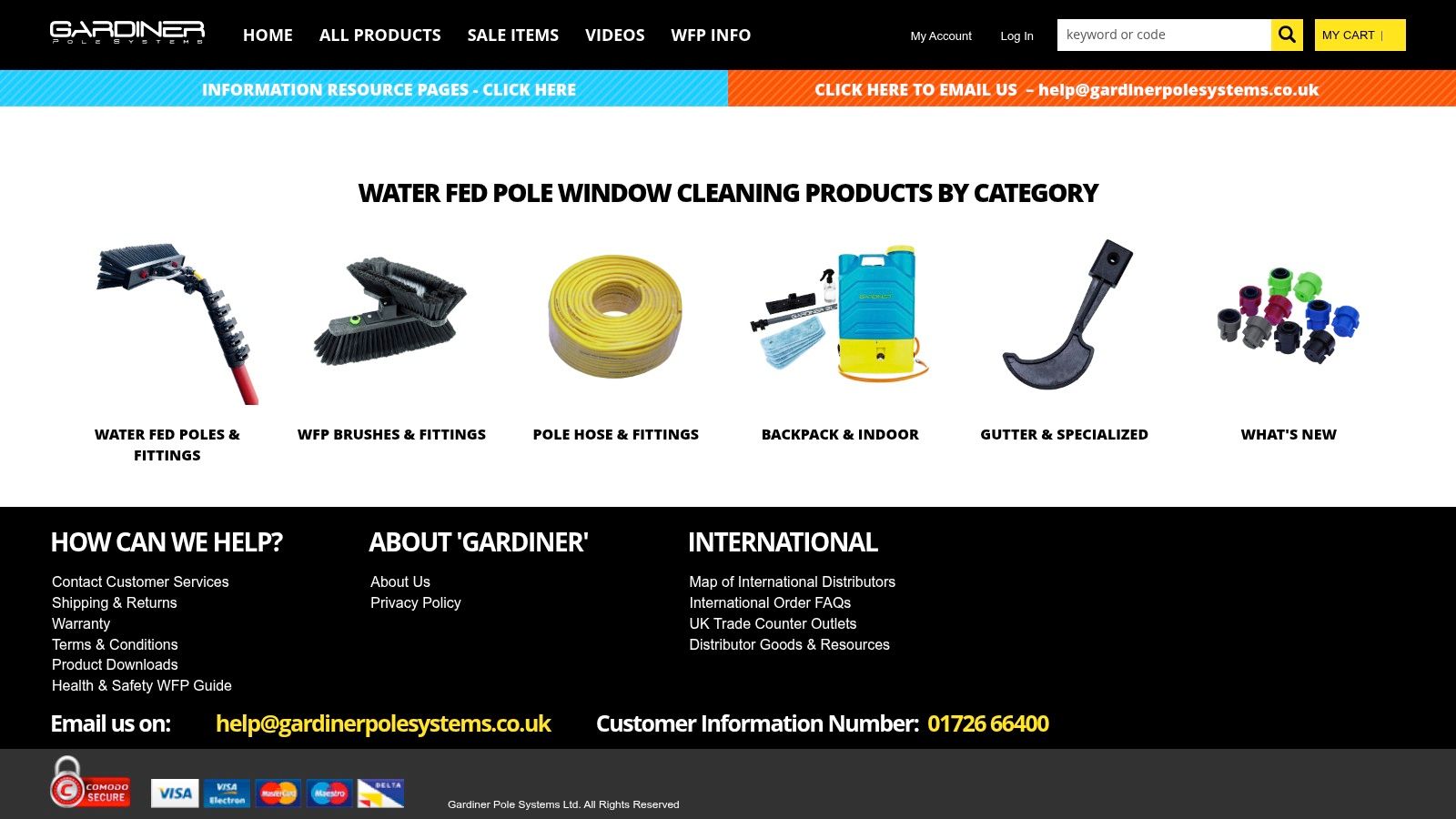
The Super-Lite range includes telescopic and modular options, with add-on sections that can extend reach as jobs demand. A broad brush and gooseneck catalog supports precise brush control on recessed or angled glass, and spare sections and clamps make the poles serviceable instead of disposable. Brush selection changes results more than many buyers expect, which is why details like choosing a water-fed window cleaning pole soft brush head deserve attention alongside pole length.
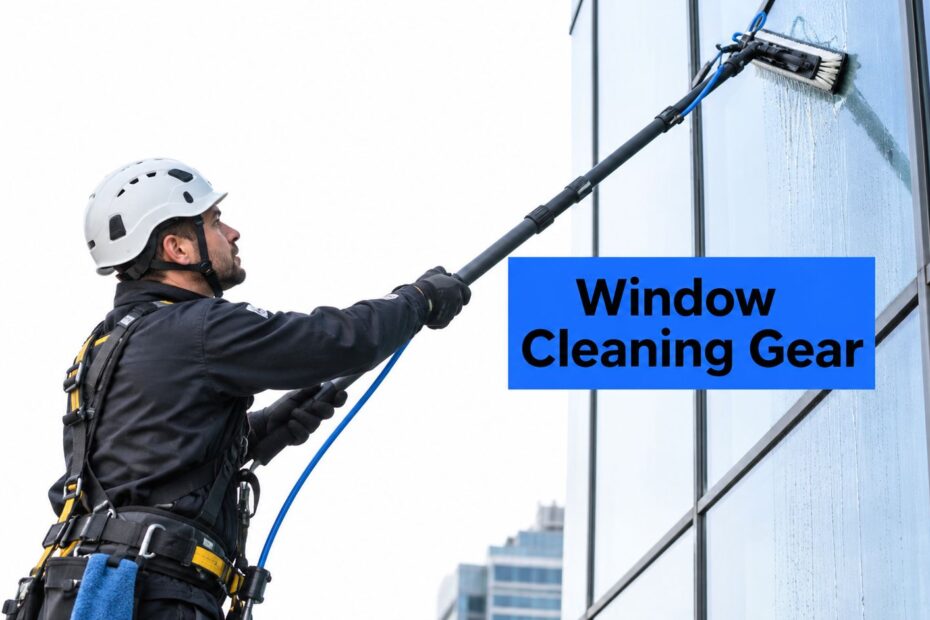
Reach claims need a reality check. The UK Health and Safety Executive states water-fed pole systems can facilitate cleaning to approximately 80 feet, or 24 meters, from ground level, reducing routine dependence on ladders, mobile elevating work platforms, or rope access where site conditions permit, in HSE best practice guidance for window cleaners. That guidance defines the system as the pole, brush, and purified-water delivery together. Your safe working position, setback, wind exposure, and overhead obstructions matter as much as the pole in your hands.
A pole that reaches the glass on a calm morning may not be controllable in afternoon gusts. Document your routinely serviceable height, not the theoretical maximum.
Gardiner's cons are logistical. US buyers may need to order through a distributor or from the UK, shipping and lead times can vary, and ultra-light poles require careful handling on rough sites.
Choose Gardiner when long-reach control and accessory precision outweigh buying convenience. See the full range at Gardiner Pole Systems.
6. Moerman Excelerator 2.0 + Liquidator System
Not every exterior pane needs pure water. Storefronts, ground-level glass, restaurant fronts, and pole-based traditional work still reward a skilled squeegee hand, especially where water discharge is restricted or detailing matters. The Moerman Excelerator 2.0 handle with Liquidator channels is built to make that traditional work faster with less edge detailing.
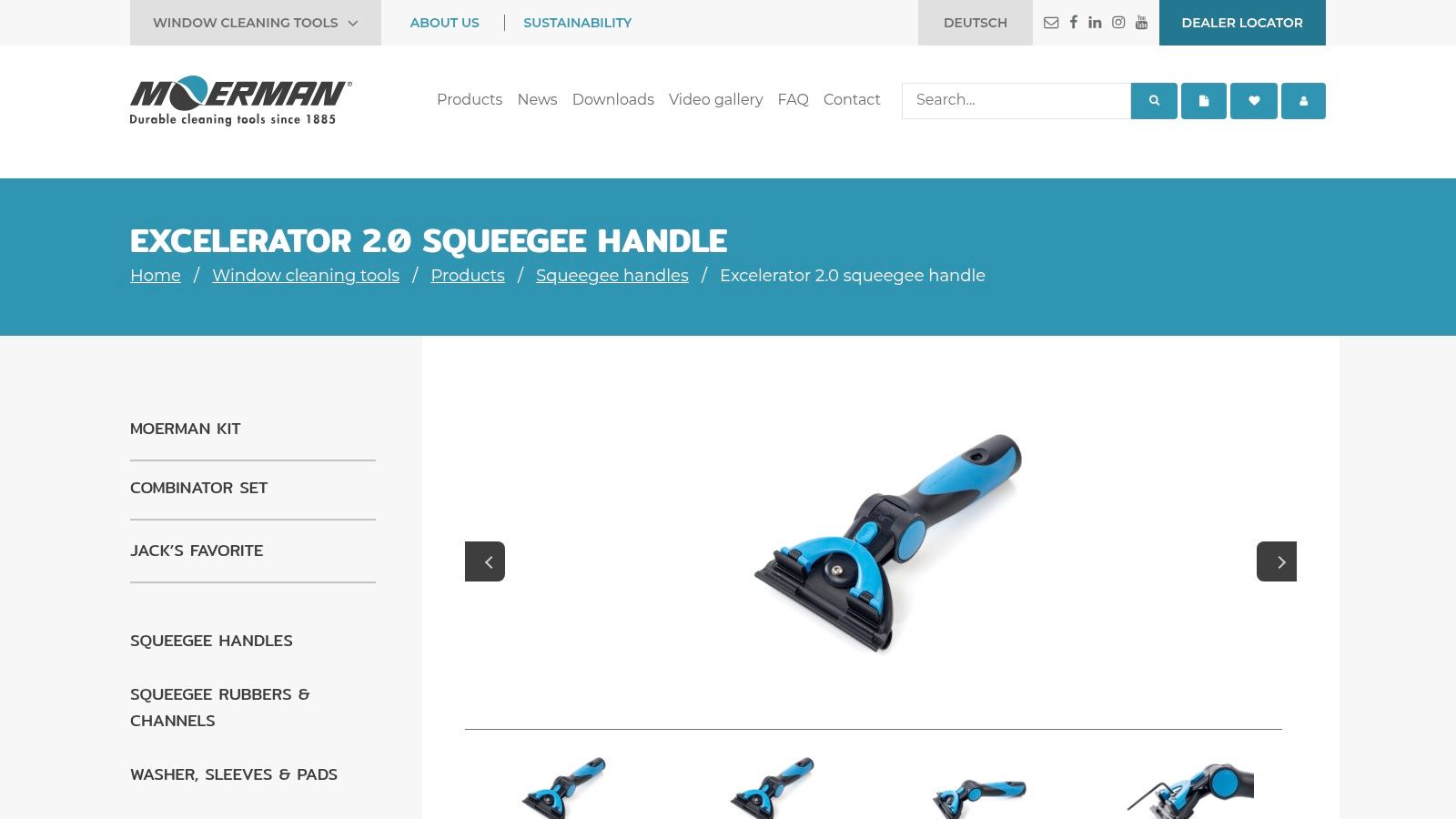
How It Changes Traditional Work
The handle can be used in swivel or fixed mode, with adjustable angles that support efficient pole work. Liquidator channel ends help reduce water trails along edges, which cuts the towel detailing that slows storefront routes. It's available through US professional suppliers, so replacement rubbers and channels aren't a special-order exercise.
Used well, the system speeds up traditional technique and costs little compared with larger equipment systems. It also complements water-fed pole equipment rather than competing with it. Many professional crews run pure water for upper exterior glass and switch to squeegees for doors, low panes, interiors, and frames. If your work mixes both, these window washing tools for high windows help frame where traditional tools stop and access equipment starts.
Be honest about the learning curve. The Excelerator requires practice to avoid edge lines, works best with compatible channels and rubbers, and does not replace a pure-water system for high-reach cleaning. A new technician won't master swivel technique on the first storefront, and forcing it on high pole work without practice creates callbacks.
Buy Moerman as a productivity upgrade for trained squeegee work, not as a shortcut around technique. It's one of the most affordable ways to make a good traditional cleaner faster. Product details are at Moerman's Excelerator 2.0 handle page.
7. Ettore Professional Window Cleaning Tools
Every professional truck needs a traditional backbone, even if most upper glass is cleaned with pure water. Ettore is the longstanding US name for that backbone. Squeegees, channels, scrapers, buckets, and poles from one widely stocked brand mean a crew in Flagstaff or Westminster can replace a worn rubber or broken handle without waiting on a specialty shipment.
- Channel materials: Brass, stainless-steel, and aluminum channels and handles for different weight and durability preferences.
- Full traditional kit: Scrapers, poles, buckets, and other traditional tools for complete ground-level and interior work.
- Crew outfitting: Professional kits that simplify equipping new technicians consistently.
- Availability: Broad US retail and parts availability, which reduces downtime.
The strengths are consistency and recognition. Ettore tools are durable, replacements are readily available, and the broad lineup lets you source traditional equipment from one brand. For property managers maintaining a small in-house kit for lobby glass and storefront touch-ups between professional visits, that simplicity has real value.
Know the boundary. Traditional tools may require ladders or other access equipment at height, and the range is not itself a pure-water cleaning system. A squeegee doesn't solve a third-story access problem. It solves the cleaning problem once a trained worker is safely positioned, whether that's on the ground with a pole, on a platform, or inside the building.
Treat Ettore as essential supporting equipment in any professional setup, paired with the access method the building requires. It won't be the most exciting purchase you make, but it may be the one your crew touches every single day. Browse the catalog at Ettore's professional window cleaning tools.
8. CR Spotless DIC-20 Portable DI System
The CR Spotless DIC-20 answers a narrower question. What if you need spot-free rinsing for residential routes and smaller jobs, but a full RO/DI cart is more system than you'll use? This portable deionization system is built for quick setup in moderate-TDS areas, and it also works as a lightweight backup when a primary system is down.
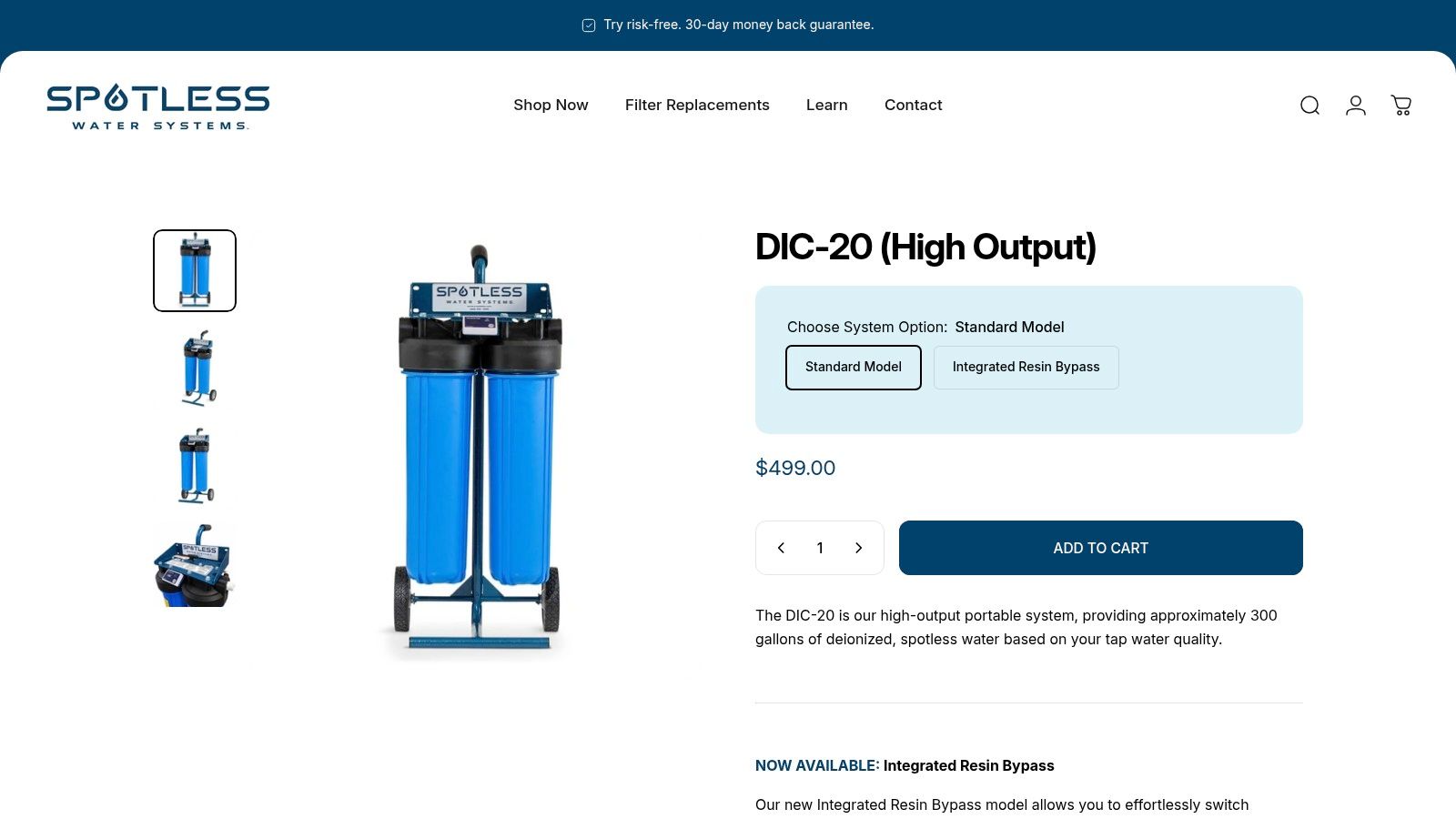
Features include deionized water output rated at 0 ppm, handheld TDS meters for checking water quality, rolling and wall-mount system options, and published output and cost-per-gallon benchmarks. That transparency helps you estimate operating cost before resin consumption surprises you.
Where Portability Wins and Where It Doesn't
The DIC-20 is portable and quick to set up, carries a lower entry cost than a full RO/DI system, and suits smaller jobs or mobile backup duty. For a homeowner-maintained property in Paradise Valley or a small route in Laughlin with manageable water, it can be entirely sufficient.
Water chemistry sets the limit. Resin consumption can be high in very hard water, RO/DI may be more economical over time in high-TDS areas, and the unit offers lower maximum flow than larger cart systems. Much of Phoenix, Las Vegas, and the desert Southwest has mineral-heavy water that can burn through DI resin quickly. Run the cost-per-gallon math against your actual source water before assuming the lower purchase price means lower total cost.
Lifecycle cost is the right lens for all access and purification equipment. Washington workplace rules require warning signs and barricades when suspended equipment is used and require clearance from power lines, as set out in Washington Administrative Code chapter 296-878 for window cleaning safety. Purchase price is only one line item beside inspection, training, transport, downtime, and consumables.
Choose the DIC-20 for portability with open eyes about resin economics. Details are at CR Spotless DIC-20 high output system.
9. REACH-iT Poles, Brushes, and Systems
REACH-iT approaches exterior window cleaning equipment from the brush backward. Many brands lead with pole length. This US-based range emphasizes brush performance and cleaning speed, arguing that better agitation and rinsing at the glass matter more than another section of pole you'll rarely extend.
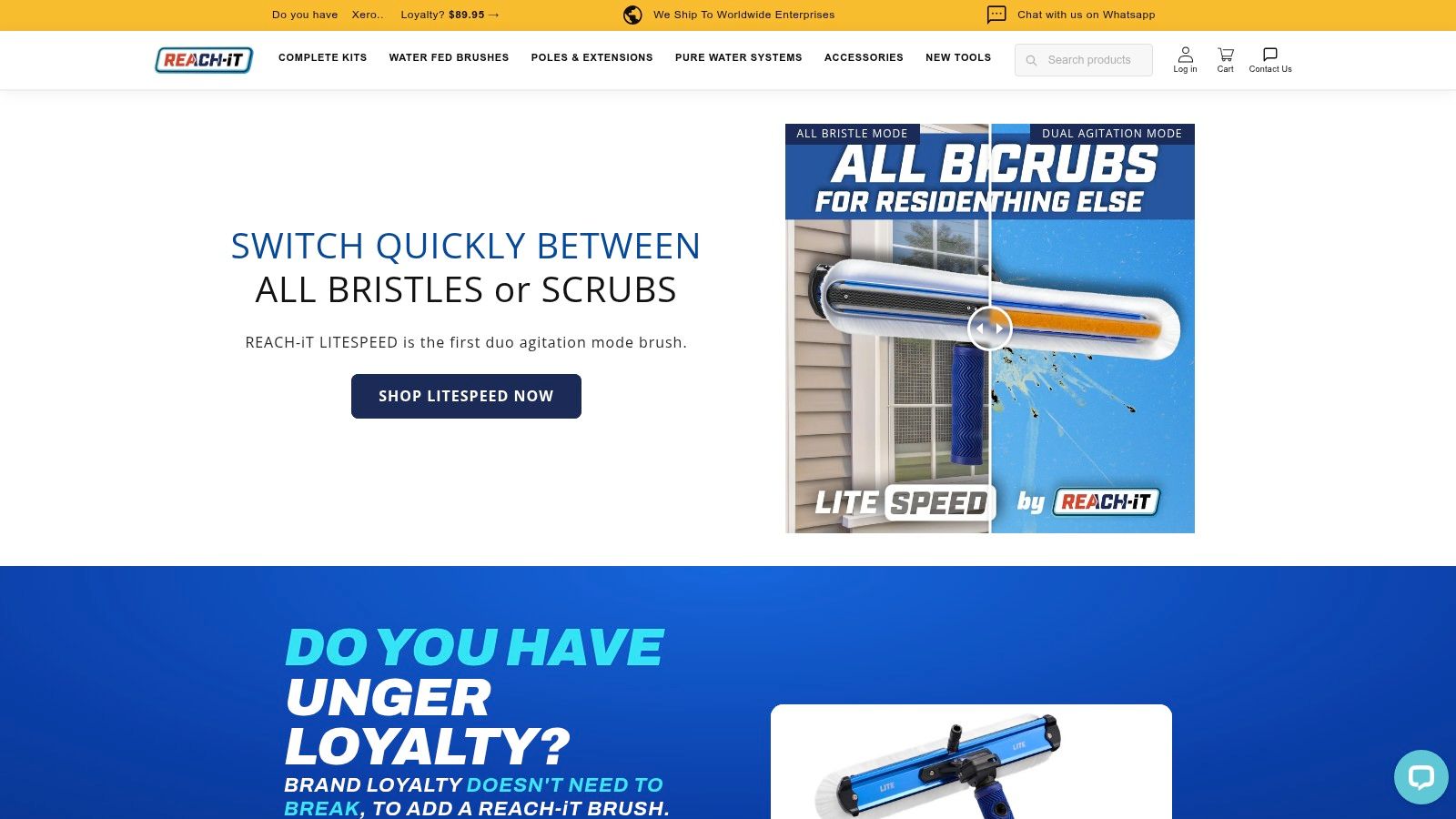
The range includes MINI and WARRIOR pole options in carbon and HiMod, RADIAL and ROCKER brush ranges, modular extensions, and SHOCKSTOP electrical-insulator options. Bundles cover residential through high-reach commercial work, so buyers can select a package by job type rather than assembling components blind.
That insulator option deserves attention because overhead lines change equipment decisions completely. California requires employers to provide safe means for exterior window cleaning and lists possible systems including elevating platforms, rolling scaffolds, suspended scaffolds, boatswain's chairs, or ladders, depending on the building and task, under California Code of Regulations section 3282 on window cleaning. The lesson transfers across states. Equipment selection must follow documented site conditions like setback, landscaping, roof access, ground bearing, pedestrian exposure, utilities, wind, and engineered anchors, not height alone. A water-fed pole isn't automatically safest near overhead power lines or in high winds.
REACH-iT brushes are intended to reduce agitation and rinse time, support is direct US sales, and bundles simplify selection. On the downside, some components are proprietary to its ecosystem, and community familiarity is more limited than for legacy brands, so peer troubleshooting may take longer.
Consider REACH-iT if brush-driven speed on repetitive commercial glass is your bottleneck and you're comfortable inside a more proprietary system. Explore bundles at REACH-iT at Future of Cleaning.
10. J. Racenstein
Sometimes the right purchase isn't a single system. It's a supplier who stocks everything. J. Racenstein is a long-established US supplier carrying multiple brands of exterior window cleaning equipment, which makes it useful when you're assembling a complete kit, replacing parts across brands, or expanding from pure water into safety gear and traditional tools.
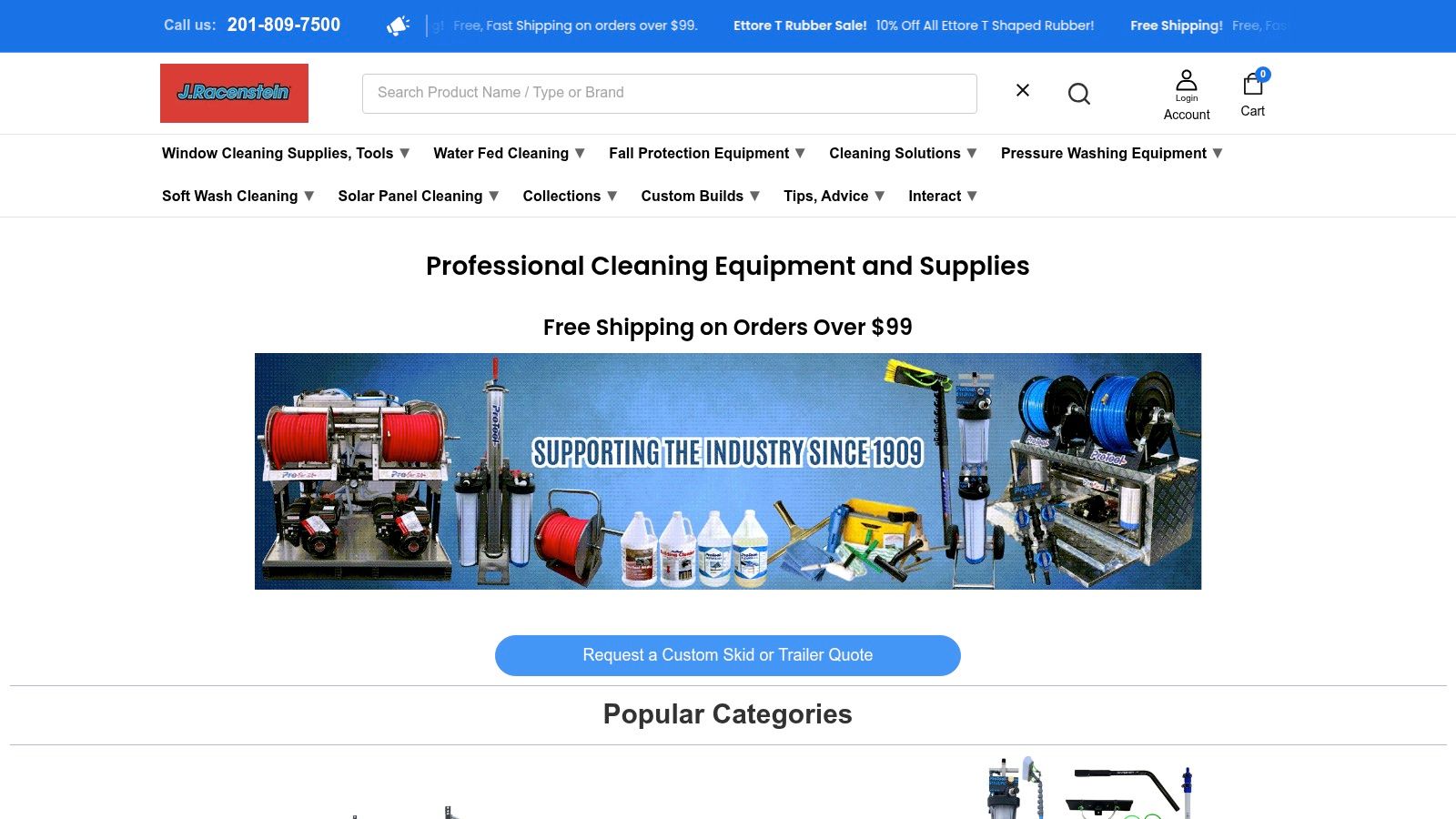
- Catalog breadth: Pure-water systems, poles, brushes, traditional tools, safety gear, and parts in one place.
- Brands carried: Includes Gardiner and RHG/Tucker among its multi-brand offerings.
- Distribution: Two US warehouses and nationwide shipping for faster fulfillment.
- Education: How-to content and industry events that support equipment decisions beyond the sale.
The advantages are consolidation and longevity. One supplier can support a broad range of equipment needs, the company has a long operating history dating to 1909, and online pricing and frequent promotions are available. For a facility team in Denver or a growing crew in Phoenix standardizing its inventory, fewer vendors means fewer mismatched orders and simpler reordering.
Breadth creates its own risk. The multi-brand catalog requires careful selection to avoid mismatches, and pricing varies by brand and configuration. A pole, brush, hose, and fitting set pulled from different brands can work well, but only if you verify compatibility before ordering. Don't assume universal fit across product lines.
Use J. Racenstein as infrastructure for your equipment program rather than as a single product choice. It's particularly valuable once you know what systems you run and need dependable parts, replacements, and accessories to keep them working. Shop the catalog at J. Racenstein window cleaning supplies.
Top 10 Exterior Window Cleaning Equipment Comparison
| Option | Core Offering | Best Fit | Standout Value | Price / Considerations |
|---|---|---|---|---|
| Professional Window Cleaning (Recommended) | Residential, commercial, mid-rise, and high-rise window cleaning | Property owners, managers, and facility teams in Arizona, Colorado, and Nevada | OSHA-trained, insured crews; local service; 100% satisfaction guarantee; 4.9-star reviews | Request a fast quote; service pricing varies by job |
| Unger nLITE + HydroPower | Modular water-fed poles with DI or RO/DI purification | Crews wanting a coordinated equipment ecosystem | Broad product range, US support, and modular kits | Premium pricing; RO/DI adds cost and complexity |
| Tucker Water-Fed Systems | US-made poles, brushes, and RO/DI systems | Residential and commercial crews, including multi-user teams | Vehicle-mounted and dual-user options; two-year system warranty | Premium packages may require a substantial investment |
| XERO Poles + XERO Pure | Poles from compact models to 70+ feet, plus RO/DI systems | Users building or upgrading a setup for varied jobs | Competitive bundles, upgrade paths, and training resources | Some models may be out of stock; larger setups may need extras |
| IPC Eagle HydroCart + HydroTube | Cart-based and portable RO/DI systems | Commercial workflows and mobile cleaning jobs | Multiple configurations and high-output options | Cart systems may be excessive for small routes; pricing often by quote |
| Gardiner Pole Systems | Lightweight, modular water-fed poles and accessories | Crews prioritizing reach and pole stiffness | Strong stiffness-to-weight performance; replaceable sections | US shipping and lead times can vary |
| Moerman Excelerator 2.0 + Liquidator | Swivel squeegee handle and precision channels | Storefronts and ground-level glass | Can speed up traditional cleaning and reduce edge detailing | Requires practice; not a substitute for pure-water high-reach systems |
| Ettore Professional Tools | Traditional squeegees, scrapers, poles, buckets, and kits | Crews equipping or replenishing traditional tools | Broad availability and easy access to replacement parts | High work may require ladders or other access equipment |
| CR Spotless DIC-20 | Portable deionization system for spot-free rinsing | Smaller jobs and residential routes in moderate-TDS areas | Portable setup and lower initial cost than full RO/DI | Resin use can be high in hard water; lower flow than cart systems |
| REACH-iT | Carbon and HiMod poles, brushes, and bundles | Residential through high-reach commercial work | Brush-focused designs and direct US support | Some components are proprietary; smaller user community |
| J. Racenstein | Multi-brand supplier of pure-water, traditional, and safety equipment | Buyers assembling a complete equipment kit | Broad catalog, nationwide shipping, and industry resources | Selection requires checking brand and component compatibility |
Build a Setup That Scales With Access
Start every equipment decision with two questions. How high is the glass under normal conditions, and what's in your water? Typical reach and water conditions determine your pole and purification core. Only then should you add the access method and safety requirements the specific building demands. Reversing that order leads people to buy lifts for pole jobs or poles for buildings that were never pole jobs.
For residential work, a portable DI system or modular pole often covers one- and two-story homes, skylights, and hard-to-reach exterior panes from the ground. That's efficient in Phoenix, Scottsdale, Tempe, Chandler, Paradise Valley, Glendale, and Flagstaff, provided local water doesn't make resin-only purification uneconomical. Add professional squeegees, scrubbers, and scrapers for doors, ground glass, and detailing, and most houses are covered without routine ladder exposure.
Commercial work shifts the balance toward production. Storefronts and low-rise offices in Denver, Boulder, Arvada, Westminster, Erie, Commerce City, and Golden benefit from higher-output RO/DI systems, dual-user capability, and strong traditional squeegee kits for entrances and interiors. Measure total cost per clean, including transport, setup, inspection, downtime, insurance, storage, and worker hours. The cheapest device on paper can become expensive once training, exclusion zones, and maintenance are counted.
When Poles Stop Being the Answer
Mid-rise and high-rise projects change the category entirely. Beyond routine pole reach, or where setbacks, geometry, winds, or obstructions defeat ground-based work, crews need boom lifts, scissor lifts, scaffolding, suspended platforms, or rope-descent systems operated by trained professionals. These aren't upgrades. They're regulated safety systems.
OSHA requires aerial lift controls to be tested before each workday or shift, requires workers to stand firmly on the basket floor, prohibits ladders or planks inside the basket for extra height, and requires a body belt with a lanyard attached to the boom or basket, under OSHA standard 1926.453 for aerial lifts. Brakes must be set, outriggers used where applicable, and load limits observed. Before any lift arrives on site, find EWP risk assessment tips and apply them to ground conditions, overhead hazards, and pedestrian control.
Suspended work carries its own rules. OSHA prohibits increasing height with ladders, boxes, or barrels placed on a suspension scaffold and requires fall-arrest and guardrail systems on single- and two-point adjustable suspension scaffolds, as explained in OSHA guidance on scaffolding safety in construction. Equipment modifications require manufacturer or equivalent qualified certification. You can't improvise reach from a swing stage.
Rope descent is the most specialized tier. OSHA defines it as a system allowing controlled descent with the ability to stop at any point, requiring inspection before initial use each shift, proper rigging with anchorages and tie-backs, and a separate independent personal fall-arrest system, per OSHA walking-working surfaces guidance on rope descent systems. Components must generally support a minimum rated load of 5,000 pounds, with seatboards rated at 300 pounds. Descents longer than 130 feet require stabilization, and use above 300 feet is prohibited unless the employer demonstrates another system is infeasible or more hazardous.
Escalation rule: When wind, geometry, anchors, or access restrictions make the planned method questionable, stop and escalate. Declining or re-planning a job is a professional decision, not a failure.
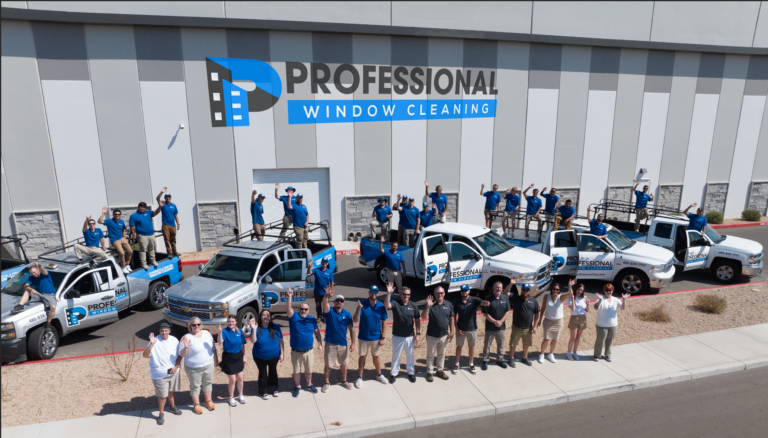
Professional Window Cleaning is one regional example of a provider structured around this full range, using water-fed poles, squeegees, ladders, boom lifts, scaffolding, and rope-descent systems with pure water across Arizona, Colorado, and Nevada, including Las Vegas and Laughlin. Whether you hire a provider or build in-house capability, let local access conditions, engineered anchors, wind, utilities, and documented safety requirements determine the final package. The right exterior window cleaning equipment is the setup that cleans the glass, protects the building, and brings every worker home, on the easiest house and the hardest tower alike.
If your property needs more than a pole can safely handle, Professional Window Cleaning brings water-fed poles, professional squeegee crews, boom lifts, scaffolding, and rope-descent systems to residential, commercial, mid-rise, and high-rise buildings across Arizona, Colorado, and Nevada. Request a fast quote and schedule service matched to your building's height, access, and safety requirements, so the glass gets cleaned with the right equipment from the start.