



The most popular advice about window washing towels is to buy microfiber and use it everywhere. That misses the part that decides whether glass looks clean: the towel's construction and the job stage matter more than the word “microfiber.” A cloth can pick up water beautifully and still leave lint, smear grit, or make a clean pane look hazy.
Say a crew is finishing a sunny storefront in Phoenix. The squeegee has already cleared the glass, but a narrow bead remains at the frame. The towel's job is to catch that bead and detail the edge, not to replace the squeegee or turn a dusty pane into clean glass. That last touch is easy to notice in Phoenix, Scottsdale, Las Vegas, or Denver, where sun can expose haze that's less visible in a shaded room.
What Window Washing Towels Do After the Squeegee
On a professional wash, the towel is a finishing tool. After a squeegee or a pure-water brush has done the main cleaning, a clean cloth handles edges, frames, corners, and leftover beads. A towel can't make an unsafe reach safe, remove a heavy layer of grit without risk, or take the place of purified water when minerals would otherwise dry on the glass.
The distinction matters across Arizona, Colorado, and Nevada. Dust can be abrasive, weather can leave film, and hard water can leave spots when minerals remain in the rinse. On a bright day, a rushed wipe can spread the very soil the wash was meant to remove. Professional crews start by clearing debris, then use the right main cleaning tool, and leave the towel for the small finishing jobs.
This guide compares flat and looped microfiber, lint-free cotton, chamois, and waffle-weave towels by the stage where each one belongs. The practical verdict is simple: weave influences lint and water movement, but it doesn't replace a squeegee, a water-fed pole with purified water, or safe access on a multi-story facade. A crew's professional setup is about more than the cloth, as this overview of professional window-cleaning tools illustrates.
By the end, you'll be able to assign each towel to one stage, spot a cloth that needs to be retired, and recognize when height, scale, or building access calls for a trained crew rather than a ground-level wipe. Start with the comparison chart. It helps you choose the right towel before you wash a single pane.
Four Towel Types Compared for Glass
| Towel type | Best stage | Behavior on glass | Construction cue | Keep it off the finish when |
|---|---|---|---|---|
| Flat-weave microfiber | Final polish after the squeegee | High contact, low lint | 1 decitex or less; often 70/30 or 80/20 polyester/polyamide | Grit, softener film, or cotton lint is in the cloth |
| Looped or terry microfiber | Solution pickup and loose dust | More surface and absorbency | Loop pile rather than a smooth weave | It leaves fibers or has touched a dirty sill |
| Lint-free cotton | Frames, sills, and light controlled wiping | Lower smear if truly lint-free, still can shed | Woven cotton kept out of the microfiber wash | It has contacted abrasive dirt or is washed with polish cloths |
| Chamois | Pulling standing water off large wet glass | Strong water draw, poor as a polish | Natural skin or synthetic chamois | It has dried stiff, is dirty, or is loaded with minerals |
| Waffle-weave | Edges, mirrors, and shower glass | Channels water and reduces a flat smear | Open waffle texture | Desert dust or sill grit is still in the weave |
The key difference isn't how much water a towel holds. Microfiber is a synthetic fiber of 1 decitex or less, and its split filaments form narrow spaces that retain water and oils. A tightly woven, low-lint flat weave makes more contact with the glass surface and is better suited to final polishing than a higher-pile cloth. Common commercial blends include 70/30 and 80/20 polyester to polyamide; polyamide contributes softness and water uptake, as described in the British Institute of Cleaning Science's microfiber guide.
Looped or terry microfiber has more surface area. That makes it useful for lifting solution and catching loose dust, but the extra pile can carry more liquid and debris into a finishing pass. Keep it in the extraction role rather than rubbing it over already-clean glass.
Cotton has a narrower role. A lint-free cotton cloth can wipe a frame or sill, but it isn't a reliable substitute for a dedicated glass-finishing towel. Cotton lint can transfer to microfiber or show up on dark-tinted and low-emissivity glass, so keep cotton cloths out of the polish-towel wash.
Chamois draws standing water from a large wet pane after scrubbing. That strong water pickup doesn't make it a detail cloth: if it's dirty, mineral-loaded, or stiff from drying, it can spread residue rather than leave a clean finish. Waffle-weave cloths have open channels that suit edges, mirrors, and shower glass when the fabric is free of grit.
Assign one towel class to each stage, then keep its use separate. Test a new cloth on a small area before using it across coated, filmed, or acrylic glass. Color-code the towels so a cloth used on a sill doesn't become a finishing cloth by mistake.
Matching a Towel to Each Cleaning Stage
A finishing towel cannot rescue a dirty pane. The result depends on the order: remove loose debris, wash the glass with the right tool, then use a towel only where water or soil remains.
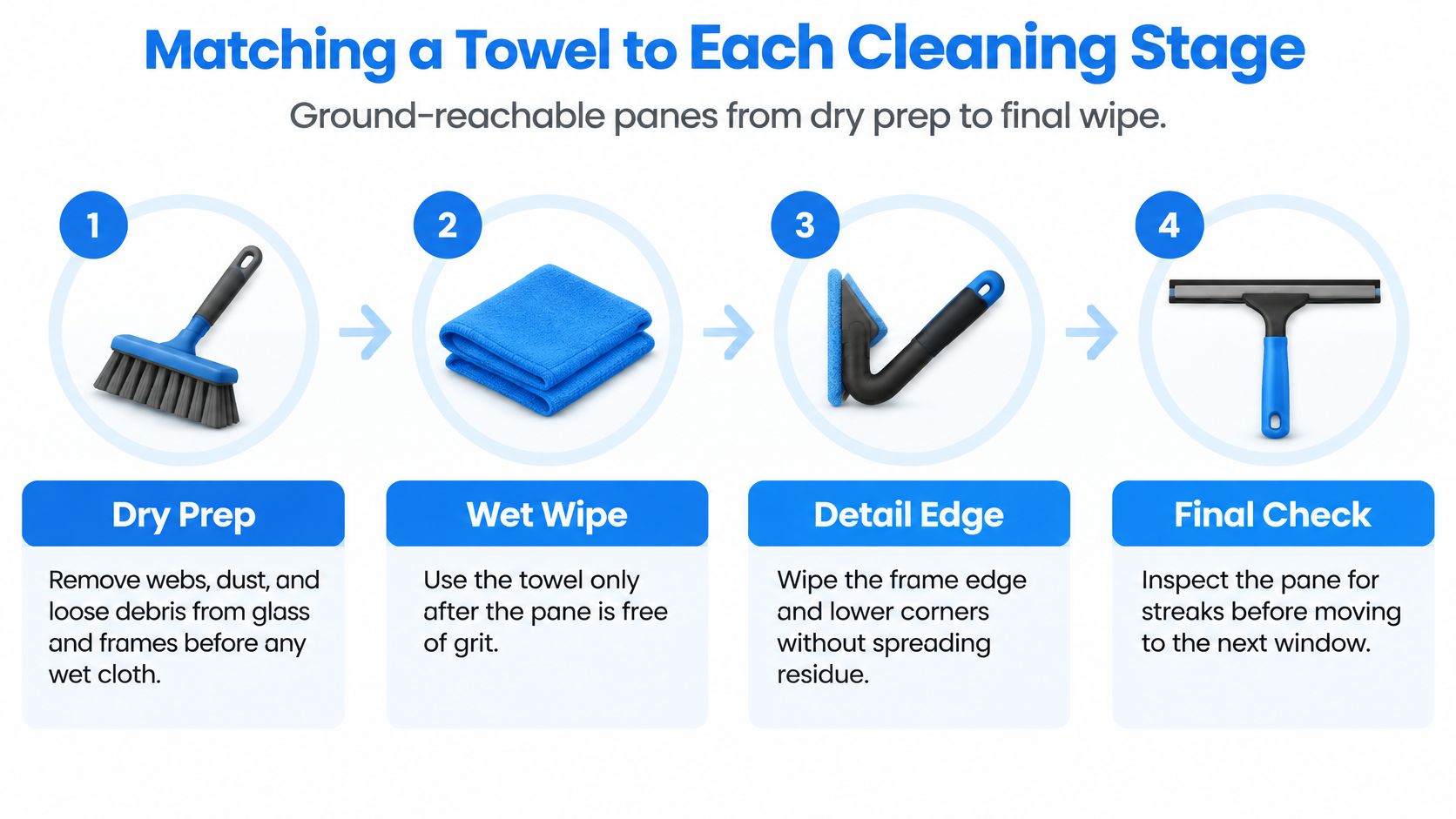
Clear loose debris. Brush webs, dust, and loose dirt from the glass and frames before wetting the pane. Otherwise, grit can get trapped in a damp cloth and scratch or smear the surface.
Agitate exterior glass. For windows suited to a water-fed pole, use a brush and purified water to loosen and rinse away soil. Purified water has had minerals removed, so it can dry without the mineral spots that tap water may leave.
Squeegee reachable glass. Use controlled strokes to remove the wash water and solution from the pane. At height, use suitable equipment and a safe access method rather than stretching from an unsafe position.
Pick up leftover solution. If water remains after the main pass, use a looped microfiber towel or chamois to absorb it. These thirsty cloths are for extraction, not for rubbing across glass that is already clean.
Detail edges and frames. Use a clean flat-weave microfiber or grit-free waffle-weave cloth at corners and edges. Keep a separate lint-free cotton cloth for a dirty sill, where it can collect soil without transferring it back to the glass.
Protect interior surfaces and inspect. Keep wet extraction towels away from carpets and ledges. On delicate finishes such as Venetian plaster, drop cloths contain water and protect surrounding surfaces.
The squeegee does the heavy lifting; the towel handles the last details. If haze appears in raking sunlight, check whether grit, detergent film, or mineral residue reached the glass or finishing cloth. Change the tool or step that caused it before continuing.
Laundering Towels Without New Streaks
A reusable towel saves disposable wipes only if washing doesn't load it with lint, detergent, or grit. Keep the routine simple and consistent:
Shake or rinse out grit. Remove abrasive dust before putting towels in the washer, so particles don't get beaten into the fibers.
Sort by condition and use. Maintain separate bins for clean, used-wet, and contaminated towels. Keep sill cloths apart from glass-polishing cloths.
Separate microfiber from cotton and workwear. Wash microfiber on its own, away from lint-heavy cotton and abrasive clothing.
Skip fabric softener and dryer sheets. Coatings can block the spaces that help microfiber pick up water and oils, leaving a cloth that smears instead of detailing cleanly.
Avoid overloading the machine. Give towels room to move, and don't add unnecessary high-spin time that increases mechanical stress.
Rinse fully, then dry. Detergent film can interfere with wetting and leave marks on glass. Make sure towels are completely dry before returning them to the clean bin.
Retire towels that fail the job. Replace a cloth that streaks, loses absorbency, frays, holds oily residue, or hides hard particles, even if it still looks intact.
The laundering problem is measurable, not just cosmetic. A peer-reviewed study of 37 textile samples across five consecutive household wash cycles measured microfiber losses from 9.6 milligrams to 1,240 milligrams per kilogram of textile per wash, with estimated releases ranging from 8,809 to more than 6,877,000 fibers, depending on textile construction and treatment (the 2021 PLOS ONE study). Those figures are about tested textiles in household washing, not a direct emissions estimate for a window-cleaning company.
The same study found mechanically treated polyester released an average of 161 ± 173 milligrams per kilogram per wash, about six times the 27 ± 14 milligrams reported for woven nylon. Cotton and wool released about 165 ± 44 milligrams. Natural fabric isn't automatically fiber-free, and microfiber isn't automatically the wrong choice. Favor tightly constructed towels, wash synthetics responsibly, and use laundry filtration where the volume justifies it.
Optical check: If a dark-tinted or low-E pane shows lint after a fresh wash, check the sorting and wash process before blaming the glass.
Desert Dust Hard Water and Mountain Film
A microfiber label alone does not tell you whether a towel will finish a pane cleanly. In Arizona, Colorado, and Nevada, the towel's construction and the cleaning stage matter more: a cloth can polish glass only after dust and grit have been removed and the main wash is complete.
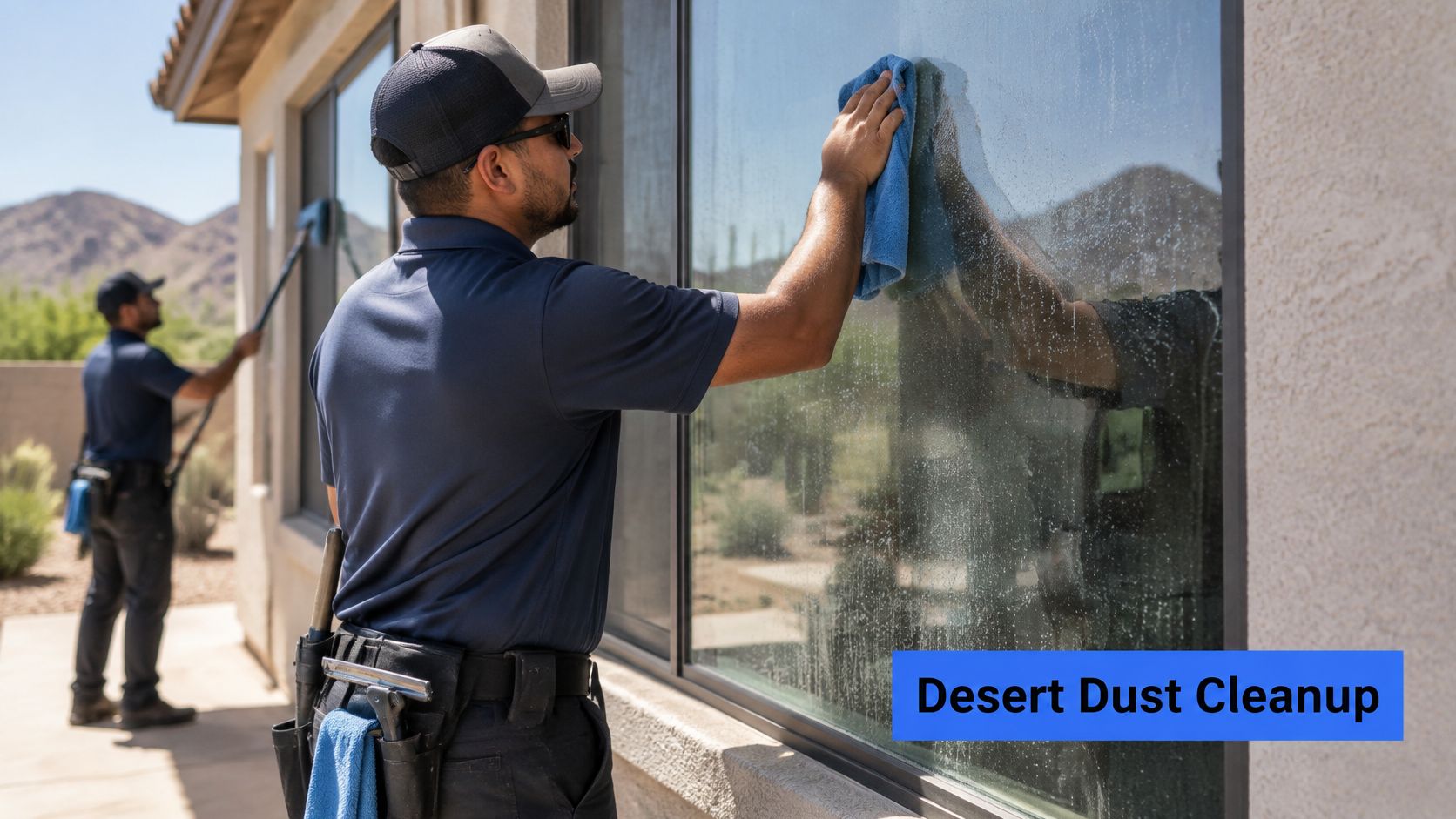
In the Phoenix area, fine dust and hard-water deposits can leave a pane hazy. Keep cloths used on sills and frames separate from the clean, low-lint towel reserved for glass. A thicker towel cannot replace a proper rinse or remove abrasive grit safely.
Flagstaff can bring cold-season film and road grit. Check a cloth's weave before it touches the pane; particles caught in the fabric can scratch or smear. In Las Vegas, strong sun and mineral spotting can make residue especially visible as glass dries.
Across Colorado, winter film, construction dust, and urban grime can load a finishing towel with residue. If a pane dries with mineral marks, polishing harder with a damp cloth may spread them rather than remove them. Learn more about what removes hard-water stains from glass.
Tinted film, low-E coatings, sunscreen residue, and sealant overspray call for care. Test a clean towel on a small area first, and avoid treating every glass surface as though it responds the same way. A controlled study found that microfiber release varied with textile construction, fiber type, and cutting method (the study in Environmental Science & Technology).
Professional Window Cleaning serves Arizona, Colorado, and Nevada with residential, commercial, mid-rise, and high-rise window washing. The practical rule is simple: choose the towel for the finish, and keep grit off the glass before the towel gets there. Learn about Professional Window Cleaning.
Lifts Poles and Rope When a Towel Cannot Reach
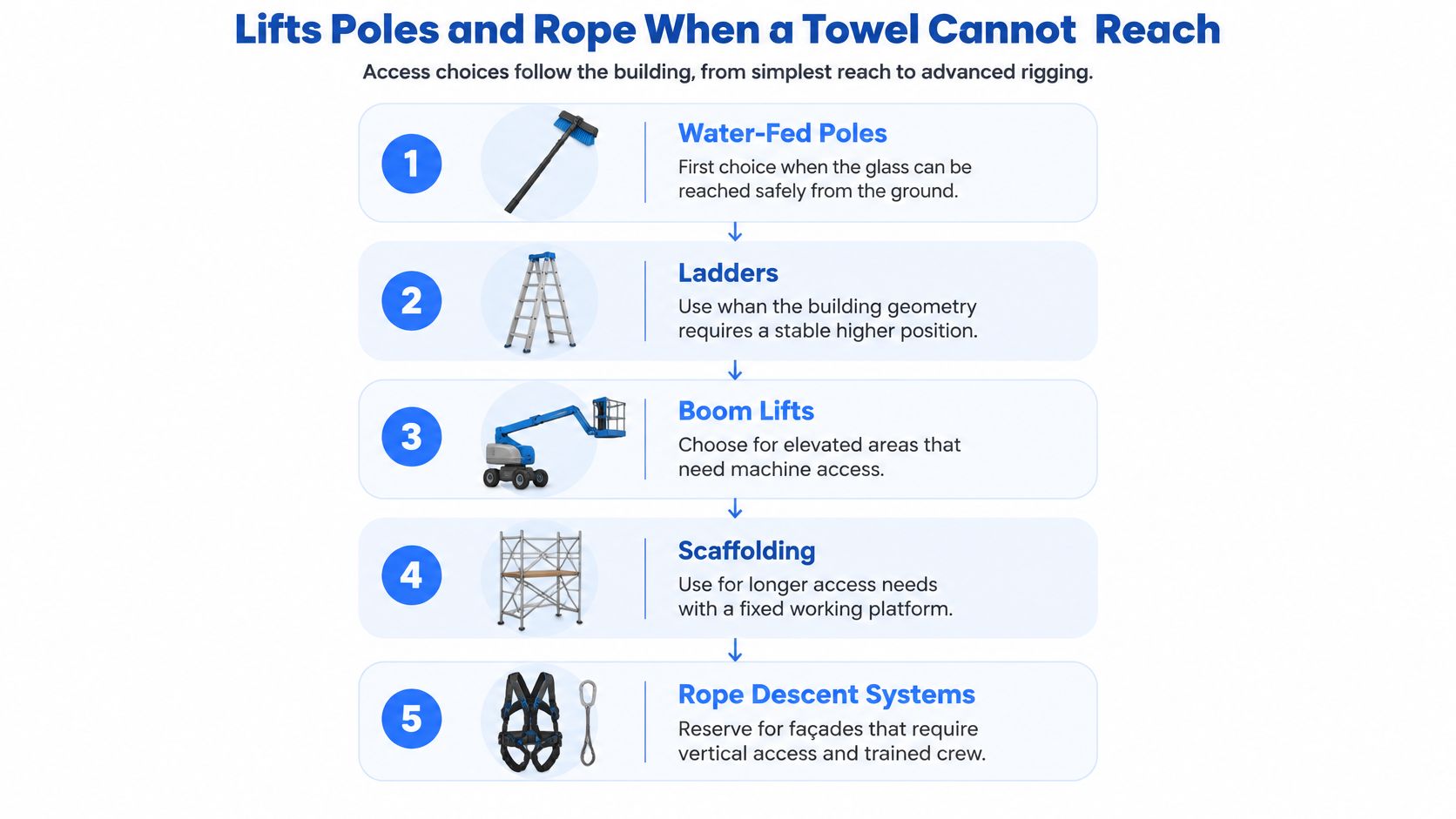
A towel finishes glass; it does not solve an access problem. The building and working position determine whether a pole, ladder, lift, scaffold, or rope system is appropriate.
| Access method | Use when | Hazard it controls |
|---|---|---|
| Water-fed pole with purified water | Exterior glass is reachable from the ground | Mineral spotting from tap water on the pane |
| Ladder | Glass is reachable within the ladder's rated limits | Falls from unstable footing |
| Boom or aerial lift | Upper glass can't be reached safely from a ladder | Falls and overhead power lines; keep 10 feet of clearance |
| Scaffolding | A stable deck is needed where a lift is the wrong fit | An unstable working platform |
| Rope descent | High-rise glass needs vertical access, generally not above 300 feet | Falling tools and unsecured anchorage; anchorage supports 5,000 pounds |
A water-fed pole with purified water reaches suitable exterior glass from the ground. A ladder works only when it can be set in a stable position and used within its rated limits. It is not a reason to lean past the rails or improvise a platform.
A boom lift calls for trained, authorized workers. They check the controls, keep both feet on the basket floor, close the gates, and connect fall protection to the designated point. They also stay within the lift's rated load and keep at least 10 feet of clearance from the nearest overhead power line, as covered in construction aerial-lift requirements. Scaffolding can provide a stable work platform when a lift is not a suitable option.
Rope descent is a specialized access system. Under 29 CFR 1910.27, the building owner must provide written notice that each anchorage has been identified, tested, certified, and maintained to support at least 5,000 pounds (2,268 kilograms) in any direction for each attached employee. Work is generally prohibited more than 300 feet (91 meters) above grade unless the employer demonstrates that other access methods are infeasible or create a greater hazard. The system needs inspection at the start of each shift, proper rigging and tiebacks, and use within manufacturer limits or under a qualified person's direction. Secure squeegees and buckets against falling, and follow OSHA's rope-descent system requirements.
For a closer look at equipment choices, see this guide to window-washing tools for high windows. The towel comes last, after the right access method has made the glass reachable.
Hire a Crew When the Glass Is Out of Reach
Keep towel work to panes you can reach safely from the ground or a stable ladder, with a clean finishing cloth and water that won't leave mineral spots as it dries. When access, soil, or the glass itself defeats that setup, a towel isn't a safe workaround.
Use this decision check in order:
Can you reach every pane safely? If a window sits beyond a safe ground or ladder position, don't stretch, climb beyond the equipment, or improvise a platform. Hire a crew.
Does the finish cloth pass the lint and grit check? Test it on a clean area. If it leaves fibers or drags particles, set it aside before it touches another pane.
Do spots return after a purified-water rinse? If so, a water-fed pole with purified water may be the appropriate method for exterior glass, rather than another pass with a thicker towel.
Does the building need a lift, scaffold, or rope descent system? That's a job for trained workers using the access method the building requires.
A storefront, hotel, office building, or high-rise often needs more than careful detailing. Professional Window Cleaning offers residential, commercial, and high-rise window washing across Arizona, Colorado, and Nevada. The company has been washing windows for over 22 years, and it's licensed and insured.
The practical dividing line is clear: use a towel for the last detail after the glass has been safely reached and properly washed. When height or scale outruns a cloth, the right answer is equipment and a trained crew, not a longer reach.
Professional Window Cleaning handles residential, commercial, and high-rise window washing with squeegees, pure-water poles, and the access method each building requires. For glass that needs a safer reach or a more controlled finish, visit Professional Window Cleaning to request a quote and schedule online.