



You're looking through hazy glass, trying to decide whether the building needs a routine wash or something more involved. The upper windows sit above landscaping, residents need access to the entrance, and a recent smoke episode may have left more than ordinary dust behind.
When comparing Boulder cleaning services for windows, start with how the crew will reach the glass and what they're removing. Those decisions shape the equipment, safety planning, schedule and price far more than a promise of streak-free results.
Which Boulder Window Cleaning Service Fits Your Property
Boulder window cleaning service and access method by property type
| Property type | Typical service | Access method | Notes |
|---|---|---|---|
| Single-family homes | Interior and exterior window cleaning, mirrors and shower doors | Ladders or water-fed poles | Ground-level and upper-storey glass |
| Storefronts and offices | Routine commercial window cleaning on a fixed schedule | Ladders, water-fed poles or boom lifts | Schedule routes to keep glass consistent |
| Mid-rise buildings | Exterior glass on multi-story buildings | Boom lifts or scaffolding | Plan access around occupied floors |
| High-rise buildings | Full exterior glass | Rope descent systems | One-time service or recurring yearly plan; safety rules apply |
| Campuses, HOA and condo buildings | Scheduled exterior window cleaning | Boom lifts or scaffolding | Coordinate timing with residents and management |
Access usually drives crew size, scheduling and timing more than window count alone. A broad wall of reachable glass can be straightforward. A smaller group of windows above an atrium, sloped roof or enclosed courtyard may take more preparation because the access route and working position are less direct.
The table is a starting point, not an equipment prescription. A condo might allow water-fed pole work along an open frontage but need a lift in an enclosed courtyard. An awning can change how a storefront is reached, even when the neighboring shop has the same amount of glass.
Match the service to the whole building
For a home, clarify whether the work covers both sides of the windows, removable screens, mirrors and shower doors. For a commercial property, identify entrances, delivery routes and occupied areas that need to remain usable. That keeps a quote for exterior panes from being confused with a broader glass-maintenance scope.
Professional Window Cleaning provides residential and commercial window cleaning across most of the Denver area, including Boulder, Golden and surrounding cities. Its services include mid-rise and high-rise window cleaning, as well as professional pressure washing for other exterior surfaces. Pressure washing is a separate service, not a substitute for window washing.
The company also serves Phoenix, Scottsdale, Tempe, Chandler, Flagstaff and Las Vegas, along with Colorado communities including Denver, Boulder, Arvada, Westminster, Erie, Commerce City, Golden and Lakewood.
Before choosing a service, consider the building's height, access and occupancy. How many storeys are there? Can the glass be reached safely from the ground, or does the site call for a lift or rope descent? Which table row best matches the property, and what areas need to stay open during the work? These answers help define a service scope that fits the building rather than the window count alone.
How Professional Tools and Pure Water Clean Boulder Glass
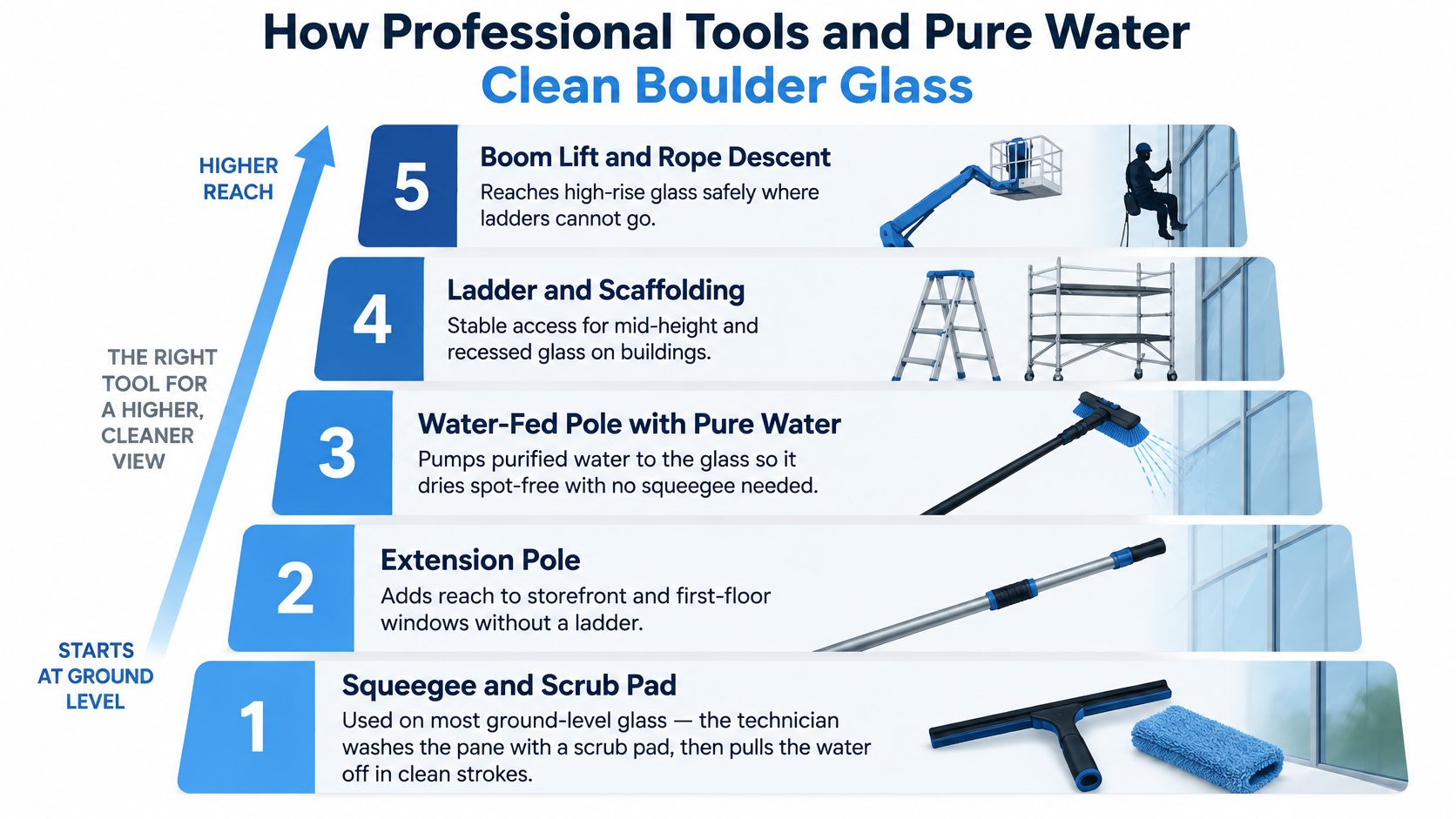
A squeegee and scrub pad remain the practical starting point for most ground-level glass. The technician wets and agitates the pane, then pulls the squeegee from top to bottom in overlapping strokes, keeping the blade clean and controlling runoff. Clean edges matter, especially above interior flooring and finished sills.
An extension pole adds reach without moving a ladder to every pane. A water-fed pole goes further: its extendable shaft delivers purified water through a brush head, allowing the technician to scrub and rinse upper-storey exterior glass from the ground where the site permits.
The tool hierarchy reflects reach, but the actual choice also depends on obstructions and working space.
Choose access before choosing speed
Ladders cover tight locations and interior-accessible spots where a pole won't give adequate brush contact or control. They need suitable footing and positioning. Stretching sideways to avoid repositioning a ladder isn't an acceptable productivity shortcut.
Boom lifts provide a working platform for storefronts and mid-rise facades when the site has suitable access and ground conditions. Scaffolding makes sense for long, continuous facades that need a fixed platform over several days. Its setup occupies space, so pedestrian routes and entrances need attention before installation.
Rope descent systems serve high-rise glass where roof access, anchorages and the building layout support their use. A taller tool isn't automatically the better tool. The crew needs controlled contact with the glass and a workable route around projections, balconies and landscaping.
Why purified water matters
The EPA's WaterSense guide to water purification describes reverse osmosis as using pressure to move water through a membrane, separating it from a higher-solute-concentration stream and removing very small particles. Think of it as removing the minerals that ordinary tap water can leave behind.
For exterior glass, reduced mineral content means less residue when rinse water dries. Our explanation of pure-water window-cleaning resin provides more context for the purification equipment behind the pole.
Practical rule: Pure water improves the rinse. It doesn't compensate for incomplete scrubbing, dirty frames or inadequate rinsing.
A pane can dry clear without a squeegee when the conditions and technique are right. Purification alone doesn't guarantee that outcome: incoming water quality, treatment performance, glass condition, wind, sun and technician technique still matter. Existing mineral deposits also need assessment rather than an assumption that a purified rinse will remove them.
High-Rise Rope Descent Rules That Protect Crews and Buildings
Rope descent is a standard approach to high-rise window cleaning, but owners need to understand the requirements before signing a contract. OSHA's rope descent standard, 29 CFR 1910.27, establishes the height, load, inspection and operating safeguards summarized below.
Rope descent requirements for high-rise window cleaning
| Requirement | Threshold or rule | Who acts |
|---|---|---|
| Maximum height | Generally not above 300 feet unless another access method is infeasible or more hazardous | Employer |
| Anchorage strength | Each anchorage supports at least 5,000 pounds in any direction per attached worker | Building owner, in writing |
| Fall protection | Each worker uses a separate, independent personal fall-arrest system | Employer |
| Component strength | Every component except the seat board has a minimum rated load of 5,000 pounds | Employer |
| Seat board | Supports a 300-pound live load | Employer |
| Stabilization | Required for descents over 130 feet | Employer |
| Inspection | Checked at the start of every work shift; defective equipment removed at once | Employer |
| Weather | No work during hazardous conditions such as storms or excessive wind | Employer |
The height restriction means the employer must justify an exception, not just bring longer ropes. Anchorage capacity must be documented for the attached workers, while independent fall protection provides a separate safeguard from the descent equipment.
Component ratings and seat-board capacity address different parts of the system. Stabilization controls movement at the work location; edge protection prevents roof edges from cutting or weakening ropes. Inspection and weather decisions remain active responsibilities throughout the job.
Owner checks before work begins
- Obtain anchorage documentation. Before work starts, provide written confirmation that each anchorage has been identified, tested, certified and maintained to the capacity required in the table. Don't assume roof hardware is suitable because a previous contractor used it.
- Request shift-inspection evidence. Confirm how the employer records inspections and removes defective equipment from service.
- Confirm independent fall protection. Each worker needs a separate personal fall-arrest system, not reliance on the working descent line alone.
- Agree on weather decisions. Establish who communicates a stoppage and how occupants will be notified when storms or high wind interrupt work.
Our technicians receive annual OSHA rope-descent training through Expert Safety Services. The explanation of fall-protection training requirements helps owners distinguish training from the building-specific documentation needed for a job.
Our Colorado high-rise coverage includes the greater Denver area, Boulder and Colorado Springs. Clients can arrange a one-time service or regular cleaning throughout the year, including a yearly plan that coordinates visits with building operations.
Missing safety documentation is a disqualifier, not a negotiating point. A lower price doesn't resolve an unverified anchorage or an incomplete fall-protection arrangement.
Wildfire Smoke, HVAC and What Window Cleaning Fixes
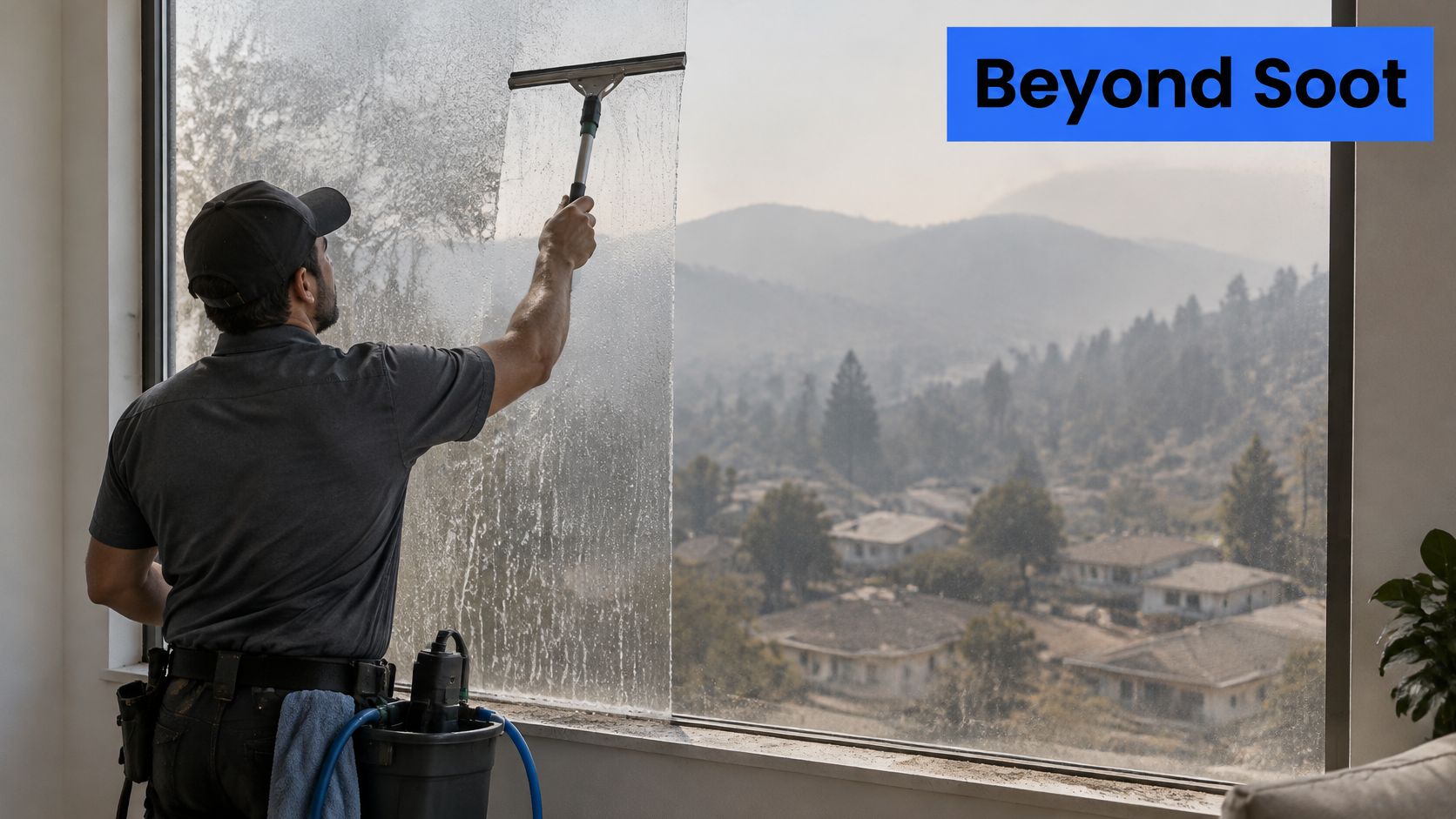
Is ordinary glass cleaning enough after wildfire smoke? It may improve the glass, but it can't establish that the property is free of smoke contamination. Smoke residue can include polycyclic aromatic hydrocarbons, or PAHs, and volatile organic compounds, or VOCs, rather than visible soot alone.
The National Collaborating Centre for Environmental Health's wildfire-smoke cleaning review reports that laboratory cleaning of smoke-exposed glass reduced PAHs by 62% with a commercial cleaner and 71% with ethanol, with outcomes varying by pollutant, surface and method. Those laboratory results aren't a recommendation to apply ethanol across a building or a guarantee for field cleaning.
Visible improvement needs to be judged separately from contaminant removal.
Remove residue without spreading it
Heavy chemical spraying isn't automatically better. Cleaning solution can remain on smooth surfaces after wiping, and spray aerosols can carry chemicals beyond the target pane. A controlled application lets the technician manage both contact and runoff.
For smoke-affected properties, use this sequence:
- Wait for smoke to clear. Schedule the full exterior wash after the active episode when conditions permit safe work, rather than washing during continuing deposition.
- Control the cleaning solution. Use compatible cleaner applied to the applicator, followed by squeegee removal and a controlled pure-water rinse where appropriate. Don't treat a rinse alone as smoke remediation.
- Separate surrounding materials. Remove and wash screens separately. Address frames and tracks without pushing dirty water indoors, and test painted finishes before treatment.
- Document the starting condition. Photograph staining, deposits and damaged finishes, and record the areas treated and products used.
Keep occupants away from active work areas and coordinate open windows with management. Persistent indoor odor, widespread soot or contamination beyond the window assembly calls for an indoor assessment, not a promise that washing the exterior will solve it.
Clean-looking glass is not proof of a residue-free building.
Keep glass work separate from air-quality work
Window cleaning can remove dust, pollen, mineral deposits and smoke film, improving visibility and daylight transmission. It doesn't replace filtration, ventilation or HVAC remediation.
Portland State University's account of targeted household cleaning research describes work across four climate zones, including a Boulder building where HVAC coil cleaning increased conditioned supply airflow by 110% and blower cleaning by 20%. These are HVAC findings, not evidence that washing windows improves HVAC performance.
For coordinated maintenance, finish dust-generating work, clean exterior glass, arrange HVAC service and filter replacement, then verify ventilation, including range-hood operation for cooking emissions. Don't delay urgent air-quality work to follow a cosmetic-cleaning schedule.
Keep product records and completion photographs if the facility maintains LEED or ESG documentation, without presenting them as proof of certification. Air-quality complaints start with HVAC and indoor-environment assessment; view and daylight complaints call for glass inspection and cleaning.
What Drives the Price of a Boulder Window Cleaning Job
There's no single rate that fits every Boulder building. Scope and access determine the quote, and a useful estimate makes both visible rather than hiding them behind a window count.
Building height is the first consideration because it narrows the available access methods. Open ground below the facade may permit pole work, while a setback, enclosed courtyard or inaccessible roof can require a different equipment plan. Equipment delivery, setup space and pedestrian protection all belong in that assessment.
Define what the price includes
Glass count matters once the crew knows how it can reach the work. Glass type matters too: exterior panes, interior partitions, mirrors and shower doors don't all require the same handling or room preparation.
Compare proposals using these scope details:
- Included surfaces: Identify interior and exterior glass separately, with mirrors, shower doors and screens explicitly included or excluded.
- Condition: Distinguish routine washing from adhered deposits, staining or smoke-affected surfaces requiring a documented starting condition.
- Visit pattern: Specify a one-time clean or recurring plan so the provider can plan the work around occupancy.
- Access preparation: Include lift positioning, roof access, required paperwork and any restrictions on work hours.
Rope descent adds pre-start planning for written anchorage confirmation and safety documentation. That preparation is part of delivering the job, not an optional administrative extra.
Our quotes follow a site assessment, and this guide doesn't publish a per-window or per-storey rate. The discussion of what it costs to clean windows can help you prepare a complete scope before requesting an estimate.
Compare like for like: A lower quote isn't equivalent if it excludes interior glass, access equipment or the preparation needed to perform the work.
For recurring and high-rise properties, a yearly schedule can distribute visits around the building's needs. Compare providers on the same glass scope and access method, not just the total at the bottom of the proposal.
Booking Your Boulder Window Cleaning
Booking should turn a general request into a defined job. Before contacting us, gather the building's height or storeys, an approximate inventory of glass surfaces, and any recent smoke or air-quality concerns. Photographs of the facade and difficult access points can help explain the site, though they don't replace an assessment.
From request to final walkthrough
- Request a quote online. Our website supports online scheduling. You can also reach our Denver, Boulder, Arvada and Lakewood team at (720) 255-0229; our Boulder office is at 1645 Pine St Unit 4, Boulder, CO 80302.
- Complete the site assessment. We assess storeys, glass types and access. Identify mirrors and shower doors you want included, along with locked rooms, screen arrangements and areas where furniture limits interior access.
- Choose the service pattern. Select a one-time visit or a recurring plan. For managed properties, coordinate the proposed dates with resident notices, delivery schedules and other contractors.
- Confirm equipment and paperwork. Establish the access method before accepting the scope. For lift or rope work, resolve site permissions, equipment placement, roof access and applicable safety documents before arrival.
- Prepare for the workday. We arrive with the planned equipment and check weather conditions before proceeding. The work generally moves from upper glass downward so runoff doesn't spoil completed panes, with the sequence adjusted for access and occupancy.
- Walk the glass afterward. Review the agreed surfaces together where practical. Distinguish remaining dirt from scratches, failed seals or staining that ordinary washing won't correct, and record any follow-up items.
Keep communication usable during the job
Give the crew a named site contact who can open doors, coordinate residents and approve access changes. For smoke-affected properties, make sure the pre-cleaning photographs and condition notes are available to the person reviewing completion.
Facility managers coordinating several trades should also consider how urgent calls reach someone while crews are working. Ansa's guide to contractor phone coverage costs and setup is a useful operational resource for evaluating that communication arrangement, separate from the window-cleaning scope.
Weather, access restrictions and building occupancy affect timing. A documented process protects the building and the crew by making responsibilities clear before equipment arrives. Request a quote with building height, glass scope and smoke or air-quality concerns ready.
Professional Window Cleaning offers residential, commercial, mid-rise and high-rise window services with access planning matched to the property. Visit Professional Window Cleaning to request a Boulder quote, and include your building's height, the glass you want cleaned and any recent smoke concerns so we can define the right scope.