




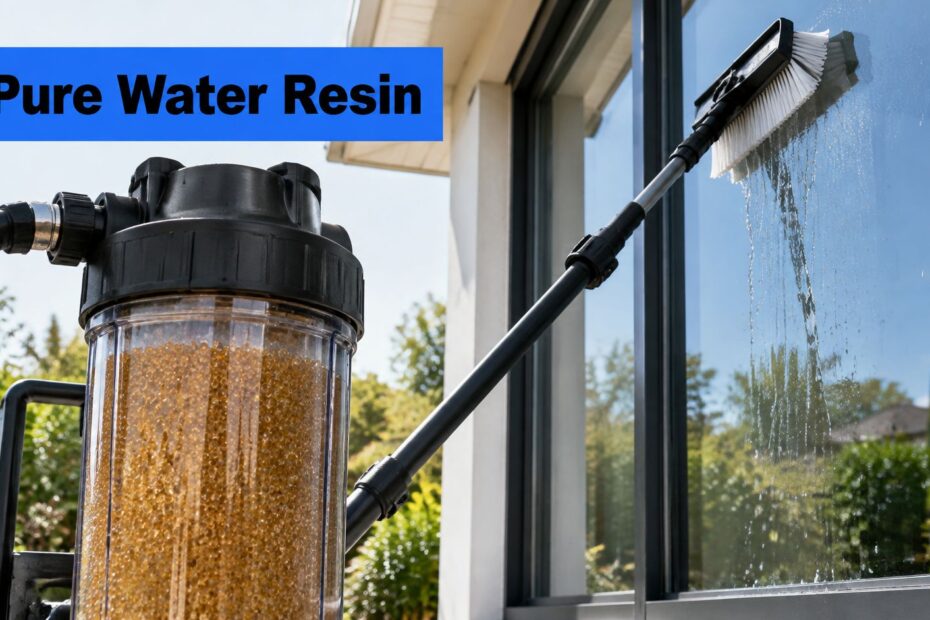
Why can a pure-water system show an acceptable meter reading while a freshly rinsed pane still dries with a faint haze? The meter measures electrical conductivity, but it doesn't reveal every contaminant that can remain on glass. For reliable results, check the glass, the final outlet reading, and the local water chemistry together.
That matters across Arizona, Colorado, and Nevada. A resin vessel used on a Phoenix route may not process the same usable volume as one working in Denver or Las Vegas, because feedwater mineral loads differ. The practical objective isn't water that merely looks clear. It's a rinse that dries clean on the glass.
What Pure Water Resin Pulls Out of Your Water
Tap water can carry dissolved minerals to a pane, where they remain as white spots after the water evaporates. If a rinse leaves deposits, the marks may look like hard-water stains, but the useful first question is what the treatment system is allowing through.

Pure-water window cleaning resin works through ion exchange. Think of a resin bead as a doorman: it holds onto a charged mineral arriving with the water and gives back another ion in its place. The exchange doesn't make the water look cleaner by trapping visible dirt. It reduces dissolved ions that could otherwise dry on the glass.
The two resin types handle opposite charges. Cation resin captures positively charged minerals such as calcium, magnesium, sodium, and iron. Anion resin captures negatively charged substances such as chloride, sulfate, nitrate, and bicarbonate. A mixed bed combines both types in one vessel, allowing the system to remove a wider range of dissolved ionic material in one treatment stage.
That exchange has limits. Resin primarily removes dissolved ions. Sediment and other particles, microorganisms, and many uncharged organic compounds need separate filtration or treatment upstream. A clear sample therefore doesn't prove that every contaminant has been removed.
Resin also has finite exchange capacity, the quantity of ionic charge it can capture before exhaustion. Actual capacity changes with feedwater chemistry, flow rate, temperature, resin condition, and regeneration or replacement practices. The same vessel can yield different usable volumes in Phoenix, Denver, or Las Vegas because municipal mineral loads aren't identical. The deionization monitoring guide from Mettler Toledo describes the exchange process and why conductivity is a practical control point as exhausted resin begins to leak ions.
For window cleaning, the operating aim is streak-free drying, not water that looks clear. The outlet reading helps track ionic leakage, but it's one part of quality control, not a substitute for checking the pane.
Water Purity Benchmarks Your Resin Must Hit
| Grade | Resistivity at 25°C | Conductivity equivalent | Role in this article |
|---|---|---|---|
| Type I reagent water | 18 MΩ·cm | about 0.055 µS/cm | Highest-purity reference for deionized water |
| Type II | 1.0 MΩ·cm | 1.0 µS/cm | Lower-grade reference |
| Type III | 4.0 MΩ·cm | 0.25 µS/cm | Lower-grade reference |
| Type IV | 0.2 MΩ·cm | 5.0 µS/cm | Lowest grade listed |
These values are reagent-water benchmarks, not automatic pass-or-fail rules for every window-cleaning job. The ASTM D1193 water specification sets Type I at a minimum of 18 MΩ·cm at 25°C. The broader highly deionized-water benchmark is approximately 18.2 MΩ·cm, equivalent to about 0.055 µS/cm conductivity at that reference temperature.
Resistivity and conductivity describe the same electrical behavior in opposite ways. Resistivity is expressed in megohm-centimeters, and conductivity in microsiemens per centimeter. At the Type I benchmark, very high resistivity corresponds to very low conductivity. The Type II, III, and IV values show progressively lower resistivity and higher conductivity, so their roles here are comparison points, not equivalent purity targets.
ASTM describes Type I water as produced through distillation or an equivalent process, followed by polishing with mixed-bed ion-exchange materials and a 0.2-micrometer membrane filter. Feedwater entering that final polishing stage must not exceed 20 µS/cm at 25°C. That specification helps distinguish laboratory reagent water from the field use of “pure water”: the practical window-cleaning concern is whether dissolved ions are low enough that evaporation leaves little or no visible residue.
Read the number, not the appearance
Water can remain visually clear while its dissolved-ion level rises. Temperature also affects resistivity, so readings should be compared at a standardized reference temperature. Use the instrument's temperature compensation if available, and note the reference temperature when recording a result.
Type I is a useful technical reference, but a field crew still needs a defined job target. Don't assume a pane will dry spot-free because the sample looks clean, and don't treat a laboratory grade as a universal operating limit without testing the actual outlet and glass.
Use this three-step check:
- Read the meter at the final outlet, not just at the source.
- Correct the reading to 25°C or use a temperature-compensated value.
- Compare it with the target set for the job, then verify the result on glass.
The number gives you a repeatable signal. The pane confirms whether the rinse is performing as needed on that route.
How Cation and Anion Resin Work Together
A mixed-bed vessel treats both sides of the dissolved ionic load. Follow the water path through it:
- Feedwater enters the vessel. It carries dissolved positive and negative ions into the resin bed.
- Cation resin in hydrogen form exchanges positive ions. It captures calcium, magnesium, sodium, and other cations, releasing hydrogen ions.
- Anion resin in hydroxide form exchanges negative ions. It captures chloride, sulfate, bicarbonate, nitrate, and other anions, releasing hydroxide ions.
- Hydrogen and hydroxide combine into water. The exchange reduces the dissolved-ion concentration, and treated water leaves the bed with far fewer ions available to dry on the glass.
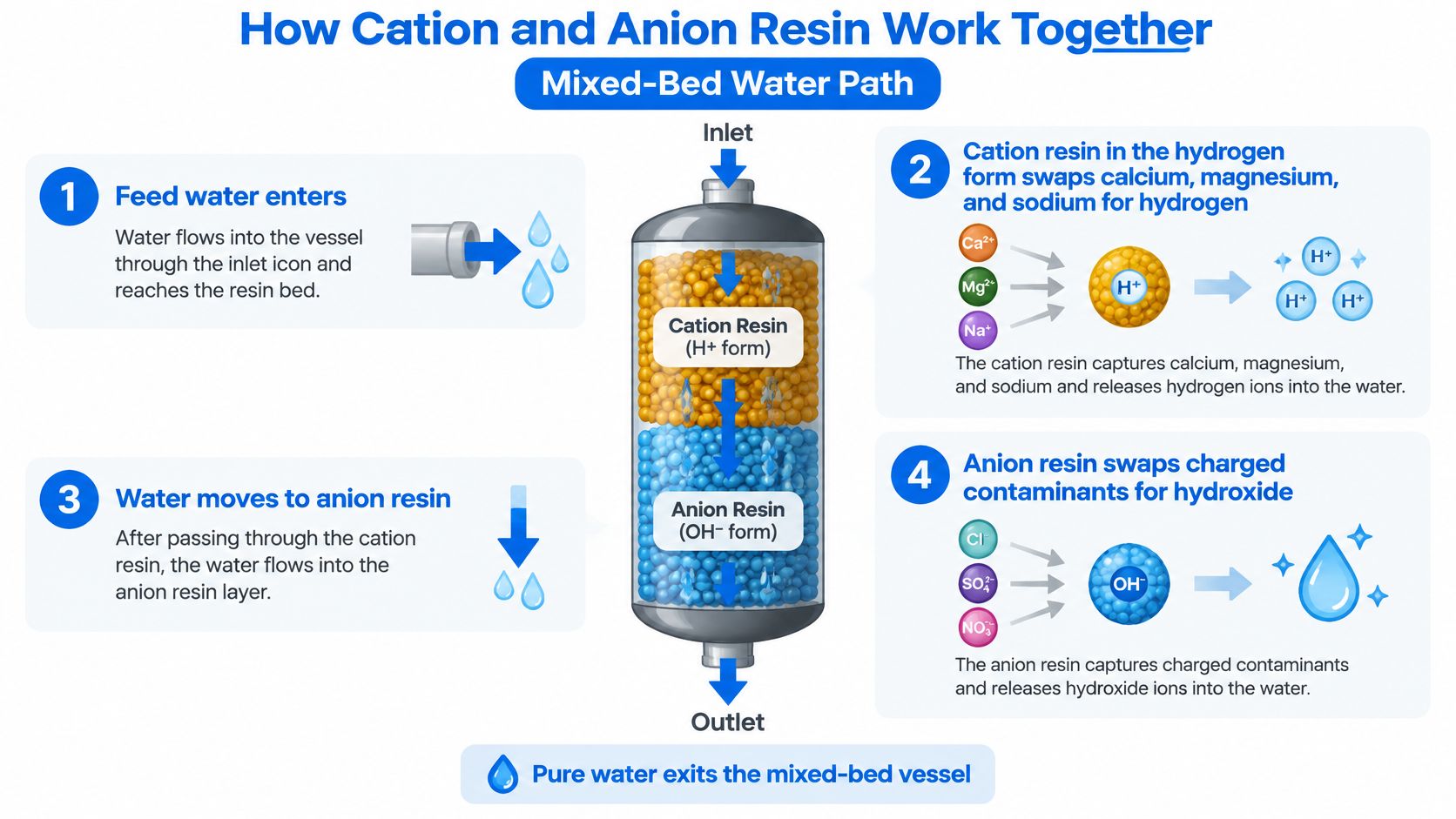
The AmberLite mixed-bed resin product data sheet from DuPont describes this hydrogen-and-hydroxide exchange and notes that capacity depends on the feedwater and operating conditions. In window cleaning, the reason for the sequence is straightforward: fewer dissolved ions in the rinse means less ionic material left behind when the water dries.
Capacity behaves like a sponge with a specific load. A sponge can absorb only so much before it stops working well; resin has exchange sites that fill as ions pass through. Its usable capacity depends on feed TDS, ionic composition, flow rate, bed volume, and the exhaustion endpoint chosen for the system. Higher-TDS municipal water consumes capacity faster, but two supplies with similar TDS readings can still differ in ionic mix.
That's why a calendar estimate alone is a poor guide. Measure feed TDS to characterize incoming water, then track conductivity or resistivity at the product-water outlet. The treated volume helps interpret the trend, but it shouldn't replace quality checks.
Magnetic ion-exchange media such as MIEX is a separate pretreatment option aimed at organic matter. It isn't a substitute for the cation-and-anion pair that removes dissolved charged minerals in a mixed-bed vessel.
Why Silica Slips Past Your Conductivity Meter
The meter reads within the operating range, but a faint haze appears after the pane dries. That can happen because silica may break through an ion-exchange bed before conductivity or resistivity visibly signals exhaustion.
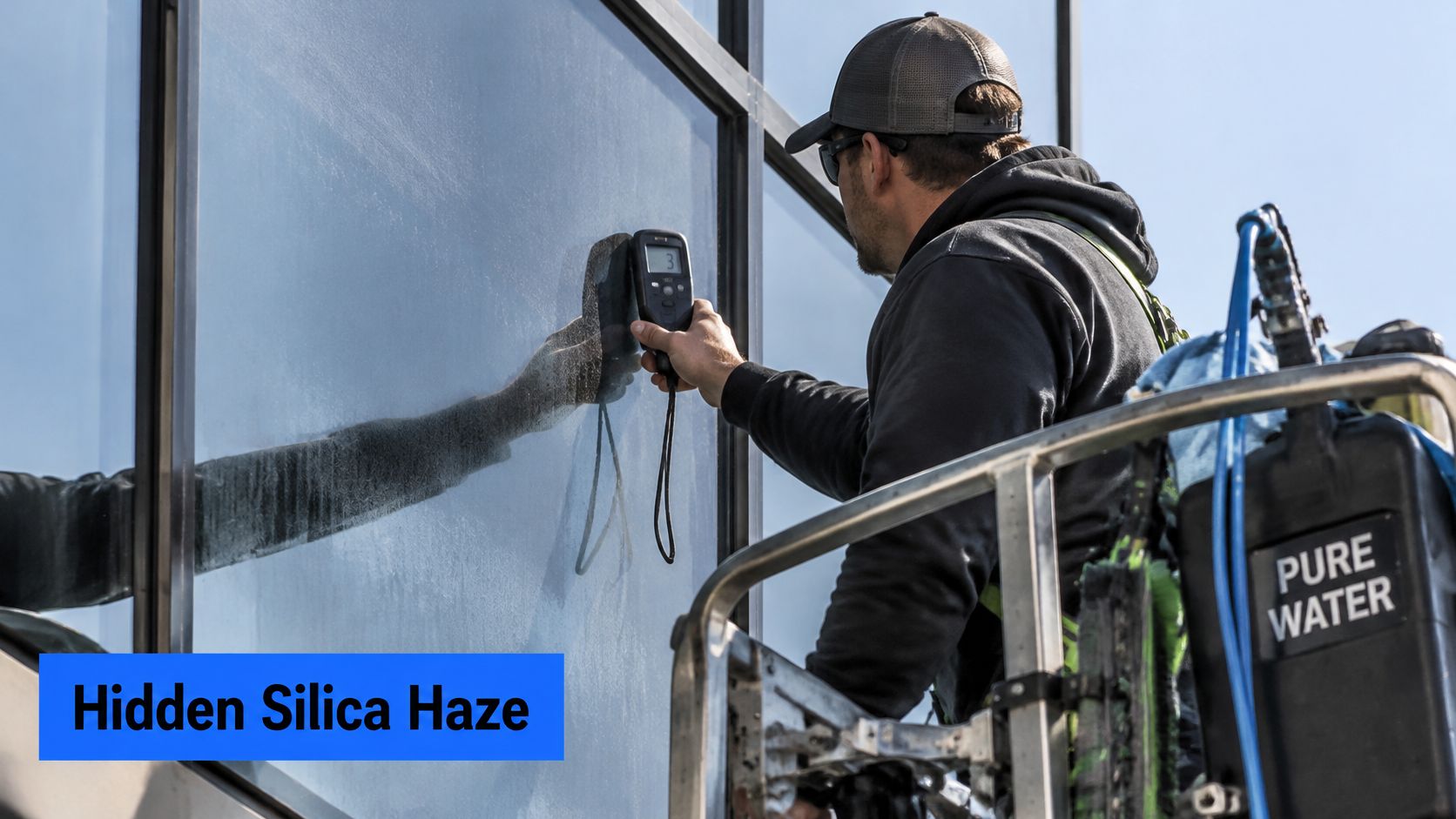
Some dissolved silica is weakly ionized or nonionic, so it contributes little to conductivity. The display can therefore look reassuring while silica concentration rises. As the water evaporates, silica or other dissolved residue remains on the glass and may show up as haze or spotting.
The Merck Millipore technical article on silica-sensitive water purification identifies silica as an early-breakthrough contaminant. It also connects leakage to anion-resin performance, including regeneration quality, feed silica, sodium leakage, flow rate, and resin condition.
What changes anion-side performance
Excessive flow can increase sodium and silica leakage, while inadequate regeneration can shorten service runs. Resin condition matters too: a bed that no longer performs properly may pass residue even if the conductivity reading hasn't crossed the operator's alarm point.
This creates a practical trade-off. A meter is valuable because it can show changes in ionic quality before every pane displays a problem, but it cannot account for every weakly ionized contaminant. On large commercial or high-rise work, trusting the display alone can spread haze across many panes before the crew recognizes the issue.
A clean meter reading doesn't overrule a residue mark on glass. If a spot test shows haze, treat that as a real quality signal even when the meter remains within its expected range. Flow control, careful bed packing, and a low-spotting test pane after a cartridge change can help expose trouble before the rinse reaches a full elevation.
Predicting Resin Life Across Variable City Water
A fixed gallon count can mislead because resin exhaustion depends on feedwater chemistry and competing ions, not just how much water has passed through the vessel. Ion-exchange selection also involves factors such as selectivity, fouling propensity, particle size, head loss, and regeneration logistics. The ion-exchange research chapter on resin selection and capacity supports a more practical approach: combine local water information with operating measurements rather than treating a handheld TDS number as a complete prediction.
Consider three routes. A Phoenix window cleaning service may encounter a mineral load that uses resin faster than the route schedule anticipated. A Denver window cleaning service may face a different hardness profile or a seasonal change in supply. On a Las Vegas window cleaning service route, the ion mix may differ again. These are operating scenarios, not published city water analyses. They show why a single calendar interval can fail across service areas.
Hardness ions and silica aren't interchangeable problems. Calcium and magnesium contribute to hardness and are charged, while some silica is weakly ionized or nonionic. A handheld TDS reading can mislead depending on where it's taken in the treatment train and which substances contribute to conductivity. Use it as one measurement, not as a complete account of resin condition.
Build a route log that answers the lifespan question
Resin life should be described as treated volume to a defined exhaustion endpoint, not as a universal number of days or gallons. BTU measures heat, so it has no place as a resin-life unit.
Record four things together: feed TDS, treated-water conductivity at the final outlet, gallons processed, and the result of a spot test on glass. Add local water-chemistry information when available. A fixed calendar swap can discard usable capacity, while waiting for visible spotting can lead to callbacks. A staged protocol gives you more control: watch the outlet, confirm performance on a pane, and use logged volume as context.
| Warning sign | Likely cause | Action |
|---|---|---|
| Glass shows haze while the meter reads normal | Silica or weakly ionized residue passing the bed | Replace or re-bed the resin, then retest with a spot pane |
| Conductivity climbs steadily across the run | Cation or anion capacity nearing exhaustion | Log treated volume and replace at the set endpoint |
| Exhaustion arrives sooner on one route | Higher feed TDS or hardness than the schedule assumed | Measure feed TDS before setting the replacement interval |
| Runs shorten after a flow change | Excessive flow raising sodium and silica leakage | Restore flow control and retest outlet water |
| Short service after a regeneration | Inadequate regeneration of the anion resin | Check regeneration practice and sodium leakage |
Running a Glass Spot Test After Every Resin Change
A spot test checks what the meter can miss. Use a clean, uncoated test pane and the final treated-water outlet, so the result reflects the water that will reach the brush and glass.
- Rinse the test pane with treated water drawn from the outlet.
- Let it air-dry without wiping. The residue left behind is what you're checking.
- Inspect under raking light and compare it with a control pane rinsed the same way.
- Record the result beside the outlet conductivity reading and treated volume.
- If residue appears with a normal meter reading, replace or re-bed the resin and repeat the test after the change.
Air-drying matters because evaporation concentrates any remaining dissolved material on the surface. That can reveal silica or other weakly ionized residue that contributes little to the meter reading.
Run the test after every cartridge change, whenever the feedwater chemistry shifts, and at the start of a shift on large commercial or high-rise routes. Keep the notes with your water-fed-pole maintenance record, including the setup details you use for your water-fed pole system.
Regenerate, Replace or Dispose and Your Next Step
Choose the resin action based on performance, not the calendar.
- Regenerate when the bed reaches its set exhaustion endpoint and the regeneration process has worked correctly. Regeneration restores exchange capacity.
- Replace when a glass test shows residue, outlet conductivity passes its endpoint, or water chemistry changes. Fouling or poor regeneration can make fresh resin necessary.
- Check flow control for leakage or channeling, then retest after changing the cartridge.
- Dispose of spent resin according to local requirements rather than assuming it can go in ordinary waste.
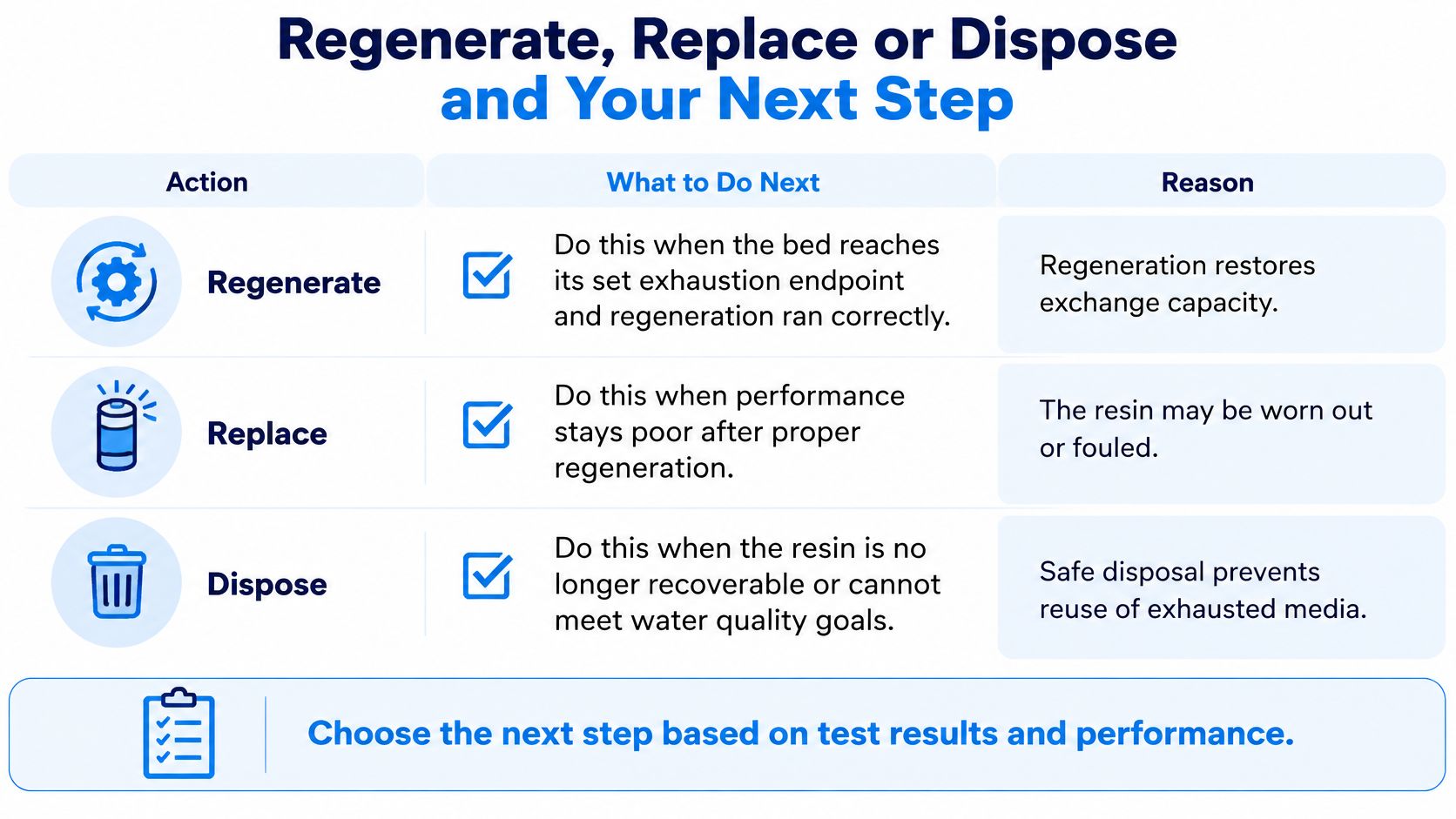
Record the date, treated volume, outlet conductivity, glass-test result, and action taken. These entries help separate changes in feedwater from issues with resin condition or flow.
Use three checks together on the next route: final-outlet conductivity, the appearance of the glass after rinsing, and treated volume from the log. A meter reading can look acceptable while the glass still spots, so consider the glass, outlet reading, and local water chemistry together. Do not replace resin solely because a calendar date has arrived, or keep working solely because one meter reading looks acceptable.
Professional Window Cleaning has been washing windows for over 22 years and is licensed and insured. For high-rise work, rope descent is subject to OSHA height and weather rules. The access method should suit the building and conditions; options can include rope descent, scaffolding, or a boom lift.
Route conditions differ across the company's service areas, including Phoenix, Scottsdale, Tempe, Chandler, and Flagstaff in Arizona; Denver and Boulder in Colorado; and Las Vegas in Nevada. Keep resin decisions tied to the water and glass on the route. For guidance on setup and operation, review this water-fed pole cleaning method.
Professional Window Cleaning provides residential, commercial, and high-rise window cleaning, along with professional pressure washing. To discuss a property's windows and access needs, visit Professional Window Cleaning to request a quote.