



You're probably here because you've already seen the sticker shock. Bay windows look fantastic from the street, pull in more light, and make a room feel bigger. They also cost real money to install, and once that glass projects out from the home, it becomes one of the most visible features on the property.
That's the part many homeowners miss. The bay window cost doesn't stop when the installer leaves. Once you've put thousands into a bay window, keeping the glass, frames, edges, and exterior trim clean becomes part of protecting the investment. Dirty runoff, hard water spotting, dust buildup, and neglected seals can make an expensive window look tired fast, especially in dry, bright climates like Arizona and Nevada and in mixed-weather markets like Colorado.
The Full Picture of Your Bay Window Cost
Those searching bay window cost are trying to answer one question. “What will it cost me to put one in?” That's fair. Installation is the big upfront decision.
The problem is that many cost guides blend together two very different jobs. A simple replacement is one thing. Turning a flat wall into a projecting bay is another. One industry guide notes that many articles cite a broad installed range of about $2,000 to $6,000, while a structural conversion can reach $4,000 to $10,000+ because framing, load-bearing changes, roof work, and permits can drive the price, not just the window unit itself (Hotian Windows bay window cost guide).

Installation is only the first bill
Once a bay window is in place, it stops being a line item and starts being an exposed architectural feature. It catches direct sun. It collects more dust at the angles. It often has deeper sills and multiple glass sections that show every streak.
That matters because bay windows are bought for appearance as much as function. If the glass stays hazy or the exterior edges collect grime, the feature you paid for loses value every single day you look at it.
Practical rule: If a window costs enough that you notice the price, it deserves a maintenance plan.
Cleaning costs work the same way many home service quotes do. Access, labor time, difficulty, and condition all change the final price. If you want a broader consumer example of how labor variables affect service pricing, this overview of factors affecting UK cleaning quotes gives a useful comparison, even though bay window cleaning requires more specialized access and glass-care methods.
Ownership cost includes safe upkeep
Homeowners often make the wrong comparison. They compare bay window installation to other remodeling projects, but they don't compare the upkeep requirements. A standard flat window is easier to reach, easier to detail, and easier to rinse clean. A projecting bay usually isn't.
That's why I tell homeowners to think in two parts:
- Upfront investment: The purchase, framing, installation, and finish work.
- Ongoing protection: Scheduled cleaning, inspection of edges and buildup, and safe access for upper-story glass.
- Appearance retention: Keeping the window looking like the premium feature it was meant to be.
If you're budgeting the full life of the feature, it helps to look beyond installation and review a dedicated window cleaning cost guide so you understand what upkeep can involve.
Why Bay Windows Demand Professional Cleaning
Bay windows are harder to clean well because their design creates work that standard flat glass doesn't. The shape is the problem and the selling point at the same time.
A typical bay has a center panel and angled side panels. Those joints trap dust, spider webs, pollen, and runoff. The lower ledges collect debris. On exterior glass, the angled faces catch light differently, which means even minor residue shows up once the sun hits it.
The geometry works against simple cleaning
Professionals look at a bay window and immediately see three challenges.
- Multiple panes at different angles: A squeegee stroke that works on one panel doesn't always flow cleanly into the next.
- Corners and meeting lines: Water and dirt gather where panels join, so detail work matters.
- Projecting sills and trim: These surfaces hold grit that can transfer back onto wet glass if the sequence is wrong.
A bay window cleaned without a method usually ends up with one clean-looking panel and two side sections with drag marks, edge residue, or drips returning from the top frame.
Exterior access changes everything
The second issue is reach. Ground-floor bay windows can still be awkward because the projection forces the technician to work around landscaping, decorative stone, or sloped ground. Second-story bays are another category altogether.
That's where professional equipment makes the difference. Depending on height and site conditions, crews may use extension ladders, sectional ladders, scaffolding, boom lifts, rope descent systems, or pure water-fed poles. Each tool solves a different access problem. None of them are interchangeable if safety and finish quality matter.
Bay windows don't just need cleaning. They need the right angle of approach, the right tool, and enough control to finish the edges cleanly.
The glass shows mistakes fast
Bay windows are often installed where homeowners want more natural light. Living rooms, dining areas, front-facing sitting spaces, breakfast nooks. Bright light is great until it exposes every missed spot.
Professionals account for that by adjusting technique to the glass layout and surroundings. That usually means:
- Pre-cleaning frames and ledges so grit doesn't wash back onto glass
- Using professional squeegees sized to the pane, not forcing one tool across every section
- Finishing edges carefully where side panels meet the center
- Using pure water systems when exterior conditions or height make spot-free rinsing the better option
That's why bay windows often look worse after a rushed amateur cleaning than before it. The dirt may be lighter, but the streaks become permanent-looking under direct sun.
The Real Risks of DIY Bay Window Cleaning
The biggest DIY mistake isn't poor effort. It's assuming a bay window is just another window.
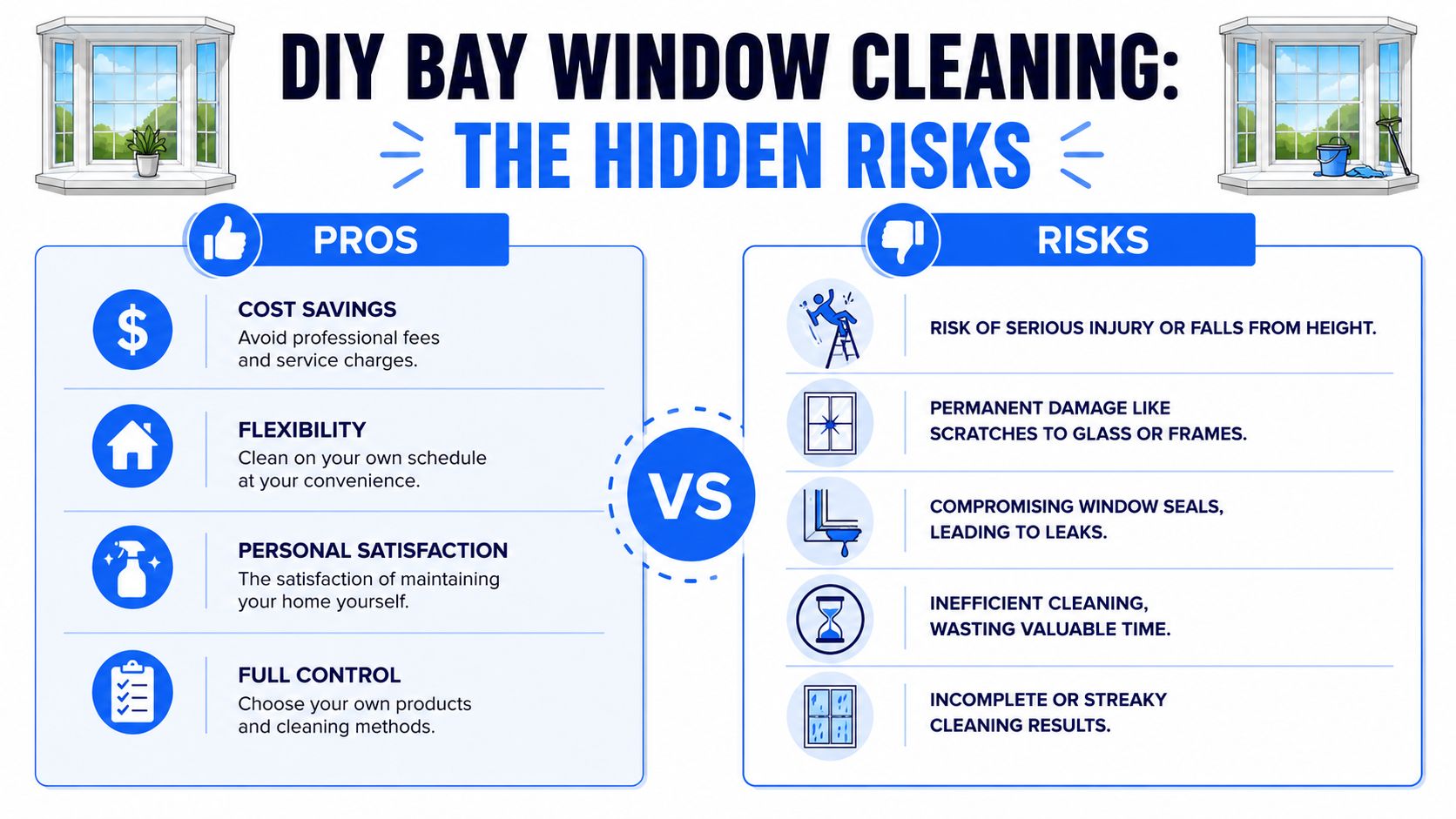
A projecting window changes your body position, your footing, and your reach. Homeowners lean sideways from ladders, stretch across shrubs, step onto decorative ledges, or try to reach upper sections from inside through partly opened panes. That's where a simple chore turns into a real hazard.
Poor results are the small problem
Most failed DIY bay window cleaning jobs leave behind the same issues. Streaks in the center. Water trails near the side seams. Dirt still packed into lower corners. Smears that only appear later when the afternoon sun hits.
That's frustrating, but it's not the part that concerns me most. The larger risk is damage caused by bad tools, too much pressure, or scraping debris across the surface before the glass is properly rinsed and controlled.
A bay window also has more vulnerable detail areas than a simple flat opening. The perimeter caulk, painted trim, seal lines, and lower ledge all take abuse if someone treats the job like a basic wipe-down.
The risky shortcuts homeowners take
When people try to save money, they usually create one of these problems:
- Overreaching from a ladder: The ladder stays put, but the body moves too far off center.
- Dragging grit across glass: Exterior dust and fine debris can mark glass or frames if the cleaning sequence is wrong.
- Forcing water into edges: Heavy-handed rinsing around joints and trim can create issues around seals and surrounding materials.
- Ignoring height conditions: Wind, uneven ground, decorative rock, and narrow side yards make access unstable fast.
A second-story bay window can look close enough to reach until you actually set the ladder and realize the projection pushes the work area farther out than expected.
False savings add up quickly
DIY only saves money if the result is good and nothing goes wrong. Bay windows narrow that margin. If the glass still looks bad, you've spent your time and still need professional service. If the trim or surrounding area gets damaged, the cleanup cost can outweigh what you were trying to save in the first place.
The safest approach is simple. Let trained crews handle the access work and the finish work. A proper window cleaning company uses stabilized ladders, lift equipment when needed, rope systems on the right buildings, and pure water or squeegee methods based on the site. That protects the window and the person cleaning it.
How Professional Bay Window Cleaning Is Priced
Homeowners often assume window cleaning quotes are arbitrary. They're not. A bay window quote usually comes down to labor, access, condition, and the equipment needed to do the work safely and cleanly.
That mirrors the installation side more than is often understood. One bay window cost guide notes that labor has historically made up 40% to 60% of the total installation bill, or roughly $1,000 to $1,500 per window, which helps explain why more complex jobs cost more (Angi bay window cost article). Cleaning follows the same logic. The harder the access and the more specialized the work, the more labor drives the price.
Access usually decides the quote
A ground-floor bay in an open front elevation is one level of work. A second-story bay over landscaping, stone veneer, or a sloped entry is another.
Companies price around what it takes to complete the work safely. That may include:
- Ladder setup time on stable ground with enough working room
- Lift access when height or projection makes ladder work inefficient or unsafe
- Scaffolding or rope systems on buildings with more demanding access conditions
- Pure water-fed poles when upper exterior glass can be cleaned more safely from the ground
If a homeowner gets two very different quotes, this is often why. One company may be pricing for proper access and detailed cleaning. Another may be pricing for a faster, riskier approach.
Condition and detail level matter
A bay window that's cleaned routinely is faster to restore than one with heavy dust, bug debris, pollen film, mineral spotting, or post-construction residue. The quote reflects the starting condition because the labor changes.
Here's what often increases cleaning time:
| Cleaning factor | Why it affects price |
|---|---|
| Heavy exterior buildup | More scrub time and more detailing at corners |
| Deep sills and trim | Extra hand work before the glass can be finished |
| Multiple divided panes | More edges to squeegee and detail clean |
| Restricted access | Slower setup and more cautious movement |
| Post-construction debris | Requires more controlled removal methods |
Ask what the quote includes
A useful quote tells you what's being cleaned and how. That matters on bay windows because “window cleaning” can mean very different things.
Look for clarity on these points:
- Interior and exterior scope: Some homeowners only need exterior work. Others want full inside and out service.
- Frames, ledges, and sills: Good cleaning includes the areas that can re-soil the glass.
- Access method: Ask whether the crew expects to use ladders, lifts, or water-fed poles.
- Condition assumptions: If the glass has construction dust or hard water spotting, mention it before the appointment.
For a broader overview of how service providers structure pricing, this window cleaning services cost guide helps homeowners understand what typically shapes a professional quote.
Sample Bay Window Cleaning Costs in Your Area
Cleaning prices vary by access, layout, and condition, so any local number should be treated as an estimate until a company sees the job. That's especially true for bay windows, because one projecting window may be easy from the ground while another needs ladder work, lift planning, or extra detail time around trim and landscaping.
The table below gives practical budgeting ranges for professional bay window cleaning in the service areas covered by this regional market. These are working estimates for a standard bay window, not structural repair, restoration, or installation pricing.
Estimated Professional Bay Window Cleaning Costs 2026
| Location | Standard Access (Ground Floor) | High Access (2nd Story+) |
|---|---|---|
| Phoenix | Quote-based estimate | Quote-based estimate |
| Scottsdale | Quote-based estimate | Quote-based estimate |
| Tempe | Quote-based estimate | Quote-based estimate |
| Chandler | Quote-based estimate | Quote-based estimate |
| Paradise Valley | Quote-based estimate | Quote-based estimate |
| Glendale | Quote-based estimate | Quote-based estimate |
| Flagstaff | Quote-based estimate | Quote-based estimate |
| Denver | Quote-based estimate | Quote-based estimate |
| Boulder | Quote-based estimate | Quote-based estimate |
| Arvada | Quote-based estimate | Quote-based estimate |
| Westminster | Quote-based estimate | Quote-based estimate |
| Erie | Quote-based estimate | Quote-based estimate |
| Commerce City | Quote-based estimate | Quote-based estimate |
| Golden | Quote-based estimate | Quote-based estimate |
| Las Vegas | Quote-based estimate | Quote-based estimate |
| Laughlin | Quote-based estimate | Quote-based estimate |
What changes the local quote
A bay window in Phoenix might need extra attention for dust and hard water residue. A bay in Boulder or Golden may have more seasonal debris and weather exposure. A property in Paradise Valley or Scottsdale may involve larger custom glass, taller elevations, or tighter architectural access.
Commercial buildings are their own category. Storefront bays, lobby glass, and projecting office windows can require different timing, traffic control, or equipment planning than residential jobs.
If you want a real number, give the cleaner photos of the window, the elevation, and the ground below it. That usually speeds up the quote and makes it more accurate.
Choosing the Right Service to Protect Your View
A bay window is not the place to hire on price alone. You want a company that can explain how it will access the glass, protect the frames, and finish the work without putting people or property at risk.
That starts with insurance and training. If a crew is working on ladders, lifts, scaffolding, or rope systems, they should be able to show that they're insured and that safety isn't an afterthought. Homeowners who want to understand what that coverage can involve can review this window washing insurance guide, which gives useful background on why proper insurance matters in this trade.

What to look for before you book
The best companies are usually easy to spot because they answer practical questions clearly.
- Insurance and accountability: They can confirm coverage and explain how they handle on-site safety.
- Real access capability: They use the right equipment, whether that means ladders, boom lifts, scaffolding, rope descent systems, or pure water-fed poles.
- Experience with projected glass: Bay windows need edge control, angle work, and careful detailing.
- Clear scope of work: You know whether the quote includes exterior only, inside and out, and whether frames and sills are included.
- Professional screening and standards: Reputable firms take hiring and safety seriously.
Good service protects more than appearance
A quality cleaning company does more than make glass look clear. It helps preserve the finish around the window. It reduces the chance of careless ladder contact with trim. It spots early issues like failed caulk lines, persistent runoff patterns, or buildup at lower corners where moisture tends to sit.
That's what homeowners should be paying for. Not just clean glass, but competent work at height and consistent results on a feature that's too expensive to treat casually.
If you're comparing providers, this overview of what to expect from a professional window cleaning company is a useful checklist for evaluating who's equipped to handle bay windows properly.
If you're ready to protect the investment you've made in your bay windows, schedule Professional Window Cleaning for safe, streak-free service on residential, commercial, mid-rise, and high-access glass across Arizona, Colorado, and Nevada.