





The most popular bathroom window advice starts in the wrong place: pick something private, attractive, and easy to match with the tile. Start with water instead. The best window treatments for bathrooms survive steam, stay clear of wet frames, and move out of the way when the glass needs professional washing.
Why Bathroom Windows Need More Than Privacy
A popular privacy treatment isn't automatically a low-maintenance treatment. Frosted glass removes the need for a hanging fabric panel, but someone still has to reach and wash the pane, its edges, and the sill.
In the 2025 U.S. Houzz Bathroom Trends Study, 27% of homeowners updating bathroom windows selected frosted glass, compared with 10% for Roman shades and 5% for window film or motorized shades; wet rooms represented 16% of bathroom remodels. Those choices make cleaning access worth discussing before installation, not after.
Privacy doesn't solve moisture
A covering can block a sightline while leaving a damp pocket behind it. Likewise, a bare privacy pane can still need attention for condensation, mineral spotting, and buildup around the frame. Removing fabric doesn't remove the maintenance job.
Our recommendation is to separate decorative privacy from water exposure. Decide how wet the window gets before choosing how to cover it. Untreated wood, paper-based shades, and absorbent textiles shouldn't make the shortlist for a regularly steamy bathroom.
Practical rule: If you can't expose the full pane and inspect the sill without dismantling the treatment, reconsider the installation.
A bathroom window needs more than a reachable center pane. The corners, lower edge, frame joints, and sill all matter. Don't accept an installation that leaves those areas permanently concealed because the front looks tidy.
Judge the whole installation
Use these questions before comparing colors or finishes:
- Humidity tolerance: Is the complete product suitable for a humid bathroom, including its hardware?
- Ventilation: Can you operate the window and reach its controls?
- Cleanability: Can a cleaner wash the glass without working around a fixed obstruction?
- Climate: Will the arrangement remain practical when outdoor conditions change?
Make the installer demonstrate the treatment fully open, not just closed. Check whether a shutter panel clears the vanity and whether a raised shade still covers the upper glass.
For homes and properties in Arizona, Colorado, and Nevada, the right answer depends on the splash line, the room's ventilation, and access from both sides of the window. Choose for those conditions first. Style comes after the installation passes that test.
What Makes a Bathroom Treatment Moisture Safe
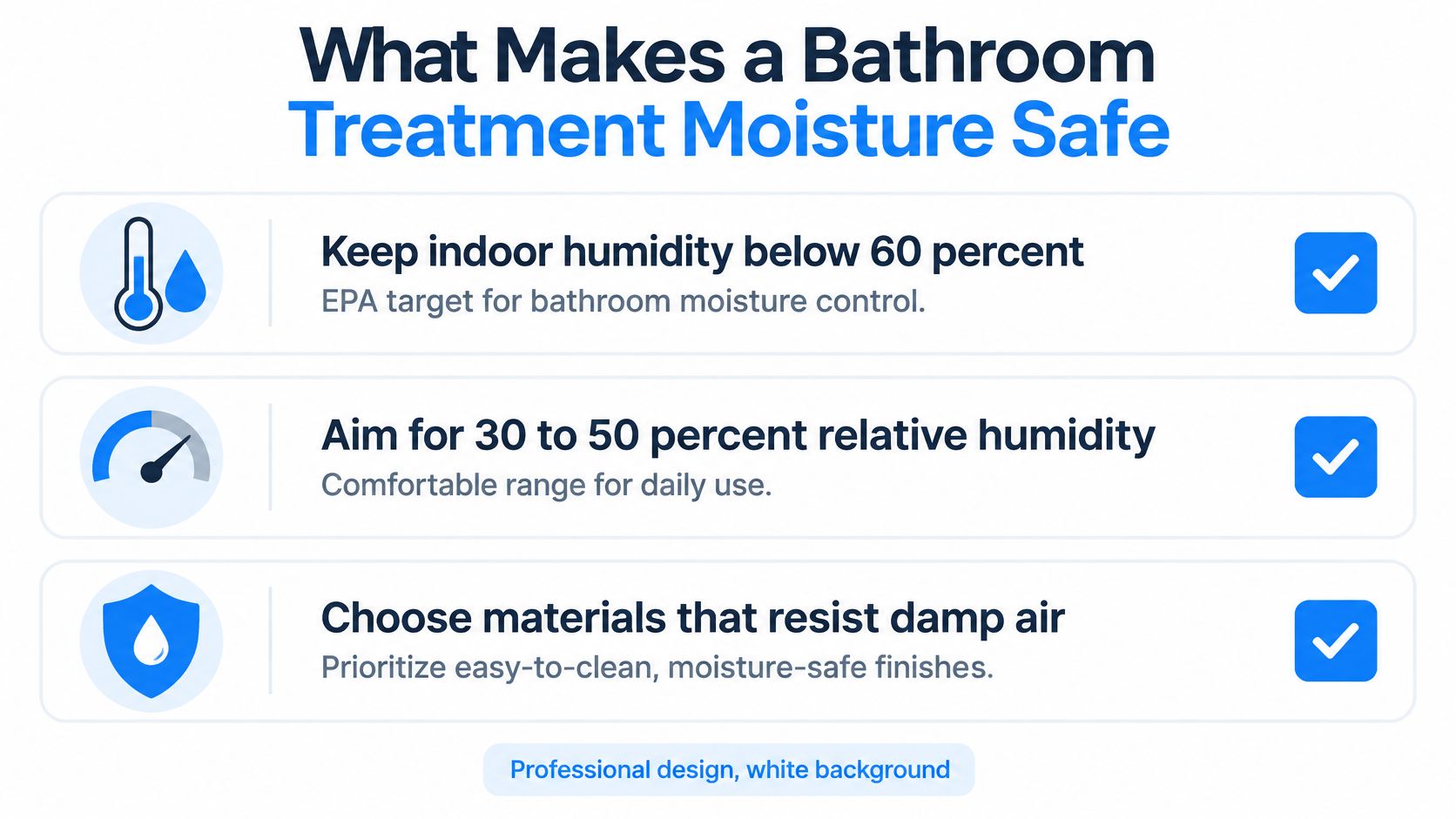
Humidity control comes before material selection. The EPA's guidance on biological contaminants and indoor air quality recommends indoor relative humidity below 60%, ideally 30%–50%, and identifies poorly ventilated bathrooms as places where biological contaminants can grow. It recommends an exhaust fan vented outdoors or opening a window during and after showering when conditions permit.
Preserve the ventilation route
ASHRAE residential ventilation guidance specifies 50 cfm, about 25 liters per second, for intermittent bathroom exhaust, or 20 cfm, about 10 liters per second, for continuous exhaust. Use applicable ventilation requirements for the property rather than assuming that an operable window makes mechanical exhaust unnecessary.
For the covering, the practical requirement is straightforward: it should open fully after bathing. Don't wedge a shade against the glass or install a shutter where it prevents the window from opening. Leave ventilation controls easy to reach.
A covering that tolerates damp air still isn't a ventilation system. Ask a qualified ventilation contractor to assess persistent moisture rather than trying to solve it with a different blind.
Inspect more than the visible surface
Before buying, check the complete assembly:
- Washable construction: Favor nonporous surfaces that can be maintained without absorbing water.
- Suitable hardware: Specify corrosion-resistant brackets, hinges, and fasteners.
- Drying clearance: Avoid contact between the treatment and wet glass or framing.
- Accessible controls: Keep handles, locks, and exhaust controls unobstructed.
Don't let a decorative material description substitute for a bathroom-use rating. A coated surface, a backing, and a bottom rail may have different care requirements. Ask for the manufacturer's written instructions for the whole product.
If you're comparing textile descriptions during a broader remodel, Stahl Home Center's guide to upholstery materials offers useful context for material selection. It isn't a bathroom wet-zone certification. For a bathroom shade, rely on the product's own exposure rating and maintenance instructions.
Moisture safe means suitable material, workable ventilation, and room to dry. None of those replaces the others.
Comparing Bathroom Window Treatments by Wet Zone
Bathroom Treatments by Moisture and Access
| Treatment | Best wet zone | Moisture behavior | Glass access |
|---|---|---|---|
| PVC or vinyl roller shade | Condensation and intermittent splash | Nonporous, washable surface; direct spray requires an explicit waterproof rating | Raises clear if the mounting position allows |
| Waterproof synthetic blind | Humid rooms and rated splash locations | Wipeable slats; check rails and hardware | Must raise, not merely tilt |
| High-humidity-rated composite shutter | Steamy rooms outside direct spray unless specifically rated | Washable construction; suitability depends on the complete product | Panels need unobstructed opening space |
| Frosted or etched privacy glass | Locations where fixed privacy is acceptable | No separate absorbent covering; glass still needs washing | Exposed pane, but texture and nearby fixtures affect access |
For ordinary condensation or intermittent splashing, our recommendation is nonporous PVC or vinyl shades, waterproof synthetic blinds, or appropriately rated composite shutters rather than absorbent materials. The underlying principle is the EPA's moisture-control guidance: address water and dampness rather than concealing them behind a finish.
Match the rating to the splash
Moisture-resistant isn't waterproof. For direct shower spray or a splash-exposed window above a tub, require an explicit waterproof or wet-zone waterproof rating.
Don't assume that a fabric coating qualifies the whole shade for repeated wetting. Ask whether the rating covers the fabric, seams, rail, operating mechanism, and hardware. If the seller can't confirm the intended exposure, choose another product.
For an easy-to-maintain installation, specify a smooth, low-texture surface, few horizontal ledges, corrosion-resistant hardware, and a fully wipeable bottom rail. Keep the assembly clear of the wettest area wherever the layout allows.
Choose the access tradeoff you can maintain
A roller shade is our first option to examine when you want a simple treatment that raises out of the working area. Check the rolled-up position carefully. A bulky assembly mounted too low can still obstruct the upper pane.
Synthetic blinds suit rooms where adjustable coverage matters. However, tilted slats don't provide full cleaning access. The blind needs to lift clear, and its stacked components shouldn't hide the frame.
Composite shutters can work well when their panels swing fully open. Reject a layout where a faucet, wall, or cabinet stops that movement. With fixed privacy glass, examine the surface finish: etched or textured areas can retain deposits, and the surrounding frame still needs inspection.
If you're also considering exterior screening, review the separate considerations for tinted screens for windows. Don't treat a screening decision as proof that an interior covering is suitable for shower exposure.
No option wins every room. Pick the one whose exposure rating and opening movement fit the actual window.
Matching Treatments to Real Bathroom Layouts
Start at the window and trace where water can reach it. Then operate the sash, handle, and proposed covering. That simple walkthrough is more useful than choosing the same treatment for every bathroom.
Light-use rooms and daily showers
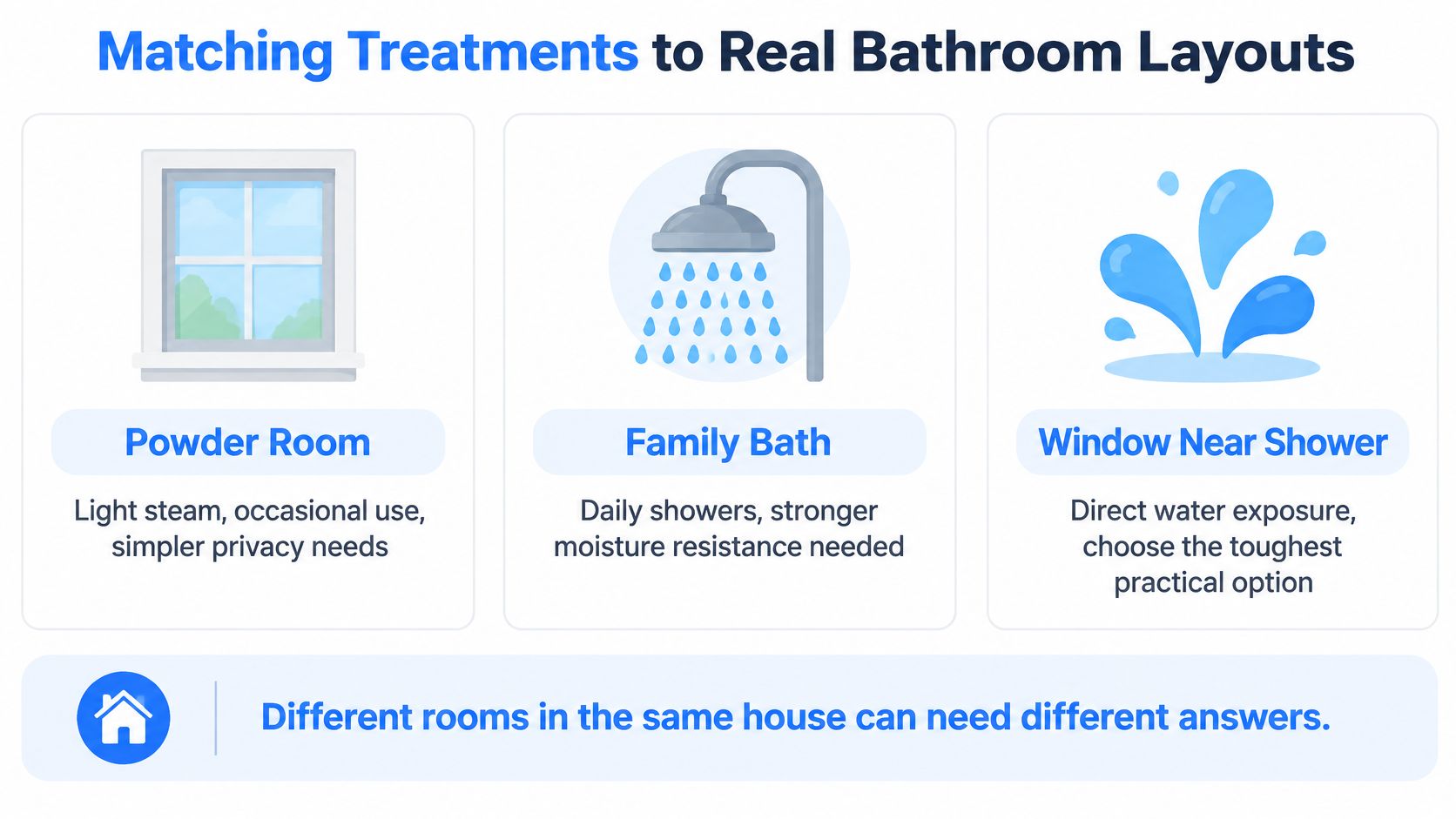
For a powder room, our preference is an operable vinyl shade or suitable synthetic blind. Keep the arrangement simple. There's little reason to add a deep assembly if a compact treatment provides the privacy you need and clears the glass.
For a family bathroom with daily showers, prioritize a full opening movement and accessible lower frame. A humidity-rated composite shutter works if its panels have room to swing. Otherwise, choose a shade or blind that lifts away from the pane.
The reason for that lower-frame inspection is physical, not cosmetic. University of Pennsylvania environmental health guidance explains that shower steam can condense on cooler windows and run downward; on single-pane windows, that runoff can contribute to rotting wood frames and sills and blistering below the window.
Tub windows and wet-room layouts
For a window directly above a tub, check actual splash exposure rather than judging by distance alone. Use the wet-zone rating discussed earlier where water reaches the treatment. Keep the bottom rail from resting on the sill.
In a wet room, fixed privacy glass is worth considering because it avoids a separate covering in the spray area. That's a layout recommendation, not permission to ignore the pane. Plan how a cleaner will reach it without climbing over fixtures.
A covering shouldn't create a new place for water to sit or make an existing damp edge harder to see.
For a rental or hospitality bathroom, favor straightforward operation and washable surfaces. Specify how staff will move the treatment clear and inspect the sill. Avoid an assembly that requires special dismantling for routine access.
If you're changing fixture positions, NorCal Construction can help you find space-saving bathroom layouts. Use that planning stage to reserve shutter swing space and a stable approach to the window.
Before ordering, sketch the splash line, sash movement, covering movement, and cleaning approach. If those overlap awkwardly, adjust the installation before it becomes permanent.
How Local Climate Changes Bathroom Glass Care
Plan around the pane's actual conditions, not the weather forecast alone. A bathroom can stay damp after a shower even when the outdoor air feels dry. Likewise, a moisture-safe covering doesn't tell you whether exterior dust or water deposits need professional attention.

Desert properties need a deposit check
For properties in Phoenix, Scottsdale, Tempe, Chandler, Paradise Valley, and Glendale, our advice is to inspect exposure to sun, dust, and mineral-bearing water before choosing a finish. Don't assume every property has the same water conditions. Look at the existing pane and ask what has been reaching it.
Apply the same inspection in Las Vegas and Laughlin. If the glass has persistent spotting, identify the deposit before scheduling ordinary washing as the entire solution. This explanation of what removes hard-water stains helps separate a mineral-deposit problem from routine surface dirt.
The sheer curtain pictured above illustrates a decorative look, not our recommendation for a splash-exposed window. Judge the material against the bathroom's exposure, not the photograph.
Colder panes need visible edges
For Flagstaff, Denver, Boulder, Arvada, Westminster, Erie, Commerce City, and Golden, assess the bathroom when the glass is cold and the shower has been used. That gives you a more useful installation check than looking at a dry window during mild weather.
The EPA's moisture and mold guidance identifies moisture control as the key to mold control and advises drying window condensation quickly while reducing its source. Leave the frame visible enough to recognize a recurring problem.
Professional access should match the building:
- Reachable residential glass: Allow space for professional squeegee work and appropriate pure-water washing.
- High windows: Keep a suitable approach available for ladders or other planned access equipment.
- Commercial and difficult exterior glass: Account for boom lifts, scaffolding, or rope descent systems where the building requires them.
Choose OSHA-trained, insured, background-checked crews for professional work. Discuss interior obstacles and exterior access before the visit, especially where tubs, landscaping, or building height complicate the approach.
Climate changes what you need to inspect. It doesn't change the basic requirement that a cleaner must reach the full surface.
Keeping Coverings and Glass Reachable
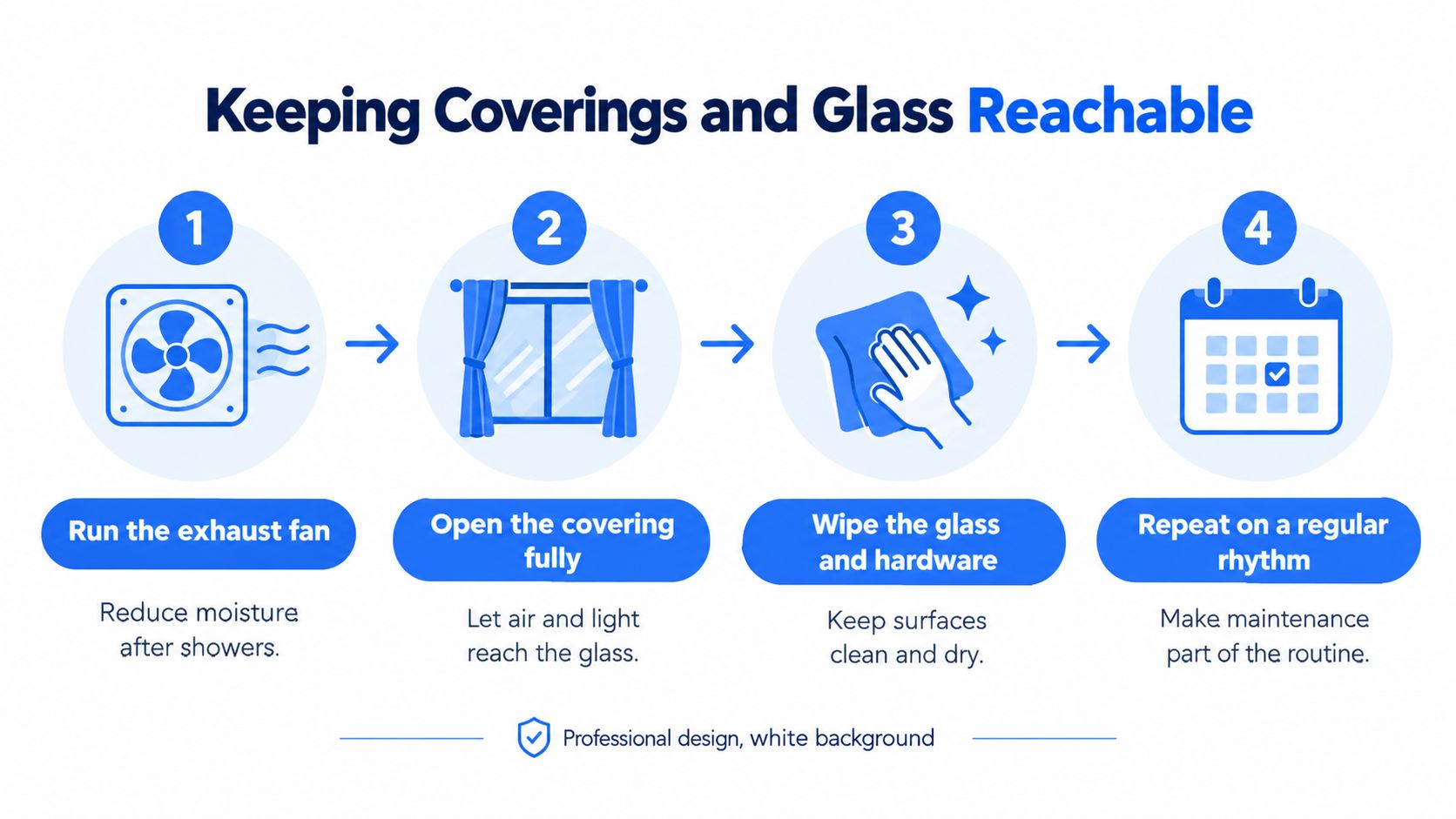
Build maintenance around what happens after bathing, not an arbitrary calendar. Persistent dampness needs prompt attention. Professional washing should then address the glass and deposits according to the property's exposure and access needs.
Follow a repeatable sequence
- Run the exhaust: Use the bathroom's ventilation during bathing and afterward as needed.
- Move the covering clear: Raise the blind or shade fully, or open shutter panels.
- Check the lower edge: Let the pane and sill dry, and maintain nonporous rails and slats according to the manufacturer's instructions.
- Inspect before closing: Don't leave absorbent material against a wet frame.
Keep maintenance products compatible with the treatment. Ask the manufacturer before using disinfectants or stronger cleaning products on coatings, rails, or hardware. A washable surface isn't necessarily compatible with every chemical.
Textured glass, fabric edges, and stacked blind components need different inspection approaches. Check textured areas for retained residue and move stacked parts away from the frame. Don't judge the condition of the window solely by the exposed center.
Keep safety glazing visible
The City of Aberdeen's summary of IRC safety-glazing provisions explains that glazing near tubs or showers generally requires safety glazing within 60 inches horizontally of the relevant edge or threshold; glazing with a sill less than 18 inches above an adjacent walking surface can also fall under hazardous-location rules. Tempered or laminated glass commonly serves this purpose, but confirm the applicable requirements for the specific installation.
Treat that as another reason to preserve inspection access. Hardware shouldn't conceal cracks, damaged edges, or possible seal problems. Suspected damage needs assessment, not a new covering placed over it.
Before the cleaning visit: Move the treatment clear and provide a stable approach. Don't ask a crew to improvise access across a wet tub.
Professional window washing uses pure water and squeegees as appropriate for residential and storefront glass. Higher or harder-to-reach windows, including skylights, may require planned lift or rope-system access.
Tell the cleaning team about fixed shutters, fragile coverings, and obstructed panes when booking. The right access plan protects both the window and the finished bathroom.
Choosing a Treatment and Booking the Glass
Choose the treatment that leaves the fewest unresolved maintenance problems. A suitable material is only part of the decision. You also need a workable opening movement, an inspectable frame, and a clear route for professional washing.
Our situational picks
- Shower-adjacent operable window: Choose a waterproof synthetic blind or vinyl shade with the appropriate exposure rating. Confirm that the covering and window can both open fully.
- Custom finish outside direct spray: Choose a humidity-rated composite shutter when the panels can swing clear without hitting fixtures.
- Fixed privacy without a hanging covering: Consider frosted privacy glass, with safety glazing where required. Accept that the pane itself still needs washing.
Keep untreated wood, paper-based shades, and absorbent textiles off the shortlist for steamy rooms. Don't let a preferred finish override an unsuitable exposure rating.
Before committing, ask the installer to show where the covering sits when fully open. Then identify how the cleaner reaches the upper corners and lower frame. A small mounting change is easier to make before the brackets are fixed and the remodel is finished.
Schedule around the installation
For homeowners, HOAs, and property managers in Arizona, Colorado, and Nevada, schedule full-pane, edge, and sill cleaning after the covering is chosen, or before a remodel permanently restricts access. Use the local window-cleaning service information to confirm service for your property.
That planning applies across Phoenix, Scottsdale, Tempe, Chandler, Paradise Valley, Glendale, and Flagstaff; Denver, Boulder, Arvada, Westminster, Erie, Commerce City, and Golden; and Las Vegas and Laughlin. Describe the window location and access limitations when requesting service.
Ask for a fast quote and use online scheduling to coordinate the visit with the installer. Confirm arrival expectations and the satisfaction guarantee before booking. For managed properties, include access instructions so the crew can reach the bathroom without disrupting occupants unnecessarily.
Buy for water exposure. Install for access. Book cleaning for the whole window, not just the visible center. That combination is more useful than another decorative layer.
Professional Window Cleaning offers fast quotes, online scheduling, on-time arrival, and a satisfaction guarantee for residential and commercial window washing. Visit Professional Window Cleaning to schedule service in Arizona, Colorado, or Nevada, and tell the team about your bathroom covering so they can plan access to the full pane, edges, and sill.