




You've probably had this happen already. The windows looked fine after the last cleaning, then Houston's humidity, pollen, rain spotting, and roadside grime put a film back on the glass faster than expected. Sunlight hits at an angle, and now every streak, drip line, and mineral mark shows up.
That frustration is why window cleaning in Houston, Texas can't be treated like a simple rinse job. The local environment puts pressure on exterior glass, frames, and screens in ways that make method matter. If the cleaner uses the wrong water, the wrong tools, or the wrong access plan, the result may look better for a day or two but not for long.
Homeowners, storefront managers, and commercial property teams all run into the same question. What separates a basic wash from a professional result that holds up?
The answer comes down to three things. First, the right equipment for the glass and building height. Second, a quote that clearly defines what's included. Third, local judgment about Houston-specific problems, especially hard water staining and high-level work safety.
Your Guide to Crystal Clear Views in Houston
Houston glass gets dirty in layers, not all at once. Airborne dust sticks to moisture on the pane. Pollen clings to frames and edges. Rain often leaves behind spotting instead of rinsing surfaces clean. If irrigation hits lower windows or runoff tracks down upper panes, you also start seeing mineral buildup that a routine pass won't fully remove.
That's why clean-looking windows and properly cleaned windows aren't the same thing. A professional service should remove soil without leaving residue, protect surrounding surfaces, and use an access method that matches the building.
What Houston property owners should expect
A serious window cleaning visit usually starts with an evaluation, even if it's brief. The crew needs to identify:
- Glass condition before work starts. Light dust and pollen are one thing. Mineral spotting, oxidation around frames, or post-rain residue require a different approach.
- Access constraints such as landscaping, narrow side yards, storefront awnings, upper-story setbacks, or limited roof access.
- Scope details that affect the finish, including whether screens, tracks, ledges, and interior panes are part of the job.
If that conversation never happens, the quote is probably too vague.
Practical rule: If a provider can't explain how they'll clean your specific glass safely and why that method fits the property, you're not getting a professional plan. You're getting a generic one.
Why this service matters more than people think
For homes, clean glass changes how rooms feel. More light comes through, views sharpen, and neglected buildup stops making the whole exterior look tired. For storefronts and offices, window clarity affects first impressions every day.
The bigger point is durability. Good window cleaning isn't just about appearance. It's about removing contamination before it bonds harder to the surface, setting realistic expectations about stains, and avoiding mistakes that create more spotting.
Houston rewards methodical work. Crews that understand local conditions tend to produce a cleaner finish and fewer callbacks. Crews that rush the process often leave behind edges, drips, or unresolved stains that customers notice as soon as the sun comes out.
What Professional Window Cleaning Really Means
Professional window cleaning starts with controlled water, proper rubber, clean detailing cloths, and safe access equipment. It isn't random scrubbing. It's a repeatable process that matches the pane, the soil load, and the height of the work.
The tools that actually change the result
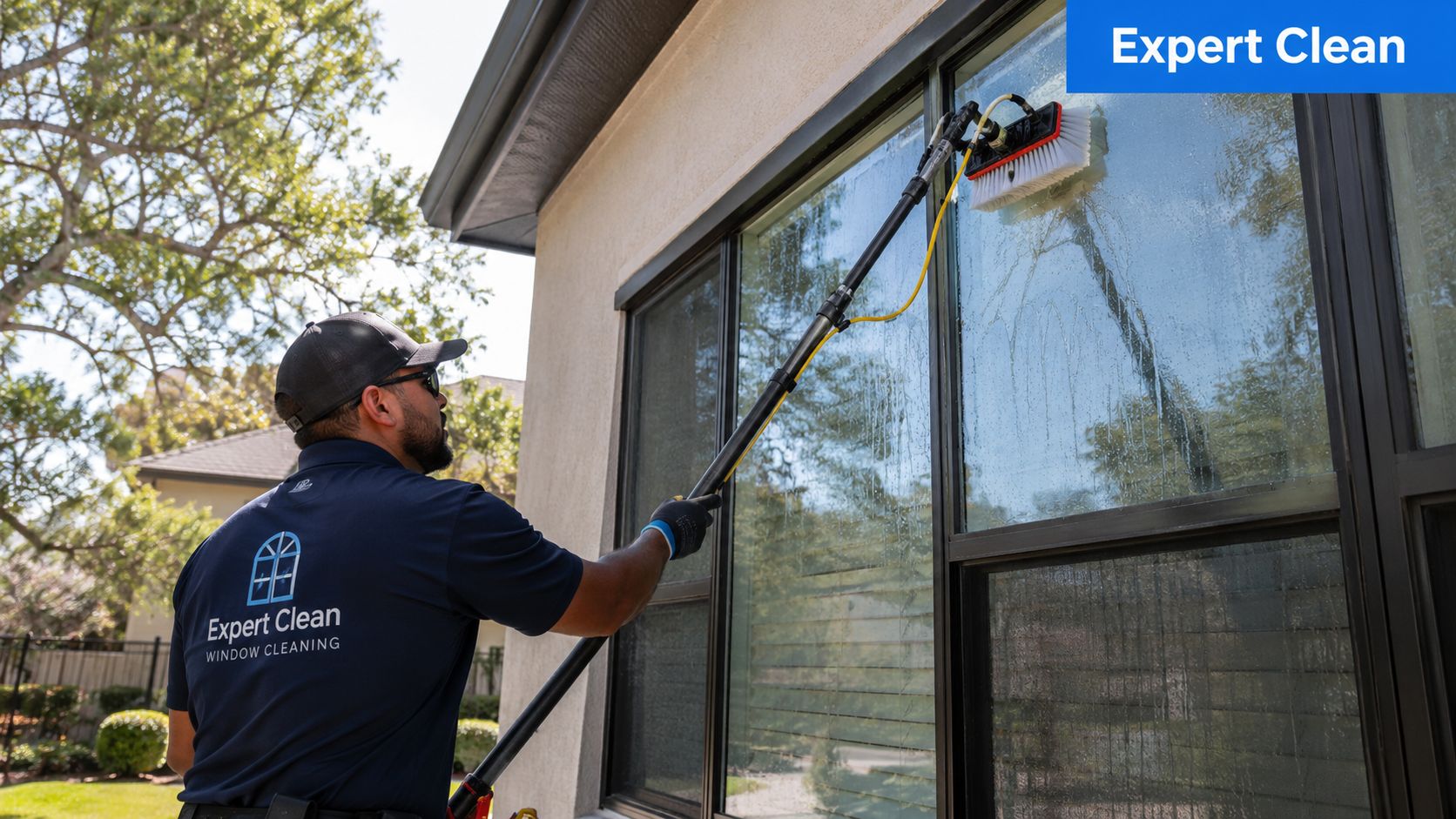
In Houston, professional window cleaners use purified water-fed pole systems combined with microfiber detailing cloths and professional-grade squeegees to achieve streak-free results, a method supported by industry standards requiring purified water to prevent mineral deposits that compromise clarity on glass surfaces, as described by Grease Kleen window cleaning.
Each tool has a job.
- Water-fed poles with purified water handle many exterior windows efficiently while reducing residue risk.
- Professional squeegees remove solution evenly and leave a uniform finish when used with proper technique.
- Microfiber detailing cloths catch remaining edge moisture and clean up corners without spreading lint.
- Ladders, boom lifts, scaffolding, and rope descent systems make access possible where ground tools alone won't reach safely.
Why purified water matters in Houston
Tap water can leave minerals behind. On glass, those deposits show up as haze, spotting, or faint residue patterns after the water dries. In a humid market, that problem gets more obvious because the finish doesn't need much residue to start looking dull again.
Purified water changes that. When used correctly on exterior glass, it dries with far less risk of mineral spotting. That's one reason skilled crews often use water-fed pole systems on homes, low-rise commercial properties, and selected mid-rise surfaces where access and glass condition allow.
Traditional squeegee work still matters. It gives technicians tighter control near edges, over frames, and on interior panes where detailing quality is more visible up close.
Good window cleaning isn't about choosing one method and forcing it everywhere. Strong crews switch between pure water, hand tools, and access equipment based on the surface in front of them.
What isn't professional
A provider falls short of professional standards when they show up without a defined process, rely on whatever access setup seems convenient, or treat every stain like ordinary dirt. That usually leads to three familiar problems:
| Problem | What causes it | What the customer sees |
|---|---|---|
| Residue on glass | Poor water quality or incomplete detailing | Haze, spotting, streak lines |
| Missed edges and corners | Weak squeegee technique or rushed cleanup | Dirty borders in direct sunlight |
| Safety shortcuts | Wrong ladder setup or no proper elevated access plan | Delays, damage risk, and liability concerns |
A Breakdown of Window Cleaning Services
Not every property needs the same service model. A single-family home, a restaurant storefront, and a mid-rise office building may all need window cleaning, but the work scope is different in practical ways.
Residential work
Home window cleaning usually involves more detail work than people expect. The glass matters, but so do screens, tracks, sills, and the awkward panes over shrubs, stair landings, or sloped entries.
Residential service often fits owners who want the whole visual package cleaned, not just the center of the pane. That includes lower windows with insect buildup, upper-story glass that needs ladder access, and exterior areas where runoff leaves a visible film over time.
A homeowner comparing providers should ask whether the quote covers only the glass or also the surrounding components. Many complaints start there.
Storefront and routine commercial work
Storefront service is simpler in one sense and less forgiving in another. Most jobs are easier to access than a multi-story property, but the standard for appearance is constant because customers pass the building every day.
Retail, restaurants, clinics, and offices usually benefit from recurring service because exterior glass loses its clean look quickly when foot traffic, street dust, fingerprints, and weather stack up. For properties that need broader facade maintenance planning, it helps to review a provider's approach to commercial and specialty access cleaning.
If the building depends on curb appeal, inconsistent window cleaning becomes visible faster than almost any other maintenance lapse.
Mid-rise and high-rise work
Service categories separate sharply. Mid-rise and high-rise window cleaning isn't just “more windows.” It requires a different access strategy, a tighter safety plan, and crews who understand how to work from lifts, scaffolding, or rope descent systems depending on the structure.
The scope also changes based on building use:
- Office buildings need minimal disruption and reliable scheduling.
- Condo and HOA properties often require coordination with residents and management.
- Hotels and mixed-use properties need polished results on highly visible elevations.
For these buildings, the customer isn't only buying cleaner glass. They're buying access competence, liability control, and a crew that can work efficiently without improvising on site.
Decoding Quotes and Pricing in the Houston Market
Most bad experiences with window cleaning don't start with the cleaning itself. They start with a quote that sounded clear but wasn't. The number looked attractive, then the final invoice changed once interior panes, difficult access, or screen removal entered the conversation.
The baseline most people want to know
In Houston, TX, commercial window cleaning services typically charge a standard rate of $3 per window for exterior-only cleaning, while adding interior cleaning increases the rate to $4–$5 per window, reflecting the added labor and time required for thorough two-sided access and microfiber detailing, according to Houston window cleaner pricing on Thumbtack.
That's useful as a starting point, not a universal promise. It gives you a frame of reference for basic commercial work, but your actual quote still depends on conditions the provider should spell out.
What moves the quote up or down
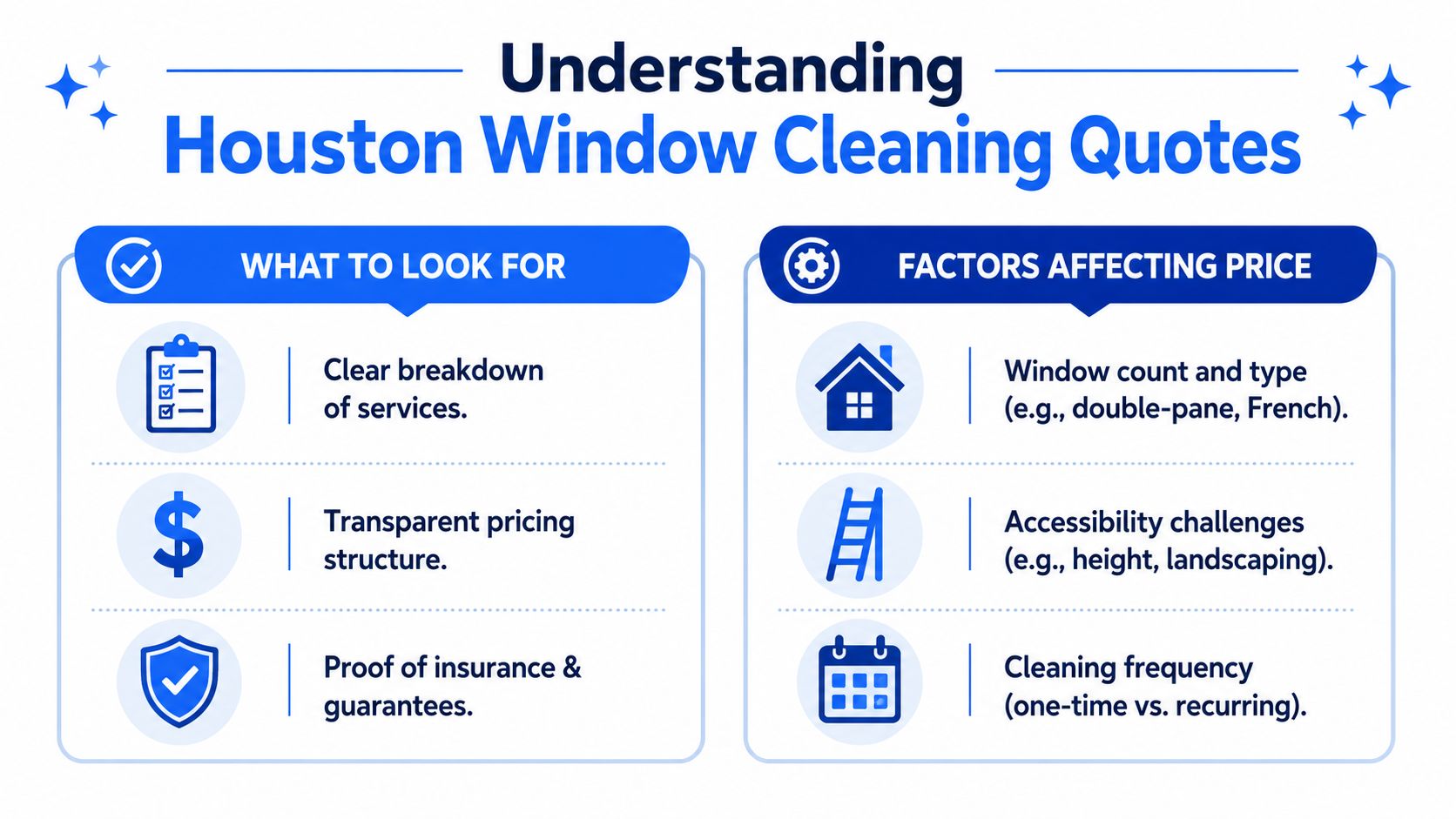
A fair quote usually reflects the following variables:
- Window count and style. Large fixed panes, divided-light glass, and French-style layouts take different amounts of labor.
- Accessibility. A ground-floor pane behind clear sidewalk access costs less effort than a third-story window over landscaping or signage.
- Interior inclusion. Inside glass adds setup time, entry coordination, and more detailed edge work.
- Soil level. Light maintenance cleaning is not the same as heavy buildup after long neglect.
- Add-ons. Screens, tracks, and sill detailing often sit outside a basic glass-only quote.
For homeowners trying to compare options, this kind of window cleaning cost guide helps frame the right questions before you approve the work.
How to read a quote without getting burned
Ask for a scope that names what's included and what isn't. That means exterior only or inside and out, screen handling, track cleaning, stain treatment, and access assumptions.
Then ask one practical question: what could change this price on site?
If the answer is vague, the estimate is weak. Good providers know where surprises typically come from and will say so upfront.
A low quote isn't automatically a good quote. If key items are missing from the scope, the price only looks low because part of the work hasn't been priced yet.
Houston Specifics Hard Water and High Rise Safety
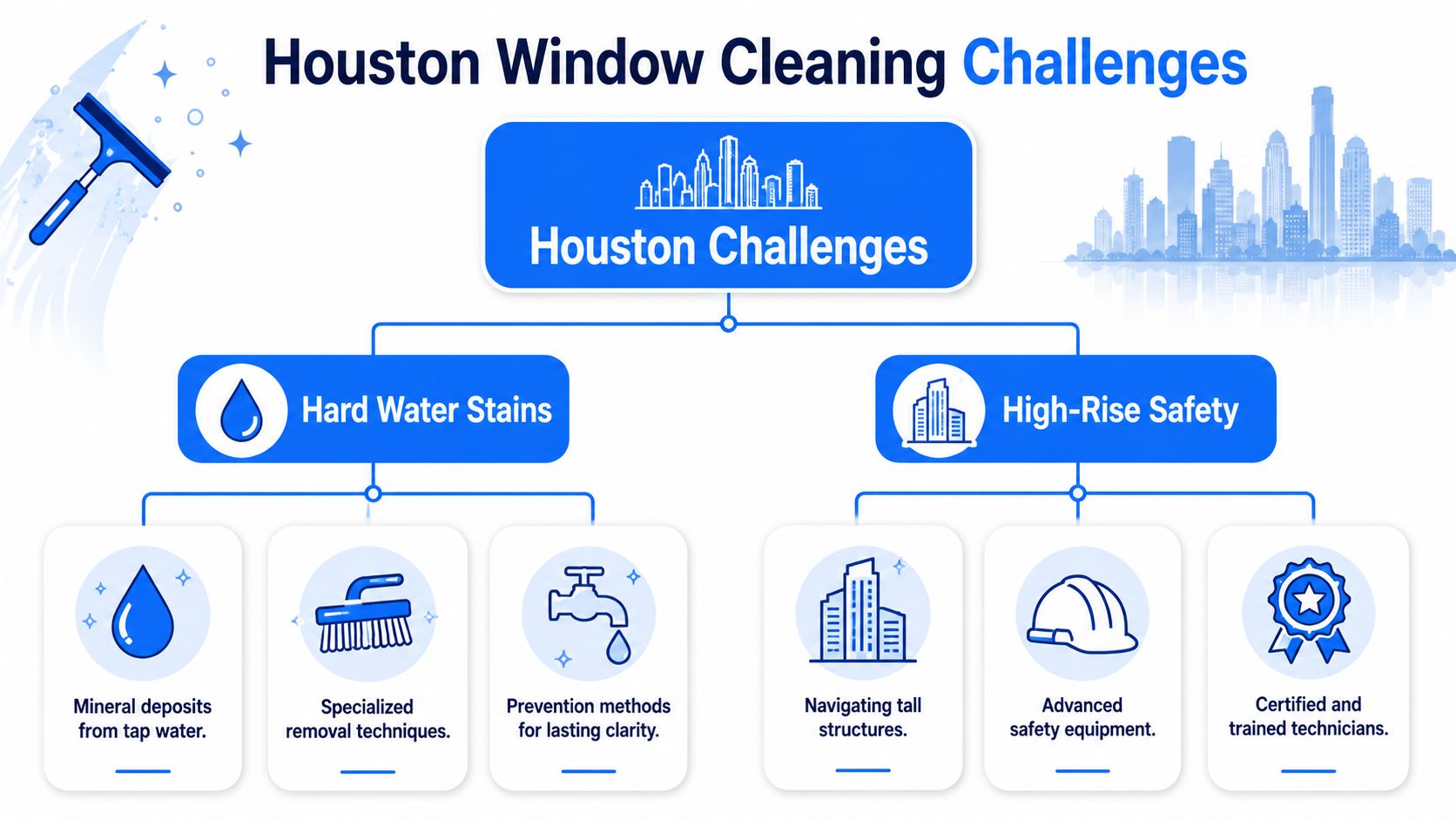
Houston creates two recurring headaches that deserve more attention than they usually get. One is hard water stain remediation. The other is safety transparency for work at height. Most generic service pages gloss over both, even though they often decide whether a customer ends up satisfied.
Hard water stains are not routine dirt
Routine cleaning removes loose contaminants. Hard water staining is different. It forms when mineral-rich water dries on the glass and leaves deposits behind. In Houston, rain, humidity, irrigation overspray, and runoff patterns can make that issue persistent, especially on lower windows, patio glass, and elevations where water repeatedly tracks over the same area.
Many local pages talk about “spot-free” or “streak-free” cleaning but don't explain the difference between ordinary washing and stain remediation. That gap matters because standard squeegee work often won't remove bonded mineral staining.
Some stains respond to mild remediation methods. Others need specialized acidic treatments and careful surface testing. If a provider doesn't inspect the severity first, they may either under-treat the stain or use a stronger method than the glass condition warrants. Customers dealing with recurring spotting can review more detailed guidance on how to get water spots off windows.
If the glass has failed seals, scratches, or frame issues contributing to the problem, cleaning alone may not solve it. In that case, a practical companion resource is Fixing windows in Houston, Texas, which helps property owners think through repair issues that affect long-term appearance.
Safety claims need proof
For mid-rise and high-rise jobs, “licensed and insured” isn't enough information. Property managers need to know whether the crew has the right training for ladders, lifts, suspended access, and rope descent systems used on the actual building.
A 2025 study by Fall Protection Experts found that 74% of Houston property managers prioritize crew safety certifications over price when hiring for work at heights, but only 22% of local vendors explicitly list these credentials on their websites, which forces managers to do manual due diligence, according to Window Gang Houston's summary of the finding.
That statistic lines up with what experienced building teams already know. The actual risk isn't just poor workmanship. It's a contractor who shows up with generic assurances and no verifiable training path for the access method required.
What to verify before approving elevated work
For any building where crews will work above straightforward ladder height, ask direct questions:
- Training standard. Does the company name the OSHA training or fall protection standard its technicians follow?
- Access method. Will they use ladders, boom lifts, scaffolding, or rope descent systems, and why is that method appropriate for your building?
- Crew documentation. Can they produce insurance and training records if management requests them?
- Site planning. How do they handle pedestrian protection, staging, and restricted access areas?
The best Houston providers don't treat these questions like obstacles. They answer them cleanly because they've already built the safety process into the job.
How to Choose Your Window Cleaning Partner
Choosing a window cleaner gets easier when you strip away the marketing language and look at the operating basics. You want a company that can explain its method, define its scope, and prove it can work safely at your property's height.
The short checklist that matters
Use this filter when comparing providers:
- Professional equipment. They should use the right combination of pure water systems, squeegees, ladders, lifts, scaffolding, or rope descent systems for the job.
- Clear quoting. The estimate should define glass-only work versus full-detail work that includes screens, tracks, or stain treatment.
- Local problem-solving. They should recognize hard water staining as a separate issue from normal dirt.
- Verifiable safety. If the property involves high access, they should identify actual training and access qualifications instead of relying on vague reassurance.
An honest note about service areas
This guide is built from the standards serious window cleaning companies should meet anywhere, including Houston. For readers vetting local Houston providers, the checklist above will help you ask sharper questions and avoid weak bids.
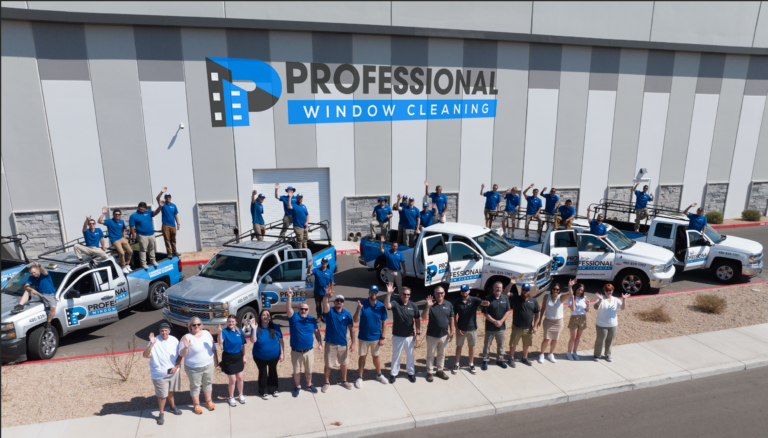
If you're in the Southwest, there's also a straightforward option. Professional Window Cleaning has been in business since 1999, brings 22+ years of experience, and serves Arizona, Colorado, and Nevada with residential, commercial, mid-rise, and high-rise service. The company operates in Phoenix, Scottsdale, Tempe, Chandler, Paradise Valley, Glendale, Flagstaff, Denver, Boulder, Arvada, Westminster, Erie, Commerce City, Golden, Las Vegas, and Laughlin.
That matters because good window cleaning is local in execution but universal in standards. Clear water, skilled technique, transparent pricing, and documented safety still decide the outcome.
If you need Professional Window Cleaning in Arizona, Colorado, or Nevada, request a quote from a team that handles residential glass, storefronts, mid-rise buildings, and high-rise access work with OSHA-trained crews, professional equipment, and straightforward scheduling.