




Your windows usually tell on the whole property before anyone notices the roof, landscaping, or lobby floor. In Cincinnati, that happens fast. Spring pollen sticks to glass, summer humidity leaves film behind, and traffic grime settles into corners and frames until the view looks dull even on a bright day.
That’s why window washing cincinnati searches usually come from people who are tired of “good enough” results. They don’t need a wipe-down. They need clean glass, safe access, and a crew that knows how to handle homes, storefronts, and taller buildings without cutting corners.
Why Professional Window Washing Matters in Cincinnati
A lot of Cincinnati property owners wait until the glass looks obviously dirty. By that point, the issue usually isn’t just dust. It’s buildup. Pollen, moisture, airborne grime, and drying residue all stack on the surface and around the edges.
Professional window washing matters because glass is a finish surface. It shows everything. Poor technique leaves drag marks, residue, detail lines at the edges, and sometimes scratches from improper tools or trapped debris.
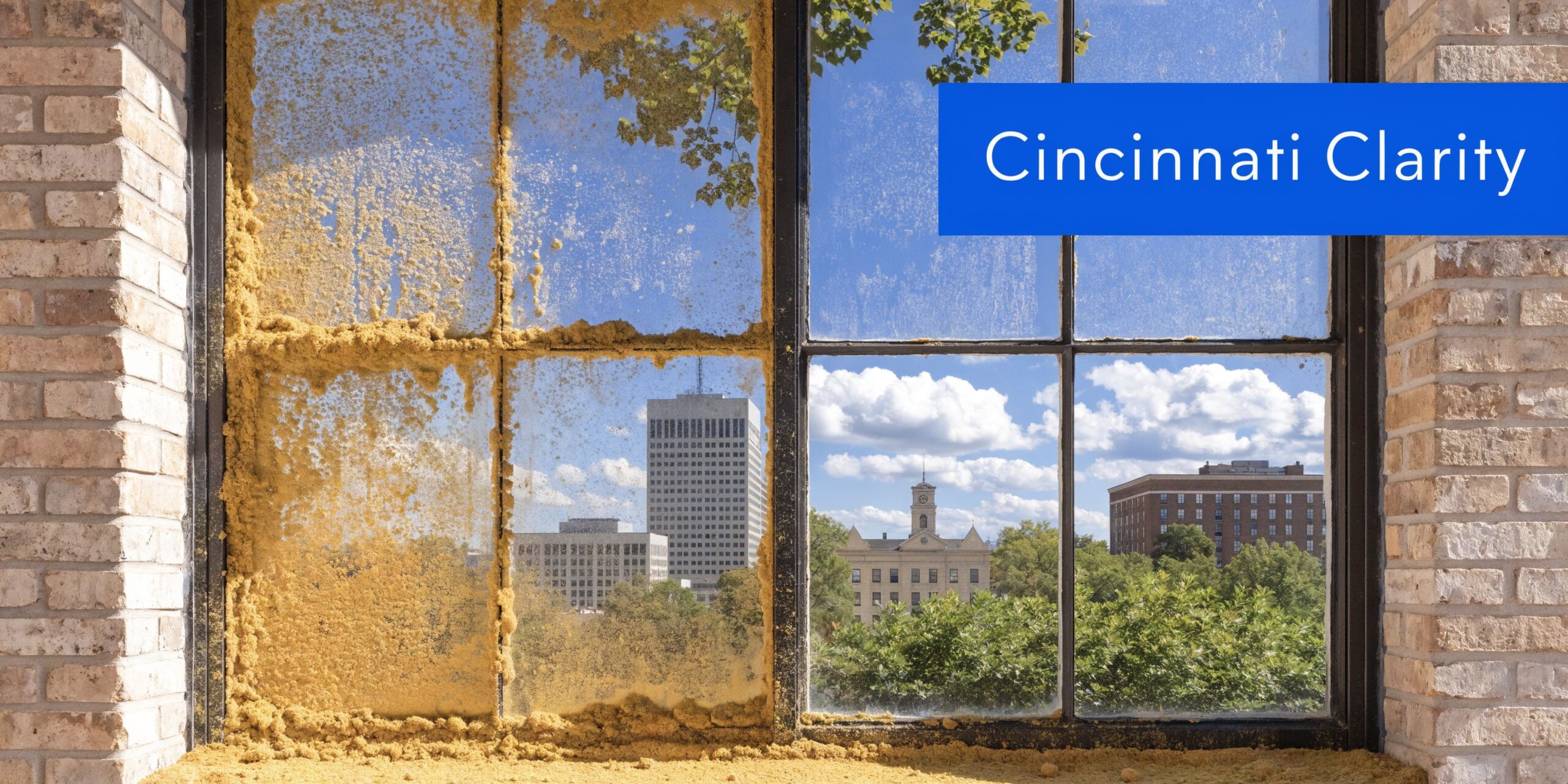
Clean windows protect more than the view
When a crew works professionally, they’re not just chasing shine. They’re managing the full glass surface, the edges, and the access method. That means using the right squeegee rubber, stable ladder setup, pure water when appropriate, and detail work that doesn’t leave residue in corners.
A proper service also helps owners catch problems early, such as:
- Seal issues: Fogging, failed edges, or moisture between panes.
- Frame drainage trouble: Weep holes clogged by debris or insect buildup.
- Surface contamination: Mineral spotting, oxidation haze, paint specks, or post-construction debris.
For many owners, the practical value shows up in day-to-day use. Rooms feel brighter. Storefront glass looks open for business. A building reads as maintained.
This is a real trade, not a side task
The industry itself reflects that. The U.S. window cleaning industry employs over 100,000 individuals, has a global market size of around $2 billion, and was projected to grow by 13% between 2020 and 2028, according to window cleaning industry statistics from Window Genie.
That kind of scale doesn’t happen because people are casually wiping glass. It happens because window cleaning became a specialized service with trained crews, safety procedures, and professional equipment.
Practical rule: If a company talks only about “making windows sparkle” and says nothing about access, safety, or glass condition, keep looking.
Owners who want a clearer sense of the long-term value can also review the broader benefits of clean windows. In practice, the biggest benefit is simple. Professional work keeps glass looking right without creating new problems.
Residential Commercial and High-Rise Services Explained
Not all window cleaning jobs are the same. The tools, workflow, and risk level change with the building type. A crew that handles ground-level storefronts well may not be the right crew for a multi-story building with difficult access.
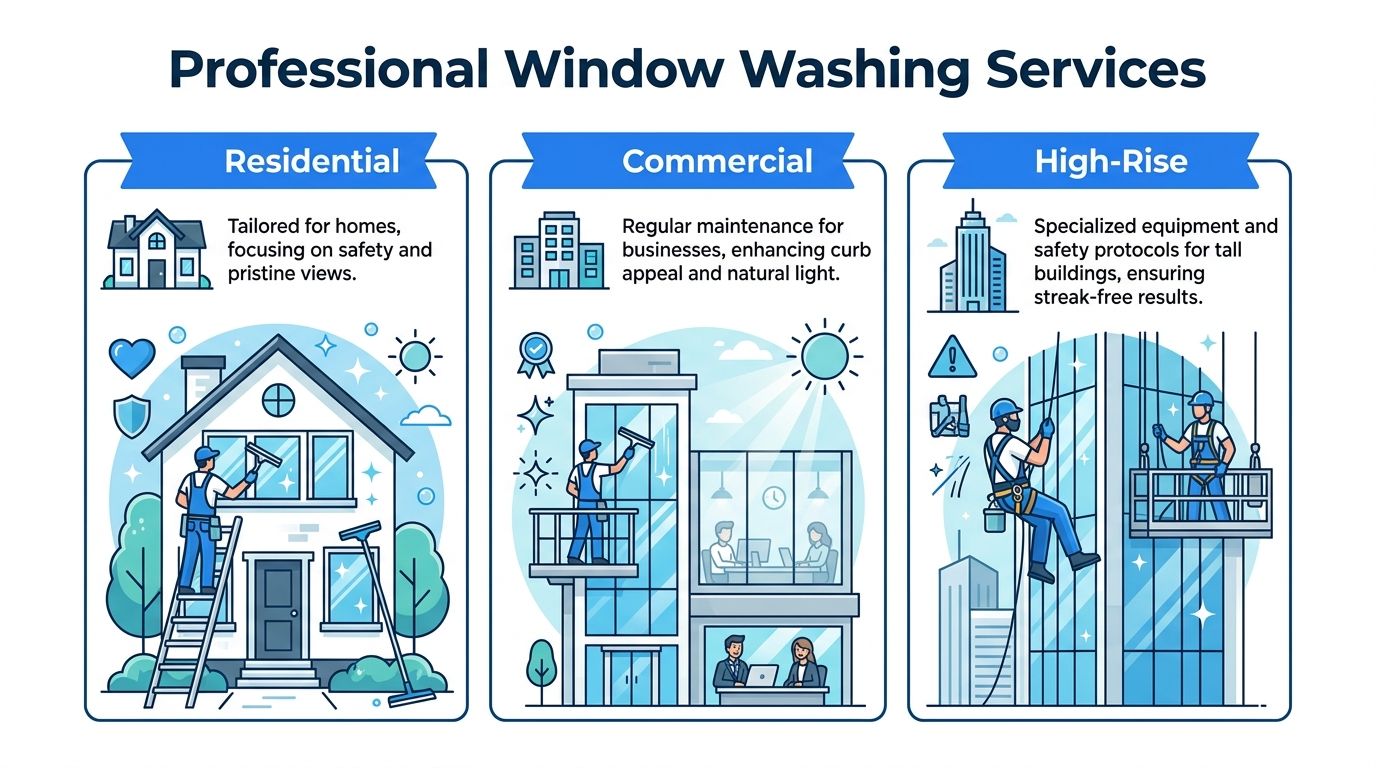
Residential service
Residential work is usually the most detail-sensitive category. Homeowners notice every streak because they live with the result every day. They also care about screens, sills, landscaping, and interior floors.
On homes, crews typically use:
- Professional squeegees: For direct glass contact and controlled finish work.
- Extension ladders and step ladders: For access where pole work isn’t the best choice.
- Water-fed poles with pure water: Useful for exterior upper-story glass, especially where ladder placement would be awkward.
- Screen and track tools: To remove loose debris before it migrates back onto clean glass.
The trade-off on residential jobs is speed versus precision. Fast isn’t always better. French panes, divided lights, skylights, and windows above landscaping all take more time if the crew is protecting the property correctly.
Commercial service
Commercial window washing covers a wide middle ground. Think retail storefronts, restaurants, office buildings, medical offices, schools, and low-rise mixed-use properties.
This work depends on consistency. A business doesn’t just need clean windows once. It needs repeatable service that keeps the building presentable without disrupting customers, tenants, or staff.
Common equipment includes:
- Route ladders: Useful for lower elevations and fast storefront maintenance.
- Water-fed pole systems: Effective for larger exterior glass runs where spot-free rinsing matters.
- Scissor lifts: Often used for interior atriums or exterior glass that sits beyond safe ladder reach.
- Boom lifts: Better for complex setbacks, canopies, and difficult approach angles.
Commercial jobs also involve workflow decisions. Crews may need to clean before opening hours, work around pedestrian traffic, or stage equipment where it won’t block entries.
Storefront glass and restaurant windows usually need more frequent attention than a suburban office with limited public traffic.
That’s why a good commercial contractor asks how the building is used, not just how many panes it has.
High-rise service
High-rise window cleaning is its own category. Once the building gets tall enough, the cleaning method is driven by engineering, access systems, and safety compliance as much as by the glass itself.
Typical methods include:
| Service type | Typical equipment | Main concern |
|---|---|---|
| Residential | Squeegees, ladders, water-fed poles | Detail work and property protection |
| Commercial | Ladders, scissor lifts, boom lifts, pure water systems | Routine access and minimal disruption |
| High-rise | Scaffolding, boom lifts, Rope Descent Systems | Certified anchorage, fall protection, route planning |
High-rise crews may work from suspended systems, lifts, or a Rope Descent System, depending on building design. That requires a very different level of planning than standard route work.
What separates a real high-rise crew
A legitimate high-rise operation doesn’t improvise. It verifies anchor locations, descent routes, rescue planning, weather conditions, glass type, and ground control.
The biggest mistake property owners make is assuming all “window cleaners” perform the same work. They don’t. Residential cleaning, commercial route service, and high-rise access each require different training, equipment, insurance expectations, and job planning.
How Much Does Window Washing Cost in Cincinnati
Price matters, but the better question is what the quote includes. In Cincinnati, professional window washing is usually priced by pane, then adjusted for access, condition, and scope.
Local market data shows residential window cleaning ranges from $5.80 to $7.60 per pane, while commercial services range from $7.60 to $9.40 per pane. For commercial properties, recommended service frequency typically falls within 1 to 3 months, based on the market information listed at Central Window Cleaning revenue and pricing data.
What changes the final quote
Two homes can have the same number of panes and still price very differently. One may have simple double-hungs with clear ladder access. The other may have tight landscaping, storm panels, skylights, and oxidation around the frames.
Here’s a practical breakdown.
| Cost Factor | Impact on Price | Notes |
|---|---|---|
| Accessibility | Higher when windows require ladders, lifts, or difficult setup | Safe access takes time and may require extra equipment |
| Window style | Multi-pane and specialty glass usually cost more | French panes, transoms, and skylights take longer |
| Interior and exterior scope | Full service costs more than exterior-only | Interior access adds labor and setup time |
| Screen and track cleaning | Increases labor time | Important if debris would otherwise contaminate clean glass |
| Soil level | Heavy buildup raises price | Post-construction debris and mineral staining need extra work |
| Frequency | Recurring service can stabilize pricing | Regular maintenance is usually easier than restoration work |
Cheap bids usually skip something
A very low quote often leaves out part of the job. Sometimes it excludes screens. Sometimes it covers exterior glass only. Sometimes it assumes easy ground access and adds charges later when the crew sees second-story windows, awkward rooflines, or interior obstacles.
Ask direct questions:
- What’s included: Glass only, or also screens, sills, and tracks?
- How is access handled: Ladders, poles, lift equipment?
- Is stain removal included: Or priced separately if spotting is heavy?
- Will the crew clean both sides: If not, the lowest price may not be comparable.
A fair quote should be easy to read
Professional estimates should explain scope in plain language. You shouldn’t have to guess whether the company plans to clean inside, outside, or both. You also shouldn’t have to guess whether the crew is prepared for access challenges.
If you want a broader frame of reference before comparing bids, this guide on cost to clean windows is useful. The main takeaway is simple. Fair pricing reflects labor, access, equipment, and risk. It doesn’t come from a random number pulled out over the phone.
How to Vet and Hire the Right Window Cleaning Company
Most hiring mistakes happen before the first drop of water touches the glass. Owners focus on price and schedule, then assume the company has the right coverage, training, and access plan. That assumption is where expensive problems start.
A good window cleaning company should be comfortable answering direct questions. If they dodge them, that tells you enough.
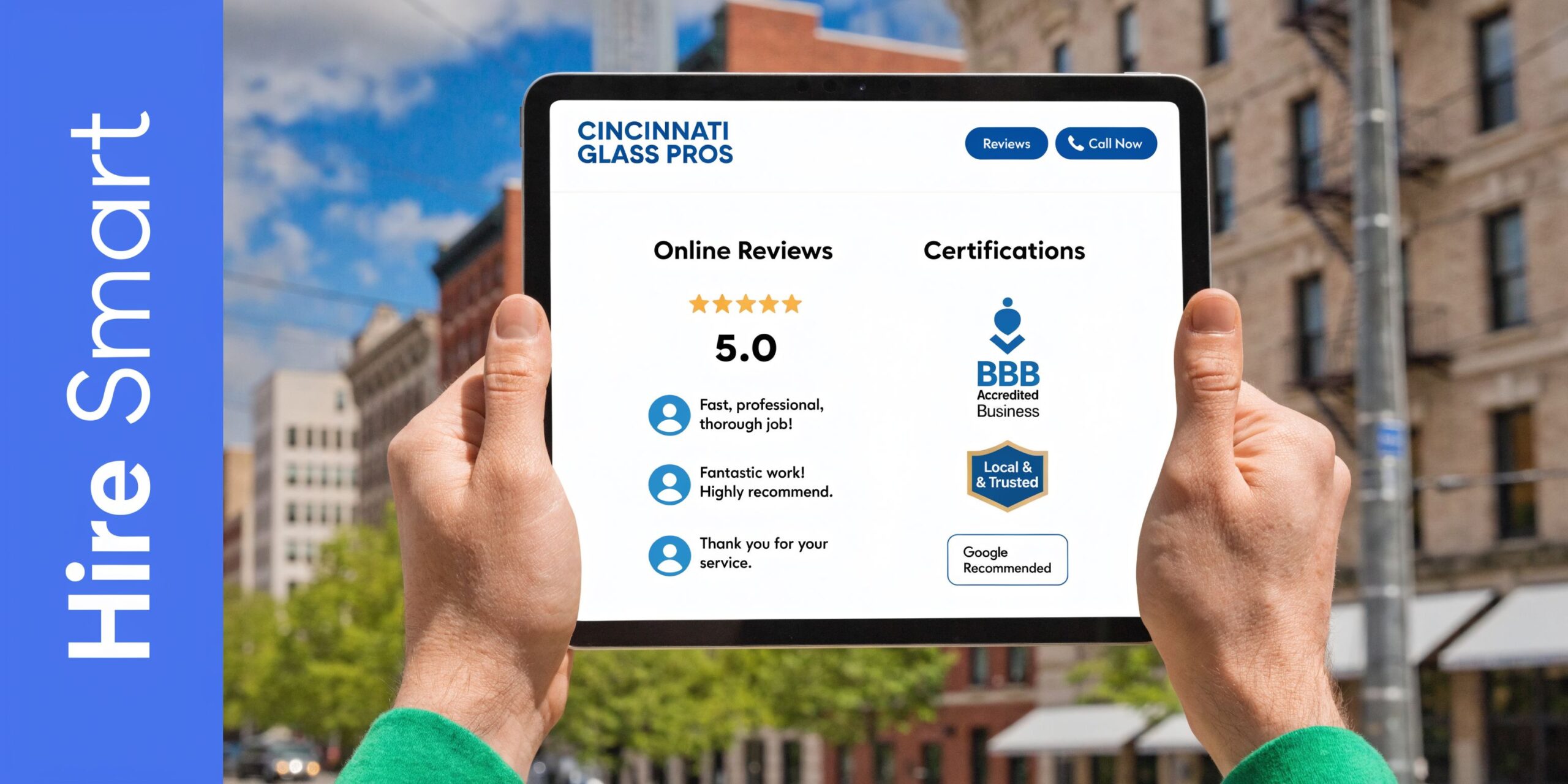
Insurance is the first filter
“Fully insured” gets thrown around loosely. Ask what that means. At minimum, owners should want current proof of general liability coverage and workers’ compensation coverage.
General liability helps protect the property if the company causes damage. Workers’ compensation matters because a crew member getting hurt on your site can create major exposure if the company isn’t carrying the right policy.
Safety language should be specific
Any company that works at height should describe its equipment and procedures in concrete terms. That includes ladder practices, lift operation, tie-off methods, and building access requirements.
If the project involves rope access, the standards get tighter. According to OSHA-related guidance summarized at OSHA requirements for window washing, all components of a Rope Descent System used in window washing must support at least 5,000 pounds, and building owners must provide written certification to employers confirming that each anchorage has been identified, tested, certified, and maintained in compliance with OSHA standards before deployment.
That’s not technical trivia. It’s the difference between a real plan and a dangerous one.
If a contractor talks casually about hanging ropes from the roof without discussing certified anchorages and written documentation, don't hire them.
What to ask before you sign
Use a short checklist. The right company won’t be offended by it.
- Ask for current insurance certificates: Don’t settle for a verbal assurance.
- Ask how the crew will access your windows: Ladder, boom lift, scaffolding, or rope descent.
- Ask who is responsible for site safety: Especially on commercial and multi-story jobs.
- Ask whether the estimate is site-specific: A real quote reflects your building, not a generic template.
- Ask for recent local references or reviews: You want evidence of consistent work, not just marketing claims.
Reviews matter, but only if they match your building type
A company may have great homeowner reviews and still be weak on commercial route work. Another may excel on larger properties but not have the patience for interior residential detail work.
Look for the kind of work you need. If you own a storefront, pay attention to comments about punctuality and recurring service. If you manage a taller building, focus on safety, communication, and coordination.
A useful comparison point is this guide on choosing a cleaning window company. The same principle applies everywhere. Hire the company that can explain its process clearly and prove it operates safely.
Seasonal Window Cleaning Tips for the Ohio Valley
Cincinnati windows don’t get dirty in one clean, predictable cycle. They get hit in waves. Spring brings pollen. Summer humidity leaves film and spotting. Fall adds leaf debris and organic residue around frames and screens.
That means timing matters, but method matters more.
Best times to schedule service
For many Cincinnati properties, two periods tend to make the biggest visual difference:
- After spring pollen settles: Cleaning too early can mean the glass is coated again almost immediately.
- Before winter weather sets in: That helps remove residue that would otherwise sit on the glass through cold months.
Commercial buildings may need a steady service plan instead of seasonal resets. Storefronts, restaurants, and customer-facing offices collect fingerprints, splash marks, and street film much faster than a detached home.
Hard water is a local problem
One issue stands out in this region. Cincinnati tap water hardness averages 120 to 150 mg/L, which is noted as higher than the national average and tied to more complaints about mineral staining on windows after they dry, according to this Cincinnati window washing page discussing local hard water conditions.
That matters because hard water doesn’t just dry slowly. It leaves minerals behind. Once those deposits build up, standard washing may improve the window without fully restoring the glass.
What works and what doesn’t
The wrong approach is repeated quick cleaning with mineral-heavy water and poor rinse control. That can leave the same problem behind every time.
The better professional approach usually involves:
- Pure water systems: These remove minerals from the rinse water so glass can dry spot-free.
- Controlled agitation: Enough to break loose bonded grime without scraping damaged surfaces.
- Assessment before cleaning: Some staining sits on the surface. Some may be etched in and require realistic expectations.
- Shade and timing awareness: Glass that dries too fast is harder to finish cleanly.
Clean glass isn't just about removing dirt. In Cincinnati, it's often about preventing minerals from drying back onto the surface.
Local conditions change the plan
Homes near trees may collect organic debris around upper windows and screens. Urban properties can see more airborne grime. Buildings with irrigation overspray or repeated runoff patterns usually develop the worst spotting on lower panes and entry glass.
That’s why the best crews don’t use one method on every building. They adjust the tools, water quality, and access strategy to the season and the property itself.
Getting Your Property Ready for a Flawless Clean
A little prep makes service day smoother for everyone. It helps the crew work faster, protects your belongings, and reduces delays once ladders, poles, or interior tools come inside.
Before the crew arrives
Use this checklist:
- Clear window sills: Move framed photos, plants, candles, and breakables.
- Open access paths: Pull back furniture if it blocks interior windows.
- Raise blinds and curtains: The crew can start immediately instead of waiting room by room.
- Secure pets: Dogs, especially, can get stressed around ladders and unfamiliar equipment.
- Make exterior areas accessible: Move grills, patio chairs, and decorative items away from work zones.
- Check water access if needed: Some services may need an outdoor spigot depending on the method.
For landlords and rental owners, a broader rental property cleaning checklist can be useful when window cleaning is part of a larger turnover or seasonal maintenance plan.
Small prep prevents common delays
Interior service slows down when technicians encounter cluttered sills or tight walkways. Exterior service slows down when gates are locked, pets are loose, or furniture blocks ladder placement.
None of this is difficult. It just helps to think through the route before the crew arrives.
Finding Your Trusted Window Washing Partner
The right company should be able to do three things well. Explain its process clearly, access your windows safely, and give you a quote that matches the full scope of work.
For window washing cincinnati, those standards matter whether you own a house, manage a storefront, or oversee a taller commercial property. Clean results come from the right tools, trained technicians, and a company that treats safety as part of the service, not as an afterthought.
If you’re looking for a provider in the company’s active service areas rather than Cincinnati, you can go directly to their city pages for Phoenix, Scottsdale, Tempe, Chandler, Paradise Valley, Glendale, Flagstaff, Denver, Boulder, Arvada, Westminster, Erie, Commerce City, Golden, Las Vegas, and Laughlin.
Frequently Asked Questions About Professional Window Washing
How often should windows be professionally cleaned
It depends on the property. Homes often do well with seasonal service, especially after spring buildup and before winter. Storefronts and customer-facing businesses usually need a tighter schedule because fingerprints, street film, and splash marks build up much faster.
Is professional cleaning safe for seals screens and landscaping
Yes, if the crew is using the right tools and methods. Professional service should account for screen removal and reinstallation, careful ladder placement, controlled water use, and protection around planting beds, trim, and interior floors. Good companies clean without forcing water where it doesn’t belong.
What is a pure water system
A pure water system filters minerals out of the water used for cleaning. That matters because mineral-heavy water can dry with spots. On exterior glass, especially upper windows and larger pane runs, pure water helps the surface dry clean without residue.
If you want experienced help from a company built around safe access, professional equipment, and streak-free results, contact Professional Window Cleaning. They serve Arizona, Colorado, and Nevada with residential, commercial, mid-rise, and high-rise window cleaning.