



Pressure washing inside a house is the kind of idea that sounds efficient until you've seen the damage. Indoors, the tool stops being a cleaning shortcut and starts acting like a water cannon aimed at drywall, trim, grout, seals, and anything electrical in the room. A cleaning guide is blunt about it, pressure washers are designed for open spaces only, and that warning exists for a reason, not as a suggestion Diamond Sparkle Cleaning.
If you're trying to clean inside glass, walls, or hard surfaces, the better question isn't how to force a pressure washer into the house. It's whether the surface can handle controlled moisture at all, and if not, whether a safer method will get you a better finish anyway. For most homeowners, the answer is yes, use a safer method. For windows, that usually means calling a crew that knows how to work with squeegees, ladders, boom lifts, scaffolding, rope descent systems, and pure water instead of blasting water into places it doesn't belong.
Why Most Indoor Pressure Washing Is a Bad Idea
Open a pressure washer inside a finished room, and the first problem is not dirt, it is containment. The spray hits a wall or window, rebounds, and starts looking for gaps. Trim joints, outlet boxes, baseboard seams, and any opening in the room become paths for water you never meant to send there.
A homeowner usually sees the mess on the surface first and misses the underlying threat. Water gets forced behind drywall, into grout lines, under caulk, and around electrical openings before the room even looks wet enough to worry about. By then, the clean-up turns into dry-out work, and dry-out work is expensive and slow.
The machine is not the issue, the setting is
Pressure washers do what they are built to do, they push water hard. That is useful on patios and siding because those surfaces are exposed and made to shed moisture. Indoors, the same force can strip paint, break down caulk, and drive water into seams that were never meant to take direct spray.
The safest window work uses controlled methods, which is why crews that specialize in interior glass lean on professional window cleaning techniques instead of blasting water into a room. That approach gives you a streak-free finish without turning the wall cavity into a hidden sponge.
The failure modes are predictable. Water gets behind tile or drywall. Overspray reaches outlets and switch plates. Sealants loosen, then the next leak follows the path you created.
Practical rule: If a surface depends on a seal, a gap, or a cavity to stay dry, do not hit it with pressure indoors.
Dropping the PSI does not solve the problem by itself. Bad spray angle, short distance, or poor shielding still push water into the wrong places. Indoor cleaning calls for containment and precision, not raw force.
For readers focused on glass and interior finishes, skip the pressure washer and use a method built for windows instead. The safer result usually comes from a crew that knows how to work with squeegees, ladders, boom lifts, scaffolding, rope descent systems, and pure water rather than from forcing exterior-style washing into a house.
Surfaces That Can and Cannot Handle Low-Pressure Wash
Not every indoor surface reacts the same way to water. Some can tolerate a controlled, low-pressure rinse if they're sealed and built for moisture. Others should be treated as off-limits because they absorb water, flex under impact, or hide damage until it shows up later.

Where a controlled wash may make sense
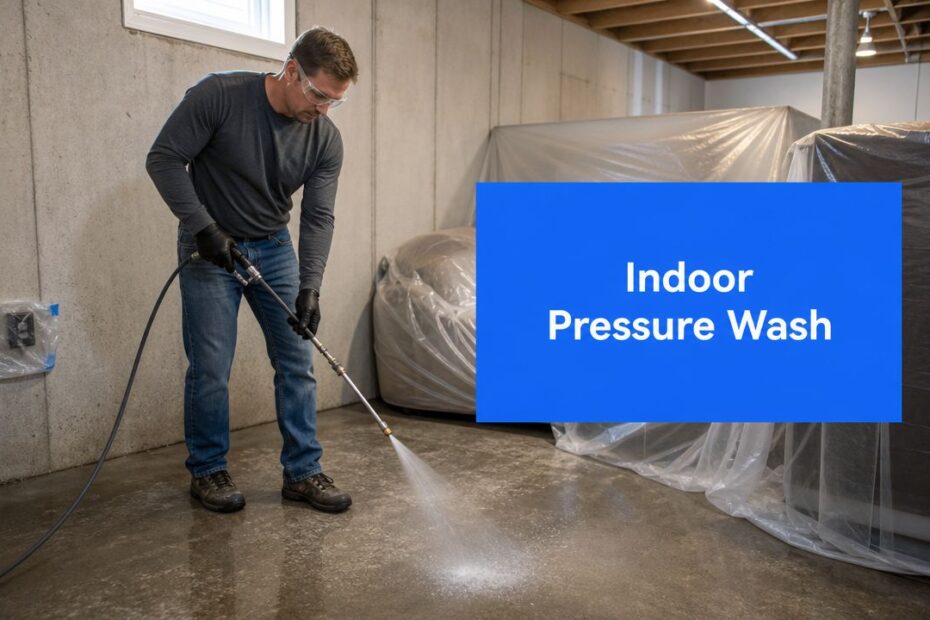
Garage floors, sealed concrete, and some basement slabs are the only indoor surfaces I'd even discuss with a homeowner who insists on using water-based cleaning. Even then, the finish has to be intact, the drainage has to be controlled, and the room has to be isolated from electrical points and finished materials.
The key is the substrate. Sealed concrete can shed water better than a porous or layered surface. Once the seal is compromised, the margin disappears fast. If the area has cracking, peeling coating, or old patchwork repairs, treat it as fragile, not washable.
Where you should stop immediately
Grouted tile, unsealed wood, drywall, baseboard assemblies, and any area near outlets, switch plates, vents, or HVAC returns are bad candidates. These surfaces can trap moisture, swell, stain, or let water travel into places you can't dry quickly enough. The same logic applies to caulking seams and aging grout, because they may look solid while still giving water a path behind the finish.
A simple decision rule helps. If the surface is porous, layered, or tied into electrical or mechanical systems, skip the pressure washer. If it's a sealed utility surface with clear drainage and plenty of clearance from sensitive components, it may be worth discussing as a low-pressure, contained cleanup.
For interior glass, the right answer is still usually not more pressure. If the goal is clearer windows and not a flooded room, a dedicated glass system is the smarter tool, not a compromise.
Equipment Settings and Spray Technique for Indoor Soft Washing
Indoor soft washing, if you insist on using water at all, is a restraint exercise. Skip gas units completely. Exhaust has no business inside a house, and a room needs tight control, not brute force. Use an electric pressure washer with barriers or containment systems like tarps, plastic sheeting, and containment mats, as outlined in the commercial electric pressure washer guide and the indoor-use advice from EcoWash.
The setup that keeps the job controlled
House-washing guidance puts the starting range at roughly 1,300–2,400 PSI, paired with a 25°–40° spray tip and a downward, top-to-bottom rinse path to reduce damage and water intrusion Greenworks. That range is not permission to blast away at indoor finishes. It is the upper edge of what a controlled soft-wash setup might use, and only on surfaces that can handle it.
Start with a hidden test spot. Hold the wand about 2–3 feet away, then move in only enough to clear the soil without marking the surface. Keep clear of windows, outlets, caulking seams, and any area that already looks loose or stressed Nationwide.
If you need to angle upward to reach the dirt, the setup is wrong.
The motion that protects the room
Spray down, not up. Upward spray drives water behind siding outdoors, and the same bad habit indoors pushes moisture under trim, behind baseboards, and toward electrical cavities. Use controlled passes, keep the wand moving, and stop the moment the surface starts shedding finish, fuzzing, or showing signs of saturation.
If overspray, foam residue, or stray material is already on the surface, use the DIY overspray removal guide to clean it up without turning a small mistake into a bigger repair job.
For crews or property managers comparing equipment, the case for electric is simple. Indoor work needs control first, and the right tool helps you keep it. When the goal is streak-free glass and not a soaked room, a dedicated window-cleaning setup still beats a pressure washer every time.
The Pre-Soak, Dwell, and Containment Workflow
Indoor cleaning works best when you slow the process down. Pre-soak first, let the detergent do its job, then rinse in tight sections. Skip that order and you get runoff, streaks, and moisture pushed into places that are hard to dry out.
The sequence professionals trust
Start with detergent on the target area, not a blast of water. Give it a short dwell period so the cleaner can break up the grime, but do not let it dry on the surface. Once the soil loosens, rinse one section at a time instead of trying to cover the entire room in a single pass.
The rinse path matters. Work from the top down so dirty water does not wash back over cleaned areas. That rule matters indoors because runoff can settle at baseboards, under doors, and into seams that stay hidden until the damage shows up later Pickens Power Washing.
Containment isn't optional indoors
Containment is what keeps a messy task under control. Use tarps, plastic sheeting, and containment mats to protect floors, furniture, and nearby rooms. Isolate the work zone so water and debris stay out of hallways, drains, and finishes that are not part of the job.
The biggest mistakes are easy to spot:
- Spraying upward: This sends water where you cannot dry it fast enough.
- Skipping outlet protection: Electrical points need real shielding.
- Treating it like an outdoor wash: Indoor work has tighter margins and slower drying.
Clean one section, check it, then move on. That beats flooding the room and hoping extraction fixes the mess.
For glass and other finish-sensitive surfaces, a professional window cleaning setup is the cleaner path. The water-fed pole window cleaning system shows the kind of controlled approach that protects the surface and avoids the spray-and-pray habit.
This workflow can make sense in a garage or basement when the surface and controls are right. It has no place in a finished living space with drywall, trim, and electrical components.
Safer Alternatives Most Homeowners Should Reach For First
For indoor work, a pressure washer is usually the wrong tool. Use the tool that fits the surface, the amount of moisture the space can tolerate, and the cleanup you can control. Microfiber cloths, soft brushes, mop systems, steam cleaners, and pure-water window cleaning handle the job with far less risk to paint, trim, and flooring.
Match the tool to the material
Microfiber and soft brushes should be your starting point for painted surfaces, trim, and delicate finishes. They lift grime without forcing water into seams or pushing dirt deeper into the surface. Mop systems fit broad floors better, since they spread moisture evenly and keep runoff easier to control. Steam cleaners also have a place where heat and limited moisture help release dirt without soaking the room.
Glass deserves its own method. Pure-water window cleaning gives you a controlled finish on interior or exterior panes without the overspray and frame damage that come from improvising with pressure equipment. If you want a clearer picture of that setup, the water-fed pole window cleaning system shows how professional glass work avoids harsh spray and keeps the process controlled.
Why the safer route wins
Gas-powered units belong outside because exhaust is a real indoor hazard. If a powered wash tool has to be used indoors at all, electric equipment with proper barriers is the only direction worth considering, and only on surfaces that can handle the water. Even then, the result depends more on setup, containment, and drying discipline than on raw pressure EcoWash.
For windows, stop trying to make a pressure washer do glass work. Professional window cleaning gives you cleaner edges, less mess, and no reason to gamble with frames, seals, or nearby finishes. The same caution applies after leaks or moisture problems, since wet surfaces can hide what is happening underneath. A practical guide on avoiding hidden moisture after leaks is a good reminder that what looks dry on the surface may not be dry where it counts.
When to Hire a Pro and Where to Book the Job
If the job involves height, multi-story glass, skylights, hard water staining, or any area near electrical or structural risk, hire a professional. That's especially true for window cleaning, because glass rewards precision and punishes shortcuts. A trained crew knows how to work safely with access equipment, protect adjacent surfaces, and leave the glass streak-free without turning the job into a repair bill.
The signs you shouldn't DIY
Look at the job, not your confidence level. If the work needs ladders, boom lifts, scaffolding, rope descent systems, or access around tight architectural features, the project has already crossed into professional territory. If the windows are high, difficult to reach, or tied into a building envelope that could trap moisture, don't improvise.
The same caution applies after leaks or water intrusion. A practical restoration guide on avoiding hidden moisture after leaks is a good reminder that wet surfaces can hide deeper problems long after the visible water is gone.
Where to book the work
Professional Window Cleaning serves Phoenix, Scottsdale, Tempe, Chandler, Paradise Valley, Glendale, and Flagstaff in Arizona, Denver, Boulder, Arvada, Westminster, Erie, Commerce City, and Golden in Colorado, plus Las Vegas and Laughlin in Nevada. The company uses squeegees, ladders, boom lifts, scaffolding, rope descent systems, and pure water, with technicians who are annually OSHA 1910.27 trained, background-checked, drug-free, and fully insured.
If you're in Phoenix, Scottsdale, Tempe, Chandler, Paradise Valley, Glendale, Flagstaff, Denver, Boulder, Arvada, Westminster, Erie, Commerce City, Golden, Las Vegas, or Laughlin, book the job with a crew that does this work every day and stands behind it with a 100% satisfaction guarantee.
A CTA for Professional Window Cleaning.