



A lot of facility managers read about facade care when the problem is already visible. The west-facing glass looks dusty by noon, tenant complaints start after a streaky service visit, and someone on your team has to decide whether the next job needs poles, lifts, scaffolding, or full rope access. That decision matters more in the Southwest, where sun, wind, mineral-heavy water, and varied architecture can turn a routine cleaning plan into an operational headache.
Professional high rise glass cleaning equipment exists for one reason. Buildings don't all fail the same way, so crews can't clean them with one method. A mid-rise office in Phoenix, a resort-style property in Scottsdale, and a downtown tower in Denver each demand different access, different safety controls, and different cleaning chemistry.
The View from the Ground Floor
If you manage a large building, you already know the moment when the glass starts working against you. Lobby-level panes show fingerprints and dust first. Then upper elevations begin to haze over, especially on facades that take direct sun or collect runoff from ledges and overhangs. By the time the problem is obvious from the parking lot, the actual issue usually isn't the dirt. It's that the building needs the right access plan, not a rushed cleaning crew.
That's where professional window cleaning separates itself from improvised work. High rise glass cleaning equipment is about controlled access, repeatable results, and risk management. A squeegee in skilled hands still matters. So do ladders for the right elevations. But once height, setbacks, or public exposure enter the picture, the conversation shifts fast to boom lifts, scaffolding, rope descent systems, and pure water systems.
What facility managers are really buying
Most buyers aren't shopping for equipment itself. They're buying confidence that a crew can reach every piece of glass without damaging the facade, blocking operations, or exposing the property to preventable risk.
Three questions usually drive the decision:
- Can the crew reach the glass safely: Not just the obvious curtain wall, but recessed corners, canopies, and architectural offsets.
- Will the method fit the site: A lift may be ideal on one building and impossible on another because of landscaping, traffic flow, or narrow access lanes.
- Will the finish hold up in local conditions: Arizona dust, Denver weather shifts, and Nevada sun all expose weak cleaning methods quickly.
Practical rule: The best-looking proposal on paper often fails on site if the access method wasn't matched to the building first.
This is also why the market keeps expanding. The global market for building window cleaning systems was estimated at US$2.4 billion in 2024 and is projected to reach US$4.8 billion by 2030, growing at a CAGR of 12.5%. That growth reflects a simple operational reality. More towers and more glass mean more demand for specialized high rise cleaning infrastructure.
Why generic advice falls short in the Southwest
A generic buyer guide might tell you to choose the “most efficient” method. In practice, efficiency depends on the building and the city. A crew working exterior glass in Tempe may need to plan around pedestrian traffic and mixed-use frontage. A property in Las Vegas may have heat exposure and reflective glass that show residue fast. A mountain-facing building in Boulder can present wind and access issues that aren't obvious from ground level.
That's why experienced crews start with the facade, not with a favorite tool.
The Essential High Rise Cleaning Toolkit
Professional crews don't choose equipment by habit. They choose it by height, access, facade design, and what will let them clean the glass thoroughly without creating a bigger problem around the building.
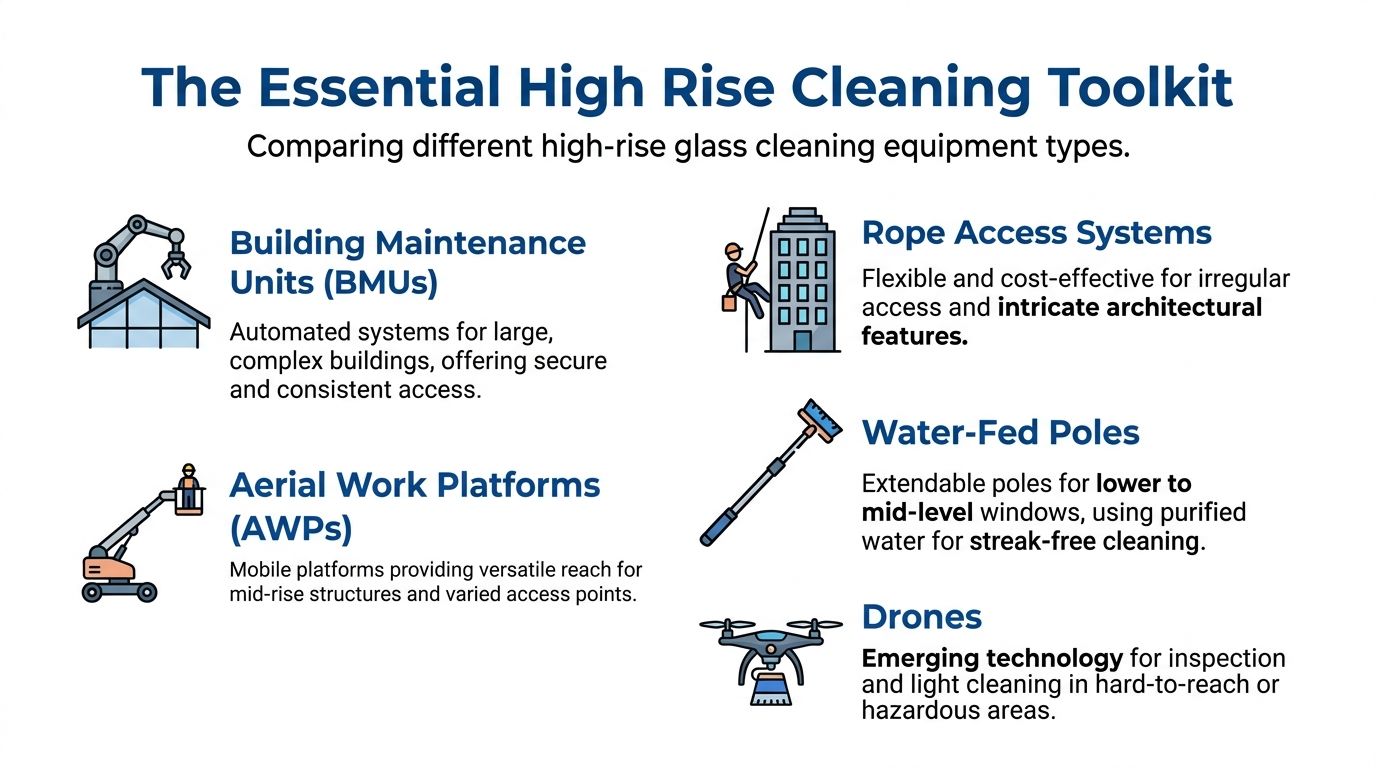
One of the clearest thresholds in the trade is the limit of water-fed poles. Professional crews use water-fed poles only up to approximately 70 to 80 feet, and jobs above that range require rope descent systems, aerial work platforms, or Building Maintenance Units. That single cutoff saves a lot of wasted site walks.
The core equipment categories
Water-fed poles are the ground-based workhorses for lower sections and some mid-level glass. They use purified water and a brush head to scrub and rinse without leaving mineral spotting when conditions are right. They're efficient on accessible elevations and ideal when you want to reduce setup time on buildings that don't justify heavy access gear. For a closer look at how crews use purified systems, this overview of a water-fed pole window cleaning system is a useful reference.
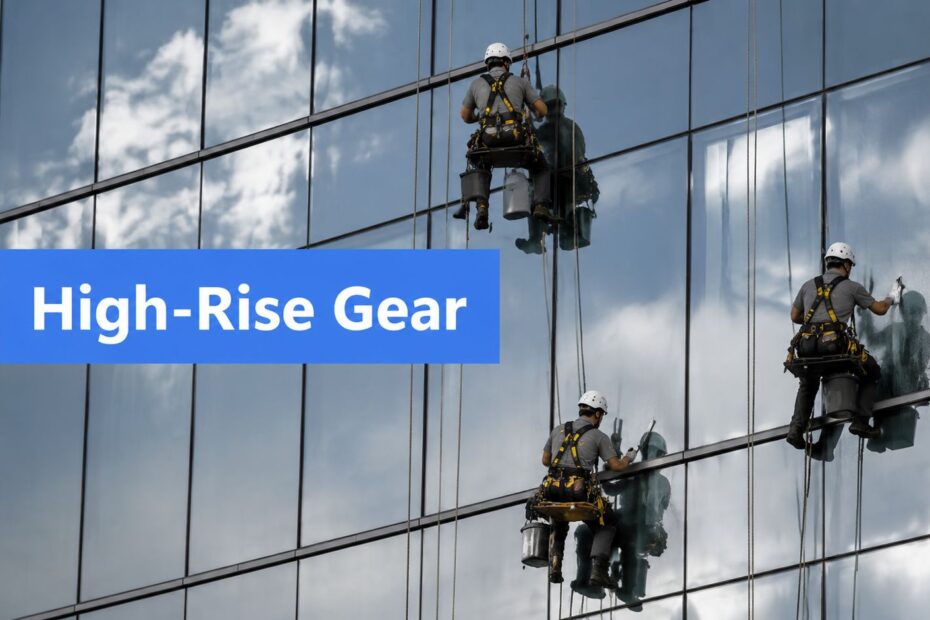
Rope descent systems are the flexible option for tall facades with limited ground access or irregular architecture. Think of them as industrial rappelling for glass work. A trained technician descends from approved roof anchors using a working line and a separate safety line. Rope systems shine on towers with setbacks, narrow service lanes, and surfaces a lift can't reach efficiently.
Bosun's chairs are still part of the conversation on some jobs, though many buyers use the term loosely when they really mean rope-suspended access. In practical operations, the key issue isn't the seat. It's the full suspension system, anchor design, backup line, and rescue readiness. A chair without a complete safety system isn't a solution.
Access machines and specialty systems
Boom lifts are the right answer when a building has exterior clearance and the glass sits within the machine's working envelope. They let technicians work from a stable platform, carry tools, and move across sections methodically. Crews often prefer them on mid-rise structures, podium levels, and elevations with awkward landscaping where ladders would be inefficient.
Scaffolding makes sense when crews need extended time on one face of a building or when repeated passes are required across the same elevation. It's slower to set up than a lift, but it provides a consistent work zone. On certain restoration or detailed exterior projects, that stability matters.
Building Maintenance Units, or BMUs, are roof-mounted systems designed into some towers. If your property has one, it can be the most controlled and repeatable access method on the building. The trade-off is that BMUs only help if they're maintained properly and the building was designed with coverage that matches the facade.
Atrium lifts and spider lifts solve a different problem. They're built for tight interior spaces, polished floors, confined entries, and complex geometry. On hotels, office atriums, and premium mixed-use properties, these machines often do work that a standard lift can't do without disruption.
Rope access is usually the most adaptable tool on a complex facade. It isn't always the fastest choice, but it often reaches glass that no ground-based machine can service cleanly.
Cleaning tools still matter
Access gets workers to the glass. It doesn't finish the job. Crews still rely on professional squeegees, scrubbers, extension poles, detailing cloths, and pure water systems to get a clean result. On scratch-sensitive glass, the chemistry and agitation method matter just as much as the access method.
For stubborn contamination on tempered or laminated glass, solvent-based cleaners are required instead of pure water or abrasive scrapers, and high-pressure cleaners with rotating wash brush attachments may be necessary when pure water alone won't remove staining. That's a practical field point many buyers miss. More pressure or more scraping isn't always better. On some glass, it's the fastest way to damage the surface.
High Rise Equipment Comparison
| Equipment Type | Ideal Height Range | Best For | Key Limitation |
|---|---|---|---|
| Water-fed poles | Lower to mid-level glass, up to approximately 70 to 80 feet | Accessible exterior windows, routine maintenance, fast setup | Limited reach on taller buildings and less useful on stubborn contamination |
| Rope descent systems | High-rise facades above pole range | Towers, setbacks, narrow access conditions, irregular architecture | Requires roof access, anchor planning, and strong rescue protocols |
| Boom lifts | Low-rise to mid-rise and select taller reachable areas | Stable platform work, podiums, exterior zones with open ground access | Needs ground space and clear machine path |
| Scaffolding | Targeted elevations where crews need longer dwell time | Repetitive work zones, restoration-adjacent cleaning, controlled frontage | Slower setup and more site disruption |
| BMUs | Buildings designed with permanent access systems | Large towers needing repeatable, engineered access | Only available on buildings equipped for them |
| Atrium or spider lifts | Interior atriums and constrained specialty spaces | Tight access, sensitive flooring, complex interior glass | Specialized equipment, limited to niche conditions |
Safety First OSHA Standards and Best Practices
The best equipment on a property means very little if the crew treats safety as paperwork. In high-rise work, safety is part of production. It determines whether the job can be done at all, how quickly it can be done, and whether the property owner is left with manageable risk or avoidable exposure.
Redundancy is not optional
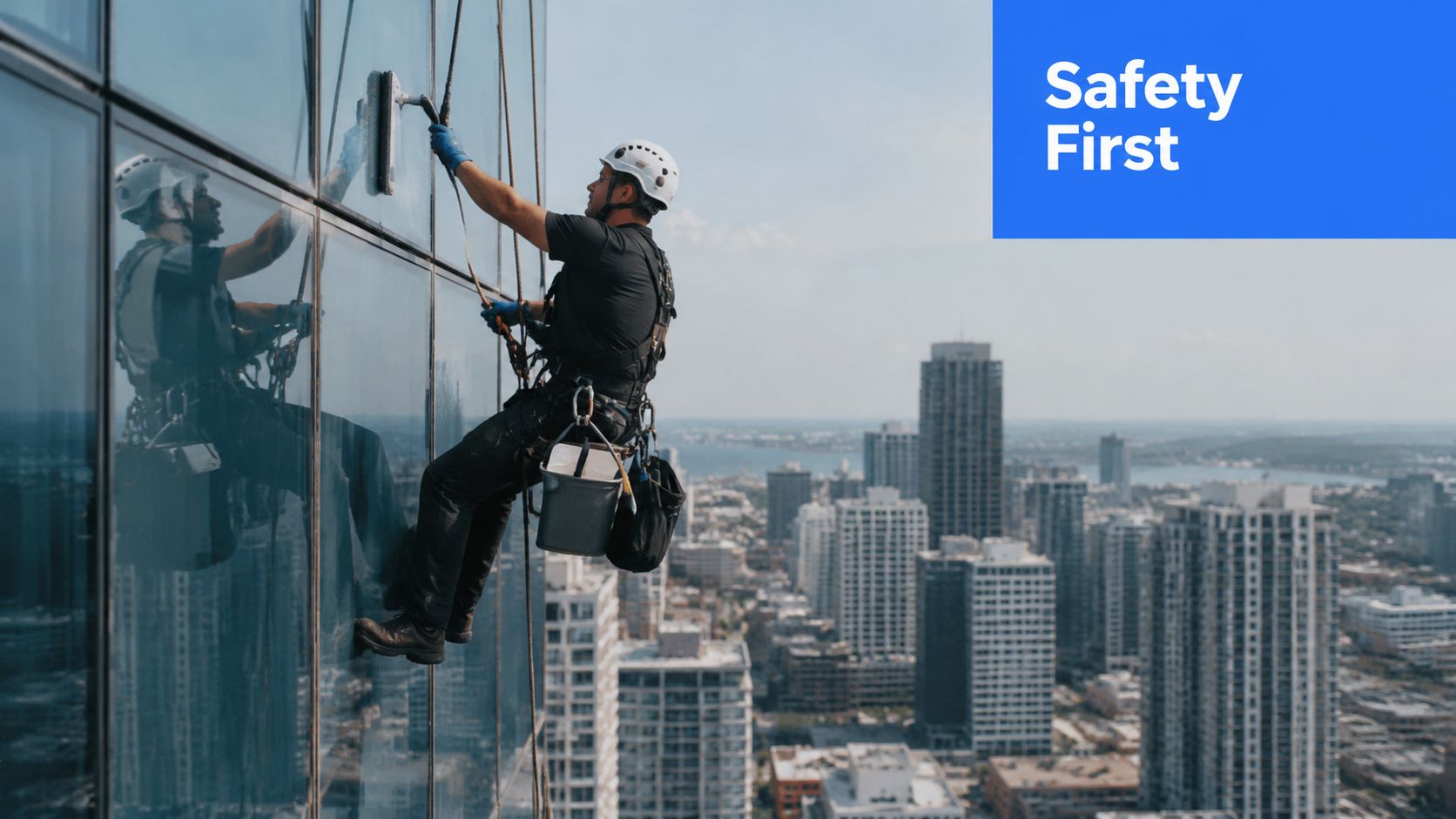
High-rise window cleaning remains hazardous work. The trade relies on fall protection, secure anchors, competent setup, and disciplined inspections because one point of failure can have severe consequences. Buyers should expect redundant systems. If a suspended platform fails, the backup harness and independent connection to the structure are what keep a bad incident from becoming a fatal one.
That's why OSHA-facing language matters, but it shouldn't be the only thing you ask about. A company can talk confidently about equipment and still be weak on the basics that protect workers and your site.
The overlooked questions
One issue gets ignored in too many buyer conversations. High-rise accidents are often avoidable if workers are trained in rescue, write a quick rescue plan, and never work alone. That point deserves more attention than it gets.
Ask direct questions:
- Who is on the rescue plan: Not in theory, but on the actual crew assigned to your building.
- How is lone work prevented: If one technician is isolated on ropes or on a suspended system, that's a red flag.
- How are inspections documented: Ropes, harnesses, lanyards, anchors, lifts, and suspended gear all need regular checks.
- Who controls the ground zone: Someone has to protect entrances, sidewalks, and loading areas below the work.
Buyer warning: If a proposal spends more time describing reach and speed than emergency response, the safety program may be thinner than it looks.
For facility teams building stronger jobsite controls, this essential guide for service business safety is a practical outside resource because it frames planning around the site itself, not just the equipment list.
What a professional crew should already have
A serious provider should arrive with a system, not just tools. At minimum, expect:
- Annual training discipline: High-rise procedures need refreshers, not one-time onboarding.
- Pre-job hazard review: Roof access, pedestrian exposure, weather, facade condition, and rescue options should all be covered before production starts.
- Equipment inspection habits: This equipment safety inspection checklist reflects the kind of process-minded approach buyers should look for.
- Clear supervision: Someone needs authority to stop work if conditions change.
The cleanest glass in the city isn't worth much if the job was done with avoidable shortcuts.
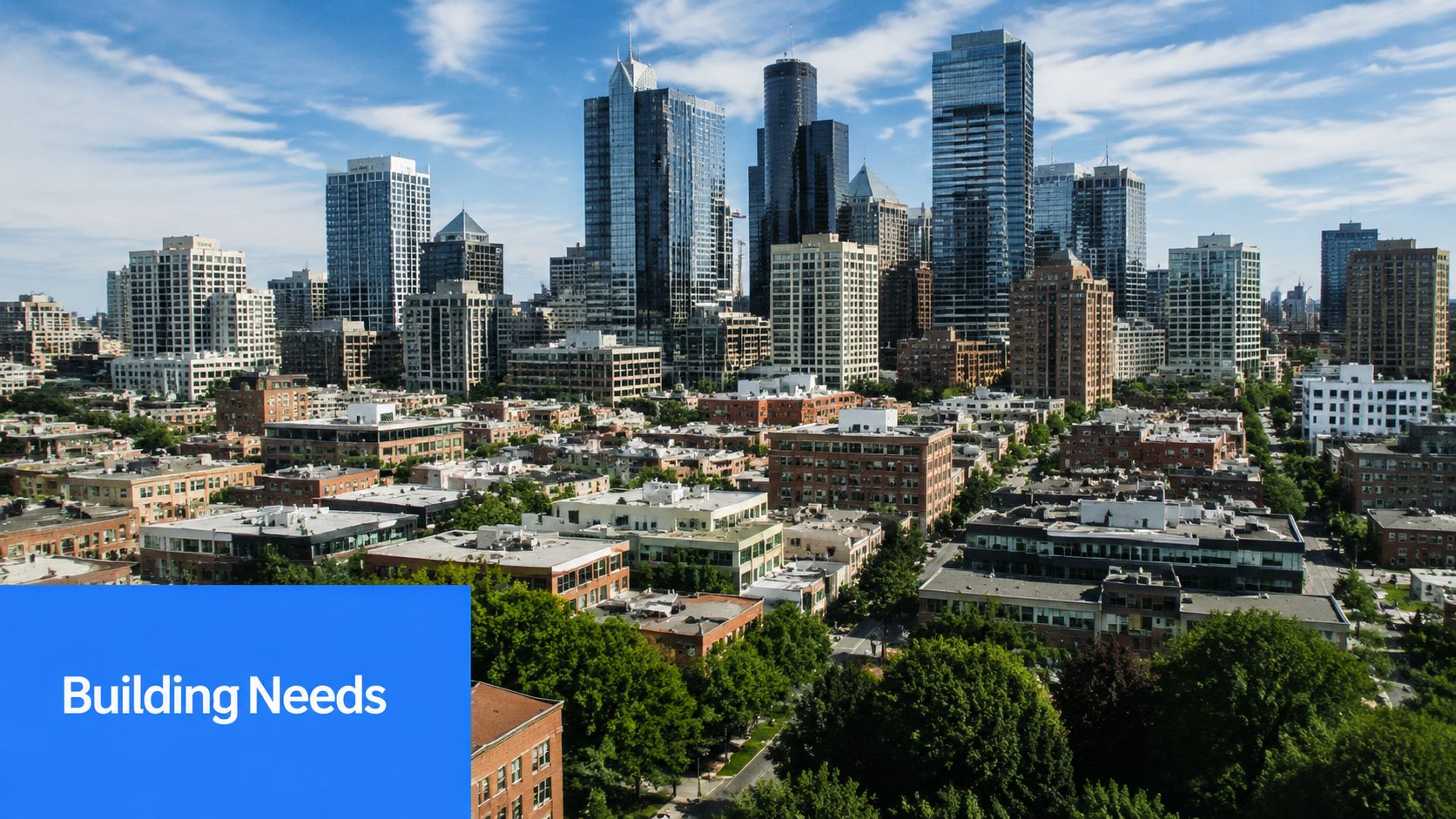
Matching Equipment to Your Building's Needs
The right question isn't “What equipment do high-rise cleaners use?” It's “What does this building force a competent crew to use?” Start there, and proposals become easier to evaluate.
Start with building geometry
A straight glass tower is simpler than it looks. A mixed-use property with balconies, overhangs, canopy lines, and recessed corners is usually harder. In the Southwest, resort-style and residential buildings often create more access complexity than raw height alone.
Work through the property this way:
- Height profile: Separate the building into zones, not one overall height. Ground floor, podium, upper tower, and rooftop glass may each need different methods.
- Facade interruptions: Balconies, shade structures, fins, and signage often block lift access and complicate rope paths.
- Ground conditions: Decorative hardscape, planters, underground parking decks, and tight service drives can rule out some machines quickly.
- Public interface: Retail frontage and busy entry points change how crews stage work and protect the area below.
Then look at the glass itself
Not all dirty glass should be cleaned the same way. Curtain wall systems, tempered panes, laminated glass, and decorative architectural glazing can react differently to friction, residue, and chemical exposure.
If your facade picks up adhesive residue, hard water staining, or construction fallout, ask the vendor how they'll remove it without scratching the surface. That answer tells you a lot about competence. Skilled crews know when pure water is enough and when the job requires a different brush, solvent-based cleaning, or a more controlled access method so they can work the surface properly.
A building with easy height but difficult glass can be more demanding than a taller building with simple access.
Regional examples matter
A downtown office in Arvada or Westminster may have broad exterior access but weather-driven scheduling constraints. A hospitality property in Paradise Valley or Chandler might look accessible from the street but become difficult once crews work around landscaping, pool decks, and guest circulation. Buildings in Flagstaff, Golden, or Commerce City each come with their own site realities.
That's why the best site walks feel diagnostic. The crew isn't trying to “sell” one machine. They're trying to eliminate the wrong ones.
Renting vs Buying High Rise Equipment
This decision is usually simpler than people expect. Most property owners and facility teams shouldn't buy high rise glass cleaning equipment unless they have a very specific operational reason to keep it in-house.
When buying can make sense
Ownership has a place on large campuses, institutional properties, or portfolios with a dedicated facilities department that already manages specialized equipment. If a team uses the same machine repeatedly, has secure storage, handles maintenance discipline well, and has trained operators, buying may be defensible.
The strongest case for ownership usually includes these conditions:
- Frequent repeat use: The equipment doesn't sit idle most of the year.
- In-house competency: Staff already know how to inspect, stage, and operate the equipment safely.
- Maintenance infrastructure: Someone is responsible for service intervals, records, repairs, and downtime planning.
- Liability awareness: Ownership shifts more responsibility to the property side.
Why renting or outsourcing is often the better move
Most buildings don't need that burden. They need clean glass on schedule, not another asset to store, insure, inspect, and keep compliant. Renting can solve a short-term access issue. Hiring a professional service solves both access and execution.
That difference matters. Equipment alone doesn't produce results. The crew still needs to select the right tools, protect the site, understand facade materials, and finish the glass properly.
A simple way to frame it:
| Option | Strongest Fit | Main Advantage | Main Drawback |
|---|---|---|---|
| Buy equipment | Large portfolios or campuses with trained internal teams | Availability and long-term operational control | Maintenance, storage, training, and liability stay with you |
| Rent equipment | One-off projects or unusual access needs | Flexibility without permanent ownership | You still need competent operators and a full safety plan |
| Hire full-service professionals | Most commercial and high-rise properties | Access, labor, safety systems, and cleaning expertise come together | Less direct control over the equipment itself |
The operational reality
If your team is debating whether to buy a boom lift or suspended access gear for occasional facade work, that's usually a sign the better answer is external service. Buying a machine is the easy part. Running it safely and getting consistent window-cleaning results is the harder part.
For most facility managers, outsourcing keeps capital free and reduces internal exposure. It also avoids the common trap of owning equipment that fits one side of the property well and the rest of the building poorly.
Hiring and Renting in Arizona Colorado and Nevada
Local hiring gets easier when you stop asking broad questions and start testing whether the provider understands your city, your building type, and the environmental conditions your glass deals with every week.
What to verify in the Southwest
In Arizona, hard water and dust change the finish standard fast. In Colorado, altitude, wind, and seasonal shifts affect scheduling and safety decisions. In Nevada, heat, reflective glazing, and hospitality-driven appearance standards put pressure on both timing and quality control.
Look for providers that can speak clearly about:
- Local access experience: The methods that work on a tower in Glendale may not fit a mixed-use property in Erie or a casino-adjacent building in Laughlin.
- Tool selection: In the Phoenix metro market, S&K Building Services explicitly lists scaffolding, boom lifts, and rope descent systems among its core tools for high-rise and mid-rise exterior glass. That's a useful reminder that real local providers rely on a mix of professional access systems, not one universal method.
- Surface awareness: Ask how they handle scratch-sensitive glass, mineral residue, and post-construction contamination.
- Site logistics: Entry restrictions, loading areas, HOA requirements, guest traffic, and retail frontage all affect execution.
Questions worth asking before you sign
These questions cut through polished proposals quickly:
- What access method would you use on each side of the building, and why?
- What changes if wind, heat, or pedestrian traffic shifts during the job?
- Who is responsible for roof coordination and ground control?
- Do you provide the lift or specialty access equipment, or are you renting it for this job?
- What would make you reject a method after the site walk?
A provider that answers specifically is usually better prepared than one that keeps everything general.
The strongest vendors don't promise that every method works. They explain where each method fails.
Local coverage matters
For regional properties, it helps to work with crews that already understand the building stock and service patterns in Phoenix, Scottsdale, Tempe, Chandler, Flagstaff, Denver, Boulder, and Las Vegas. If the scope extends beyond glass and into adjacent exterior maintenance, some buyers also review related capabilities such as this page on a commercial pressure washer electric setup, especially when planning broader exterior cleaning schedules.
That local familiarity cuts down on surprises. Crews know which properties have tight staging, which elevations collect the worst runoff, and which schedules require early coordination.
Ensuring Crystal-Clear Results Safely
Clean high-rise glass comes from a simple formula. Use the right access equipment, match the cleaning method to the facade, and insist on disciplined safety practices every time.
Facility managers don't need to become rope technicians or lift specialists. They do need to recognize the difference between a crew that understands building access and one that only understands basic window washing. That difference shows up in the proposal, the site plan, the safety conversation, and finally in the glass itself.
The best outcomes are rarely about one impressive piece of equipment. They come from good decisions made before work starts, then carried out by trained people using professional tools that fit the building.
If your property needs a partner that can handle everything from routine commercial glass to complex high-rise access, Professional Window Cleaning is built for that kind of work across Arizona, Colorado, and Nevada. Their crews use professional squeegees, ladders, boom lifts, scaffolding, rope descent systems, and pure water methods to deliver clean results without cutting corners on safety.